 Add to Chrome
 Add to Firefox
 Add to Edge
Beyond Field Accuracy: Two-Axis Diagnosis of Inverse-PINN Parameter Error
Aug 15, 2026
Inverse physics-informed neural networks (PINNs) can reconstruct a field accurately while returning an incorrect physical parameter. We introduce a two-axis post-training diagnosis that separates finite-sample resolution under a specified observation-and-estimation protocol from the signed parameter preference encoded by the final learned field and residual metric. The first axis repeatedly fits noisy observations with a matched forward estimator. At known synthetic truth, the second freezes the field and residual view and computes a local score displacement toward a nearby residual-profile minimum. Endpoint consistency then tests whether joint training delivers that preference under the same final view. Across three synthetic one-dimensional, scalar-parameter PDEs, matched-forward mean absolute relative error ranges from 2.34 percent to 17.46 percent. The displacement tracks frozen-profile minima across locked seeds, architectures, and fresh-noise retraining (r from .945 to .982), and it tracks delivered signed log-error in 240 fresh-noise RBA runs (r = .994; 237/240 correct directions). A coupled two-parameter Darcy check validates the full matrix calculation. The axes are complementary diagnostic coordinates, not additive error components or a deployable oracle-free estimator. Together, they route follow-up work toward observations, residual evidence, or endpoint delivery.

Set-Based Groupwise Registration for Variable-Length, Variable-Contrast Cardiac MRI
May 11, 2026Quantitative cardiac magnetic resonance imaging (MRI) enables non-invasive myocardial tissue characterization but relies on robust motion correction within these variable-length, variable-contrast image sequences. Groupwise registration, which simultaneously aligns all images, has shown greater robustness than pairwise registration for motion correction. However, current deep-learning-based groupwise registration methods cannot generalize across MRI sequences: the architecture typically encodes input data as a fixed-length channel stack, which rigidly couples network design to protocol-specific sequence length, input ordering, and contrast dynamics. At inference time, any change in imaging protocols will render the network unusable. In this work, we introduce \emph{\AnyTwoReg}, a new set-based groupwise registration framework that takes a quantitative MRI sequence as an unordered set. This set formulation fundamentally decouples network design from sequence length and input ordering. By utilizing a shared encoder and correlation-guided feature aggregation, \emph{\AnyTwoReg} constructs a permutation-invariant canonical reference for registration, and learns a permutation-equivariant mapping from images to deformation fields. Additionally, we extract contrast-insensitive image features from an existing foundation model to handle extreme contrast variations. Trained exclusively on a single public $T_1$ mapping dataset (STONE, sequence length $L=11$), \AnyTwoReg generalizes to two unseen quantitative MRI datasets (MOLLI, ASL) with variable lengths ($L \in [11, 60]$) and different contrast dynamics. It achieves strong cross-protocol generalization in a zero-shot manner, and consistently improves downstream quantitative mapping quality. Notably, while designed for quantitative MRI sequences, our framework is directly applicable to Cine MRI sequences for inter-cardiac-phase registration.
Adapting Frozen Mono-modal Backbones for Multi-modal Registration via Contrast-Agnostic Instance Optimization
Mar 27, 2026Deformable image registration remains a central challenge in medical image analysis, particularly under multi-modal scenarios where intensity distributions vary significantly across scans. While deep learning methods provide efficient feed-forward predictions, they often fail to generalize robustly under distribution shifts at test time. A straightforward remedy is full network fine-tuning, yet for modern architectures such as Transformers or deep U-Nets, this adaptation is prohibitively expensive in both memory and runtime when operating in 3D. Meanwhile, the naive fine-tuning struggles more with potential degradation in performance in the existence of drastic domain shifts. In this work, we propose a registration framework that integrates a frozen pretrained \textbf{mono-modal} registration model with a lightweight adaptation pipeline for \textbf{multi-modal} image registration. Specifically, we employ style transfer based on contrast-agnostic representation generation and refinement modules to bridge modality and domain gaps with instance optimization at test time. This design is orthogonal to the choice of backbone mono-modal model, thus avoids the computational burden of full fine-tuning while retaining the flexibility to adapt to unseen domains. We evaluate our approach on the Learn2Reg 2025 LUMIR validation set and observe consistent improvements over the pretrained state-of-the-art mono-modal backbone. In particular, the method ranks second on the multi-modal subset, third on the out-of-domain subset, and achieves fourth place overall in Dice score. These results demonstrate that combining frozen mono-modal models with modality adaptation and lightweight instance optimization offers an effective and practical pathway toward robust multi-modal registration.
Enabling Ultra-Fast Cardiovascular Imaging Across Heterogeneous Clinical Environments with a Generalist Foundation Model and Multimodal Database
Dec 25, 2025Multimodal cardiovascular magnetic resonance (CMR) imaging provides comprehensive and non-invasive insights into cardiovascular disease (CVD) diagnosis and underlying mechanisms. Despite decades of advancements, its widespread clinical adoption remains constrained by prolonged scan times and heterogeneity across medical environments. This underscores the urgent need for a generalist reconstruction foundation model for ultra-fast CMR imaging, one capable of adapting across diverse imaging scenarios and serving as the essential substrate for all downstream analyses. To enable this goal, we curate MMCMR-427K, the largest and most comprehensive multimodal CMR k-space database to date, comprising 427,465 multi-coil k-space data paired with structured metadata across 13 international centers, 12 CMR modalities, 15 scanners, and 17 CVD categories in populations across three continents. Building on this unprecedented resource, we introduce CardioMM, a generalist reconstruction foundation model capable of dynamically adapting to heterogeneous fast CMR imaging scenarios. CardioMM unifies semantic contextual understanding with physics-informed data consistency to deliver robust reconstructions across varied scanners, protocols, and patient presentations. Comprehensive evaluations demonstrate that CardioMM achieves state-of-the-art performance in the internal centers and exhibits strong zero-shot generalization to unseen external settings. Even at imaging acceleration up to 24x, CardioMM reliably preserves key cardiac phenotypes, quantitative myocardial biomarkers, and diagnostic image quality, enabling a substantial increase in CMR examination throughput without compromising clinical integrity. Together, our open-access MMCMR-427K database and CardioMM framework establish a scalable pathway toward high-throughput, high-quality, and clinically accessible cardiovascular imaging.
Groupwise Registration with Physics-Informed Test-Time Adaptation on Multi-parametric Cardiac MRI
Oct 29, 2025Multiparametric mapping MRI has become a viable tool for myocardial tissue characterization. However, misalignment between multiparametric maps makes pixel-wise analysis challenging. To address this challenge, we developed a generalizable physics-informed deep-learning model using test-time adaptation to enable group image registration across contrast weighted images acquired from multiple physical models (e.g., a T1 mapping model and T2 mapping model). The physics-informed adaptation utilized the synthetic images from specific physics model as registration reference, allows for transductive learning for various tissue contrast. We validated the model in healthy volunteers with various MRI sequences, demonstrating its improvement for multi-modal registration with a wide range of image contrast variability.
Beyond the LUMIR challenge: The pathway to foundational registration models
May 30, 2025
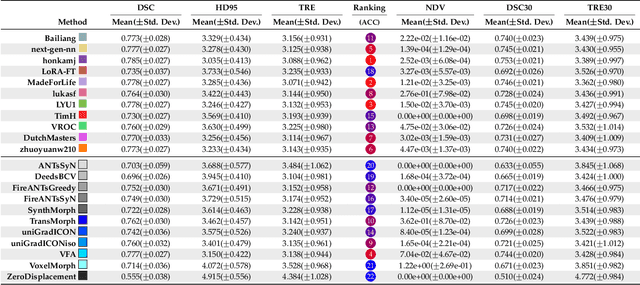
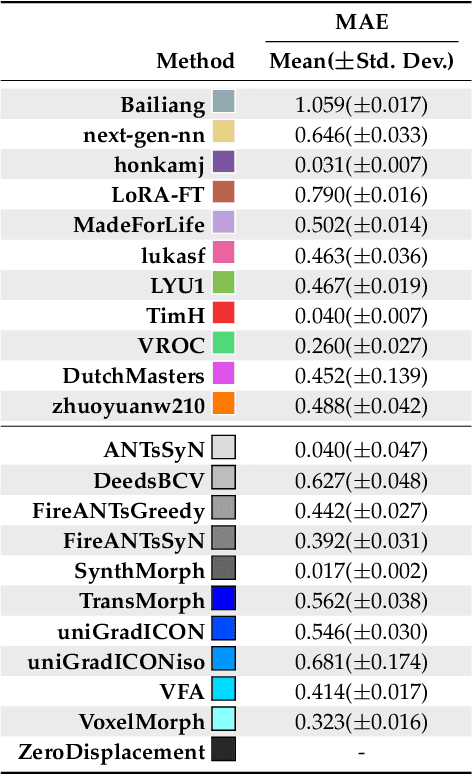
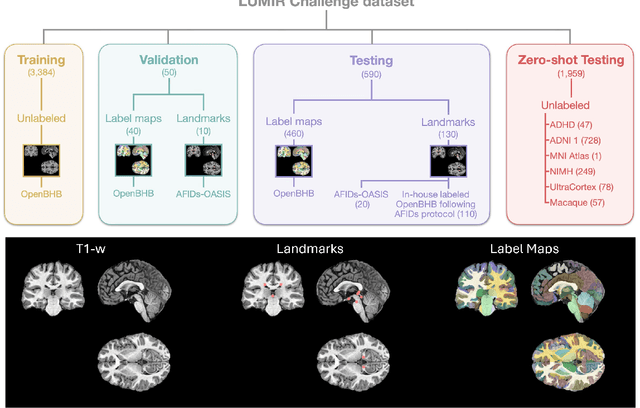
Medical image challenges have played a transformative role in advancing the field, catalyzing algorithmic innovation and establishing new performance standards across diverse clinical applications. Image registration, a foundational task in neuroimaging pipelines, has similarly benefited from the Learn2Reg initiative. Building on this foundation, we introduce the Large-scale Unsupervised Brain MRI Image Registration (LUMIR) challenge, a next-generation benchmark designed to assess and advance unsupervised brain MRI registration. Distinct from prior challenges that leveraged anatomical label maps for supervision, LUMIR removes this dependency by providing over 4,000 preprocessed T1-weighted brain MRIs for training without any label maps, encouraging biologically plausible deformation modeling through self-supervision. In addition to evaluating performance on 590 held-out test subjects, LUMIR introduces a rigorous suite of zero-shot generalization tasks, spanning out-of-domain imaging modalities (e.g., FLAIR, T2-weighted, T2*-weighted), disease populations (e.g., Alzheimer's disease), acquisition protocols (e.g., 9.4T MRI), and species (e.g., macaque brains). A total of 1,158 subjects and over 4,000 image pairs were included for evaluation. Performance was assessed using both segmentation-based metrics (Dice coefficient, 95th percentile Hausdorff distance) and landmark-based registration accuracy (target registration error). Across both in-domain and zero-shot tasks, deep learning-based methods consistently achieved state-of-the-art accuracy while producing anatomically plausible deformation fields. The top-performing deep learning-based models demonstrated diffeomorphic properties and inverse consistency, outperforming several leading optimization-based methods, and showing strong robustness to most domain shifts, the exception being a drop in performance on out-of-domain contrasts.
Towards Universal Learning-based Model for Cardiac Image Reconstruction: Summary of the CMRxRecon2024 Challenge
Mar 05, 2025Cardiovascular magnetic resonance (CMR) offers diverse imaging contrasts for assessment of cardiac function and tissue characterization. However, acquiring each single CMR modality is often time-consuming, and comprehensive clinical protocols require multiple modalities with various sampling patterns, further extending the overall acquisition time and increasing susceptibility to motion artifacts. Existing deep learning-based reconstruction methods are often designed for specific acquisition parameters, which limits their ability to generalize across a variety of scan scenarios. As part of the CMRxRecon Series, the CMRxRecon2024 challenge provides diverse datasets encompassing multi-modality multi-view imaging with various sampling patterns, and a platform for the international community to develop and benchmark reconstruction solutions in two well-crafted tasks. Task 1 is a modality-universal setting, evaluating the out-of-distribution generalization of the reconstructed model, while Task 2 follows sampling-universal setting assessing the one-for-all adaptability of the universal model. Main contributions include providing the first and largest publicly available multi-modality, multi-view cardiac k-space dataset; developing a benchmarking platform that simulates clinical acceleration protocols, with a shared code library and tutorial for various k-t undersampling patterns and data processing; giving technical insights of enhanced data consistency based on physic-informed networks and adaptive prompt-learning embedding to be versatile to different clinical settings; additional finding on evaluation metrics to address the limitations of conventional ground-truth references in universal reconstruction tasks.
Exact Acceleration of Subgraph Graph Neural Networks by Eliminating Computation Redundancy
Dec 24, 2024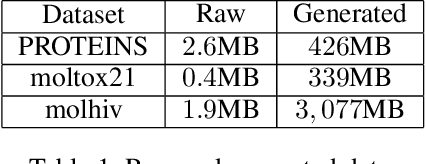


Graph neural networks (GNNs) have become a prevalent framework for graph tasks. Many recent studies have proposed the use of graph convolution methods over the numerous subgraphs of each graph, a concept known as subgraph graph neural networks (subgraph GNNs), to enhance GNNs' ability to distinguish non-isomorphic graphs. To maximize the expressiveness, subgraph GNNs often require each subgraph to have equal size to the original graph. Despite their impressive performance, subgraph GNNs face challenges due to the vast number and large size of subgraphs which lead to a surge in training data, resulting in both storage and computational inefficiencies. In response to this problem, this paper introduces Ego-Nets-Fit-All (ENFA), a model that uniformly takes the smaller ego nets as subgraphs, thereby providing greater storage and computational efficiency, while at the same time guarantees identical outputs to the original subgraph GNNs even taking the whole graph as subgraphs. The key is to identify and eliminate the redundant computation among subgraphs. For example, a node $v_i$ may appear in multiple subgraphs but is far away from all of their centers (the unsymmetric part between subgraphs). Therefore, its first few rounds of message passing within each subgraph can be computed once in the original graph instead of being computed multiple times within each subgraph. Such strategy enables our ENFA to accelerate subgraph GNNs in an exact way, unlike previous sampling approaches that often lose the performance. Extensive experiments across various datasets reveal that compared with the conventional subgraph GNNs, ENFA can reduce storage space by 29.0% to 84.5% and improve training efficiency by up to 1.66x.
GL-Fusion: Rethinking the Combination of Graph Neural Network and Large Language model
Dec 08, 2024
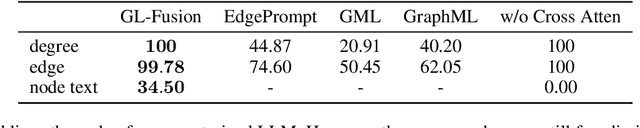


Recent research on integrating Large Language Models (LLMs) with Graph Neural Networks (GNNs) typically follows two approaches: LLM-centered models, which convert graph data into tokens for LLM processing, and GNN-centered models, which use LLMs to encode text features into node and edge representations for GNN input. LLM-centered models often struggle to capture graph structures effectively, while GNN-centered models compress variable-length textual data into fixed-size vectors, limiting their ability to understand complex semantics. Additionally, GNN-centered approaches require converting tasks into a uniform, manually-designed format, restricting them to classification tasks and preventing language output. To address these limitations, we introduce a new architecture that deeply integrates GNN with LLM, featuring three key innovations: (1) Structure-Aware Transformers, which incorporate GNN's message-passing capabilities directly into LLM's transformer layers, allowing simultaneous processing of textual and structural information and generating outputs from both GNN and LLM; (2) Graph-Text Cross-Attention, which processes full, uncompressed text from graph nodes and edges, ensuring complete semantic integration; and (3) GNN-LLM Twin Predictor, enabling LLM's flexible autoregressive generation alongside GNN's scalable one-pass prediction. GL-Fusion achieves outstand performance on various tasks. Notably, it achieves state-of-the-art performance on OGBN-Arxiv and OGBG-Code2.
Improving Instance Optimization in Deformable Image Registration with Gradient Projection
Oct 21, 2024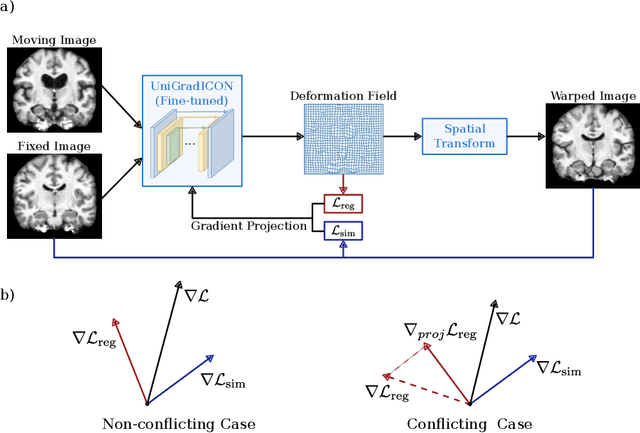
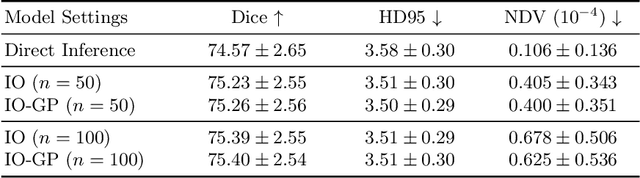

Deformable image registration is inherently a multi-objective optimization (MOO) problem, requiring a delicate balance between image similarity and deformation regularity. These conflicting objectives often lead to poor optimization outcomes, such as being trapped in unsatisfactory local minima or experiencing slow convergence. Deep learning methods have recently gained popularity in this domain due to their efficiency in processing large datasets and achieving high accuracy. However, they often underperform during test time compared to traditional optimization techniques, which further explore iterative, instance-specific gradient-based optimization. This performance gap is more pronounced when a distribution shift between training and test data exists. To address this issue, we focus on the instance optimization (IO) paradigm, which involves additional optimization for test-time instances based on a pre-trained model. IO effectively combines the generalization capabilities of deep learning with the fine-tuning advantages of instance-specific optimization. Within this framework, we emphasize the use of gradient projection to mitigate conflicting updates in MOO. This technique projects conflicting gradients into a common space, better aligning the dual objectives and enhancing optimization stability. We validate our method using a state-of-the-art foundation model on the 3D Brain inter-subject registration task (LUMIR) from the Learn2Reg 2024 Challenge. Our results show significant improvements over standard gradient descent, leading to more accurate and reliable registration results.