 Add to Chrome
 Add to Firefox
 Add to Edge
Inclusive Interactive Collisions for Multi-View Consistent Compositional 3D Generation
Jun 23, 2026
Recent breakthroughs in 3D generation have advanced notably with the development of text-to-image diffusion model. However, existing methods remain two practical challenges: (1) They primarily generate single 3D object, but struggle to generate multi-object compositional 3D assets due to the lack of the modeling for Gaussian primitives in reasonable interactions. (2) They often suffer from cross-view inconsistency during 3D optimization, as Score Distillation Sampling inherently performs on each single view, inevitably resulting in cross-view hallucinations. To solve above issues, we propose I2C-3D, a novel optimization-based method to generate multi-view consistent compositional 3D assets with reasonable interactions. Specifically, we propose an Inclusive Interactive Collisions strategy to guide Gaussian primitives appearing in reasonable interaction regions naturally, thereby ensuring objects in the compositional scene interact in a physically plausible and visually coherent way. Additionally, to enhance multi-view consistency, Multi-View Adaptive Score Distillation Sampling is devised to distill multi-view consistency prior and layout prior from pre-trained diffusion model by modulating attention map of instance token and spatial token across viewpoints. Benefiting from above elaborate designs, I2C-3D not only generates high-fidelity multi-view consistent compositional 3D assets but also supports 3D editing flexibly, facilitating complex scene generation. Extensive experiments demonstrate our I2C-3D outperforms existing methods in generation quality and multi-view consistency.

FlowTTS-GRPO: Online Reinforcement Learning with Multi-Objective Reward Optimization for Flow-Matching Based Text-to-Speech
Jun 22, 2026Existing Reinforcement Learning (RL) research for Text-to-Speech (TTS) focuses on large language models (LLMs), leaving Flow-Matching (FM) under-explored. We present FlowTTS-GRPO, an online RL framework for FM-based TTS. By converting ordinary differential equation (ODE) trajectories into stochastic differential equation (SDE) paths, our method enables direct fine-tuning of open-source FM models without auxiliary models. We show that a weighted reward combination converges faster than a probabilistic scheme, and identify three practical optimizations: omitting classifier-free guidance (CFG) during training accelerates convergence; synthesizing hard cases improves robustness; and applying RL to the FM component enhances audio-detail metrics. Experiments on CosyVoice 3.0 and F5-TTS demonstrate objective and subjective preference gains in speaker similarity and perceptual quality, with F5-TTS also improving intelligibility.
FunAudio-ASR Technical Report
Sep 15, 2025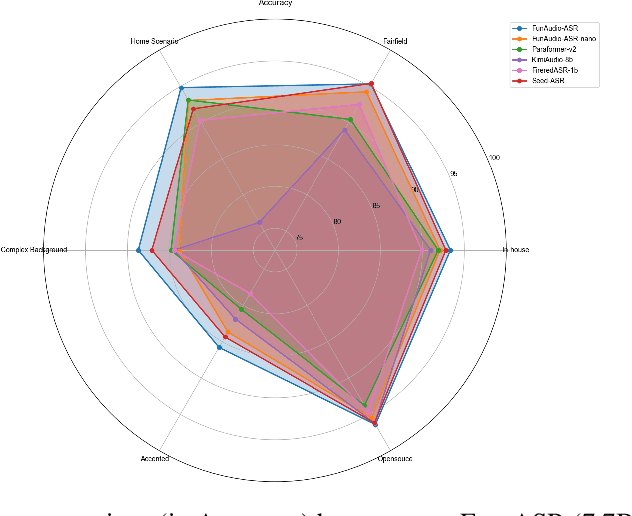
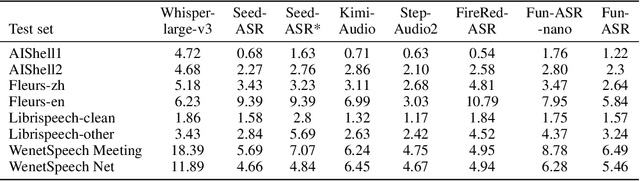
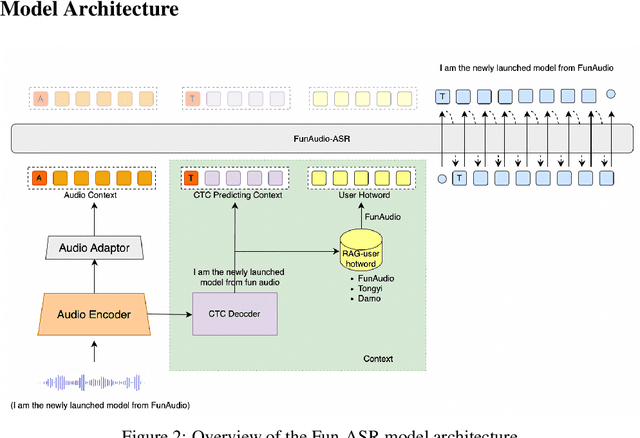
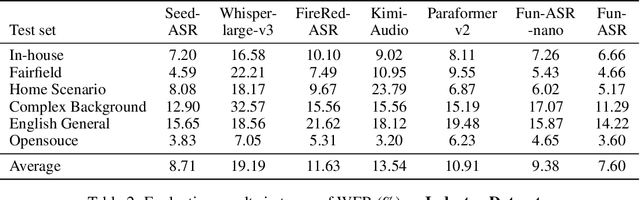
In recent years, automatic speech recognition (ASR) has witnessed transformative advancements driven by three complementary paradigms: data scaling, model size scaling, and deep integration with large language models (LLMs). However, LLMs are prone to hallucination, which can significantly degrade user experience in real-world ASR applications. In this paper, we present FunAudio-ASR, a large-scale, LLM-based ASR system that synergistically combines massive data, large model capacity, LLM integration, and reinforcement learning to achieve state-of-the-art performance across diverse and complex speech recognition scenarios. Moreover, FunAudio-ASR is specifically optimized for practical deployment, with enhancements in streaming capability, noise robustness, code-switching, hotword customization, and satisfying other real-world application requirements. Experimental results show that while most LLM-based ASR systems achieve strong performance on open-source benchmarks, they often underperform on real industry evaluation sets. Thanks to production-oriented optimizations, FunAudio-ASR achieves SOTA performance on real application datasets, demonstrating its effectiveness and robustness in practical settings.
OmniDRCA: Parallel Speech-Text Foundation Model via Dual-Resolution Speech Representations and Contrastive Alignment
Jun 11, 2025Recent studies on end-to-end speech generation with large language models (LLMs) have attracted significant community attention, with multiple works extending text-based LLMs to generate discrete speech tokens. Existing approaches primarily fall into two categories: (1) Methods that generate discrete speech tokens independently without incorporating them into the LLM's autoregressive process, resulting in text generation being unaware of concurrent speech synthesis. (2) Models that generate interleaved or parallel speech-text tokens through joint autoregressive modeling, enabling mutual modality awareness during generation. This paper presents OmniDRCA, a parallel speech-text foundation model based on joint autoregressive modeling, featuring dual-resolution speech representations and contrastive cross-modal alignment. Our approach processes speech and text representations in parallel while enhancing audio comprehension through contrastive alignment. Experimental results on Spoken Question Answering benchmarks demonstrate that OmniDRCA establishes new state-of-the-art (SOTA) performance among parallel joint speech-text modeling based foundation models, and achieves competitive performance compared to interleaved models. Additionally, we explore the potential of extending the framework to full-duplex conversational scenarios.
Astra: Toward General-Purpose Mobile Robots via Hierarchical Multimodal Learning
Jun 06, 2025Modern robot navigation systems encounter difficulties in diverse and complex indoor environments. Traditional approaches rely on multiple modules with small models or rule-based systems and thus lack adaptability to new environments. To address this, we developed Astra, a comprehensive dual-model architecture, Astra-Global and Astra-Local, for mobile robot navigation. Astra-Global, a multimodal LLM, processes vision and language inputs to perform self and goal localization using a hybrid topological-semantic graph as the global map, and outperforms traditional visual place recognition methods. Astra-Local, a multitask network, handles local path planning and odometry estimation. Its 4D spatial-temporal encoder, trained through self-supervised learning, generates robust 4D features for downstream tasks. The planning head utilizes flow matching and a novel masked ESDF loss to minimize collision risks for generating local trajectories, and the odometry head integrates multi-sensor inputs via a transformer encoder to predict the relative pose of the robot. Deployed on real in-house mobile robots, Astra achieves high end-to-end mission success rate across diverse indoor environments.
CosyVoice 3: Towards In-the-wild Speech Generation via Scaling-up and Post-training
May 23, 2025In our prior works, we introduced a scalable streaming speech synthesis model, CosyVoice 2, which integrates a large language model (LLM) and a chunk-aware flow matching (FM) model, and achieves low-latency bi-streaming speech synthesis and human-parity quality. Despite these advancements, CosyVoice 2 exhibits limitations in language coverage, domain diversity, data volume, text formats, and post-training techniques. In this paper, we present CosyVoice 3, an improved model designed for zero-shot multilingual speech synthesis in the wild, surpassing its predecessor in content consistency, speaker similarity, and prosody naturalness. Key features of CosyVoice 3 include: 1) A novel speech tokenizer to improve prosody naturalness, developed via supervised multi-task training, including automatic speech recognition, speech emotion recognition, language identification, audio event detection, and speaker analysis. 2) A new differentiable reward model for post-training applicable not only to CosyVoice 3 but also to other LLM-based speech synthesis models. 3) Dataset Size Scaling: Training data is expanded from ten thousand hours to one million hours, encompassing 9 languages and 18 Chinese dialects across various domains and text formats. 4) Model Size Scaling: Model parameters are increased from 0.5 billion to 1.5 billion, resulting in enhanced performance on our multilingual benchmark due to the larger model capacity. These advancements contribute significantly to the progress of speech synthesis in the wild. We encourage readers to listen to the demo at https://funaudiollm.github.io/cosyvoice3.
MinMo: A Multimodal Large Language Model for Seamless Voice Interaction
Jan 10, 2025


Recent advancements in large language models (LLMs) and multimodal speech-text models have laid the groundwork for seamless voice interactions, enabling real-time, natural, and human-like conversations. Previous models for voice interactions are categorized as native and aligned. Native models integrate speech and text processing in one framework but struggle with issues like differing sequence lengths and insufficient pre-training. Aligned models maintain text LLM capabilities but are often limited by small datasets and a narrow focus on speech tasks. In this work, we introduce MinMo, a Multimodal Large Language Model with approximately 8B parameters for seamless voice interaction. We address the main limitations of prior aligned multimodal models. We train MinMo through multiple stages of speech-to-text alignment, text-to-speech alignment, speech-to-speech alignment, and duplex interaction alignment, on 1.4 million hours of diverse speech data and a broad range of speech tasks. After the multi-stage training, MinMo achieves state-of-the-art performance across various benchmarks for voice comprehension and generation while maintaining the capabilities of text LLMs, and also facilitates full-duplex conversation, that is, simultaneous two-way communication between the user and the system. Moreover, we propose a novel and simple voice decoder that outperforms prior models in voice generation. The enhanced instruction-following capabilities of MinMo supports controlling speech generation based on user instructions, with various nuances including emotions, dialects, and speaking rates, and mimicking specific voices. For MinMo, the speech-to-text latency is approximately 100ms, full-duplex latency is approximately 600ms in theory and 800ms in practice. The MinMo project web page is https://funaudiollm.github.io/minmo, and the code and models will be released soon.
CosyVoice 2: Scalable Streaming Speech Synthesis with Large Language Models
Dec 13, 2024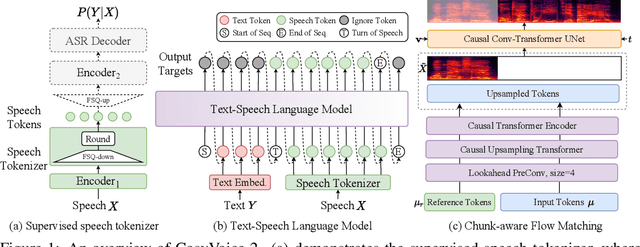
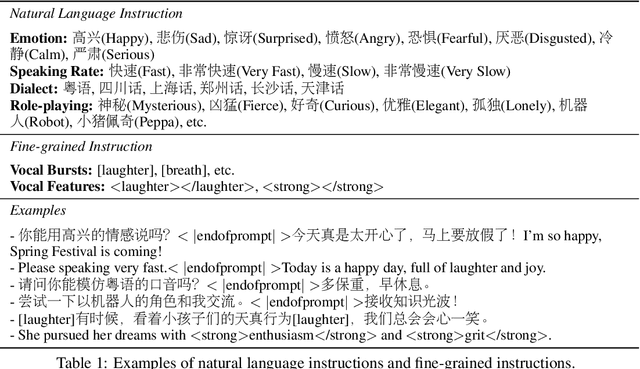
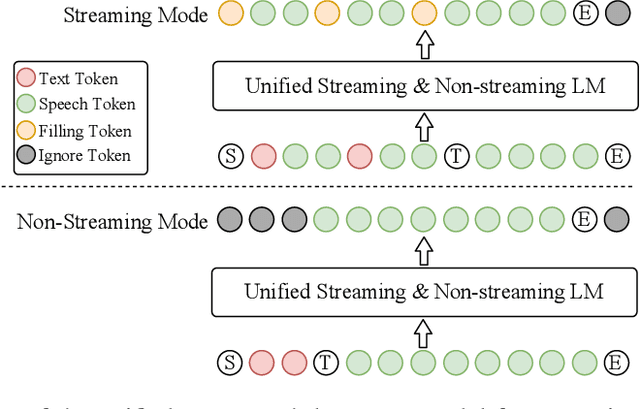
In our previous work, we introduced CosyVoice, a multilingual speech synthesis model based on supervised discrete speech tokens. By employing progressive semantic decoding with two popular generative models, language models (LMs) and Flow Matching, CosyVoice demonstrated high prosody naturalness, content consistency, and speaker similarity in speech in-context learning. Recently, significant progress has been made in multi-modal large language models (LLMs), where the response latency and real-time factor of speech synthesis play a crucial role in the interactive experience. Therefore, in this report, we present an improved streaming speech synthesis model, CosyVoice 2, which incorporates comprehensive and systematic optimizations. Specifically, we introduce finite-scalar quantization to improve the codebook utilization of speech tokens. For the text-speech LM, we streamline the model architecture to allow direct use of a pre-trained LLM as the backbone. In addition, we develop a chunk-aware causal flow matching model to support various synthesis scenarios, enabling both streaming and non-streaming synthesis within a single model. By training on a large-scale multilingual dataset, CosyVoice 2 achieves human-parity naturalness, minimal response latency, and virtually lossless synthesis quality in the streaming mode. We invite readers to listen to the demos at https://funaudiollm.github.io/cosyvoice2.
The USTC-Ximalaya system for the ICASSP 2022 multi-channel multi-party meeting transcription challenge
Feb 10, 2022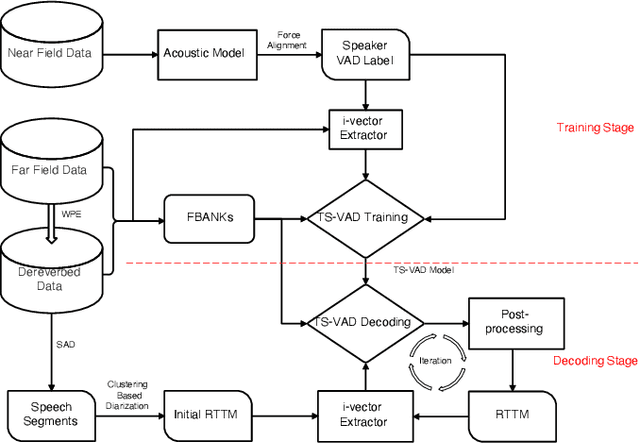
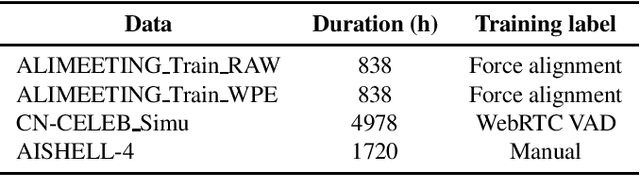
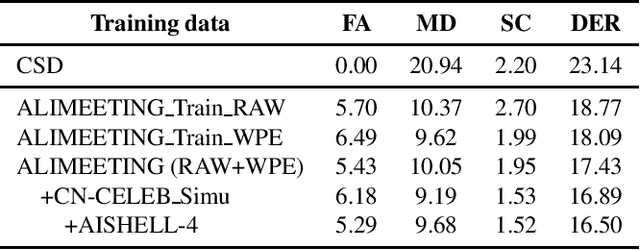
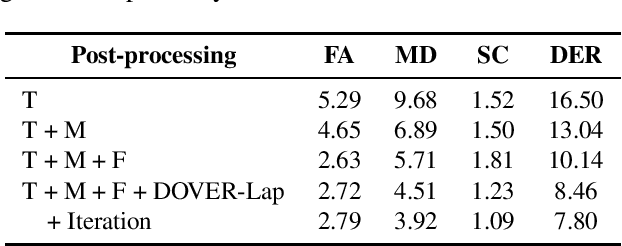
We propose two improvements to target-speaker voice activity detection (TS-VAD), the core component in our proposed speaker diarization system that was submitted to the 2022 Multi-Channel Multi-Party Meeting Transcription (M2MeT) challenge. These techniques are designed to handle multi-speaker conversations in real-world meeting scenarios with high speaker-overlap ratios and under heavy reverberant and noisy condition. First, for data preparation and augmentation in training TS-VAD models, speech data containing both real meetings and simulated indoor conversations are used. Second, in refining results obtained after TS-VAD based decoding, we perform a series of post-processing steps to improve the VAD results needed to reduce diarization error rates (DERs). Tested on the ALIMEETING corpus, the newly released Mandarin meeting dataset used in M2MeT, we demonstrate that our proposed system can decrease the DER by up to 66.55/60.59% relatively when compared with classical clustering based diarization on the Eval/Test set.