 Add to Chrome
 Add to Firefox
 Add to Edge
Video = World + Event Stream
Jul 16, 2026
We present Wan-Streamer v0.3, which reframes our native-streaming interaction model under a single organizing view: a video is a world plus an event stream. The world is the persistent context in which a video unfolds, including the environment, scene, subjects, ambient acoustic conditions, voice characteristics, and other relatively stable conditions. The event stream is everything that changes over time within that world, including scene or environmental changes, subject behavior, speech, and other sounds. This yields a general-purpose pretraining task over large amounts of real video: given a world and incoming input, predict how the world moves, changes, and responds in real time. The resulting competence can be specialized to a broad family of real-time downstream tasks. We instantiate it on real-time full-duplex audio-visual interaction, where the event stream is the agent's speech together with free-form behavior. Functionally, the model's multimodal understanding process is vision-language-action-like: it maps multimodal user input to language-form speech and behavior actions. Wan-Streamer v0.3 preserves the v0.2 operating point: 640x368 video at 25 FPS, a 160 ms streaming unit, approximately 200 ms model-side response latency, and approximately 550 ms total interaction latency under a 350 ms bidirectional network budget.

Wan-Streamer v0.2: Higher Resolution, Same Latency
Jul 05, 2026We present Wan-Streamer v0.2, a latency-preserving upgrade of the native-streaming, end-to-end audio-visual interaction model. v0.2 keeps the v0.1 modeling formulation, but raises the interactive output stream from 192x336 to 640x368 while preserving approximately 200 ms model-side signal-to-signal latency at 25 FPS. The higher-resolution stream supports scene-grounded mid-shot agents whose posture, gaze, hands, nearby objects, and local scene layout remain legible during real-time conversation. To support the larger visual stream without adding user-visible delay, v0.2 keeps the thinker as a single-GPU low-latency path for streaming perception, the short language/state Transformer pass that builds the generation cache, and final decoding. The performer becomes a multi-GPU Ulysses-style context-parallel group for the expensive next-unit latent generation. Each performer rank writes incoming K/V into a pre-sharded local cache. The long high-resolution latent video sequence is split across ranks for denoising and gathered through Ulysses communication, while the much shorter audio latent sequence is generated without sequence sharding. In this split, the thinker's language/state computation reaches the performer only as K/V conditioning, so no separate language sequence has to be communicated inside the performer group. This concentrates additional hardware on visual generation while preserving the compact thinker-performer boundary, keeping total remote interaction latency at approximately 550 ms when a 350 ms bidirectional network budget is included.
Wan-Streamer v0.1: End-to-end Real-time Interactive Foundation Models
Jun 25, 2026We present Wan-Streamer, a native-streaming, end-to-end interactive foundation model designed from the ground up for real-time, low-latency, full-duplex audio-visual interaction. Wan-Streamer seamlessly models language, audio, and video as both input and output within a single Transformer, where the sequence is represented as interleaved visual, audio, and text input tokens together with visual, audio, and text output tokens, coordinated by block-causal attention for incremental streaming. Unlike cascaded interactive systems that rely on separate VAD, ASR, language, TTS, audio-driven animation, or video-generation modules, Wan-Streamer does not rely on external language, speech, avatar, or video-generation modules: perception, reasoning, generation, response timing, turn management, and cross-modal synchronization are learned jointly within one unified model, reducing pipeline latency and error accumulation. To support natural audio-visual responsiveness, we redesign the entire stack around streamability, including causal encoders, causal decoders, block-causal attention, and low-latency multimodal token scheduling, enabling streaming units as short as 160 ms at 25 fps. Wan-Streamer achieves approximately 200 ms model-side response latency and approximately 550 ms total interaction latency when combined with 350 ms bidirectional network latency, supporting sub-second duplex audio-visual communication. These results position Wan-Streamer as a unified, end-to-end, multimodal interactive foundation model for low-latency streaming interaction.
Mutual Forcing: Dual-Mode Self-Evolution for Fast Autoregressive Audio-Video Character Generation
Apr 28, 2026In this work, we propose Mutual Forcing, a framework for fast autoregressive audio-video generation with long-horizon audio-video synchronization. Our approach addresses two key challenges: joint audio-video modeling and fast autoregressive generation. To ease joint audio-video optimization, we adopt a two-stage training strategy: we first train uni-modal generators and then couple them into a unified audio-video model for joint training on paired data. For streaming generation, we ask whether a native fast causal audio-video model can be trained directly, instead of following existing streaming distillation pipelines that typically train a bidirectional model first and then convert it into a causal generator through multiple distillation stages. Our answer is Mutual Forcing, which builds directly on native autoregressive model and integrates few-step and multi-step generation within a single weight-shared model, enabling self-distillation and improved training-inference consistency. The multi-step mode improves the few-step mode via self-distillation, while the few-step mode generates historical context during training to improve training-inference consistency; because the two modes share parameters, these two effects reinforce each other within a single model. Compared with prior approaches such as Self-Forcing, Mutual Forcing removes the need for an additional bidirectional teacher model, supports more flexible training sequence lengths, reduces training overhead, and allows the model to improve directly from real paired data rather than a fixed teacher. Experiments show that Mutual Forcing matches or surpasses strong baselines that require around 50 sampling steps while using only 4 to 8 steps, demonstrating substantial advantages in both efficiency and quality. The project page is available at https://mutualforcing.github.io.
Wan: Open and Advanced Large-Scale Video Generative Models
Mar 26, 2025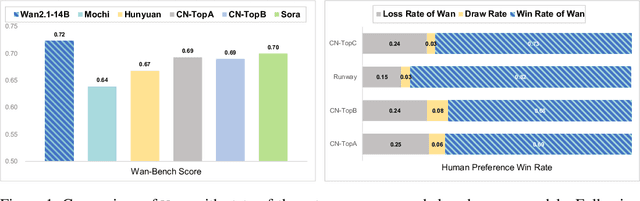
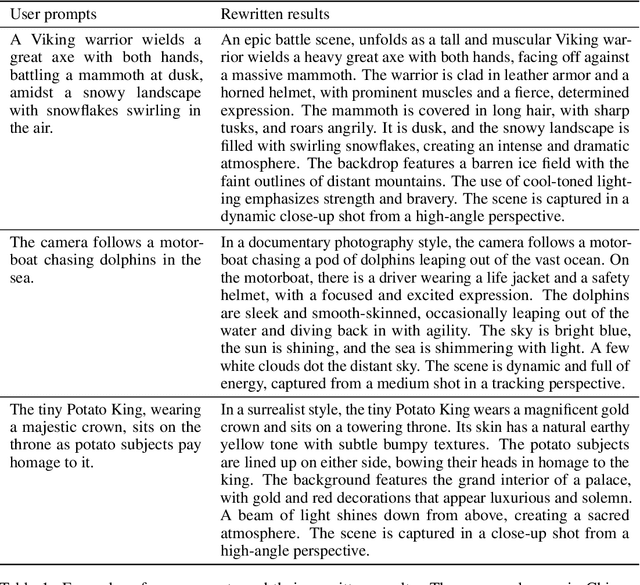
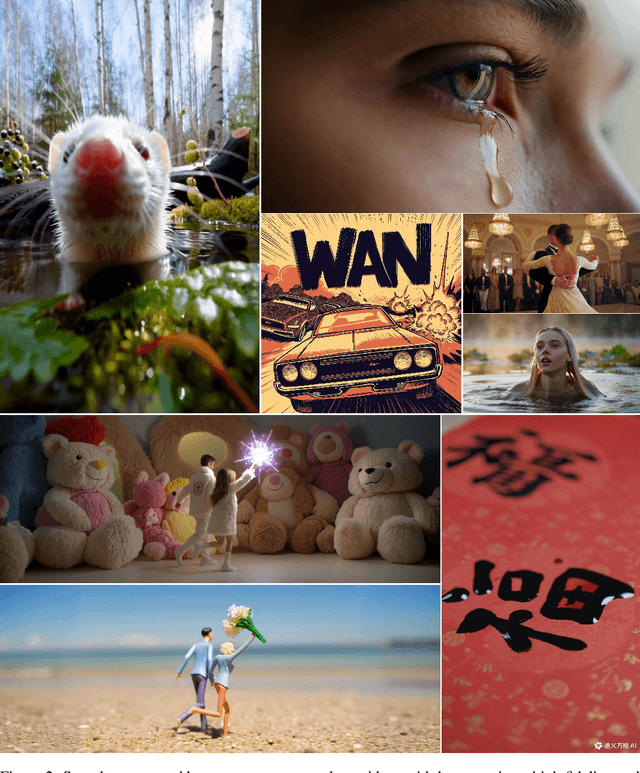
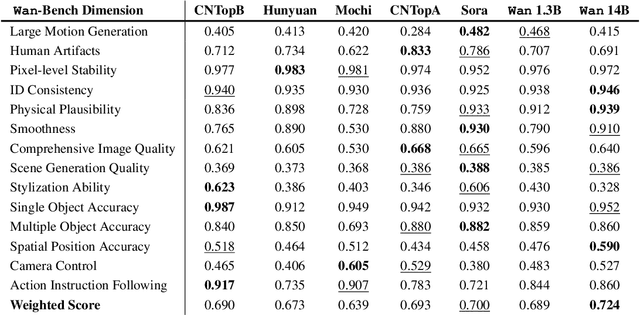
This report presents Wan, a comprehensive and open suite of video foundation models designed to push the boundaries of video generation. Built upon the mainstream diffusion transformer paradigm, Wan achieves significant advancements in generative capabilities through a series of innovations, including our novel VAE, scalable pre-training strategies, large-scale data curation, and automated evaluation metrics. These contributions collectively enhance the model's performance and versatility. Specifically, Wan is characterized by four key features: Leading Performance: The 14B model of Wan, trained on a vast dataset comprising billions of images and videos, demonstrates the scaling laws of video generation with respect to both data and model size. It consistently outperforms the existing open-source models as well as state-of-the-art commercial solutions across multiple internal and external benchmarks, demonstrating a clear and significant performance superiority. Comprehensiveness: Wan offers two capable models, i.e., 1.3B and 14B parameters, for efficiency and effectiveness respectively. It also covers multiple downstream applications, including image-to-video, instruction-guided video editing, and personal video generation, encompassing up to eight tasks. Consumer-Grade Efficiency: The 1.3B model demonstrates exceptional resource efficiency, requiring only 8.19 GB VRAM, making it compatible with a wide range of consumer-grade GPUs. Openness: We open-source the entire series of Wan, including source code and all models, with the goal of fostering the growth of the video generation community. This openness seeks to significantly expand the creative possibilities of video production in the industry and provide academia with high-quality video foundation models. All the code and models are available at https://github.com/Wan-Video/Wan2.1.
Exploring Few-Shot Defect Segmentation in General Industrial Scenarios with Metric Learning and Vision Foundation Models
Feb 03, 2025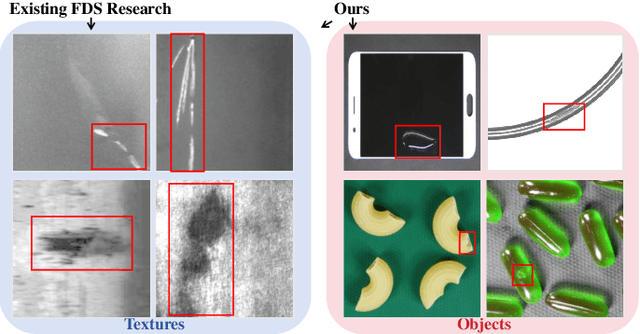

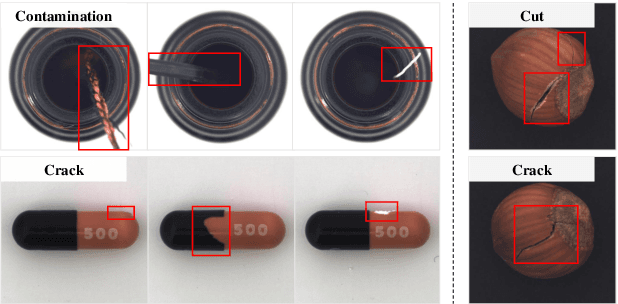
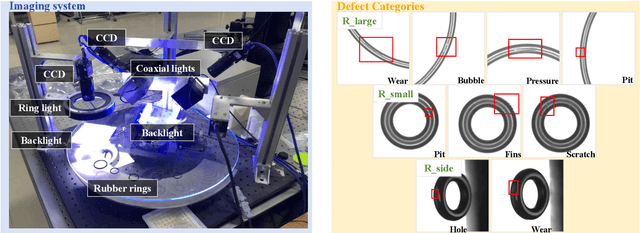
Industrial defect segmentation is critical for manufacturing quality control. Due to the scarcity of training defect samples, few-shot semantic segmentation (FSS) holds significant value in this field. However, existing studies mostly apply FSS to tackle defects on simple textures, without considering more diverse scenarios. This paper aims to address this gap by exploring FSS in broader industrial products with various defect types. To this end, we contribute a new real-world dataset and reorganize some existing datasets to build a more comprehensive few-shot defect segmentation (FDS) benchmark. On this benchmark, we thoroughly investigate metric learning-based FSS methods, including those based on meta-learning and those based on Vision Foundation Models (VFMs). We observe that existing meta-learning-based methods are generally not well-suited for this task, while VFMs hold great potential. We further systematically study the applicability of various VFMs in this task, involving two paradigms: feature matching and the use of Segment Anything (SAM) models. We propose a novel efficient FDS method based on feature matching. Meanwhile, we find that SAM2 is particularly effective for addressing FDS through its video track mode. The contributed dataset and code will be available at: https://github.com/liutongkun/GFDS.
ChatDiT: A Training-Free Baseline for Task-Agnostic Free-Form Chatting with Diffusion Transformers
Dec 17, 2024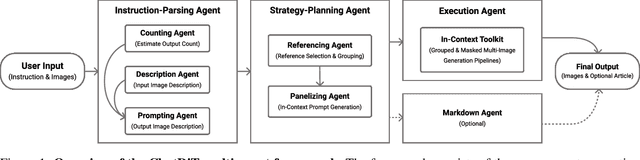

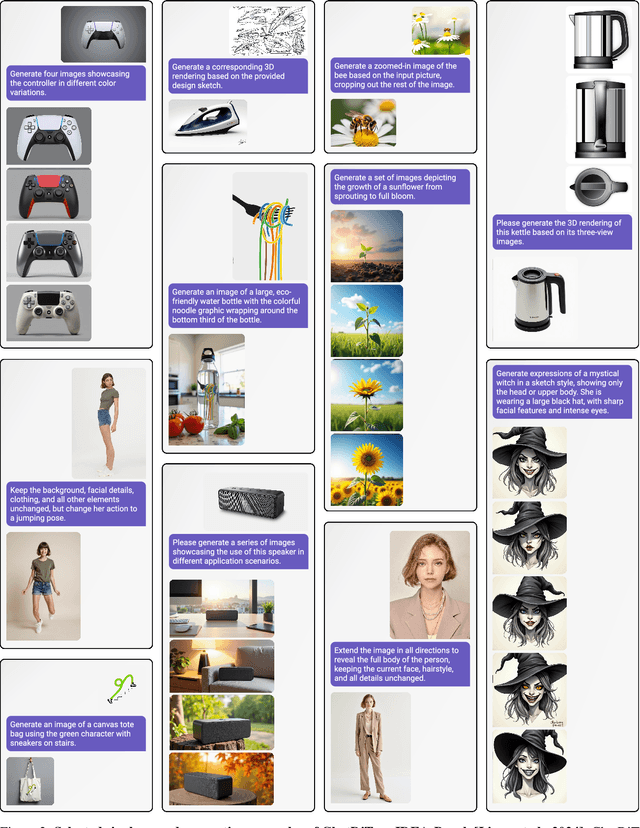
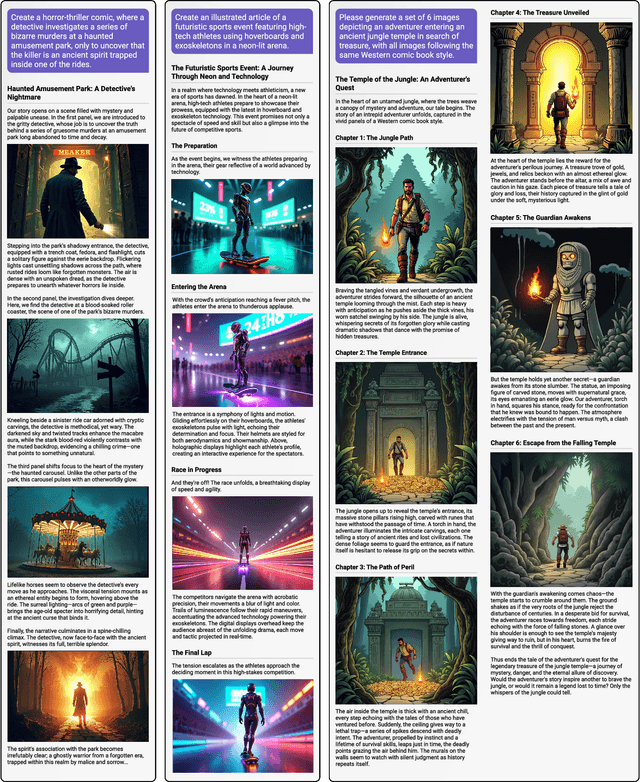
Recent research arXiv:2410.15027 arXiv:2410.23775 has highlighted the inherent in-context generation capabilities of pretrained diffusion transformers (DiTs), enabling them to seamlessly adapt to diverse visual tasks with minimal or no architectural modifications. These capabilities are unlocked by concatenating self-attention tokens across multiple input and target images, combined with grouped and masked generation pipelines. Building upon this foundation, we present ChatDiT, a zero-shot, general-purpose, and interactive visual generation framework that leverages pretrained diffusion transformers in their original form, requiring no additional tuning, adapters, or modifications. Users can interact with ChatDiT to create interleaved text-image articles, multi-page picture books, edit images, design IP derivatives, or develop character design settings, all through free-form natural language across one or more conversational rounds. At its core, ChatDiT employs a multi-agent system comprising three key components: an Instruction-Parsing agent that interprets user-uploaded images and instructions, a Strategy-Planning agent that devises single-step or multi-step generation actions, and an Execution agent that performs these actions using an in-context toolkit of diffusion transformers. We thoroughly evaluate ChatDiT on IDEA-Bench arXiv:2412.11767, comprising 100 real-world design tasks and 275 cases with diverse instructions and varying numbers of input and target images. Despite its simplicity and training-free approach, ChatDiT surpasses all competitors, including those specifically designed and trained on extensive multi-task datasets. We further identify key limitations of pretrained DiTs in zero-shot adapting to tasks. We release all code, agents, results, and intermediate outputs to facilitate further research at https://github.com/ali-vilab/ChatDiT
IDEA-Bench: How Far are Generative Models from Professional Designing?
Dec 16, 2024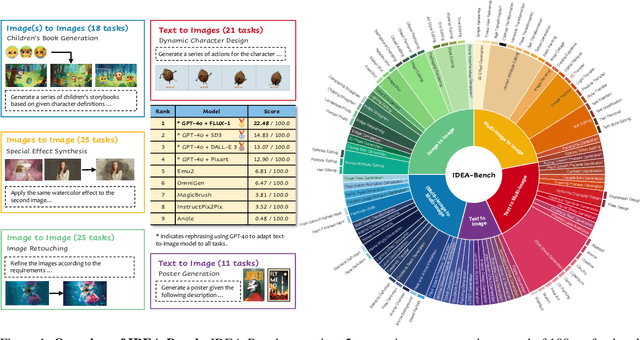
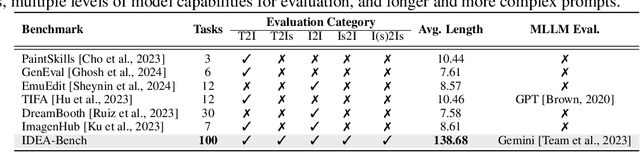
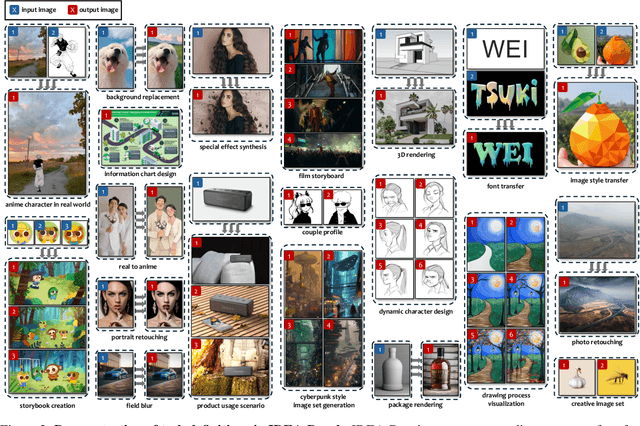
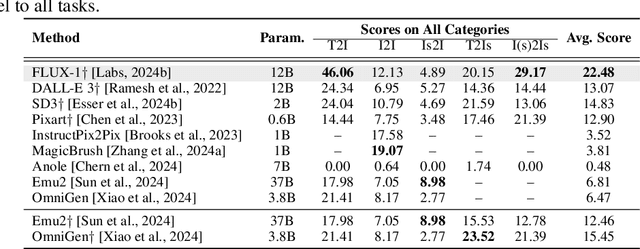
Real-world design tasks - such as picture book creation, film storyboard development using character sets, photo retouching, visual effects, and font transfer - are highly diverse and complex, requiring deep interpretation and extraction of various elements from instructions, descriptions, and reference images. The resulting images often implicitly capture key features from references or user inputs, making it challenging to develop models that can effectively address such varied tasks. While existing visual generative models can produce high-quality images based on prompts, they face significant limitations in professional design scenarios that involve varied forms and multiple inputs and outputs, even when enhanced with adapters like ControlNets and LoRAs. To address this, we introduce IDEA-Bench, a comprehensive benchmark encompassing 100 real-world design tasks, including rendering, visual effects, storyboarding, picture books, fonts, style-based, and identity-preserving generation, with 275 test cases to thoroughly evaluate a model's general-purpose generation capabilities. Notably, even the best-performing model only achieves 22.48 on IDEA-Bench, while the best general-purpose model only achieves 6.81. We provide a detailed analysis of these results, highlighting the inherent challenges and providing actionable directions for improvement. Additionally, we provide a subset of 18 representative tasks equipped with multimodal large language model (MLLM)-based auto-evaluation techniques to facilitate rapid model development and comparison. We releases the benchmark data, evaluation toolkits, and an online leaderboard at https://github.com/ali-vilab/IDEA-Bench, aiming to drive the advancement of generative models toward more versatile and applicable intelligent design systems.
In-Context LoRA for Diffusion Transformers
Oct 31, 2024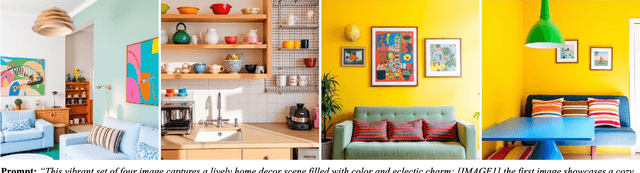

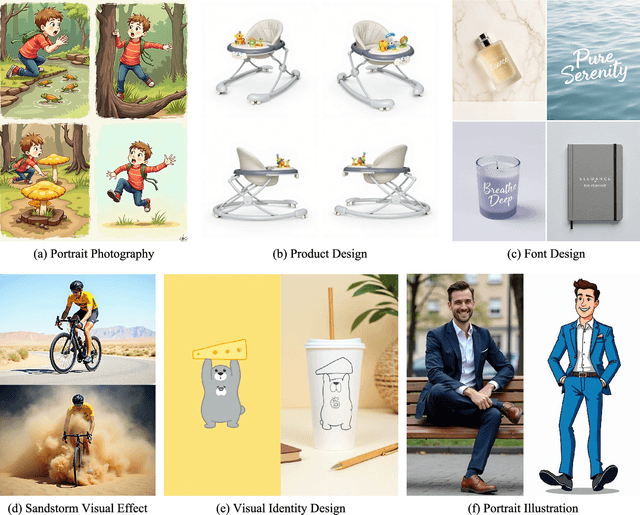
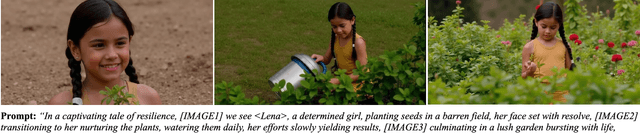
Recent research arXiv:2410.15027 has explored the use of diffusion transformers (DiTs) for task-agnostic image generation by simply concatenating attention tokens across images. However, despite substantial computational resources, the fidelity of the generated images remains suboptimal. In this study, we reevaluate and streamline this framework by hypothesizing that text-to-image DiTs inherently possess in-context generation capabilities, requiring only minimal tuning to activate them. Through diverse task experiments, we qualitatively demonstrate that existing text-to-image DiTs can effectively perform in-context generation without any tuning. Building on this insight, we propose a remarkably simple pipeline to leverage the in-context abilities of DiTs: (1) concatenate images instead of tokens, (2) perform joint captioning of multiple images, and (3) apply task-specific LoRA tuning using small datasets (e.g., $20\sim 100$ samples) instead of full-parameter tuning with large datasets. We name our models In-Context LoRA (IC-LoRA). This approach requires no modifications to the original DiT models, only changes to the training data. Remarkably, our pipeline generates high-fidelity image sets that better adhere to prompts. While task-specific in terms of tuning data, our framework remains task-agnostic in architecture and pipeline, offering a powerful tool for the community and providing valuable insights for further research on product-level task-agnostic generation systems. We release our code, data, and models at https://github.com/ali-vilab/In-Context-LoRA
Group Diffusion Transformers are Unsupervised Multitask Learners
Oct 19, 2024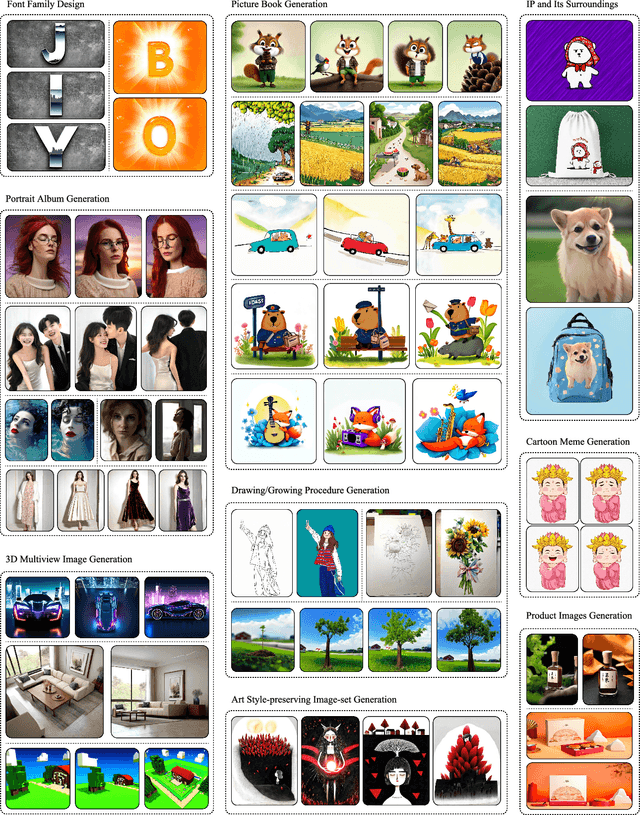
While large language models (LLMs) have revolutionized natural language processing with their task-agnostic capabilities, visual generation tasks such as image translation, style transfer, and character customization still rely heavily on supervised, task-specific datasets. In this work, we introduce Group Diffusion Transformers (GDTs), a novel framework that unifies diverse visual generation tasks by redefining them as a group generation problem. In this approach, a set of related images is generated simultaneously, optionally conditioned on a subset of the group. GDTs build upon diffusion transformers with minimal architectural modifications by concatenating self-attention tokens across images. This allows the model to implicitly capture cross-image relationships (e.g., identities, styles, layouts, surroundings, and color schemes) through caption-based correlations. Our design enables scalable, unsupervised, and task-agnostic pretraining using extensive collections of image groups sourced from multimodal internet articles, image galleries, and video frames. We evaluate GDTs on a comprehensive benchmark featuring over 200 instructions across 30 distinct visual generation tasks, including picture book creation, font design, style transfer, sketching, colorization, drawing sequence generation, and character customization. Our models achieve competitive zero-shot performance without any additional fine-tuning or gradient updates. Furthermore, ablation studies confirm the effectiveness of key components such as data scaling, group size, and model design. These results demonstrate the potential of GDTs as scalable, general-purpose visual generation systems.