 Add to Chrome
 Add to Firefox
 Add to Edge
Unsupervised Pre-training with Language-Vision Prompts for Low-Data Instance Segmentation
May 22, 2024
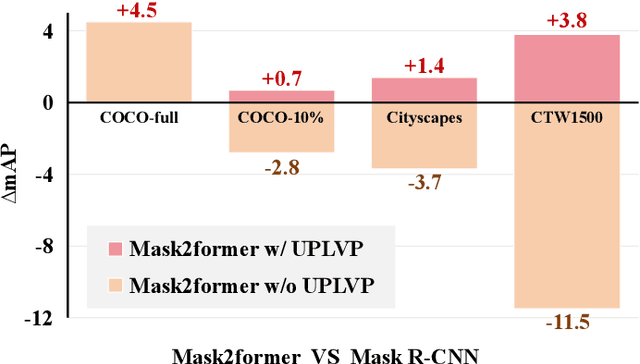
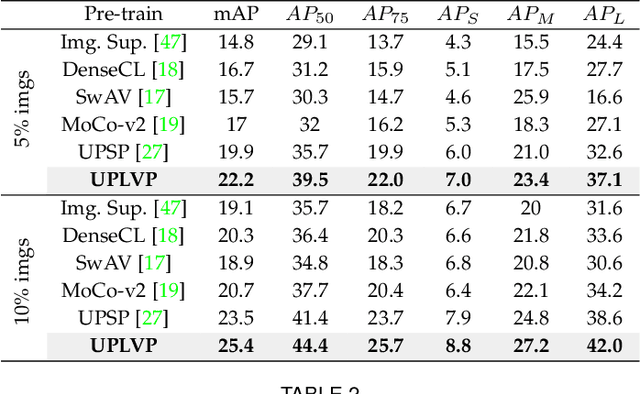
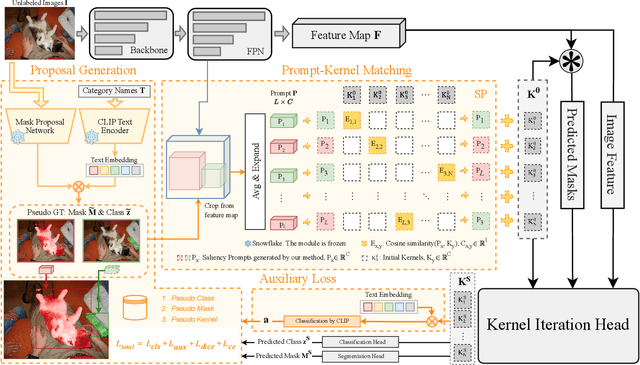
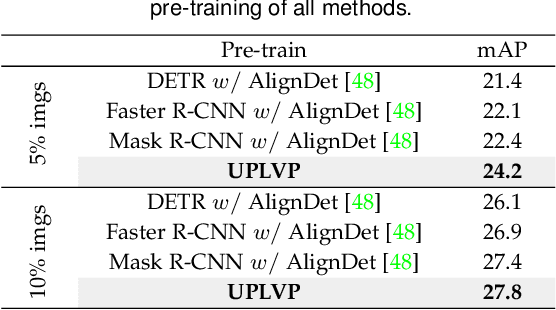
In recent times, following the paradigm of DETR (DEtection TRansformer), query-based end-to-end instance segmentation (QEIS) methods have exhibited superior performance compared to CNN-based models, particularly when trained on large-scale datasets. Nevertheless, the effectiveness of these QEIS methods diminishes significantly when confronted with limited training data. This limitation arises from their reliance on substantial data volumes to effectively train the pivotal queries/kernels that are essential for acquiring localization and shape priors. To address this problem, we propose a novel method for unsupervised pre-training in low-data regimes. Inspired by the recently successful prompting technique, we introduce a new method, Unsupervised Pre-training with Language-Vision Prompts (UPLVP), which improves QEIS models' instance segmentation by bringing language-vision prompts to queries/kernels. Our method consists of three parts: (1) Masks Proposal: Utilizes language-vision models to generate pseudo masks based on unlabeled images. (2) Prompt-Kernel Matching: Converts pseudo masks into prompts and injects the best-matched localization and shape features to their corresponding kernels. (3) Kernel Supervision: Formulates supervision for pre-training at the kernel level to ensure robust learning. With the help of our pre-training method, QEIS models can converge faster and perform better than CNN-based models in low-data regimes. Experimental evaluations conducted on MS COCO, Cityscapes, and CTW1500 datasets indicate that the QEIS models' performance can be significantly improved when pre-trained with our method. Code will be available at: https://github.com/lifuguan/UPLVP.

Dense Connector for MLLMs
May 22, 2024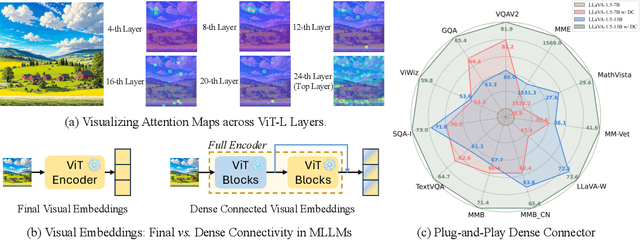
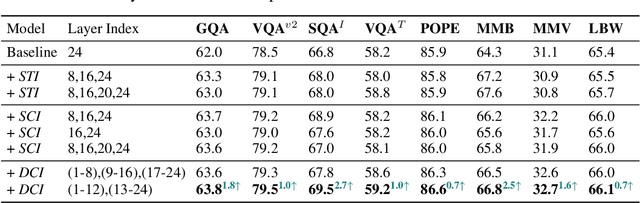
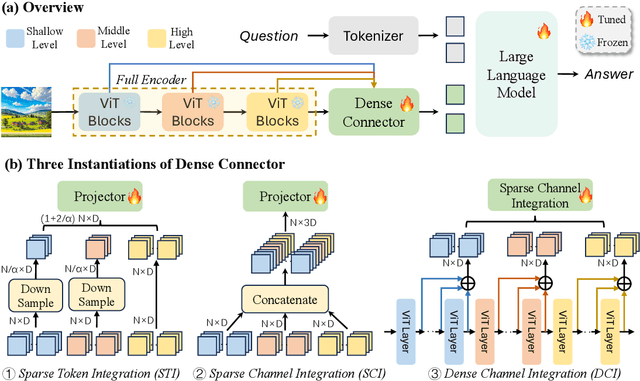
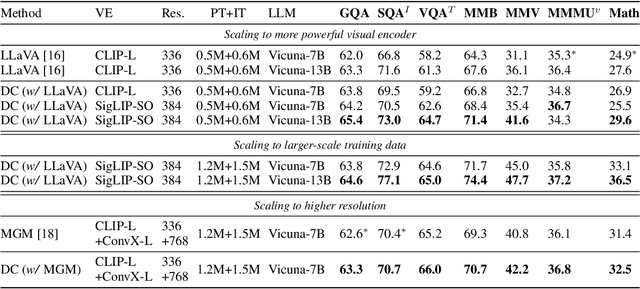
Do we fully leverage the potential of visual encoder in Multimodal Large Language Models (MLLMs)? The recent outstanding performance of MLLMs in multimodal understanding has garnered broad attention from both academia and industry. In the current MLLM rat race, the focus seems to be predominantly on the linguistic side. We witness the rise of larger and higher-quality instruction datasets, as well as the involvement of larger-sized LLMs. Yet, scant attention has been directed towards the visual signals utilized by MLLMs, often assumed to be the final high-level features extracted by a frozen visual encoder. In this paper, we introduce the Dense Connector - a simple, effective, and plug-and-play vision-language connector that significantly enhances existing MLLMs by leveraging multi-layer visual features, with minimal additional computational overhead. Furthermore, our model, trained solely on images, showcases remarkable zero-shot capabilities in video understanding as well. Experimental results across various vision encoders, image resolutions, training dataset scales, varying sizes of LLMs (2.7B->70B), and diverse architectures of MLLMs (e.g., LLaVA and Mini-Gemini) validate the versatility and scalability of our approach, achieving state-of-the-art performance on across 19 image and video benchmarks. We hope that this work will provide valuable experience and serve as a basic module for future MLLM development.
RTG-SLAM: Real-time 3D Reconstruction at Scale using Gaussian Splatting
May 01, 2024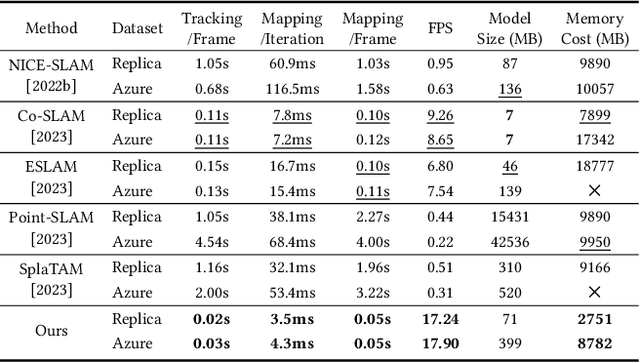
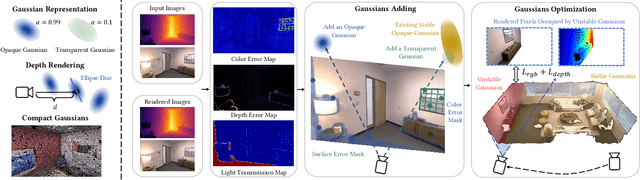
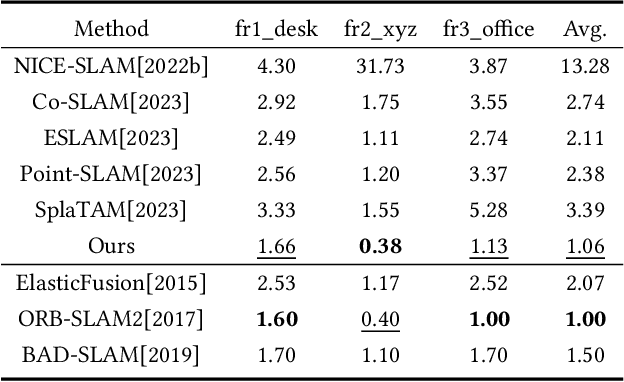
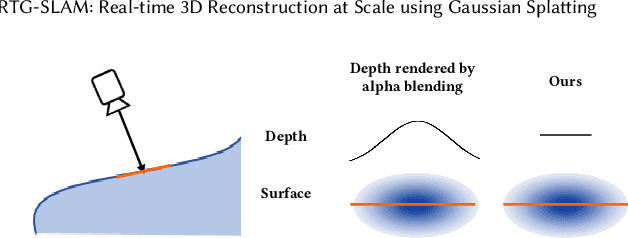
We present Real-time Gaussian SLAM (RTG-SLAM), a real-time 3D reconstruction system with an RGBD camera for large-scale environments using Gaussian splatting. The system features a compact Gaussian representation and a highly efficient on-the-fly Gaussian optimization scheme. We force each Gaussian to be either opaque or nearly transparent, with the opaque ones fitting the surface and dominant colors, and transparent ones fitting residual colors. By rendering depth in a different way from color rendering, we let a single opaque Gaussian well fit a local surface region without the need of multiple overlapping Gaussians, hence largely reducing the memory and computation cost. For on-the-fly Gaussian optimization, we explicitly add Gaussians for three types of pixels per frame: newly observed, with large color errors, and with large depth errors. We also categorize all Gaussians into stable and unstable ones, where the stable Gaussians are expected to well fit previously observed RGBD images and otherwise unstable. We only optimize the unstable Gaussians and only render the pixels occupied by unstable Gaussians. In this way, both the number of Gaussians to be optimized and pixels to be rendered are largely reduced, and the optimization can be done in real time. We show real-time reconstructions of a variety of large scenes. Compared with the state-of-the-art NeRF-based RGBD SLAM, our system achieves comparable high-quality reconstruction but with around twice the speed and half the memory cost, and shows superior performance in the realism of novel view synthesis and camera tracking accuracy.
Training-Free Unsupervised Prompt for Vision-Language Models
Apr 25, 2024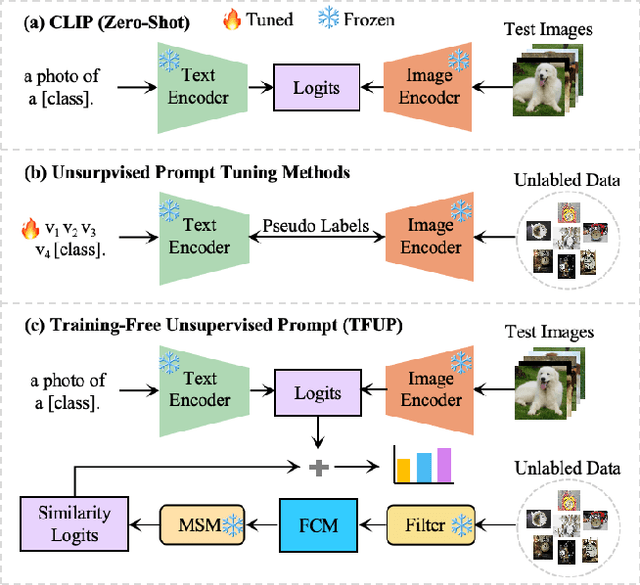
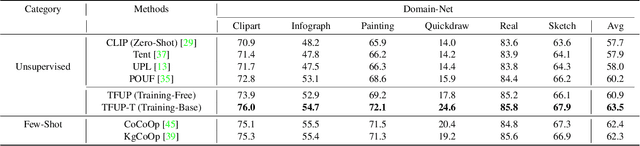
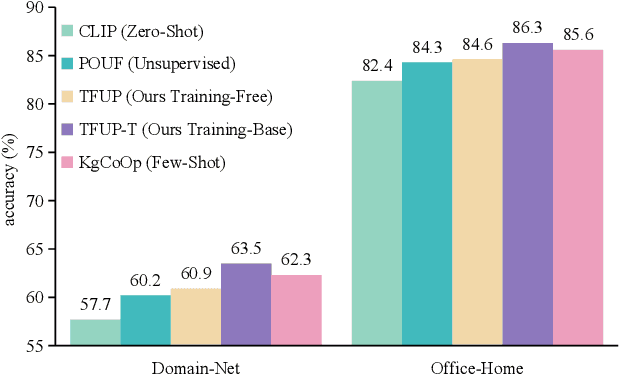
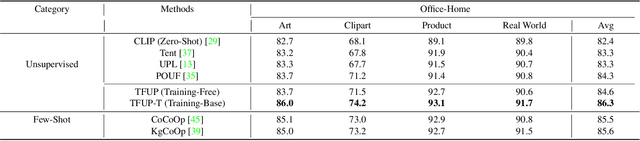
Prompt learning has become the most effective paradigm for adapting large pre-trained vision-language models (VLMs) to downstream tasks. Recently, unsupervised prompt tuning methods, such as UPL and POUF, directly leverage pseudo-labels as supervisory information to fine-tune additional adaptation modules on unlabeled data. However, inaccurate pseudo labels easily misguide the tuning process and result in poor representation capabilities. In light of this, we propose Training-Free Unsupervised Prompts (TFUP), which maximally preserves the inherent representation capabilities and enhances them with a residual connection to similarity-based prediction probabilities in a training-free and labeling-free manner. Specifically, we integrate both instance confidence and prototype scores to select representative samples, which are used to customize a reliable Feature Cache Model (FCM) for training-free inference. Then, we design a Multi-level Similarity Measure (MSM) that considers both feature-level and semantic-level similarities to calculate the distance between each test image and the cached sample as the weight of the corresponding cached label to generate similarity-based prediction probabilities. In this way, TFUP achieves surprising performance, even surpassing the training-base method on multiple classification datasets. Based on our TFUP, we propose a training-based approach (TFUP-T) to further boost the adaptation performance. In addition to the standard cross-entropy loss, TFUP-T adopts an additional marginal distribution entropy loss to constrain the model from a global perspective. Our TFUP-T achieves new state-of-the-art classification performance compared to unsupervised and few-shot adaptation approaches on multiple benchmarks. In particular, TFUP-T improves the classification accuracy of POUF by 3.3% on the most challenging Domain-Net dataset.
CLIP-GS: CLIP-Informed Gaussian Splatting for Real-time and View-consistent 3D Semantic Understanding
Apr 22, 2024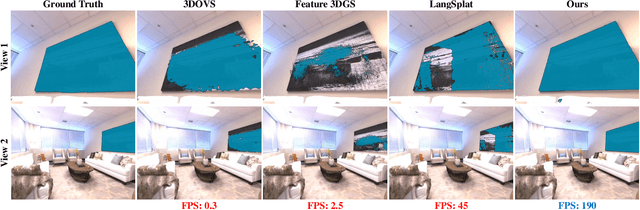
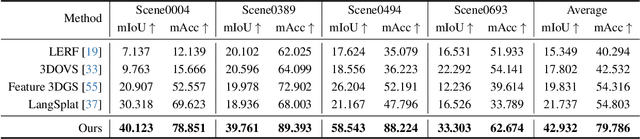
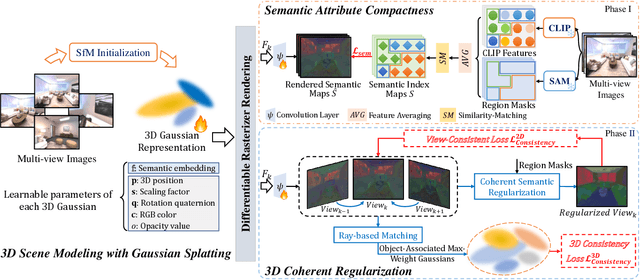

The recent 3D Gaussian Splatting (GS) exhibits high-quality and real-time synthesis of novel views in 3D scenes. Currently, it primarily focuses on geometry and appearance modeling, while lacking the semantic understanding of scenes. To bridge this gap, we present CLIP-GS, which integrates semantics from Contrastive Language-Image Pre-Training (CLIP) into Gaussian Splatting to efficiently comprehend 3D environments without annotated semantic data. In specific, rather than straightforwardly learning and rendering high-dimensional semantic features of 3D Gaussians, which significantly diminishes the efficiency, we propose a Semantic Attribute Compactness (SAC) approach. SAC exploits the inherent unified semantics within objects to learn compact yet effective semantic representations of 3D Gaussians, enabling highly efficient rendering (>100 FPS). Additionally, to address the semantic ambiguity, caused by utilizing view-inconsistent 2D CLIP semantics to supervise Gaussians, we introduce a 3D Coherent Self-training (3DCS) strategy, resorting to the multi-view consistency originated from the 3D model. 3DCS imposes cross-view semantic consistency constraints by leveraging refined, self-predicted pseudo-labels derived from the trained 3D Gaussian model, thereby enhancing precise and view-consistent segmentation results. Extensive experiments demonstrate that our method remarkably outperforms existing state-of-the-art approaches, achieving improvements of 17.29% and 20.81% in mIoU metric on Replica and ScanNet datasets, respectively, while maintaining real-time rendering speed. Furthermore, our approach exhibits superior performance even with sparse input data, verifying the robustness of our method.
TryOn-Adapter: Efficient Fine-Grained Clothing Identity Adaptation for High-Fidelity Virtual Try-On
Apr 01, 2024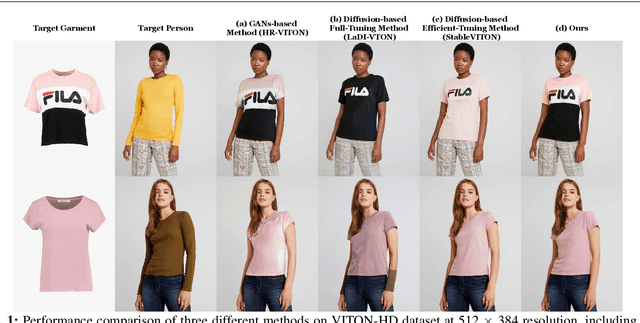


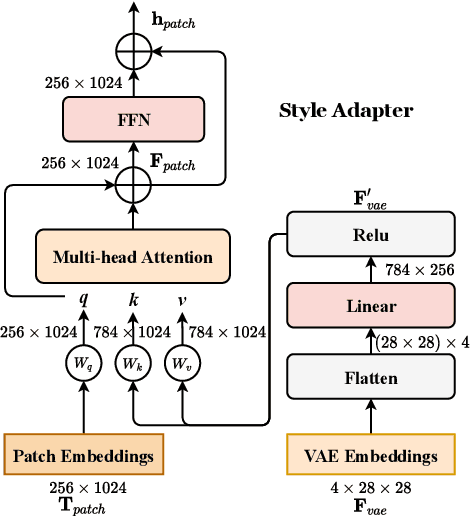
Virtual try-on focuses on adjusting the given clothes to fit a specific person seamlessly while avoiding any distortion of the patterns and textures of the garment. However, the clothing identity uncontrollability and training inefficiency of existing diffusion-based methods, which struggle to maintain the identity even with full parameter training, are significant limitations that hinder the widespread applications. In this work, we propose an effective and efficient framework, termed TryOn-Adapter. Specifically, we first decouple clothing identity into fine-grained factors: style for color and category information, texture for high-frequency details, and structure for smooth spatial adaptive transformation. Our approach utilizes a pre-trained exemplar-based diffusion model as the fundamental network, whose parameters are frozen except for the attention layers. We then customize three lightweight modules (Style Preserving, Texture Highlighting, and Structure Adapting) incorporated with fine-tuning techniques to enable precise and efficient identity control. Meanwhile, we introduce the training-free T-RePaint strategy to further enhance clothing identity preservation while maintaining the realistic try-on effect during the inference. Our experiments demonstrate that our approach achieves state-of-the-art performance on two widely-used benchmarks. Additionally, compared with recent full-tuning diffusion-based methods, we only use about half of their tunable parameters during training. The code will be made publicly available at https://github.com/jiazheng-xing/TryOn-Adapter.
DreamSalon: A Staged Diffusion Framework for Preserving Identity-Context in Editable Face Generation
Mar 28, 2024While large-scale pre-trained text-to-image models can synthesize diverse and high-quality human-centered images, novel challenges arise with a nuanced task of "identity fine editing": precisely modifying specific features of a subject while maintaining its inherent identity and context. Existing personalization methods either require time-consuming optimization or learning additional encoders, adept in "identity re-contextualization". However, they often struggle with detailed and sensitive tasks like human face editing. To address these challenges, we introduce DreamSalon, a noise-guided, staged-editing framework, uniquely focusing on detailed image manipulations and identity-context preservation. By discerning editing and boosting stages via the frequency and gradient of predicted noises, DreamSalon first performs detailed manipulations on specific features in the editing stage, guided by high-frequency information, and then employs stochastic denoising in the boosting stage to improve image quality. For more precise editing, DreamSalon semantically mixes source and target textual prompts, guided by differences in their embedding covariances, to direct the model's focus on specific manipulation areas. Our experiments demonstrate DreamSalon's ability to efficiently and faithfully edit fine details on human faces, outperforming existing methods both qualitatively and quantitatively.
Decoupled Pseudo-labeling for Semi-Supervised Monocular 3D Object Detection
Mar 26, 2024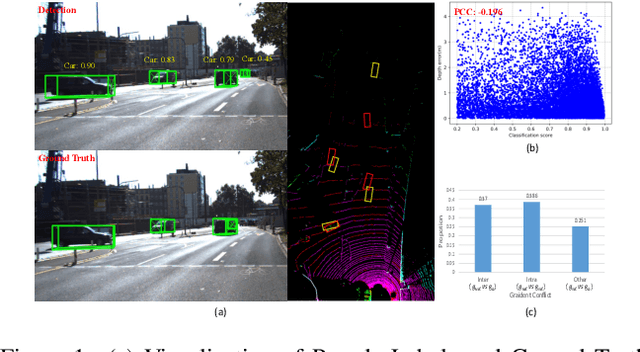
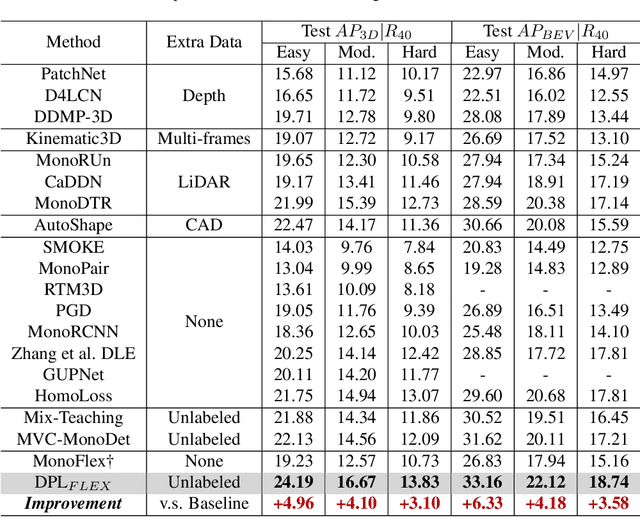
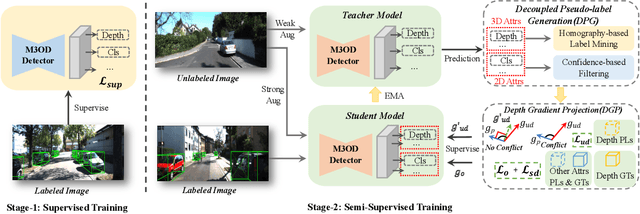

We delve into pseudo-labeling for semi-supervised monocular 3D object detection (SSM3OD) and discover two primary issues: a misalignment between the prediction quality of 3D and 2D attributes and the tendency of depth supervision derived from pseudo-labels to be noisy, leading to significant optimization conflicts with other reliable forms of supervision. We introduce a novel decoupled pseudo-labeling (DPL) approach for SSM3OD. Our approach features a Decoupled Pseudo-label Generation (DPG) module, designed to efficiently generate pseudo-labels by separately processing 2D and 3D attributes. This module incorporates a unique homography-based method for identifying dependable pseudo-labels in BEV space, specifically for 3D attributes. Additionally, we present a DepthGradient Projection (DGP) module to mitigate optimization conflicts caused by noisy depth supervision of pseudo-labels, effectively decoupling the depth gradient and removing conflicting gradients. This dual decoupling strategy-at both the pseudo-label generation and gradient levels-significantly improves the utilization of pseudo-labels in SSM3OD. Our comprehensive experiments on the KITTI benchmark demonstrate the superiority of our method over existing approaches.
Gradient-based Sampling for Class Imbalanced Semi-supervised Object Detection
Mar 22, 2024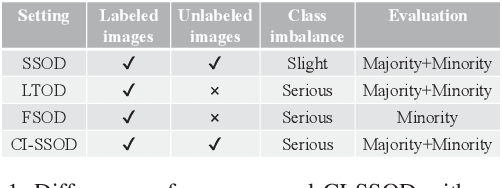

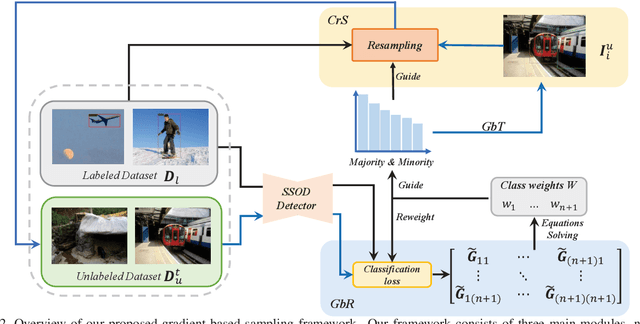

Current semi-supervised object detection (SSOD) algorithms typically assume class balanced datasets (PASCAL VOC etc.) or slightly class imbalanced datasets (MS-COCO, etc). This assumption can be easily violated since real world datasets can be extremely class imbalanced in nature, thus making the performance of semi-supervised object detectors far from satisfactory. Besides, the research for this problem in SSOD is severely under-explored. To bridge this research gap, we comprehensively study the class imbalance problem for SSOD under more challenging scenarios, thus forming the first experimental setting for class imbalanced SSOD (CI-SSOD). Moreover, we propose a simple yet effective gradient-based sampling framework that tackles the class imbalance problem from the perspective of two types of confirmation biases. To tackle confirmation bias towards majority classes, the gradient-based reweighting and gradient-based thresholding modules leverage the gradients from each class to fully balance the influence of the majority and minority classes. To tackle the confirmation bias from incorrect pseudo labels of minority classes, the class-rebalancing sampling module resamples unlabeled data following the guidance of the gradient-based reweighting module. Experiments on three proposed sub-tasks, namely MS-COCO, MS-COCO to Object365 and LVIS, suggest that our method outperforms current class imbalanced object detectors by clear margins, serving as a baseline for future research in CI-SSOD. Code will be available at https://github.com/nightkeepers/CI-SSOD.
TexRO: Generating Delicate Textures of 3D Models by Recursive Optimization
Mar 22, 2024This paper presents TexRO, a novel method for generating delicate textures of a known 3D mesh by optimizing its UV texture. The key contributions are two-fold. We propose an optimal viewpoint selection strategy, that finds the most miniature set of viewpoints covering all the faces of a mesh. Our viewpoint selection strategy guarantees the completeness of a generated result. We propose a recursive optimization pipeline that optimizes a UV texture at increasing resolutions, with an adaptive denoising method that re-uses existing textures for new texture generation. Through extensive experimentation, we demonstrate the superior performance of TexRO in terms of texture quality, detail preservation, visual consistency, and, notably runtime speed, outperforming other current methods. The broad applicability of TexRO is further confirmed through its successful use on diverse 3D models.