 Add to Chrome
 Add to Firefox
 Add to Edge
ONE-SHOT: Compositional Human-Environment Video Synthesis via Spatial-Decoupled Motion Injection and Hybrid Context Integration
Apr 01, 2026
Recent advances in Video Foundation Models (VFMs) have revolutionized human-centric video synthesis, yet fine-grained and independent editing of subjects and scenes remains a critical challenge. Recent attempts to incorporate richer environment control through rigid 3D geometric compositions often encounter a stark trade-off between precise control and generative flexibility. Furthermore, the heavy 3D pre-processing still limits practical scalability. In this paper, we propose ONE-SHOT, a parameter-efficient framework for compositional human-environment video generation. Our key insight is to factorize the generative process into disentangled signals. Specifically, we introduce a canonical-space injection mechanism that decouples human dynamics from environmental cues via cross-attention. We also propose Dynamic-Grounded-RoPE, a novel positional embedding strategy that establishes spatial correspondences between disparate spatial domains without any heuristic 3D alignments. To support long-horizon synthesis, we introduce a Hybrid Context Integration mechanism to maintain subject and scene consistency across minute-level generations. Experiments demonstrate that our method significantly outperforms state-of-the-art methods, offering superior structural control and creative diversity for video synthesis. Our project has been available on: https://martayang.github.io/ONE-SHOT/.

RefAlign: Representation Alignment for Reference-to-Video Generation
Mar 26, 2026Reference-to-video (R2V) generation is a controllable video synthesis paradigm that constrains the generation process using both text prompts and reference images, enabling applications such as personalized advertising and virtual try-on. In practice, existing R2V methods typically introduce additional high-level semantic or cross-modal features alongside the VAE latent representation of the reference image and jointly feed them into the diffusion Transformer (DiT). These auxiliary representations provide semantic guidance and act as implicit alignment signals, which can partially alleviate pixel-level information leakage in the VAE latent space. However, they may still struggle to address copy--paste artifacts and multi-subject confusion caused by modality mismatch across heterogeneous encoder features. In this paper, we propose RefAlign, a representation alignment framework that explicitly aligns DiT reference-branch features to the semantic space of a visual foundation model (VFM). The core of RefAlign is a reference alignment loss that pulls the reference features and VFM features of the same subject closer to improve identity consistency, while pushing apart the corresponding features of different subjects to enhance semantic discriminability. This simple yet effective strategy is applied only during training, incurring no inference-time overhead, and achieves a better balance between text controllability and reference fidelity. Extensive experiments on the OpenS2V-Eval benchmark demonstrate that RefAlign outperforms current state-of-the-art methods in TotalScore, validating the effectiveness of explicit reference alignment for R2V tasks.
InterDyad: Interactive Dyadic Speech-to-Video Generation by Querying Intermediate Visual Guidance
Mar 24, 2026Despite progress in speech-to-video synthesis, existing methods often struggle to capture cross-individual dependencies and provide fine-grained control over reactive behaviors in dyadic settings. To address these challenges, we propose InterDyad, a framework that enables naturalistic interactive dynamics synthesis via querying structural motion guidance. Specifically, we first design an Interactivity Injector that achieves video reenactment based on identity-agnostic motion priors extracted from reference videos. Building upon this, we introduce a MetaQuery-based modality alignment mechanism to bridge the gap between conversational audio and these motion priors. By leveraging a Multimodal Large Language Model (MLLM), our framework is able to distill linguistic intent from audio to dictate the precise timing and appropriateness of reactions. To further improve lip-sync quality under extreme head poses, we propose Role-aware Dyadic Gaussian Guidance (RoDG) for enhanced lip-synchronization and spatial consistency. Finally, we introduce a dedicated evaluation suite with novelly designed metrics to quantify dyadic interaction. Comprehensive experiments demonstrate that InterDyad significantly outperforms state-of-the-art methods in producing natural and contextually grounded two-person interactions. Please refer to our project page for demo videos: https://interdyad.github.io/.
SAMA: Factorized Semantic Anchoring and Motion Alignment for Instruction-Guided Video Editing
Mar 19, 2026Current instruction-guided video editing models struggle to simultaneously balance precise semantic modifications with faithful motion preservation. While existing approaches rely on injecting explicit external priors (e.g., VLM features or structural conditions) to mitigate these issues, this reliance severely bottlenecks model robustness and generalization. To overcome this limitation, we present SAMA (factorized Semantic Anchoring and Motion Alignment), a framework that factorizes video editing into semantic anchoring and motion modeling. First, we introduce Semantic Anchoring, which establishes a reliable visual anchor by jointly predicting semantic tokens and video latents at sparse anchor frames, enabling purely instruction-aware structural planning. Second, Motion Alignment pre-trains the same backbone on motion-centric video restoration pretext tasks (cube inpainting, speed perturbation, and tube shuffle), enabling the model to internalize temporal dynamics directly from raw videos. SAMA is optimized with a two-stage pipeline: a factorized pre-training stage that learns inherent semantic-motion representations without paired video-instruction editing data, followed by supervised fine-tuning on paired editing data. Remarkably, the factorized pre-training alone already yields strong zero-shot video editing ability, validating the proposed factorization. SAMA achieves state-of-the-art performance among open-source models and is competitive with leading commercial systems (e.g., Kling-Omni). Code, models, and datasets will be released.
MVHOI: Bridge Multi-view Condition to Complex Human-Object Interaction Video Reenactment via 3D Foundation Model
Mar 16, 2026Human-Object Interaction (HOI) video reenactment with realistic motion remains a frontier in expressive digital human creation. Existing approaches primarily handle simple image-plane motion (e.g., in-plane translations), struggling with complex non-planar manipulations like out-of-plane reorientation. In this paper, we propose MVHOI, a two-stage HOI video reenactment framework that bridges multi-view reference conditions and video foundation models via a 3D Foundation Model (3DFM). The 3DFM first produces view-consistent object priors conditioned on implicit motion dynamics across novel viewpoints. A controllable video generation model then synthesizes high-fidelity object texture by incorporating multi-view reference images, ensuring appearance consistency via a reasonable retrieval mechanism. By enabling these two stages to mutually reinforce one another during the inference phase, our framework shows superior performance in generating long-duration HOI videos with intricate object manipulations. Extensive experiments show substantial improvements over prior approaches, especially for HOI with complex 3D object manipulations.
DISPLAY: Directable Human-Object Interaction Video Generation via Sparse Motion Guidance and Multi-Task Auxiliary
Mar 10, 2026Human-centric video generation has advanced rapidly, yet existing methods struggle to produce controllable and physically consistent Human-Object Interaction (HOI) videos. Existing works rely on dense control signals, template videos, or carefully crafted text prompts, which limit flexibility and generalization to novel objects. We introduce a framework, namely DISPLAY, guided by Sparse Motion Guidance, composed only of wrist joint coordinates and a shape-agnostic object bounding box. This lightweight guidance alleviates the imbalance between human and object representations and enables intuitive user control. To enhance fidelity under such sparse conditions, we propose an Object-Stressed Attention mechanism that improves object robustness. To address the scarcity of high-quality HOI data, we further develop a Multi-Task Auxiliary Training strategy with a dedicated data curation pipeline, allowing the model to benefit from both reliable HOI samples and auxiliary tasks. Comprehensive experiments show that our method achieves high-fidelity, controllable HOI generation across diverse tasks. The project page can be found at \href{https://mumuwei.github.io/DISPLAY/}.
RnG: A Unified Transformer for Complete 3D Modeling from Partial Observations
Mar 01, 2026Human perceive the 3D world through 2D observations from limited viewpoints. While recent feed-forward generalizable 3D reconstruction models excel at recovering 3D structures from sparse images, their representations are often confined to observed regions, leaving unseen geometry un-modeled. This raises a key, fundamental challenge: Can we infer a complete 3D structure from partial 2D observations? We present RnG (Reconstruction and Generation), a novel feed-forward Transformer that unifies these two tasks by predicting an implicit, complete 3D representation. At the core of RnG, we propose a reconstruction-guided causal attention mechanism that separates reconstruction and generation at the attention level, and treats the KV-cache as an implicit 3D representation. Then, arbitrary poses can efficiently query this cache to render high-fidelity, novel-view RGBD outputs. As a result, RnG not only accurately reconstructs visible geometry but also generates plausible, coherent unseen geometry and appearance. Our method achieves state-of-the-art performance in both generalizable 3D reconstruction and novel view generation, while operating efficiently enough for real-time interactive applications. Project page: https://npucvr.github.io/RnG
CoLoGen: Progressive Learning of Concept-Localization Duality for Unified Image Generation
Feb 26, 2026Unified conditional image generation remains difficult because different tasks depend on fundamentally different internal representations. Some require conceptual understanding for semantic synthesis, while others rely on localization cues for spatial precision. Forcing these heterogeneous tasks to share a single representation leads to concept-localization representational conflict. To address this issue, we propose CoLoGen, a unified diffusion framework that progressively learns and reconciles this concept-localization duality. CoLoGen uses a staged curriculum that first builds core conceptual and localization abilities, then adapts them to diverse visual conditions, and finally refines their synergy for complex instruction-driven tasks. Central to this process is the Progressive Representation Weaving (PRW) module, which dynamically routes features to specialized experts and stably integrates their outputs across stages. Experiments on editing, controllable generation, and customized generation show that CoLoGen achieves competitive or superior performance, offering a principled representational perspective for unified image generation.
Query-Kontext: An Unified Multimodal Model for Image Generation and Editing
Sep 30, 2025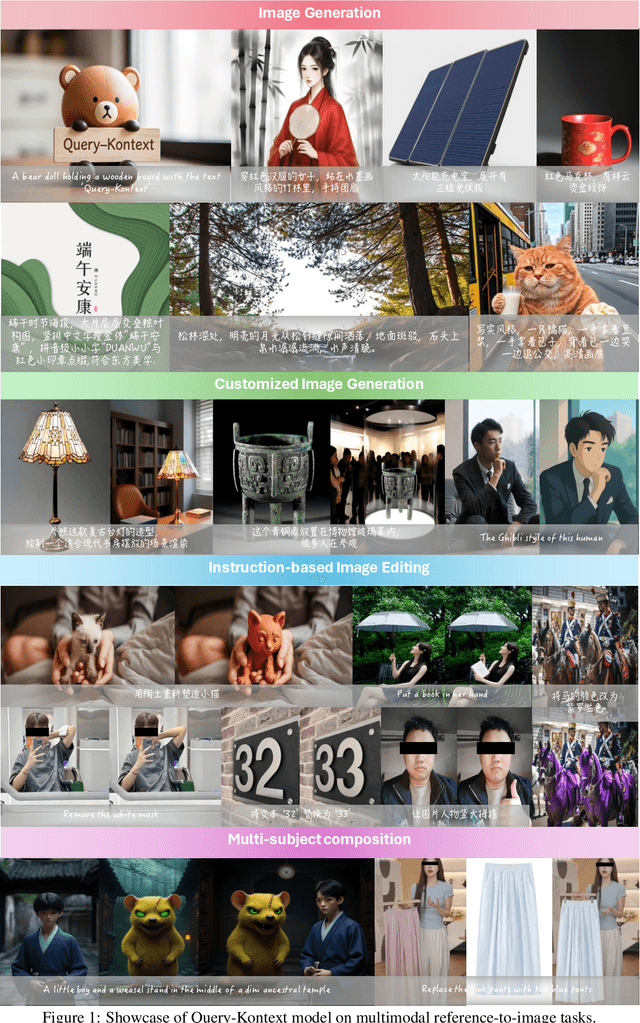
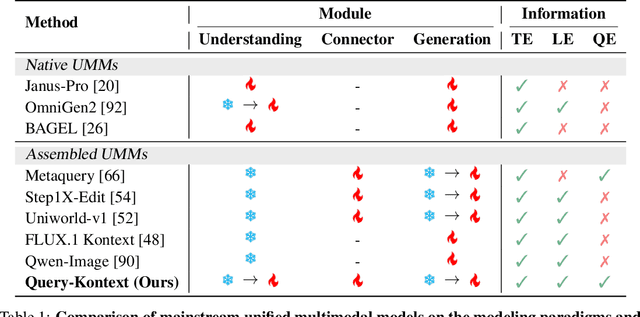
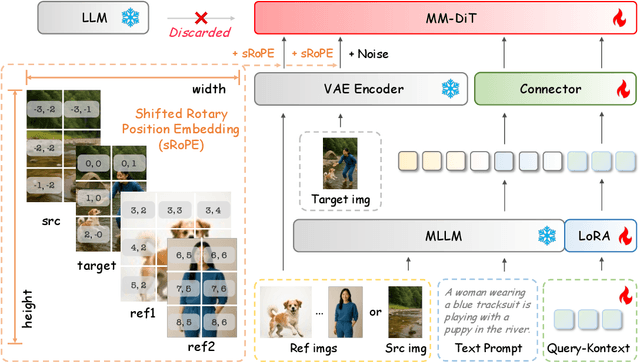
Unified Multimodal Models (UMMs) have demonstrated remarkable performance in text-to-image generation (T2I) and editing (TI2I), whether instantiated as assembled unified frameworks which couple powerful vision-language model (VLM) with diffusion-based generator, or as naive Unified Multimodal Models with an early fusion of understanding and generation modalities. We contend that in current unified frameworks, the crucial capability of multimodal generative reasoning which encompasses instruction understanding, grounding, and image referring for identity preservation and faithful reconstruction, is intrinsically entangled with high-fidelity synthesis. In this work, we introduce Query-Kontext, a novel approach that bridges the VLM and diffusion model via a multimodal ``kontext'' composed of semantic cues and coarse-grained image conditions encoded from multimodal inputs. This design delegates the complex ability of multimodal generative reasoning to powerful VLM while reserving diffusion model's role for high-quality visual synthesis. To achieve this, we propose a three-stage progressive training strategy. First, we connect the VLM to a lightweight diffusion head via multimodal kontext tokens to unleash the VLM's generative reasoning ability. Second, we scale this head to a large, pre-trained diffusion model to enhance visual detail and realism. Finally, we introduce a low-level image encoder to improve image fidelity and perform instruction tuning on downstream tasks. Furthermore, we build a comprehensive data pipeline integrating real, synthetic, and open-source datasets, covering diverse multimodal reference-to-image scenarios, including image generation, instruction-driven editing, customized generation, and multi-subject composition. Experiments show that our approach matches strong unified baselines and even outperforms task-specific state-of-the-art methods in several cases.
iDiT-HOI: Inpainting-based Hand Object Interaction Reenactment via Video Diffusion Transformer
Jun 15, 2025Digital human video generation is gaining traction in fields like education and e-commerce, driven by advancements in head-body animation and lip-syncing technologies. However, realistic Hand-Object Interaction (HOI) - the complex dynamics between human hands and objects - continues to pose challenges. Generating natural and believable HOI reenactments is difficult due to issues such as occlusion between hands and objects, variations in object shapes and orientations, and the necessity for precise physical interactions, and importantly, the ability to generalize to unseen humans and objects. This paper presents a novel framework iDiT-HOI that enables in-the-wild HOI reenactment generation. Specifically, we propose a unified inpainting-based token process method, called Inp-TPU, with a two-stage video diffusion transformer (DiT) model. The first stage generates a key frame by inserting the designated object into the hand region, providing a reference for subsequent frames. The second stage ensures temporal coherence and fluidity in hand-object interactions. The key contribution of our method is to reuse the pretrained model's context perception capabilities without introducing additional parameters, enabling strong generalization to unseen objects and scenarios, and our proposed paradigm naturally supports long video generation. Comprehensive evaluations demonstrate that our approach outperforms existing methods, particularly in challenging real-world scenes, offering enhanced realism and more seamless hand-object interactions.