 Add to Chrome
 Add to Firefox
 Add to Edge
EA-Nav: Learning Safe Visual Navigation Policies with Embodiment Awareness
Jul 22, 2026
Cross-embodiment navigation is a key challenge in embodied intelligence. Due to differences in embodiment, the same visual observation may imply different actions for different agents, making prediction ambiguous when relying solely on vision. Existing studies mainly rely on reinforcement learning, which requires large-scale interaction and careful reward design, making it difficult to support scalable pretraining and real-world adaptation. In contrast, imitation-learning-based approaches remain limited. To address these challenges, we propose an imitation-learning-based embodiment-aware navigation framework with a modular multi-stage design. In pretraining, we construct a cross-embodiment navigation dataset from Internet videos and introduce embodiment geometry as conditional tokens to reduce action ambiguity under the same observation. In fine-tuning, we design a multimodal information injection mechanism based on a decoupled architecture. Specifically, we design a trajectory augmentation strategy to generate high-risk samples, which are used to train spatial perception and risk-aware correction separately, thereby explicitly incorporating embodiment geometry for safe navigation. Experimental results show that the proposed method effectively improves navigation performance across different embodiment settings, demonstrating the effectiveness of incorporating embodiment geometry into embodied navigation.

TFP: Temporally Conditioned Memory-Fusion Policies for Visuomotor Learning
Jul 09, 2026Vision--Language--Action (VLA) policies such as $π_{0.5}$ and OpenVLA perform well on many manipulation tasks, but they are often reactive: the next action is predicted from the current observation, instruction, and proprioceptive state. This assumption breaks down in stage-dependent manipulation, where visually similar states may require different actions depending on latent task progress and previous interaction outcomes. We argue that such tasks require not only memory, but dynamics-aware belief updates: the policy should preserve task progress during stable or occluded phases and revise its belief near contact, release, or subgoal transitions. We introduce Temporally Conditioned Memory-Fusion Policies (TFP), a lightweight memory-action framework for VLA backbones. TFP maintains an episode-local task-progress belief with Liquid Time-Constant dynamics and injects the updated belief directly into the flow-matching action decoder through adaptive modulation. This lets temporally accumulated context shape the generated action chunk, rather than serving only as passive history context. With a 3.3B-parameter model, TFP improves the average success rate from \(96.9\%\) to \(98.75\%\) on LIBERO and from \(91.4\%\) to \(93.77\%\) on LIBERO-plus. On the memory-focused MIKASA ShellGameTouch diagnostic, TFP achieves success up to \(75.0\%\). Mechanistic analyses show that write-gain changes near manipulation events are about \(6\times\) larger than far non-event phases, and hidden-state interventions show that the belief causally modulates generated action chunks. These results suggest that compact, event-sensitive memory dynamics can improve VLA policies under occlusion, visual perturbation, and stage-dependent task structure.
CylindTrack: Depth-Aware Cylindrical Motion Modeling for Panoramic Multi-Object Tracking
Jun 29, 2026Multi-Object Tracking (MOT) is a core capability for embodied perception, and panoramic cameras are attractive for embodied systems because their 360° field of view reduces blind spots and keeps surrounding targets observable for longer durations. However, panoramic MOT is not a straightforward extension of perspective MOT. In equirectangular panoramic videos, the horizontal image domain is periodic rather than Euclidean, which breaks planar motion assumptions and makes IoU-based association unreliable near the 0°/360° seam. Meanwhile, large-FoV scenes often contain more objects, stronger scale variation, and more frequent interactions, making online association particularly sensitive to unstable frame-wise depth cues. To address these issues, we propose CylindTrack, a depth-aware cylindrical tracking-by-detection framework for panoramic MOT. CylindTrack first introduces Depth-Temporal Trajectory Modeling (DTM), which promotes instance depth from an isolated frame-wise cue to a temporally filtered trajectory-level state. To improve the reliability of depth observations, we further develop Spherical Spatio-Temporal Consistency Learning (SSTC), which combines a Temporal Mixer and Spherical Geometry-aware Attention to enhance temporal coherence and panoramic geometric alignment in depth-aware representations. Finally, we design a Topology-Aware Cylindrical Motion Model (TCMM) that lifts horizontal motion into a continuous angular state space and performs seam-consistent motion prediction and association in the periodic panoramic domain. By jointly modeling trajectory-level depth consistency and panoramic topology, CylindTrack improves identity preservation and trajectory continuity in challenging panoramic scenes. The source code will be released at https://github.com/warriordby/CylindTrack.
MVOFormer: Flow-Semantic Transformer for Robust Monocular Visual Odometry
Jun 15, 2026Monocular visual odometry (MVO) is foundational to autonomous navigation and robotic localization. However, existing learning-based MVO approaches often struggle with either a lack of interpretable, complementary features or overly complex multi-stage architectures. These limitations inherently restrict their robustness and cross-domain generalization. In this work, we propose MVOFormer, a novel transformer framework for robust monocular visual odometry. Our architecture features a Flow-Semantic Dual Branch Encoder that synergizes dense geometric motion cues with object-centric semantic priors, explicitly distinguishing static structures from dynamic distractors. These representations are then fused by an Iterative Multimodal Decoder, enabling coarse-to-fine pose refinement while dynamically suppressing attention on unreliable regions. Extensive evaluations demonstrate that, without any target-domain fine-tuning, MVOFormer achieves superior zero-shot generalization and robustness, significantly outperforming prior learning-based frame-to-frame methods across diverse benchmarks including TartanAir, KITTI, TUM-RGBD, and ETH3D-SLAM.
R$^3$D: Regional-guided Residual Radar Diffusion
Jan 10, 2026Millimeter-wave radar enables robust environment perception in autonomous systems under adverse conditions yet suffers from sparse, noisy point clouds with low angular resolution. Existing diffusion-based radar enhancement methods either incur high learning complexity by modeling full LiDAR distributions or fail to prioritize critical structures due to uniform regional processing. To address these issues, we propose R3D, a regional-guided residual radar diffusion framework that integrates residual diffusion modeling-focusing on the concentrated LiDAR-radar residual encoding complementary high-frequency details to reduce learning difficulty-and sigma-adaptive regional guidance-leveraging radar-specific signal properties to generate attention maps and applying lightweight guidance only in low-noise stages to avoid gradient imbalance while refining key regions. Extensive experiments on the ColoRadar dataset demonstrate that R3D outperforms state-of-the-art methods, providing a practical solution for radar perception enhancement. Our anonymous code and pretrained models are released here: https://anonymous.4open.science/r/r3d-F836
MambaVLT: Time-Evolving Multimodal State Space Model for Vision-Language Tracking
Nov 23, 2024


The vision-language tracking task aims to perform object tracking based on various modality references. Existing Transformer-based vision-language tracking methods have made remarkable progress by leveraging the global modeling ability of self-attention. However, current approaches still face challenges in effectively exploiting the temporal information and dynamically updating reference features during tracking. Recently, the State Space Model (SSM), known as Mamba, has shown astonishing ability in efficient long-sequence modeling. Particularly, its state space evolving process demonstrates promising capabilities in memorizing multimodal temporal information with linear complexity. Witnessing its success, we propose a Mamba-based vision-language tracking model to exploit its state space evolving ability in temporal space for robust multimodal tracking, dubbed MambaVLT. In particular, our approach mainly integrates a time-evolving hybrid state space block and a selective locality enhancement block, to capture contextual information for multimodal modeling and adaptive reference feature update. Besides, we introduce a modality-selection module that dynamically adjusts the weighting between visual and language references, mitigating potential ambiguities from either reference type. Extensive experimental results show that our method performs favorably against state-of-the-art trackers across diverse benchmarks.
GraphFM: A Comprehensive Benchmark for Graph Foundation Model
Jun 12, 2024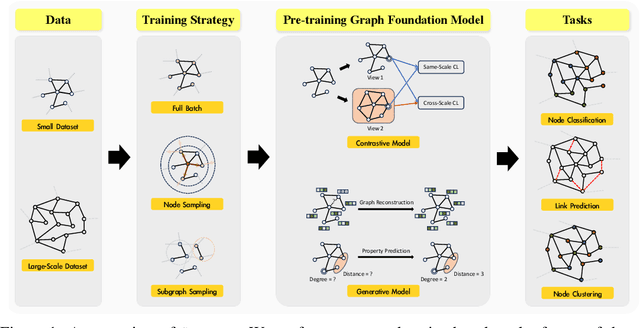
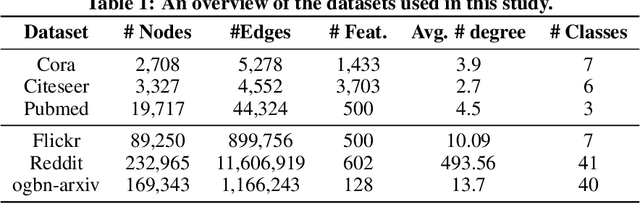
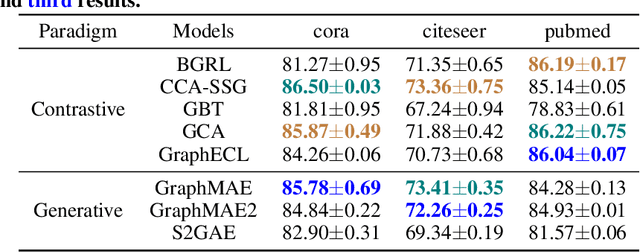
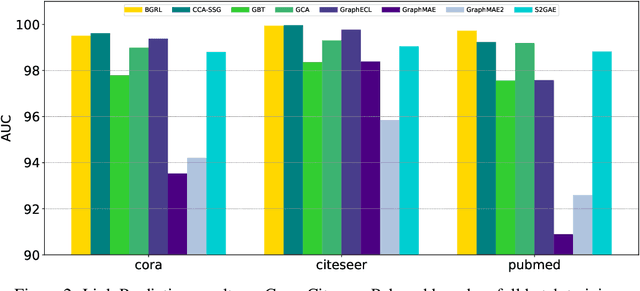
Foundation Models (FMs) serve as a general class for the development of artificial intelligence systems, offering broad potential for generalization across a spectrum of downstream tasks. Despite extensive research into self-supervised learning as the cornerstone of FMs, several outstanding issues persist in Graph Foundation Models that rely on graph self-supervised learning, namely: 1) Homogenization. The extent of generalization capability on downstream tasks remains unclear. 2) Scalability. It is unknown how effectively these models can scale to large datasets. 3) Efficiency. The training time and memory usage of these models require evaluation. 4) Training Stop Criteria. Determining the optimal stopping strategy for pre-training across multiple tasks to maximize performance on downstream tasks. To address these questions, we have constructed a rigorous benchmark that thoroughly analyzes and studies the generalization and scalability of self-supervised Graph Neural Network (GNN) models. Regarding generalization, we have implemented and compared the performance of various self-supervised GNN models, trained to generate node representations, across tasks such as node classification, link prediction, and node clustering. For scalability, we have compared the performance of various models after training using full-batch and mini-batch strategies. Additionally, we have assessed the training efficiency of these models by conducting experiments to test their GPU memory usage and throughput. Through these experiments, we aim to provide insights to motivate future research. The code for this benchmark is publicly available at https://github.com/NYUSHCS/GraphFM.
TexRO: Generating Delicate Textures of 3D Models by Recursive Optimization
Mar 22, 2024This paper presents TexRO, a novel method for generating delicate textures of a known 3D mesh by optimizing its UV texture. The key contributions are two-fold. We propose an optimal viewpoint selection strategy, that finds the most miniature set of viewpoints covering all the faces of a mesh. Our viewpoint selection strategy guarantees the completeness of a generated result. We propose a recursive optimization pipeline that optimizes a UV texture at increasing resolutions, with an adaptive denoising method that re-uses existing textures for new texture generation. Through extensive experimentation, we demonstrate the superior performance of TexRO in terms of texture quality, detail preservation, visual consistency, and, notably runtime speed, outperforming other current methods. The broad applicability of TexRO is further confirmed through its successful use on diverse 3D models.
GEA: Reconstructing Expressive 3D Gaussian Avatar from Monocular Video
Feb 26, 2024
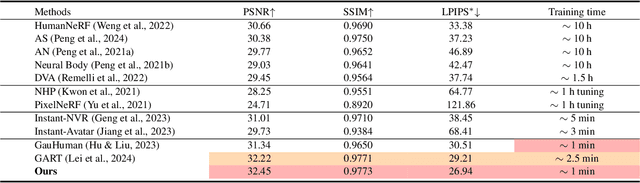

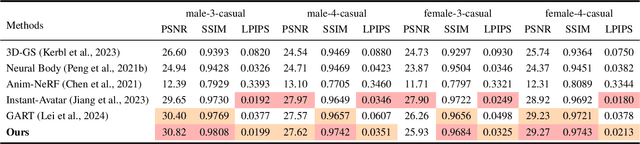
This paper presents GEA, a novel method for creating expressive 3D avatars with high-fidelity reconstructions of body and hands based on 3D Gaussians. The key contributions are twofold. First, we design a two-stage pose estimation method to obtain an accurate SMPL-X pose from input images, providing a correct mapping between the pixels of a training image and the SMPL-X model. It uses an attention-aware network and an optimization scheme to align the normal and silhouette between the estimated SMPL-X body and the real body in the image. Second, we propose an iterative re-initialization strategy to handle unbalanced aggregation and initialization bias faced by Gaussian representation. This strategy iteratively redistributes the avatar's Gaussian points, making it evenly distributed near the human body surface by applying meshing, resampling and re-Gaussian operations. As a result, higher-quality rendering can be achieved. Extensive experimental analyses validate the effectiveness of the proposed model, demonstrating that it achieves state-of-the-art performance in photorealistic novel view synthesis while offering fine-grained control over the human body and hand pose. Project page: https://3d-aigc.github.io/GEA/.