 Add to Chrome
 Add to Firefox
 Add to Edge
FadeMem: Distance-Aware Memory Consolidation for Autoregressive Video Diffusion
Jun 09, 2026
Autoregressive video generators synthesize long videos by generating successive temporal segments, but their historical KV cache grows with video length. Existing bounded-cache methods reduce this cost with local windows, sink tokens, or compressed memory states, yet they usually assign fixed roles to different parts of the history. We propose FadeMem, a distance-aware KV memory consolidation mechanism that organizes historical KV blocks into a temporal hierarchy under a fixed cache budget. This design is motivated by frequency-dependent temporal decay: fine details decorrelate quickly, while coarse scene structure and identity remain useful over longer horizons. During generation, new history is inserted as fine-grained entries, while older adjacent entries are progressively merged under a power-law temporal allocation schedule, yielding a dense-near, sparse-far memory within one cache. Without architectural changes, FadeMem preserves recent context for short-term dynamics and compact long-range anchors for identity and scene coherence. Experiments show improved subject consistency, background stability, and temporal coherence over existing bounded-cache strategies.

RefAlign: Representation Alignment for Reference-to-Video Generation
Mar 26, 2026Reference-to-video (R2V) generation is a controllable video synthesis paradigm that constrains the generation process using both text prompts and reference images, enabling applications such as personalized advertising and virtual try-on. In practice, existing R2V methods typically introduce additional high-level semantic or cross-modal features alongside the VAE latent representation of the reference image and jointly feed them into the diffusion Transformer (DiT). These auxiliary representations provide semantic guidance and act as implicit alignment signals, which can partially alleviate pixel-level information leakage in the VAE latent space. However, they may still struggle to address copy--paste artifacts and multi-subject confusion caused by modality mismatch across heterogeneous encoder features. In this paper, we propose RefAlign, a representation alignment framework that explicitly aligns DiT reference-branch features to the semantic space of a visual foundation model (VFM). The core of RefAlign is a reference alignment loss that pulls the reference features and VFM features of the same subject closer to improve identity consistency, while pushing apart the corresponding features of different subjects to enhance semantic discriminability. This simple yet effective strategy is applied only during training, incurring no inference-time overhead, and achieves a better balance between text controllability and reference fidelity. Extensive experiments on the OpenS2V-Eval benchmark demonstrate that RefAlign outperforms current state-of-the-art methods in TotalScore, validating the effectiveness of explicit reference alignment for R2V tasks.
CoLoGen: Progressive Learning of Concept-Localization Duality for Unified Image Generation
Feb 26, 2026Unified conditional image generation remains difficult because different tasks depend on fundamentally different internal representations. Some require conceptual understanding for semantic synthesis, while others rely on localization cues for spatial precision. Forcing these heterogeneous tasks to share a single representation leads to concept-localization representational conflict. To address this issue, we propose CoLoGen, a unified diffusion framework that progressively learns and reconciles this concept-localization duality. CoLoGen uses a staged curriculum that first builds core conceptual and localization abilities, then adapts them to diverse visual conditions, and finally refines their synergy for complex instruction-driven tasks. Central to this process is the Progressive Representation Weaving (PRW) module, which dynamically routes features to specialized experts and stably integrates their outputs across stages. Experiments on editing, controllable generation, and customized generation show that CoLoGen achieves competitive or superior performance, offering a principled representational perspective for unified image generation.
Dense Connector for MLLMs
May 22, 2024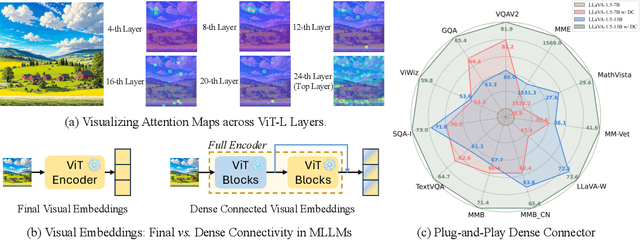
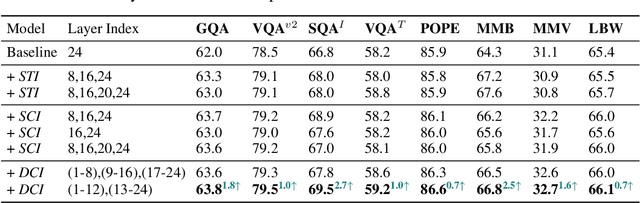
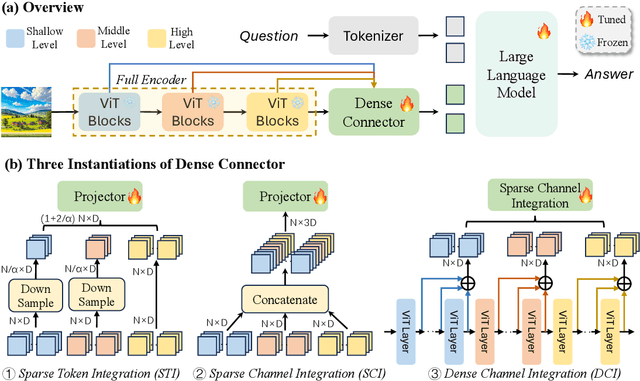
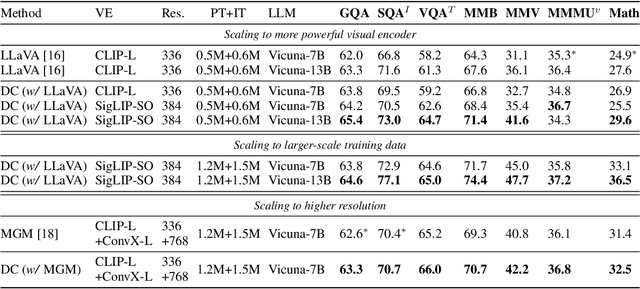
Do we fully leverage the potential of visual encoder in Multimodal Large Language Models (MLLMs)? The recent outstanding performance of MLLMs in multimodal understanding has garnered broad attention from both academia and industry. In the current MLLM rat race, the focus seems to be predominantly on the linguistic side. We witness the rise of larger and higher-quality instruction datasets, as well as the involvement of larger-sized LLMs. Yet, scant attention has been directed towards the visual signals utilized by MLLMs, often assumed to be the final high-level features extracted by a frozen visual encoder. In this paper, we introduce the Dense Connector - a simple, effective, and plug-and-play vision-language connector that significantly enhances existing MLLMs by leveraging multi-layer visual features, with minimal additional computational overhead. Furthermore, our model, trained solely on images, showcases remarkable zero-shot capabilities in video understanding as well. Experimental results across various vision encoders, image resolutions, training dataset scales, varying sizes of LLMs (2.7B->70B), and diverse architectures of MLLMs (e.g., LLaVA and Mini-Gemini) validate the versatility and scalability of our approach, achieving state-of-the-art performance on across 19 image and video benchmarks. We hope that this work will provide valuable experience and serve as a basic module for future MLLM development.