 Add to Chrome
 Add to Firefox
 Add to Edge
Learning from Self-Sampled Correct and Partially-Correct Programs
May 28, 2022
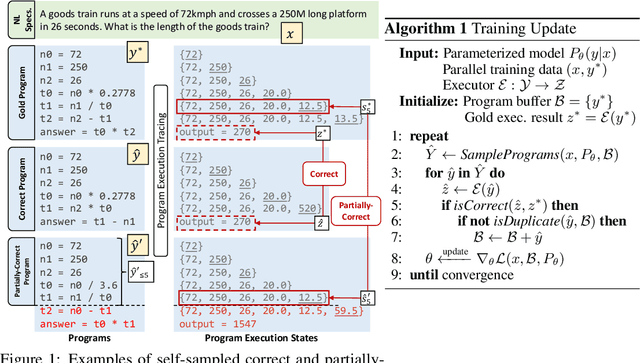
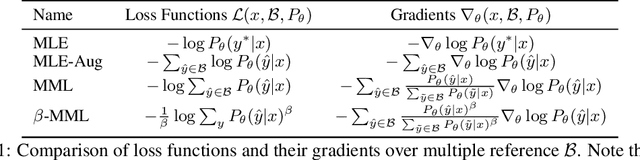
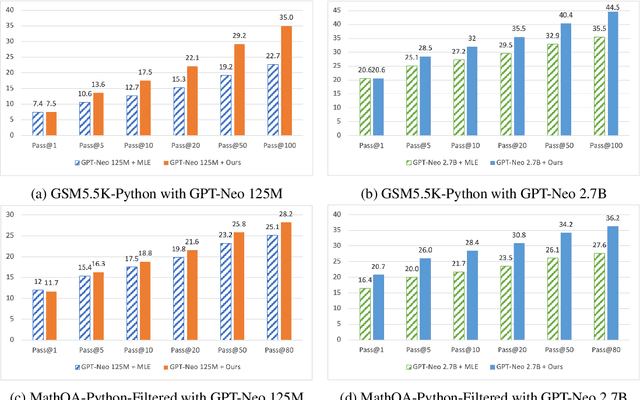
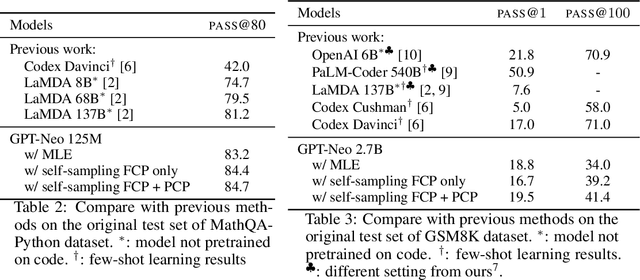
Program synthesis aims to generate executable programs that are consistent with the user specification. While there are often multiple programs that satisfy the same user specification, existing neural program synthesis models are often only learned from one reference program by maximizing its log-likelihood. This causes the model to be overly confident in its predictions as it sees the single solution repeatedly during training. This leads to poor generalization on unseen examples, even when multiple attempts are allowed. To mitigate this issue, we propose to let the model perform sampling during training and learn from both self-sampled fully-correct programs, which yield the gold execution results, as well as partially-correct programs, whose intermediate execution state matches another correct program. We show that our use of self-sampled correct and partially-correct programs can benefit learning and help guide the sampling process, leading to more efficient exploration of the program space. Additionally, we explore various training objectives to support learning from multiple programs per example and find they greatly affect the performance. Experiments on the MathQA and GSM8K datasets show that our proposed method improves the pass@k performance by 3.1% to 12.3% compared to learning from a single reference program with MLE.

AdaMix: Mixture-of-Adapter for Parameter-efficient Tuning of Large Language Models
May 24, 2022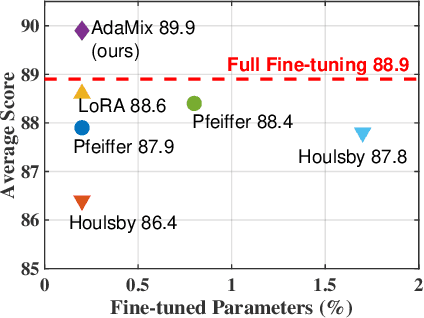
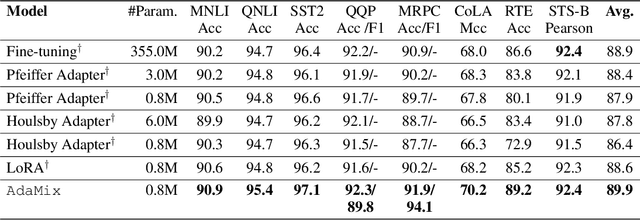
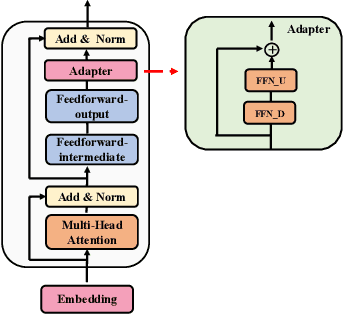
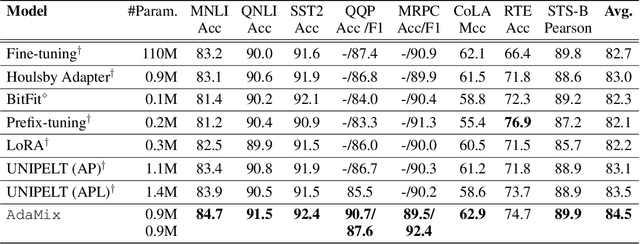
Fine-tuning large-scale pre-trained language models to downstream tasks require updating hundreds of millions of parameters. This not only increases the serving cost to store a large copy of the model weights for every task, but also exhibits instability during few-shot task adaptation. Parameter-efficient techniques have been developed that tune small trainable components (e.g., adapters) injected in the large model while keeping most of the model weights frozen. The prevalent mechanism to increase adapter capacity is to increase the bottleneck dimension which increases the adapter parameters. In this work, we introduce a new mechanism to improve adapter capacity without increasing parameters or computational cost by two key techniques. (i) We introduce multiple shared adapter components in each layer of the Transformer architecture. We leverage sparse learning via random routing to update the adapter parameters (encoder is kept frozen) resulting in the same amount of computational cost (FLOPs) as that of training a single adapter. (ii) We propose a simple merging mechanism to average the weights of multiple adapter components to collapse to a single adapter in each Transformer layer, thereby, keeping the overall parameters also the same but with significant performance improvement. We demonstrate these techniques to work well across multiple task settings including fully supervised and few-shot Natural Language Understanding tasks. By only tuning 0.23% of a pre-trained language model's parameters, our model outperforms the full model fine-tuning performance and several competing methods.
Visually-Augmented Language Modeling
May 20, 2022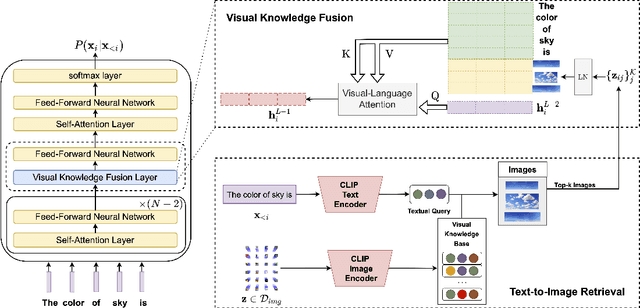

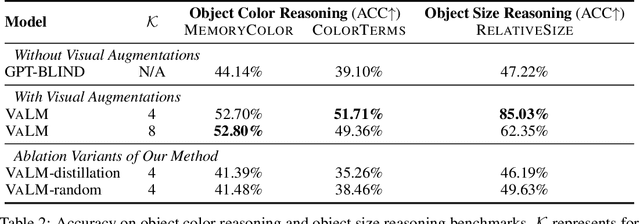
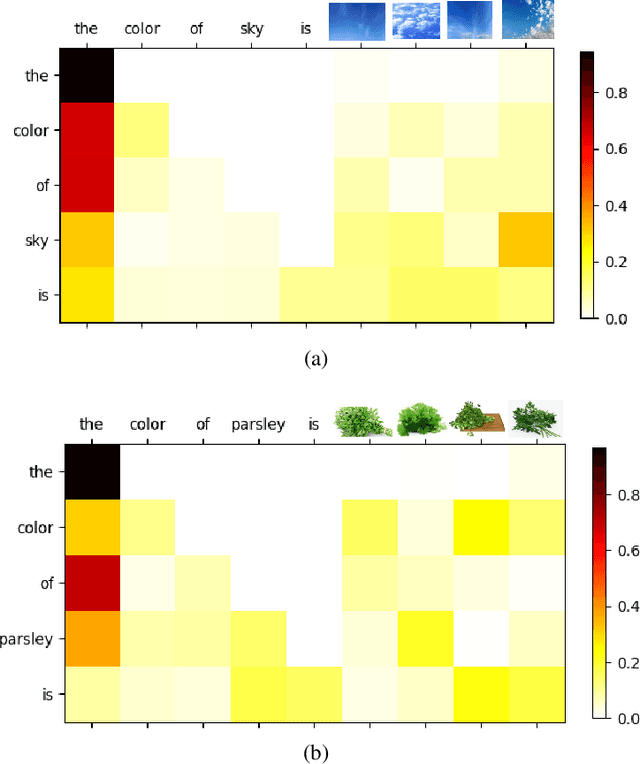
Human language is grounded on multimodal knowledge including visual knowledge like colors, sizes, and shapes. However, current large-scale pre-trained language models rely on the text-only self-supervised training with massive text data, which precludes them from utilizing relevant visual information when necessary. To address this, we propose a novel pre-training framework, named VaLM, to Visually-augment text tokens with retrieved relevant images for Language Modeling. Specifically, VaLM builds on a novel text-vision alignment method via an image retrieval module to fetch corresponding images given a textual context. With the visually-augmented context, VaLM uses a visual knowledge fusion layer to enable multimodal grounded language modeling by attending on both text context and visual knowledge in images. We evaluate the proposed model on various multimodal commonsense reasoning tasks, which require visual information to excel. VaLM outperforms the text-only baseline with substantial gains of +8.66% and +37.81% accuracy on object color and size reasoning, respectively.
Training Vision-Language Transformers from Captions Alone
May 19, 2022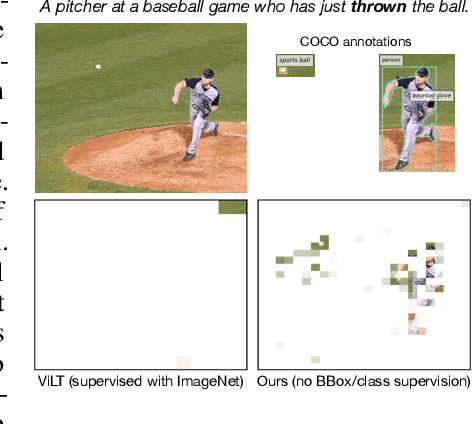
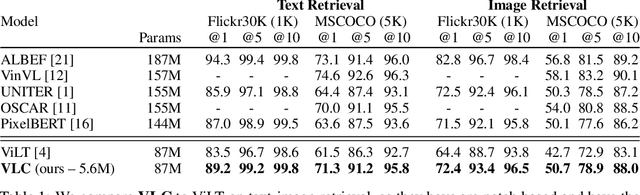
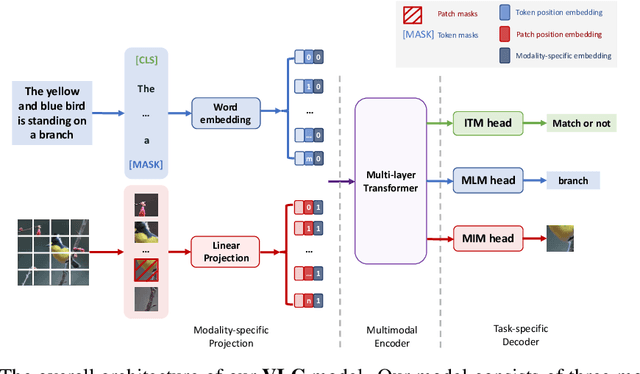
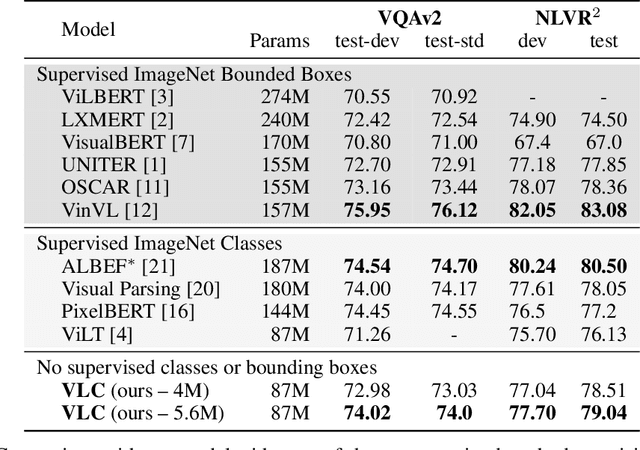
We show that Vision-Language Transformers can be learned without human labels (e.g. class labels, bounding boxes, etc). Existing work, whether explicitly utilizing bounding boxes or patches, assumes that the visual backbone must first be trained on ImageNet class prediction before being integrated into a multimodal linguistic pipeline. We show that this is not necessary and introduce a new model Vision-Language from Captions (VLC) built on top of Masked Auto-Encoders that does not require this supervision. In fact, in a head-to-head comparison between ViLT, the current state-of-the-art patch-based vision-language transformer which is pretrained with supervised object classification, and our model, VLC, we find that our approach 1. outperforms ViLT on standard benchmarks, 2. provides more interpretable and intuitive patch visualizations, and 3. is competitive with many larger models that utilize ROIs trained on annotated bounding-boxes.
Neurocompositional computing: From the Central Paradox of Cognition to a new generation of AI systems
May 02, 2022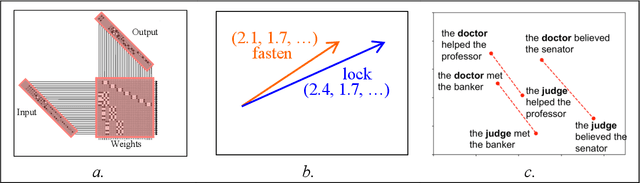
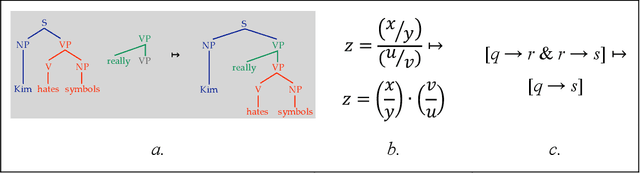
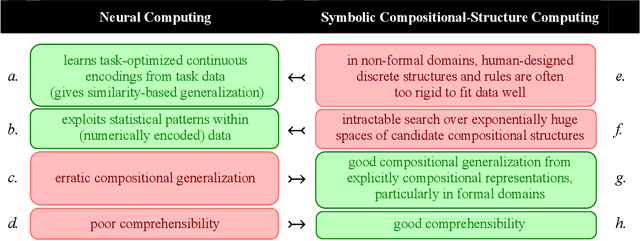
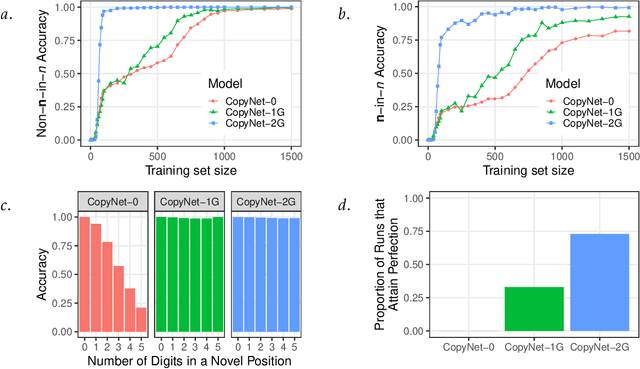
What explains the dramatic progress from 20th-century to 21st-century AI, and how can the remaining limitations of current AI be overcome? The widely accepted narrative attributes this progress to massive increases in the quantity of computational and data resources available to support statistical learning in deep artificial neural networks. We show that an additional crucial factor is the development of a new type of computation. Neurocompositional computing adopts two principles that must be simultaneously respected to enable human-level cognition: the principles of Compositionality and Continuity. These have seemed irreconcilable until the recent mathematical discovery that compositionality can be realized not only through discrete methods of symbolic computing, but also through novel forms of continuous neural computing. The revolutionary recent progress in AI has resulted from the use of limited forms of neurocompositional computing. New, deeper forms of neurocompositional computing create AI systems that are more robust, accurate, and comprehensible.
ELEVATER: A Benchmark and Toolkit for Evaluating Language-Augmented Visual Models
Apr 20, 2022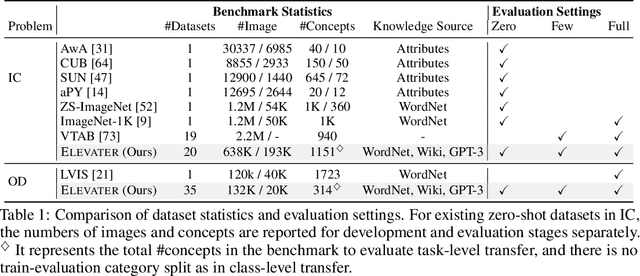
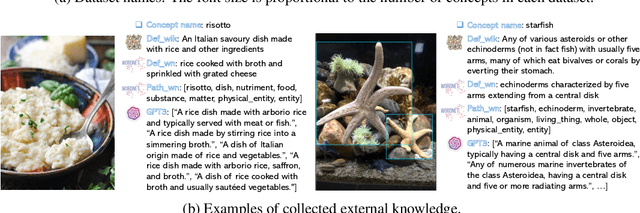
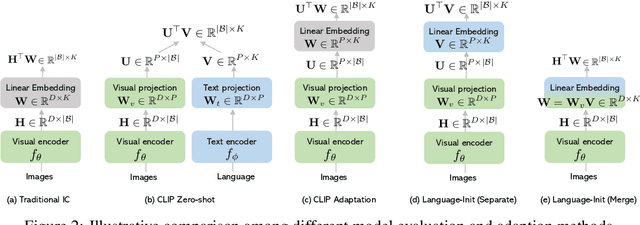
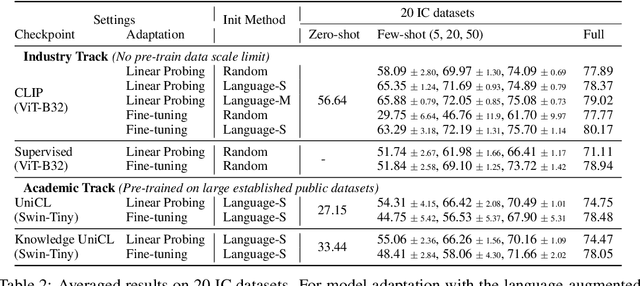
Learning visual representations from natural language supervision has recently shown great promise in a number of pioneering works. In general, these language-augmented visual models demonstrate strong transferability to a variety of datasets/tasks. However, it remains a challenge to evaluate the transferablity of these foundation models due to the lack of easy-to-use toolkits for fair benchmarking. To tackle this, we build ELEVATER (Evaluation of Language-augmented Visual Task-level Transfer), the first benchmark to compare and evaluate pre-trained language-augmented visual models. Several highlights include: (i) Datasets. As downstream evaluation suites, it consists of 20 image classification datasets and 35 object detection datasets, each of which is augmented with external knowledge. (ii) Toolkit. An automatic hyper-parameter tuning toolkit is developed to ensure the fairness in model adaption. To leverage the full power of language-augmented visual models, novel language-aware initialization methods are proposed to significantly improve the adaption performance. (iii) Metrics. A variety of evaluation metrics are used, including sample-efficiency (zero-shot and few-shot) and parameter-efficiency (linear probing and full model fine-tuning). We will release our toolkit and evaluation platforms for the research community.
K-LITE: Learning Transferable Visual Models with External Knowledge
Apr 20, 2022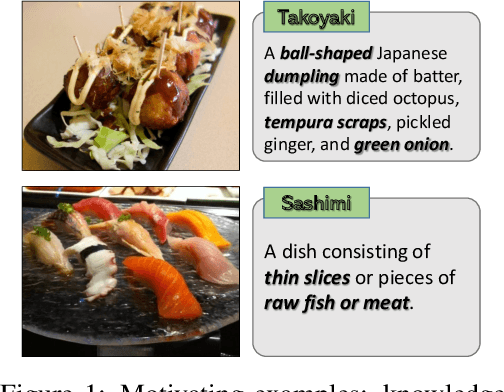
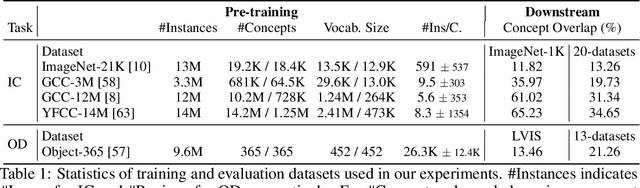
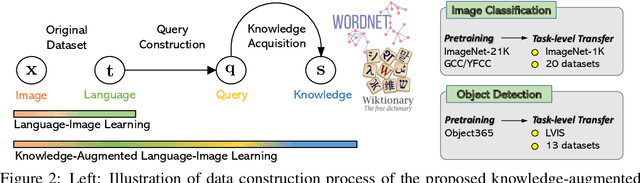
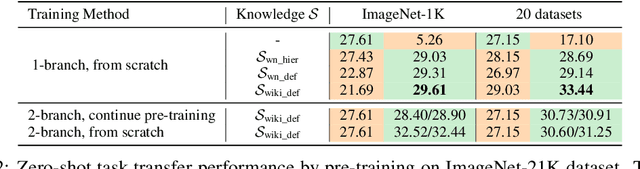
Recent state-of-the-art computer vision systems are trained from natural language supervision, ranging from simple object category names to descriptive captions. This free form of supervision ensures high generality and usability of the learned visual models, based on extensive heuristics on data collection to cover as many visual concepts as possible. Alternatively, learning with external knowledge about images is a promising way which leverages a much more structured source of supervision. In this paper, we propose K-LITE (Knowledge-augmented Language-Image Training and Evaluation), a simple strategy to leverage external knowledge to build transferable visual systems: In training, it enriches entities in natural language with WordNet and Wiktionary knowledge, leading to an efficient and scalable approach to learning image representations that can understand both visual concepts and their knowledge; In evaluation, the natural language is also augmented with external knowledge and then used to reference learned visual concepts (or describe new ones) to enable zero-shot and few-shot transfer of the pre-trained models. We study the performance of K-LITE on two important computer vision problems, image classification and object detection, benchmarking on 20 and 13 different existing datasets, respectively. The proposed knowledge-augmented models show significant improvement in transfer learning performance over existing methods.
METRO: Efficient Denoising Pretraining of Large Scale Autoencoding Language Models with Model Generated Signals
Apr 16, 2022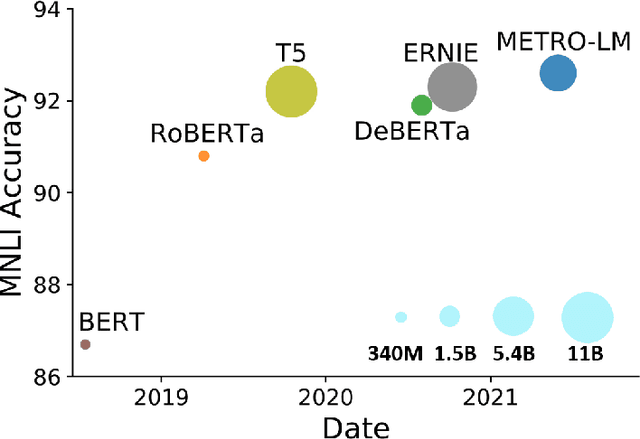
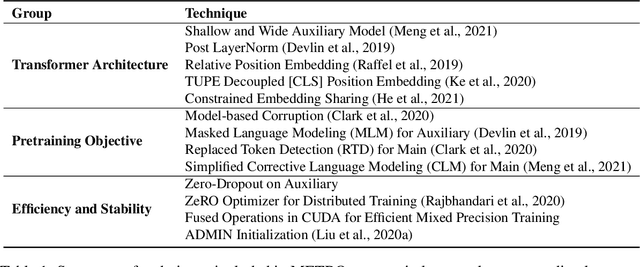
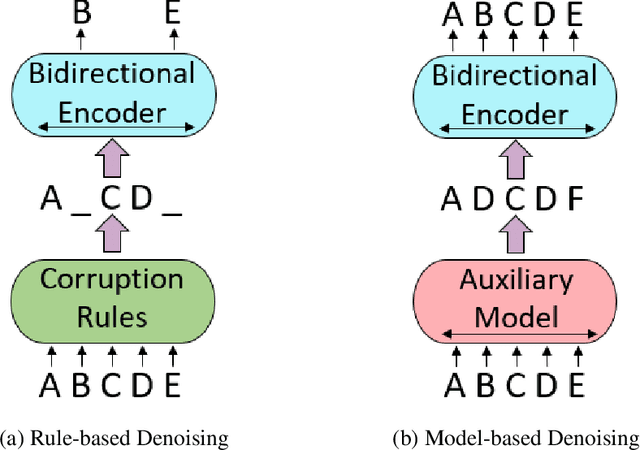
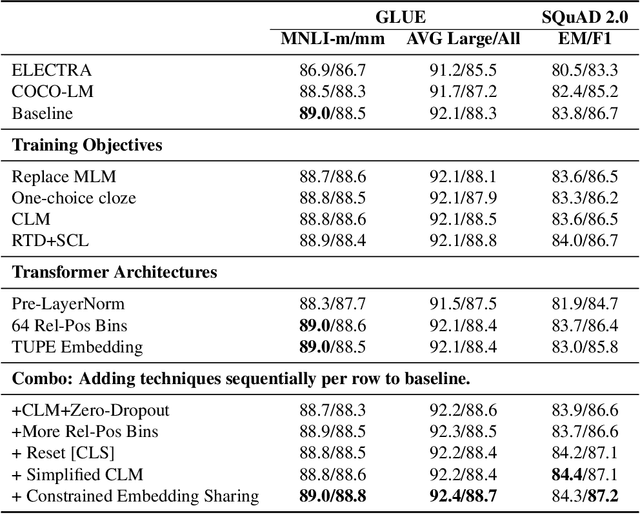
We present an efficient method of pretraining large-scale autoencoding language models using training signals generated by an auxiliary model. Originated in ELECTRA, this training strategy has demonstrated sample-efficiency to pretrain models at the scale of hundreds of millions of parameters. In this work, we conduct a comprehensive empirical study, and propose a recipe, namely "Model generated dEnoising TRaining Objective" (METRO), which incorporates some of the best modeling techniques developed recently to speed up, stabilize, and enhance pretrained language models without compromising model effectiveness. The resultant models, METRO-LM, consisting of up to 5.4 billion parameters, achieve new state-of-the-art on the GLUE, SuperGLUE, and SQuAD benchmarks. More importantly, METRO-LM are efficient in that they often outperform previous large models with significantly smaller model sizes and lower pretraining cost.
Sparsely Activated Mixture-of-Experts are Robust Multi-Task Learners
Apr 16, 2022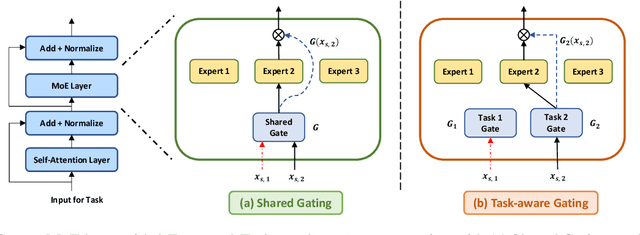
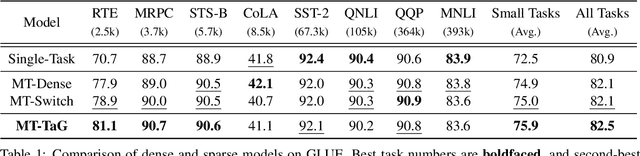
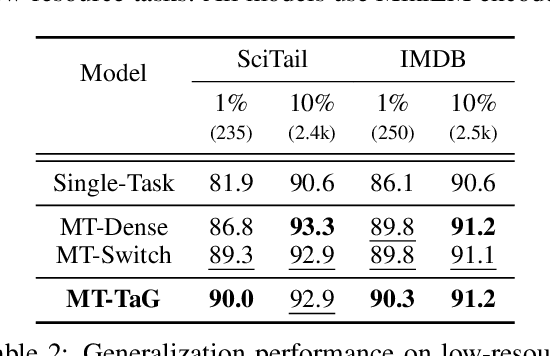
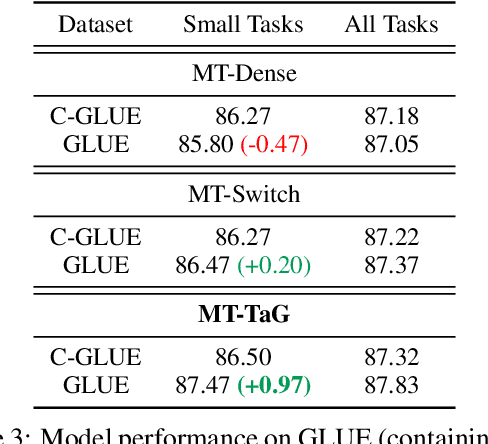
Traditional multi-task learning (MTL) methods use dense networks that use the same set of shared weights across several different tasks. This often creates interference where two or more tasks compete to pull model parameters in different directions. In this work, we study whether sparsely activated Mixture-of-Experts (MoE) improve multi-task learning by specializing some weights for learning shared representations and using the others for learning task-specific information. To this end, we devise task-aware gating functions to route examples from different tasks to specialized experts which share subsets of network weights conditioned on the task. This results in a sparsely activated multi-task model with a large number of parameters, but with the same computational cost as that of a dense model. We demonstrate such sparse networks to improve multi-task learning along three key dimensions: (i) transfer to low-resource tasks from related tasks in the training mixture; (ii) sample-efficient generalization to tasks not seen during training by making use of task-aware routing from seen related tasks; (iii) robustness to the addition of unrelated tasks by avoiding catastrophic forgetting of existing tasks.
Unified Contrastive Learning in Image-Text-Label Space
Apr 07, 2022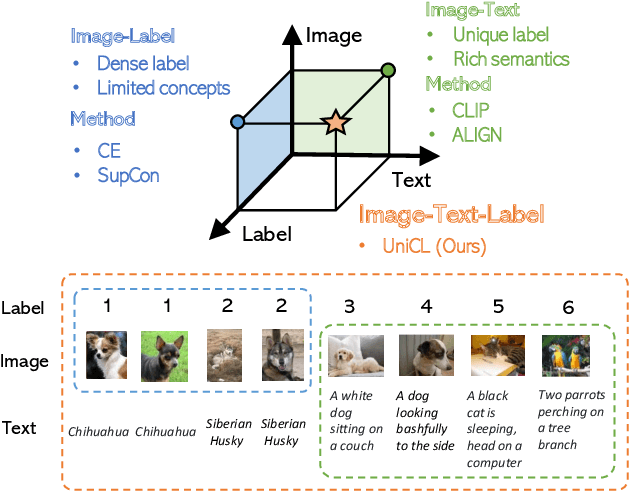
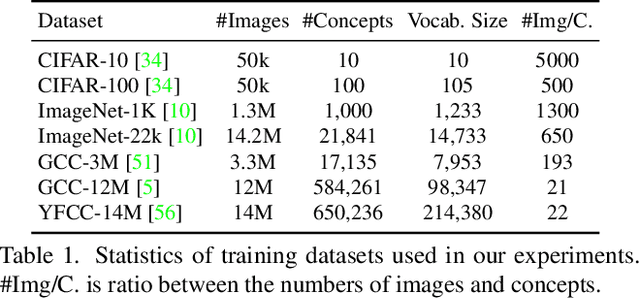
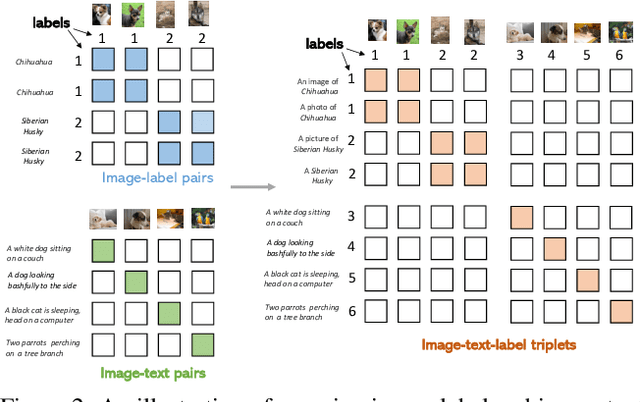

Visual recognition is recently learned via either supervised learning on human-annotated image-label data or language-image contrastive learning with webly-crawled image-text pairs. While supervised learning may result in a more discriminative representation, language-image pretraining shows unprecedented zero-shot recognition capability, largely due to the different properties of data sources and learning objectives. In this work, we introduce a new formulation by combining the two data sources into a common image-text-label space. In this space, we propose a new learning paradigm, called Unified Contrastive Learning (UniCL) with a single learning objective to seamlessly prompt the synergy of two data types. Extensive experiments show that our UniCL is an effective way of learning semantically rich yet discriminative representations, universally for image recognition in zero-shot, linear-probe, fully finetuning and transfer learning scenarios. Particularly, it attains gains up to 9.2% and 14.5% in average on zero-shot recognition benchmarks over the language-image contrastive learning and supervised learning methods, respectively. In linear probe setting, it also boosts the performance over the two methods by 7.3% and 3.4%, respectively. Our study also indicates that UniCL stand-alone is a good learner on pure image-label data, rivaling the supervised learning methods across three image classification datasets and two types of vision backbones, ResNet and Swin Transformer. Code is available at https://github.com/microsoft/UniCL.