 Add to Chrome
 Add to Firefox
 Add to Edge
TimeFound: A Foundation Model for Time Series Forecasting
Mar 06, 2025
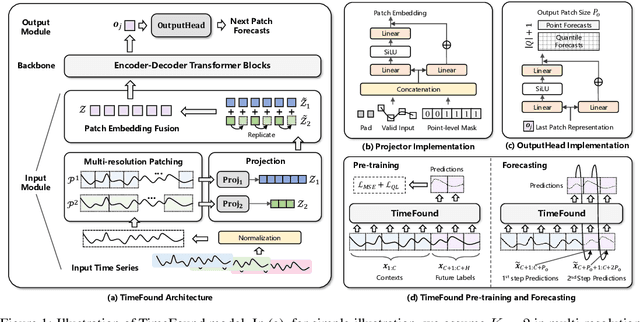
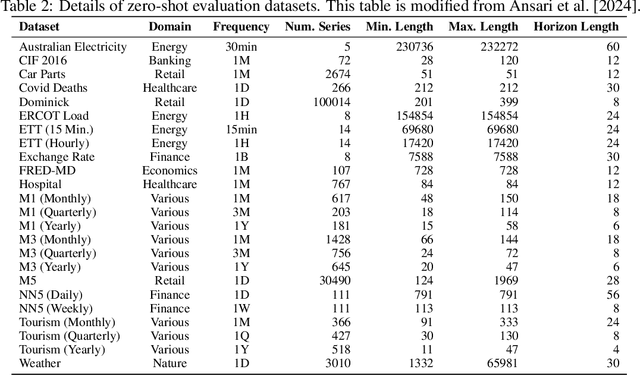
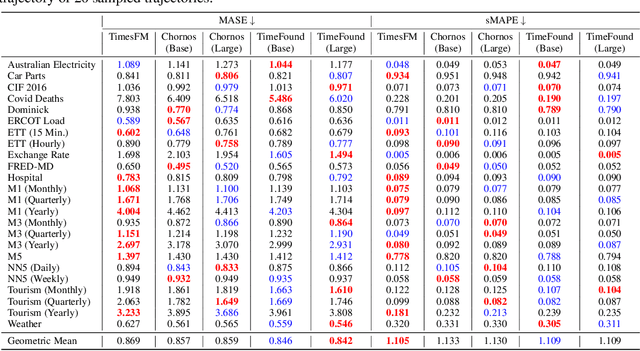
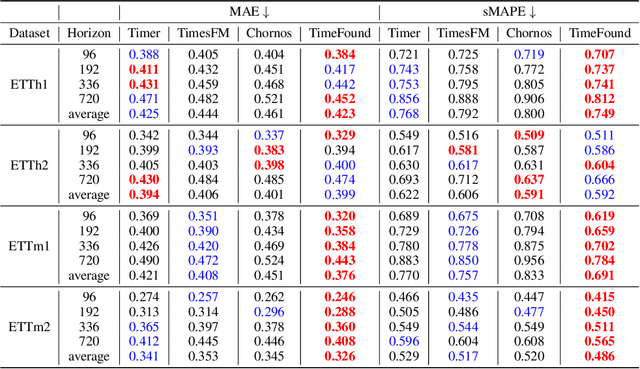
We present TimeFound, an encoder-decoder transformer-based time series foundation model for out-of-the-box zero-shot forecasting. To handle time series data from various domains, TimeFound employs a multi-resolution patching strategy to capture complex temporal patterns at multiple scales. We pre-train our model with two sizes (200M and 710M parameters) on a large time-series corpus comprising both real-world and synthetic datasets. Over a collection of unseen datasets across diverse domains and forecasting horizons, our empirical evaluations suggest that TimeFound can achieve superior or competitive zero-shot forecasting performance, compared to state-of-the-art time series foundation models.

Mark Your LLM: Detecting the Misuse of Open-Source Large Language Models via Watermarking
Mar 06, 2025As open-source large language models (LLMs) like Llama3 become more capable, it is crucial to develop watermarking techniques to detect their potential misuse. Existing watermarking methods either add watermarks during LLM inference, which is unsuitable for open-source LLMs, or primarily target classification LLMs rather than recent generative LLMs. Adapting these watermarks to open-source LLMs for misuse detection remains an open challenge. This work defines two misuse scenarios for open-source LLMs: intellectual property (IP) violation and LLM Usage Violation. Then, we explore the application of inference-time watermark distillation and backdoor watermarking in these contexts. We propose comprehensive evaluation methods to assess the impact of various real-world further fine-tuning scenarios on watermarks and the effect of these watermarks on LLM performance. Our experiments reveal that backdoor watermarking could effectively detect IP Violation, while inference-time watermark distillation is applicable in both scenarios but less robust to further fine-tuning and has a more significant impact on LLM performance compared to backdoor watermarking. Exploring more advanced watermarking methods for open-source LLMs to detect their misuse should be an important future direction.
SePer: Measure Retrieval Utility Through The Lens Of Semantic Perplexity Reduction
Mar 05, 2025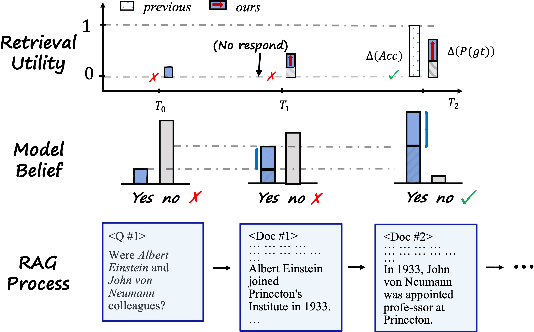
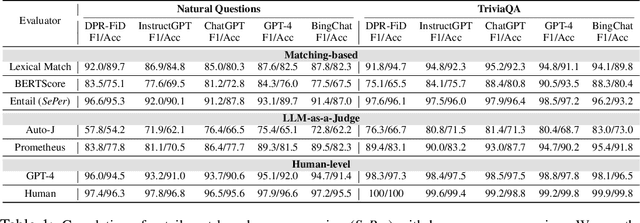
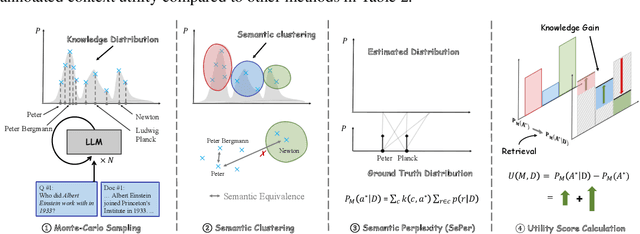
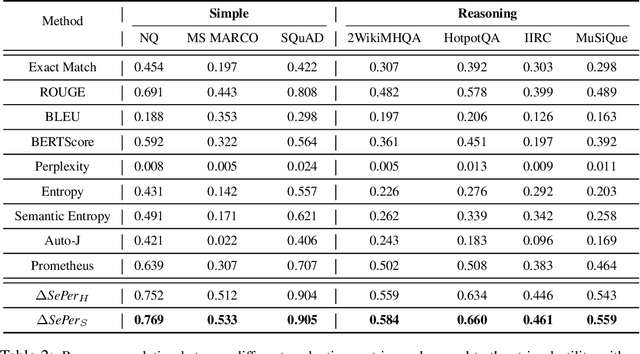
Large Language Models (LLMs) have demonstrated improved generation performance by incorporating externally retrieved knowledge, a process known as retrieval-augmented generation (RAG). Despite the potential of this approach, existing studies evaluate RAG effectiveness by 1) assessing retrieval and generation components jointly, which obscures retrieval's distinct contribution, or 2) examining retrievers using traditional metrics such as NDCG, which creates a gap in understanding retrieval's true utility in the overall generation process. To address the above limitations, in this work, we introduce an automatic evaluation method that measures retrieval quality through the lens of information gain within the RAG framework. Specifically, we propose Semantic Perplexity (SePer), a metric that captures the LLM's internal belief about the correctness of the retrieved information. We quantify the utility of retrieval by the extent to which it reduces semantic perplexity post-retrieval. Extensive experiments demonstrate that SePer not only aligns closely with human preferences but also offers a more precise and efficient evaluation of retrieval utility across diverse RAG scenarios.
Can Large Language Models Help Experimental Design for Causal Discovery?
Mar 04, 2025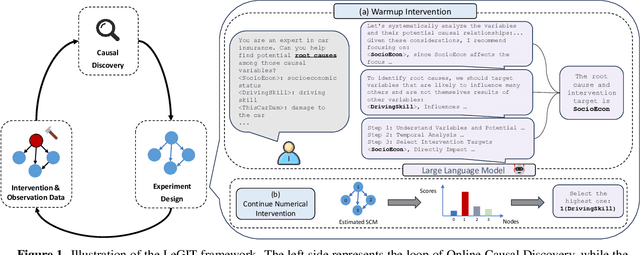
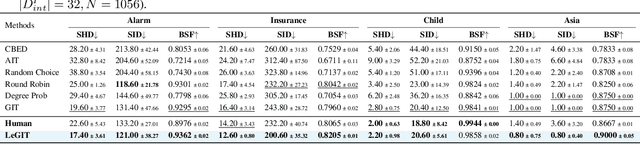
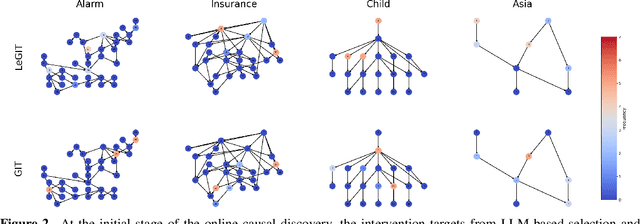
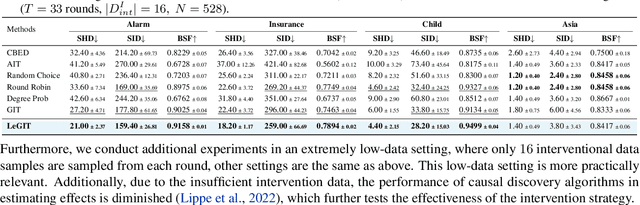
Designing proper experiments and selecting optimal intervention targets is a longstanding problem in scientific or causal discovery. Identifying the underlying causal structure from observational data alone is inherently difficult. Obtaining interventional data, on the other hand, is crucial to causal discovery, yet it is usually expensive and time-consuming to gather sufficient interventional data to facilitate causal discovery. Previous approaches commonly utilize uncertainty or gradient signals to determine the intervention targets. However, numerical-based approaches may yield suboptimal results due to the inaccurate estimation of the guiding signals at the beginning when with limited interventional data. In this work, we investigate a different approach, whether we can leverage Large Language Models (LLMs) to assist with the intervention targeting in causal discovery by making use of the rich world knowledge about the experimental design in LLMs. Specifically, we present Large Language Model Guided Intervention Targeting (LeGIT) -- a robust framework that effectively incorporates LLMs to augment existing numerical approaches for the intervention targeting in causal discovery. Across 4 realistic benchmark scales, LeGIT demonstrates significant improvements and robustness over existing methods and even surpasses humans, which demonstrates the usefulness of LLMs in assisting with experimental design for scientific discovery.
SEE: See Everything Every Time -- Adaptive Brightness Adjustment for Broad Light Range Images via Events
Feb 28, 2025Event cameras, with a high dynamic range exceeding $120dB$, significantly outperform traditional embedded cameras, robustly recording detailed changing information under various lighting conditions, including both low- and high-light situations. However, recent research on utilizing event data has primarily focused on low-light image enhancement, neglecting image enhancement and brightness adjustment across a broader range of lighting conditions, such as normal or high illumination. Based on this, we propose a novel research question: how to employ events to enhance and adaptively adjust the brightness of images captured under broad lighting conditions? To investigate this question, we first collected a new dataset, SEE-600K, consisting of 610,126 images and corresponding events across 202 scenarios, each featuring an average of four lighting conditions with over a 1000-fold variation in illumination. Subsequently, we propose a framework that effectively utilizes events to smoothly adjust image brightness through the use of prompts. Our framework captures color through sensor patterns, uses cross-attention to model events as a brightness dictionary, and adjusts the image's dynamic range to form a broad light-range representation (BLR), which is then decoded at the pixel level based on the brightness prompt. Experimental results demonstrate that our method not only performs well on the low-light enhancement dataset but also shows robust performance on broader light-range image enhancement using the SEE-600K dataset. Additionally, our approach enables pixel-level brightness adjustment, providing flexibility for post-processing and inspiring more imaging applications. The dataset and source code are publicly available at:https://github.com/yunfanLu/SEE.
SCA3D: Enhancing Cross-modal 3D Retrieval via 3D Shape and Caption Paired Data Augmentation
Feb 26, 2025The cross-modal 3D retrieval task aims to achieve mutual matching between text descriptions and 3D shapes. This has the potential to enhance the interaction between natural language and the 3D environment, especially within the realms of robotics and embodied artificial intelligence (AI) applications. However, the scarcity and expensiveness of 3D data constrain the performance of existing cross-modal 3D retrieval methods. These methods heavily rely on features derived from the limited number of 3D shapes, resulting in poor generalization ability across diverse scenarios. To address this challenge, we introduce SCA3D, a novel 3D shape and caption online data augmentation method for cross-modal 3D retrieval. Our approach uses the LLaVA model to create a component library, captioning each segmented part of every 3D shape within the dataset. Notably, it facilitates the generation of extensive new 3D-text pairs containing new semantic features. We employ both inter and intra distances to align various components into a new 3D shape, ensuring that the components do not overlap and are closely fitted. Further, text templates are utilized to process the captions of each component and generate new text descriptions. Besides, we use unimodal encoders to extract embeddings for 3D shapes and texts based on the enriched dataset. We then calculate fine-grained cross-modal similarity using Earth Mover's Distance (EMD) and enhance cross-modal matching with contrastive learning, enabling bidirectional retrieval between texts and 3D shapes. Extensive experiments show our SCA3D outperforms previous works on the Text2Shape dataset, raising the Shape-to-Text RR@1 score from 20.03 to 27.22 and the Text-to-Shape RR@1 score from 13.12 to 16.67. Codes can be found in https://github.com/3DAgentWorld/SCA3D.
A Survey of fMRI to Image Reconstruction
Feb 24, 2025Functional magnetic resonance imaging (fMRI) based image reconstruction plays a pivotal role in decoding human perception, with applications in neuroscience and brain-computer interfaces. While recent advancements in deep learning and large-scale datasets have driven progress, challenges such as data scarcity, cross-subject variability, and low semantic consistency persist. To address these issues, we introduce the concept of fMRI-to-Image Learning (fMRI2Image) and present the first systematic review in this field. This review highlights key challenges, categorizes methodologies such as fMRI signal encoding, feature mapping, and image generator. Finally, promising research directions are proposed to advance this emerging frontier, providing a reference for future studies.
LongFaith: Enhancing Long-Context Reasoning in LLMs with Faithful Synthetic Data
Feb 18, 2025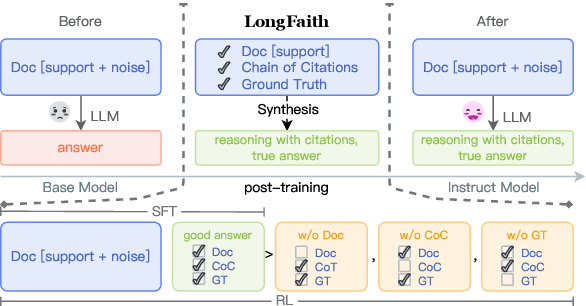
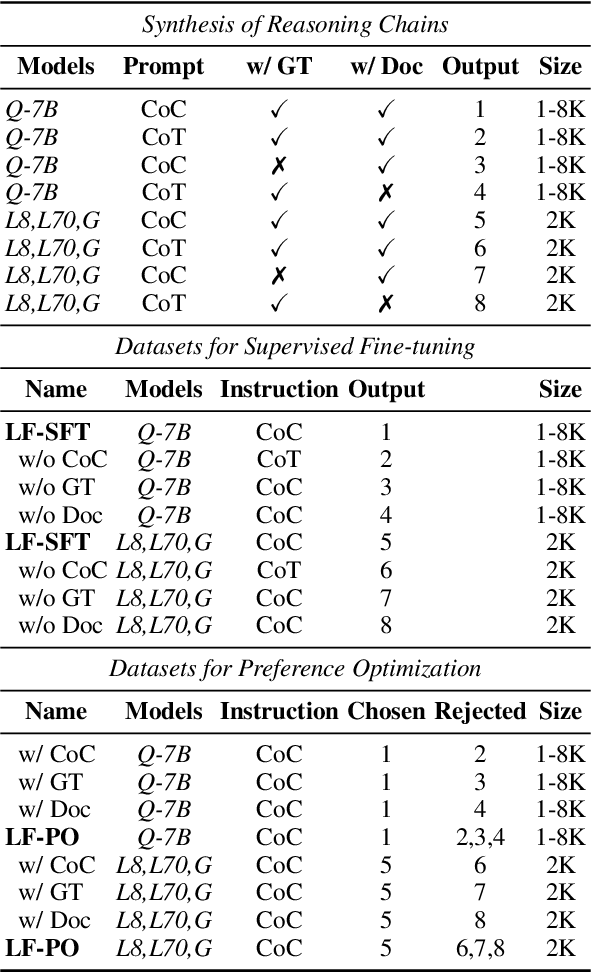
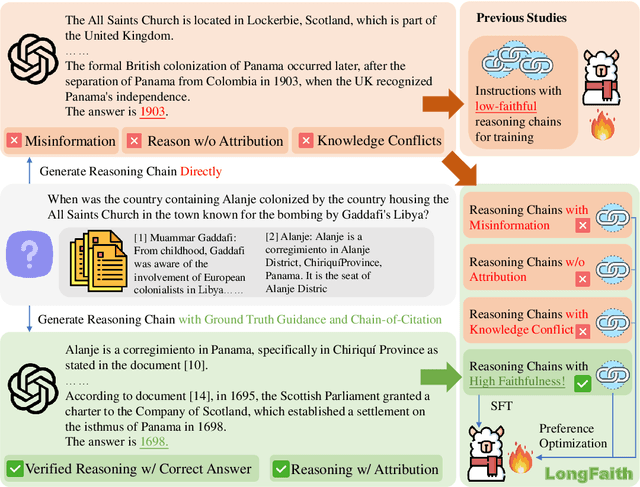
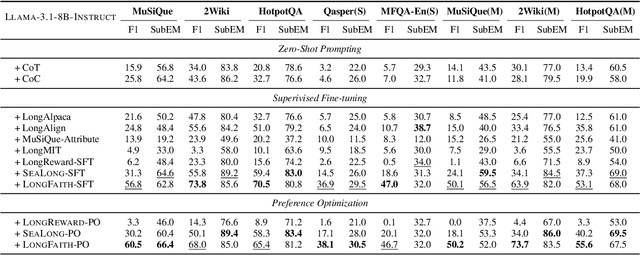
Despite the growing development of long-context large language models (LLMs), data-centric approaches relying on synthetic data have been hindered by issues related to faithfulness, which limit their effectiveness in enhancing model performance on tasks such as long-context reasoning and question answering (QA). These challenges are often exacerbated by misinformation caused by lack of verification, reasoning without attribution, and potential knowledge conflicts. We propose LongFaith, a novel pipeline for synthesizing faithful long-context reasoning instruction datasets. By integrating ground truth and citation-based reasoning prompts, we eliminate distractions and improve the accuracy of reasoning chains, thus mitigating the need for costly verification processes. We open-source two synthesized datasets, LongFaith-SFT and LongFaith-PO, which systematically address multiple dimensions of faithfulness, including verified reasoning, attribution, and contextual grounding. Extensive experiments on multi-hop reasoning datasets and LongBench demonstrate that models fine-tuned on these datasets significantly improve performance. Our ablation studies highlight the scalability and adaptability of the LongFaith pipeline, showcasing its broad applicability in developing long-context LLMs.
Unleashing the Power of Large Language Model for Denoising Recommendation
Feb 13, 2025Recommender systems are crucial for personalizing user experiences but often depend on implicit feedback data, which can be noisy and misleading. Existing denoising studies involve incorporating auxiliary information or learning strategies from interaction data. However, they struggle with the inherent limitations of external knowledge and interaction data, as well as the non-universality of certain predefined assumptions, hindering accurate noise identification. Recently, large language models (LLMs) have gained attention for their extensive world knowledge and reasoning abilities, yet their potential in enhancing denoising in recommendations remains underexplored. In this paper, we introduce LLaRD, a framework leveraging LLMs to improve denoising in recommender systems, thereby boosting overall recommendation performance. Specifically, LLaRD generates denoising-related knowledge by first enriching semantic insights from observational data via LLMs and inferring user-item preference knowledge. It then employs a novel Chain-of-Thought (CoT) technique over user-item interaction graphs to reveal relation knowledge for denoising. Finally, it applies the Information Bottleneck (IB) principle to align LLM-generated denoising knowledge with recommendation targets, filtering out noise and irrelevant LLM knowledge. Empirical results demonstrate LLaRD's effectiveness in enhancing denoising and recommendation accuracy.
GENERator: A Long-Context Generative Genomic Foundation Model
Feb 11, 2025Advancements in DNA sequencing technologies have significantly improved our ability to decode genomic sequences. However, the prediction and interpretation of these sequences remain challenging due to the intricate nature of genetic material. Large language models (LLMs) have introduced new opportunities for biological sequence analysis. Recent developments in genomic language models have underscored the potential of LLMs in deciphering DNA sequences. Nonetheless, existing models often face limitations in robustness and application scope, primarily due to constraints in model structure and training data scale. To address these limitations, we present GENERator, a generative genomic foundation model featuring a context length of 98k base pairs (bp) and 1.2B parameters. Trained on an expansive dataset comprising 386B bp of eukaryotic DNA, the GENERator demonstrates state-of-the-art performance across both established and newly proposed benchmarks. The model adheres to the central dogma of molecular biology, accurately generating protein-coding sequences that translate into proteins structurally analogous to known families. It also shows significant promise in sequence optimization, particularly through the prompt-responsive generation of promoter sequences with specific activity profiles. These capabilities position the GENERator as a pivotal tool for genomic research and biotechnological advancement, enhancing our ability to interpret and predict complex biological systems and enabling precise genomic interventions.