 Add to Chrome
 Add to Firefox
 Add to Edge
Plug-and-Play Fidelity Optimization for Diffusion Transformer Acceleration via Cumulative Error Minimization
Dec 29, 2025
Although Diffusion Transformer (DiT) has emerged as a predominant architecture for image and video generation, its iterative denoising process results in slow inference, which hinders broader applicability and development. Caching-based methods achieve training-free acceleration, while suffering from considerable computational error. Existing methods typically incorporate error correction strategies such as pruning or prediction to mitigate it. However, their fixed caching strategy fails to adapt to the complex error variations during denoising, which limits the full potential of error correction. To tackle this challenge, we propose a novel fidelity-optimization plugin for existing error correction methods via cumulative error minimization, named CEM. CEM predefines the error to characterize the sensitivity of model to acceleration jointly influenced by timesteps and cache intervals. Guided by this prior, we formulate a dynamic programming algorithm with cumulative error approximation for strategy optimization, which achieves the caching error minimization, resulting in a substantial improvement in generation fidelity. CEM is model-agnostic and exhibits strong generalization, which is adaptable to arbitrary acceleration budgets. It can be seamlessly integrated into existing error correction frameworks and quantized models without introducing any additional computational overhead. Extensive experiments conducted on nine generation models and quantized methods across three tasks demonstrate that CEM significantly improves generation fidelity of existing acceleration models, and outperforms the original generation performance on FLUX.1-dev, PixArt-$α$, StableDiffusion1.5 and Hunyuan. The code will be made publicly available.

EDIT: Enhancing Vision Transformers by Mitigating Attention Sink through an Encoder-Decoder Architecture
Apr 09, 2025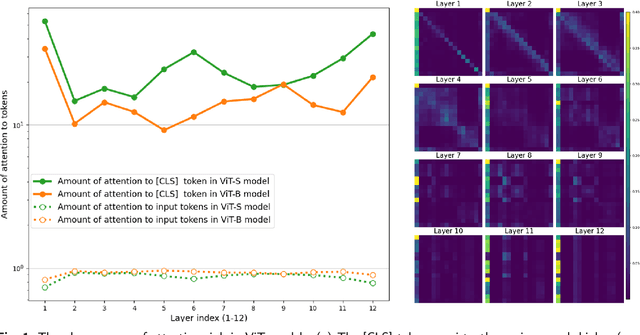
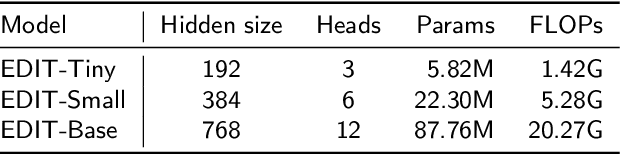
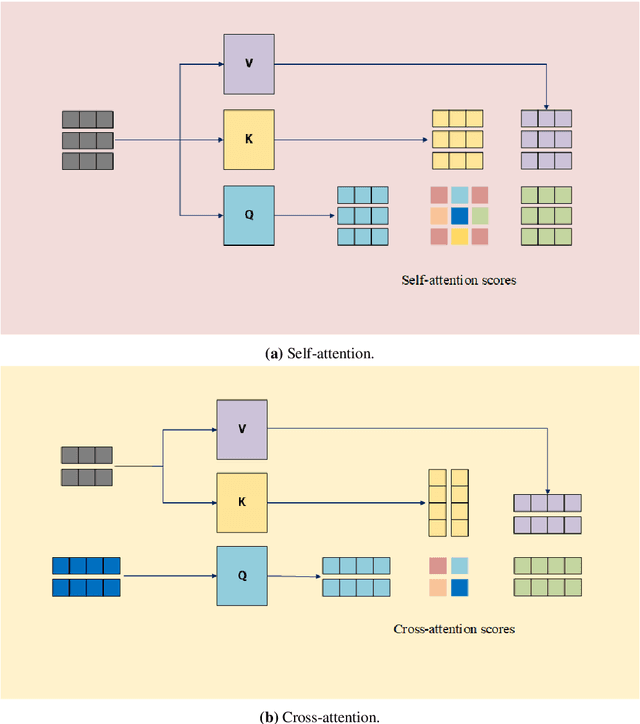
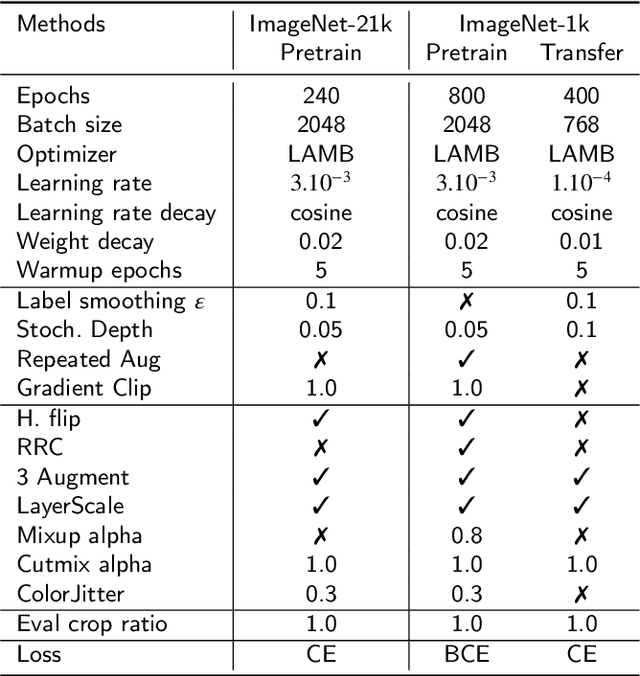
In this paper, we propose EDIT (Encoder-Decoder Image Transformer), a novel architecture designed to mitigate the attention sink phenomenon observed in Vision Transformer models. Attention sink occurs when an excessive amount of attention is allocated to the [CLS] token, distorting the model's ability to effectively process image patches. To address this, we introduce a layer-aligned encoder-decoder architecture, where the encoder utilizes self-attention to process image patches, while the decoder uses cross-attention to focus on the [CLS] token. Unlike traditional encoder-decoder framework, where the decoder depends solely on high-level encoder representations, EDIT allows the decoder to extract information starting from low-level features, progressively refining the representation layer by layer. EDIT is naturally interpretable demonstrated through sequential attention maps, illustrating the refined, layer-by-layer focus on key image features. Experiments on ImageNet-1k and ImageNet-21k, along with transfer learning tasks, show that EDIT achieves consistent performance improvements over DeiT3 models. These results highlight the effectiveness of EDIT's design in addressing attention sink and improving visual feature extraction.
A Survey of fMRI to Image Reconstruction
Feb 24, 2025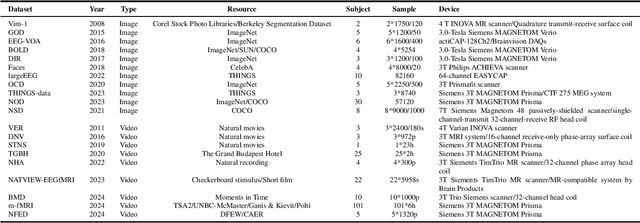
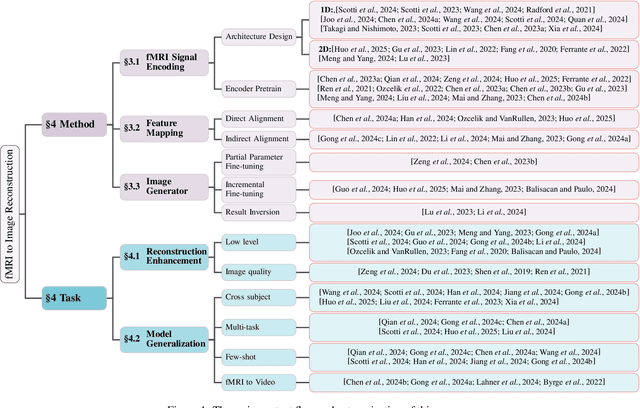
Functional magnetic resonance imaging (fMRI) based image reconstruction plays a pivotal role in decoding human perception, with applications in neuroscience and brain-computer interfaces. While recent advancements in deep learning and large-scale datasets have driven progress, challenges such as data scarcity, cross-subject variability, and low semantic consistency persist. To address these issues, we introduce the concept of fMRI-to-Image Learning (fMRI2Image) and present the first systematic review in this field. This review highlights key challenges, categorizes methodologies such as fMRI signal encoding, feature mapping, and image generator. Finally, promising research directions are proposed to advance this emerging frontier, providing a reference for future studies.