 Add to Chrome
 Add to Firefox
 Add to Edge
Envs-FORGE: Frontier-Optimized Reward-Grounded Environment Synthesis for Agent RL
Aug 14, 2026
Reinforcement learning (RL) for terminal agents needs executable training environments with reliable rewards and useful difficulty. Fixed recipes such as few-shot, Self-Instruct, and Evol-Instruct apply the same prompting policy to every seed, even when the current policy would benefit from a harder, easier, or simply different task. We present Envs-FORGE, a prompting policy that converts verifier rewards into per-seed environment-synthesis actions. Envs-FORGE estimates seed pass rates, scores six projection--direction actions around a target learning frontier, and solves a per-seed mixed-integer linear program (MILP) to choose the action that conditions generation. The selected action drives synchronized rewriting of the instruction, fixtures, oracle solution, tests, and Docker environment; only gold-verified bundles enter RL training. The indexed MILP form also supports optional soft skill coverage for portfolio planning. On Qwen 3.5 35B, Envs-FORGE improves Pass@1 over Base by 9.2 percentage points on tb-core (40.0% to 49.2%) and 6.4 points on tb-2.0 (23.0% to 29.4%), exceeding the strongest fixed-recipe baseline by 2.4 and 2.1 points. It reaches 77.1% on SWE-bench Verified versus 73.4% for Base, and improves tb-core by 6.8--9.2 points across the evaluated 4B--35B models. All synthesis methods export 100 verified environments and use 2.27M--2.88M synthesis tokens, placing the comparison at the same downstream training-set size and the same operational scale. The source code is available at https://github.com/DataArcTech/DataArc-SynData-Toolkit/.

LazyTrain: Limited-resource Allocation toward Zero-waste Yield Optimization in Large Language Model Training
Aug 12, 2026Training large language models on limited hardware is increasingly a scheduling problem across GPU compute, host memory, PCIe transfer, and storage bandwidth. Existing offloading systems reduce GPU residency, and MegaTrain shows that a CPU-master layer-streaming executor can train large models on a single GPU, but fixed checkpointing and placement heuristics still leave communication exposed on the critical path. We propose LazyTrain, an optimization layer over a layer-streaming executor. LazyTrain formulates checkpoint selection, activation placement, recomputation, and CPU-GPU-NVMe communication overlap as a mixed-integer scheduling problem, then executes the solved policy during training. It further couples 8-bit optimizer states with fast gradient clipping as a single Hybrid 8-bit operator: state compression reduces optimizer-state memory, while fast clipping counteracts the additional CPU-side update overhead. Across H800 experiments from Qwen2.5-3B to Qwen3.6-27B, LazyTrain improves sustained TFLOPS over matched baselines runs by approximately 1.24$\times$; RTX 3090 experiments likewise increase the maximum feasible batch size by one at each model scale. In the primary Qwen3.6-27B H800 MetaMathQA run, LazyTrain reaches 219.95 TFLOPS and 1361 tokens/s at batch size 72, peaks at 68.84\,GB of GPU memory, and obtains 95.42\% exact-match accuracy on the full evaluation split. The source code is available at https://github.com/DataArcTech/LazyTrain.
Bayesian-Agent: Posterior-Guided Skill Evolution for LLM Agent Harnesses
Jun 06, 2026LLM agents increasingly rely on external inference conditions: prompts, tools, memory, SOPs, skills, and harness feedback. These assets can improve task execution without changing model weights, but they are often revised by heuristic reflection or by reusing observed successes and failures as if counts alone were reliable belief. We introduce \textbf{Bayesian-Agent}, a native and cross-harness framework that treats reusable skills and SOPs as hypotheses about whether a frozen model will succeed under a particular prompt, context, and harness environment. Bayesian-Agent records verified trajectory evidence, maintains a feature-conditioned categorical posterior over each skill, and maps posterior state into inspectable actions such as patch, split, compress, retire, and explore. Model-facing prompts receive executable guardrails and failure-mode patches, while posterior summaries remain available for audit. With \texttt{deepseek-v4-flash}, incremental repair improves SOP-Bench from 80\% to 95\%, Lifelong AgentBench from 90\% to 100\%, and RealFin-Bench from 45\% to 65\%. We further evaluate Bayesian-Agent's native backend and optional GenericAgent, mini-swe-agent, and Claude Code backends. The results include positive, negative, saturated, and case-study settings, suggesting that agent skill evolution is best viewed as posterior-guided harness optimization rather than uncalibrated prompt accumulation. The source code is available at https://github.com/DataArcTech/Bayesian-Agent.
Conflicts Make Large Reasoning Models Vulnerable to Attacks
Apr 10, 2026Large Reasoning Models (LRMs) have achieved remarkable performance across diverse domains, yet their decision-making under conflicting objectives remains insufficiently understood. This work investigates how LRMs respond to harmful queries when confronted with two categories of conflicts: internal conflicts that pit alignment values against each other and dilemmas, which impose mutually contradictory choices, including sacrificial, duress, agent-centered, and social forms. Using over 1,300 prompts across five benchmarks, we evaluate three representative LRMs - Llama-3.1-Nemotron-8B, QwQ-32B, and DeepSeek R1 - and find that conflicts significantly increase attack success rates, even under single-round non-narrative queries without sophisticated auto-attack techniques. Our findings reveal through layerwise and neuron-level analyses that safety-related and functional representations shift and overlap under conflict, interfering with safety-aligned behavior. This study highlights the need for deeper alignment strategies to ensure the robustness and trustworthiness of next-generation reasoning models. Our code is available at https://github.com/DataArcTech/ConflictHarm. Warning: This paper contains inappropriate, offensive and harmful content.
Towards Knowledgeable Deep Research: Framework and Benchmark
Apr 09, 2026Deep Research (DR) requires LLM agents to autonomously perform multi-step information seeking, processing, and reasoning to generate comprehensive reports. In contrast to existing studies that mainly focus on unstructured web content, a more challenging DR task should additionally utilize structured knowledge to provide a solid data foundation, facilitate quantitative computation, and lead to in-depth analyses. In this paper, we refer to this novel task as Knowledgeable Deep Research (KDR), which requires DR agents to generate reports with both structured and unstructured knowledge. Furthermore, we propose the Hybrid Knowledge Analysis framework (HKA), a multi-agent architecture that reasons over both kinds of knowledge and integrates the texts, figures, and tables into coherent multimodal reports. The key design is the Structured Knowledge Analyzer, which utilizes both coding and vision-language models to produce figures, tables, and corresponding insights. To support systematic evaluation, we construct KDR-Bench, which covers 9 domains, includes 41 expert-level questions, and incorporates a large number of structured knowledge resources (e.g., 1,252 tables). We further annotate the main conclusions and key points for each question and propose three categories of evaluation metrics including general-purpose, knowledge-centric, and vision-enhanced ones. Experimental results demonstrate that HKA consistently outperforms most existing DR agents on general-purpose and knowledge-centric metrics, and even surpasses the Gemini DR agent on vision-enhanced metrics, highlighting its effectiveness in deep, structure-aware knowledge analysis. Finally, we hope this work can serve as a new foundation for structured knowledge analysis in DR agents and facilitate future multimodal DR studies.
Continual Pretraining on Encrypted Synthetic Data for Privacy-Preserving LLMs
Jan 12, 2026Preserving privacy in sensitive data while pretraining large language models on small, domain-specific corpora presents a significant challenge. In this work, we take an exploratory step toward privacy-preserving continual pretraining by proposing an entity-based framework that synthesizes encrypted training data to protect personally identifiable information (PII). Our approach constructs a weighted entity graph to guide data synthesis and applies deterministic encryption to PII entities, enabling LLMs to encode new knowledge through continual pretraining while granting authorized access to sensitive data through decryption keys. Our results on limited-scale datasets demonstrate that our pretrained models outperform base models and ensure PII security, while exhibiting a modest performance gap compared to models trained on unencrypted synthetic data. We further show that increasing the number of entities and leveraging graph-based synthesis improves model performance, and that encrypted models retain instruction-following capabilities with long retrieved contexts. We discuss the security implications and limitations of deterministic encryption, positioning this work as an initial investigation into the design space of encrypted data pretraining for privacy-preserving LLMs. Our code is available at https://github.com/DataArcTech/SoE.
GraphSearch: An Agentic Deep Searching Workflow for Graph Retrieval-Augmented Generation
Sep 26, 2025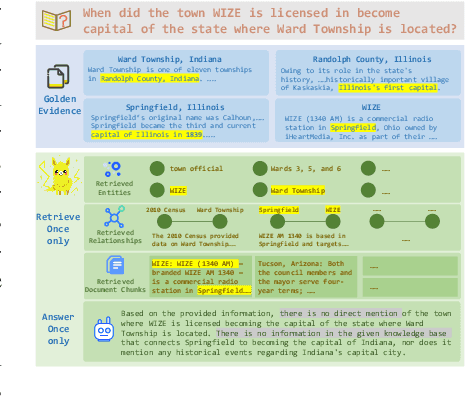
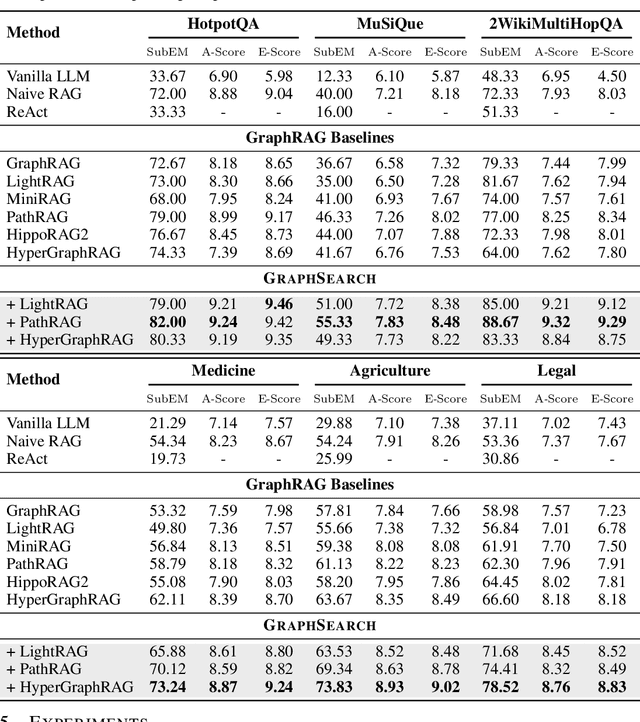

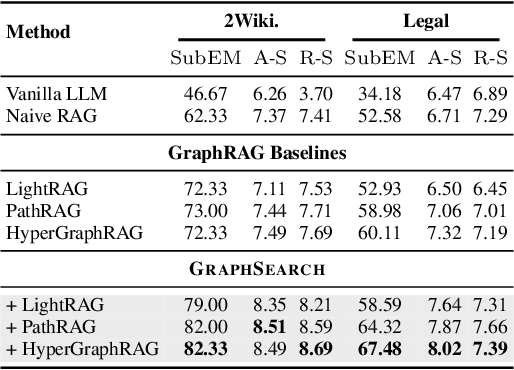
Graph Retrieval-Augmented Generation (GraphRAG) enhances factual reasoning in LLMs by structurally modeling knowledge through graph-based representations. However, existing GraphRAG approaches face two core limitations: shallow retrieval that fails to surface all critical evidence, and inefficient utilization of pre-constructed structural graph data, which hinders effective reasoning from complex queries. To address these challenges, we propose \textsc{GraphSearch}, a novel agentic deep searching workflow with dual-channel retrieval for GraphRAG. \textsc{GraphSearch} organizes the retrieval process into a modular framework comprising six modules, enabling multi-turn interactions and iterative reasoning. Furthermore, \textsc{GraphSearch} adopts a dual-channel retrieval strategy that issues semantic queries over chunk-based text data and relational queries over structural graph data, enabling comprehensive utilization of both modalities and their complementary strengths. Experimental results across six multi-hop RAG benchmarks demonstrate that \textsc{GraphSearch} consistently improves answer accuracy and generation quality over the traditional strategy, confirming \textsc{GraphSearch} as a promising direction for advancing graph retrieval-augmented generation.
KnowCoder-V2: Deep Knowledge Analysis
Jun 07, 2025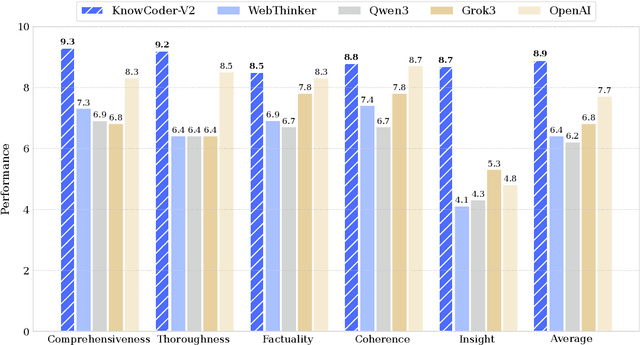
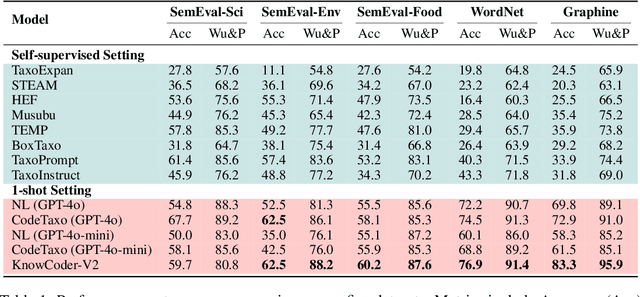
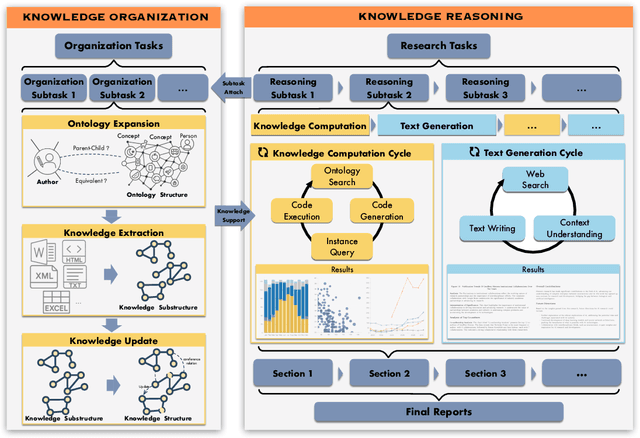
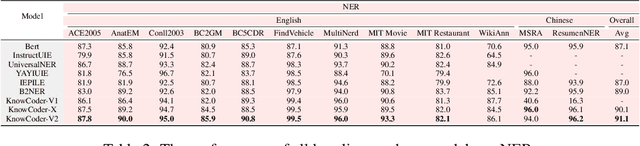
Deep knowledge analysis tasks always involve the systematic extraction and association of knowledge from large volumes of data, followed by logical reasoning to discover insights. However, to solve such complex tasks, existing deep research frameworks face three major challenges: 1) They lack systematic organization and management of knowledge; 2) They operate purely online, making it inefficient for tasks that rely on shared and large-scale knowledge; 3) They cannot perform complex knowledge computation, limiting their abilities to produce insightful analytical results. Motivated by these, in this paper, we propose a \textbf{K}nowledgeable \textbf{D}eep \textbf{R}esearch (\textbf{KDR}) framework that empowers deep research with deep knowledge analysis capability. Specifically, it introduces an independent knowledge organization phase to preprocess large-scale, domain-relevant data into systematic knowledge offline. Based on this knowledge, it extends deep research with an additional kind of reasoning steps that perform complex knowledge computation in an online manner. To enhance the abilities of LLMs to solve knowledge analysis tasks in the above framework, we further introduce \textbf{\KCII}, an LLM that bridges knowledge organization and reasoning via unified code generation. For knowledge organization, it generates instantiation code for predefined classes, transforming data into knowledge objects. For knowledge computation, it generates analysis code and executes on the above knowledge objects to obtain deep analysis results. Experimental results on more than thirty datasets across six knowledge analysis tasks demonstrate the effectiveness of \KCII. Moreover, when integrated into the KDR framework, \KCII can generate high-quality reports with insightful analytical results compared to the mainstream deep research framework.
Select2Reason: Efficient Instruction-Tuning Data Selection for Long-CoT Reasoning
May 22, 2025A practical approach to activate long chain-of-thoughts reasoning ability in pre-trained large language models is to perform supervised fine-tuning on instruction datasets synthesized by strong Large Reasoning Models such as DeepSeek-R1, offering a cost-effective alternative to reinforcement learning. However, large-scale instruction sets with more than 100k samples incur significant training overhead, while effective strategies for automatic long-CoT instruction selection still remain unexplored. In this work, we propose Select2Reason, a novel and efficient instruction-tuning data selection framework for long-CoT reasoning. From the perspective of emergence of rethinking behaviors like self-correction and backtracking, we investigate common metrics that may determine the quality of long-CoT reasoning instructions. Select2Reason leverages a quantifier to estimate difficulty of question and jointly incorporates a reasoning trace length-based heuristic through a weighted scheme for ranking to prioritize high-utility examples. Empirical results on OpenR1-Math-220k demonstrate that fine-tuning LLM on only 10% of the data selected by Select2Reason achieves performance competitive with or superior to full-data tuning and open-source baseline OpenR1-Qwen-7B across three competition-level and six comprehensive mathematical benchmarks. Further experiments highlight the scalability in varying data size, efficiency during inference, and its adaptability to other instruction pools with minimal cost.
Fractal Graph Contrastive Learning
May 16, 2025While Graph Contrastive Learning (GCL) has attracted considerable attention in the field of graph self-supervised learning, its performance heavily relies on data augmentations that are expected to generate semantically consistent positive pairs. Existing strategies typically resort to random perturbations or local structure preservation, yet lack explicit control over global structural consistency between augmented views. To address this limitation, we propose Fractal Graph Contrastive Learning (FractalGCL), a theory-driven framework that leverages fractal self-similarity to enforce global topological coherence. FractalGCL introduces two key innovations: a renormalisation-based augmentation that generates structurally aligned positive views via box coverings; and a fractal-dimension-aware contrastive loss that aligns graph embeddings according to their fractal dimensions. While combining the two innovations markedly boosts graph-representation quality, it also adds non-trivial computational overhead. To mitigate the computational overhead of fractal dimension estimation, we derive a one-shot estimator by proving that the dimension discrepancy between original and renormalised graphs converges weakly to a centred Gaussian distribution. This theoretical insight enables a reduction in dimension computation cost by an order of magnitude, cutting overall training time by approximately 61%. The experiments show that FractalGCL not only delivers state-of-the-art results on standard benchmarks but also outperforms traditional baselines on traffic networks by an average margin of about remarkably 7%. Codes are available at (https://anonymous.4open.science/r/FractalGCL-0511).