 Add to Chrome
 Add to Firefox
 Add to Edge
Training LLMs with LogicReward for Faithful and Rigorous Reasoning
Dec 20, 2025
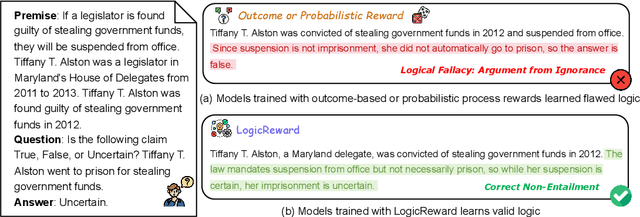
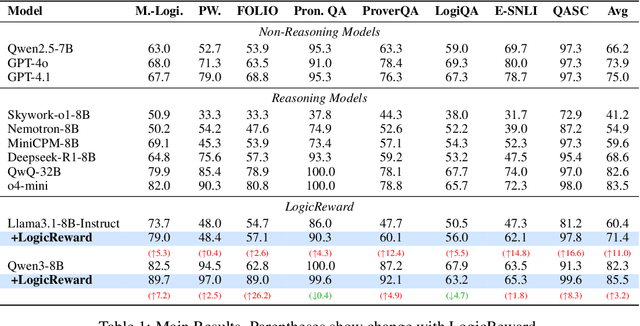
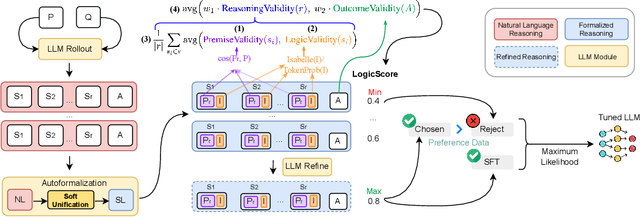

Although LLMs exhibit strong reasoning capabilities, existing training methods largely depend on outcome-based feedback, which can produce correct answers with flawed reasoning. Prior work introduces supervision on intermediate steps but still lacks guarantees of logical soundness, which is crucial in high-stakes scenarios where logical consistency is paramount. To address this, we propose LogicReward, a novel reward system that guides model training by enforcing step-level logical correctness with a theorem prover. We further introduce Autoformalization with Soft Unification, which reduces natural language ambiguity and improves formalization quality, enabling more effective use of the theorem prover. An 8B model trained on data constructed with LogicReward surpasses GPT-4o and o4-mini by 11.6\% and 2\% on natural language inference and logical reasoning tasks with simple training procedures. Further analysis shows that LogicReward enhances reasoning faithfulness, improves generalizability to unseen tasks such as math and commonsense reasoning, and provides a reliable reward signal even without ground-truth labels. We will release all data and code at https://llm-symbol.github.io/LogicReward.

UniVA: Universal Video Agent towards Open-Source Next-Generation Video Generalist
Nov 11, 2025While specialized AI models excel at isolated video tasks like generation or understanding, real-world applications demand complex, iterative workflows that combine these capabilities. To bridge this gap, we introduce UniVA, an open-source, omni-capable multi-agent framework for next-generation video generalists that unifies video understanding, segmentation, editing, and generation into cohesive workflows. UniVA employs a Plan-and-Act dual-agent architecture that drives a highly automated and proactive workflow: a planner agent interprets user intentions and decomposes them into structured video-processing steps, while executor agents execute these through modular, MCP-based tool servers (for analysis, generation, editing, tracking, etc.). Through a hierarchical multi-level memory (global knowledge, task context, and user-specific preferences), UniVA sustains long-horizon reasoning, contextual continuity, and inter-agent communication, enabling interactive and self-reflective video creation with full traceability. This design enables iterative and any-conditioned video workflows (e.g., text/image/video-conditioned generation $\rightarrow$ multi-round editing $\rightarrow$ object segmentation $\rightarrow$ compositional synthesis) that were previously cumbersome to achieve with single-purpose models or monolithic video-language models. We also introduce UniVA-Bench, a benchmark suite of multi-step video tasks spanning understanding, editing, segmentation, and generation, to rigorously evaluate such agentic video systems. Both UniVA and UniVA-Bench are fully open-sourced, aiming to catalyze research on interactive, agentic, and general-purpose video intelligence for the next generation of multimodal AI systems. (https://univa.online/)
MCM-DPO: Multifaceted Cross-Modal Direct Preference Optimization for Alt-text Generation
Oct 01, 2025The alt-text generation task produces concise, context-relevant descriptions of images, enabling blind and low-vision users to access online images. Despite the capabilities of large vision-language models, alt-text generation performance remains limited due to noisy user annotations, inconsistent standards, and MLLMs' insensitivity to contextual information. Previous efforts to fine-tune MLLMs using supervised fine-tuning (SFT) have struggled, as SFT relies on accurate target annotations, which are often flawed in user-generated alt-text. To address this, we propose Multi-faceted Cross-modal Direct Preference Optimization (MCM-DPO), which improves alt-text generation by learning to identify better options in preference pairs without requiring precise annotations. MCM-DPO optimizes preferences across single, paired, and multi-preference dimensions, covering textual, visual, and cross-modal factors. In light of the scarcity of high-quality annotated and preference-labeled datasets for alt-text, we constructed two large-scale, high-quality datasets named TAlt and PAlt, sourced from Twitter and Pinterest. These datasets include 202k annotated alt-text samples and 18k preference pairs that cover diverse preference dimensions, aiming to support further research in this domain. Experimental results show that our proposed MCM-DPO method consistently outperforms both DPO and SFT, establishing a new state of the art in alt-text generation. We release the code and data here: https://github.com/LVUGAI/MCM-DPO
Enhancing Hyperbole and Metaphor Detection with Their Bidirectional Dynamic Interaction and Emotion Knowledge
Jun 18, 2025Text-based hyperbole and metaphor detection are of great significance for natural language processing (NLP) tasks. However, due to their semantic obscurity and expressive diversity, it is rather challenging to identify them. Existing methods mostly focus on superficial text features, ignoring the associations of hyperbole and metaphor as well as the effect of implicit emotion on perceiving these rhetorical devices. To implement these hypotheses, we propose an emotion-guided hyperbole and metaphor detection framework based on bidirectional dynamic interaction (EmoBi). Firstly, the emotion analysis module deeply mines the emotion connotations behind hyperbole and metaphor. Next, the emotion-based domain mapping module identifies the target and source domains to gain a deeper understanding of the implicit meanings of hyperbole and metaphor. Finally, the bidirectional dynamic interaction module enables the mutual promotion between hyperbole and metaphor. Meanwhile, a verification mechanism is designed to ensure detection accuracy and reliability. Experiments show that EmoBi outperforms all baseline methods on four datasets. Specifically, compared to the current SoTA, the F1 score increased by 28.1% for hyperbole detection on the TroFi dataset and 23.1% for metaphor detection on the HYPO-L dataset. These results, underpinned by in-depth analyses, underscore the effectiveness and potential of our approach for advancing hyperbole and metaphor detection.
Uncertainty-o: One Model-agnostic Framework for Unveiling Uncertainty in Large Multimodal Models
Jun 09, 2025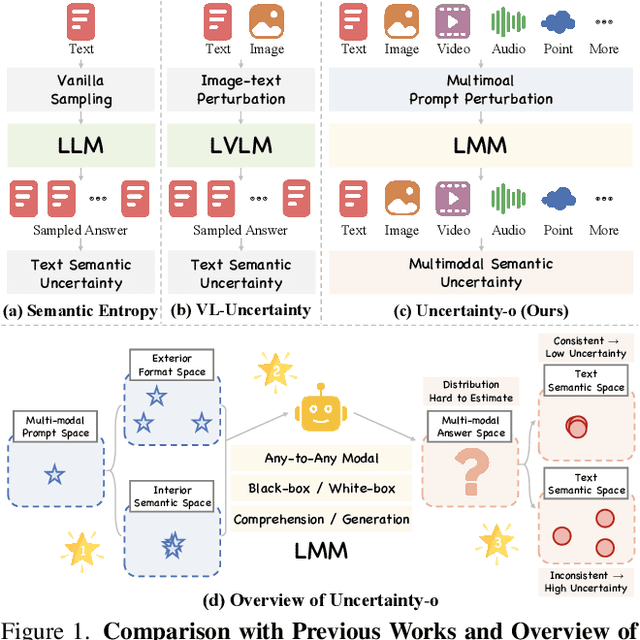
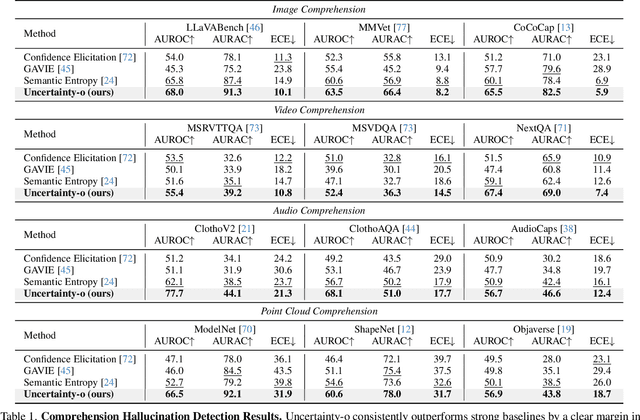
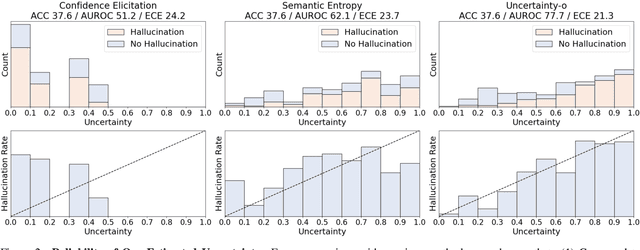
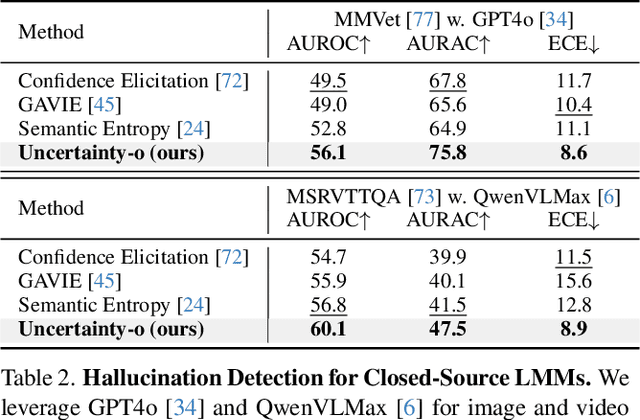
Large Multimodal Models (LMMs), harnessing the complementarity among diverse modalities, are often considered more robust than pure Language Large Models (LLMs); yet do LMMs know what they do not know? There are three key open questions remaining: (1) how to evaluate the uncertainty of diverse LMMs in a unified manner, (2) how to prompt LMMs to show its uncertainty, and (3) how to quantify uncertainty for downstream tasks. In an attempt to address these challenges, we introduce Uncertainty-o: (1) a model-agnostic framework designed to reveal uncertainty in LMMs regardless of their modalities, architectures, or capabilities, (2) an empirical exploration of multimodal prompt perturbations to uncover LMM uncertainty, offering insights and findings, and (3) derive the formulation of multimodal semantic uncertainty, which enables quantifying uncertainty from multimodal responses. Experiments across 18 benchmarks spanning various modalities and 10 LMMs (both open- and closed-source) demonstrate the effectiveness of Uncertainty-o in reliably estimating LMM uncertainty, thereby enhancing downstream tasks such as hallucination detection, hallucination mitigation, and uncertainty-aware Chain-of-Thought reasoning.
DragNeXt: Rethinking Drag-Based Image Editing
Jun 09, 2025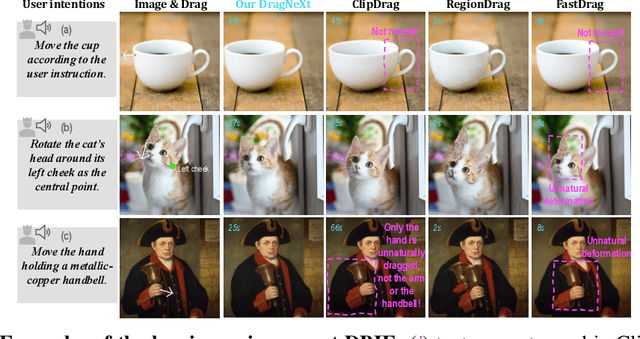
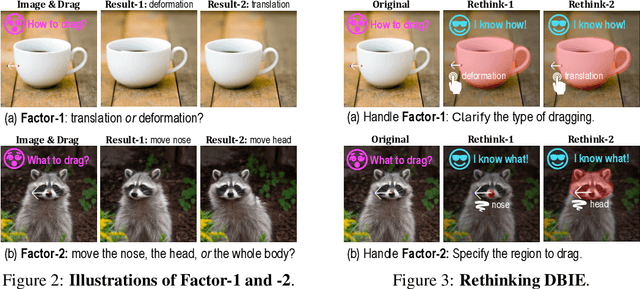
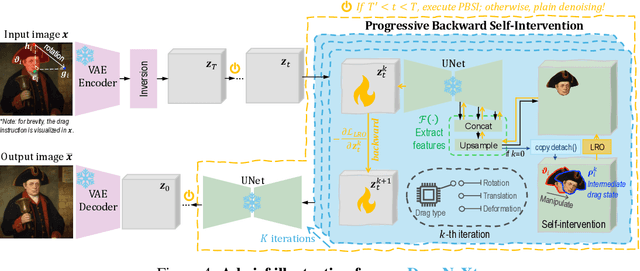
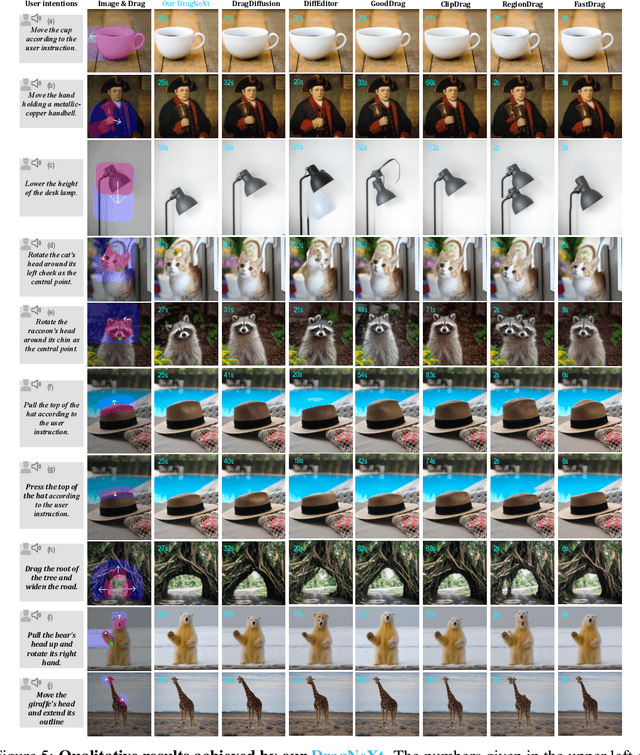
Drag-Based Image Editing (DBIE), which allows users to manipulate images by directly dragging objects within them, has recently attracted much attention from the community. However, it faces two key challenges: (\emph{\textcolor{magenta}{i}}) point-based drag is often highly ambiguous and difficult to align with users' intentions; (\emph{\textcolor{magenta}{ii}}) current DBIE methods primarily rely on alternating between motion supervision and point tracking, which is not only cumbersome but also fails to produce high-quality results. These limitations motivate us to explore DBIE from a new perspective -- redefining it as deformation, rotation, and translation of user-specified handle regions. Thereby, by requiring users to explicitly specify both drag areas and types, we can effectively address the ambiguity issue. Furthermore, we propose a simple-yet-effective editing framework, dubbed \textcolor{SkyBlue}{\textbf{DragNeXt}}. It unifies DBIE as a Latent Region Optimization (LRO) problem and solves it through Progressive Backward Self-Intervention (PBSI), simplifying the overall procedure of DBIE while further enhancing quality by fully leveraging region-level structure information and progressive guidance from intermediate drag states. We validate \textcolor{SkyBlue}{\textbf{DragNeXt}} on our NextBench, and extensive experiments demonstrate that our proposed method can significantly outperform existing approaches. Code will be released on github.
On the Adaptive Psychological Persuasion of Large Language Models
Jun 07, 2025Previous work has showcased the intriguing capabilities of Large Language Models (LLMs) in instruction-following and rhetorical fluency. However, systematic exploration of their dual capabilities to autonomously persuade and resist persuasion, particularly in contexts involving psychological rhetoric, remains unexplored. In this paper, we first evaluate four commonly adopted LLMs by tasking them to alternately act as persuaders and listeners in adversarial dialogues. Empirical results show that persuader LLMs predominantly employ repetitive strategies, leading to low success rates. Then we introduce eleven comprehensive psychological persuasion strategies, finding that explicitly instructing LLMs to adopt specific strategies such as Fluency Effect and Repetition Effect significantly improves persuasion success rates. However, no ``one-size-fits-all'' strategy proves universally effective, with performance heavily dependent on contextual counterfactuals. Motivated by these observations, we propose an adaptive framework based on direct preference optimization that trains LLMs to autonomously select optimal strategies by leveraging persuasion results from strategy-specific responses as preference pairs. Experiments on three open-source LLMs confirm that the proposed adaptive psychological persuasion method effectively enables persuader LLMs to select optimal strategies, significantly enhancing their success rates while maintaining general capabilities. Our code is available at https://github.com/KalinaEine/PsychologicalPersuasion.
Mixed-R1: Unified Reward Perspective For Reasoning Capability in Multimodal Large Language Models
May 30, 2025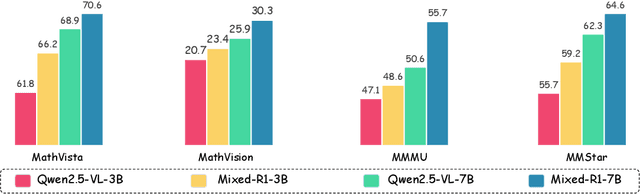
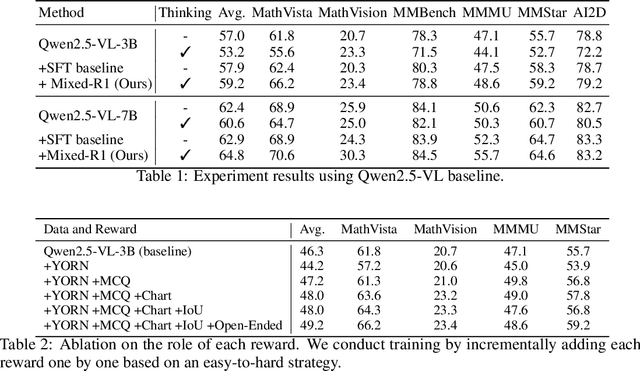
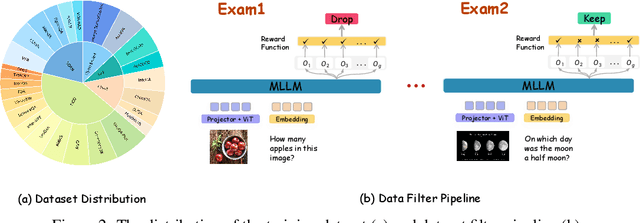

Recent works on large language models (LLMs) have successfully demonstrated the emergence of reasoning capabilities via reinforcement learning (RL). Although recent efforts leverage group relative policy optimization (GRPO) for MLLMs post-training, they constantly explore one specific aspect, such as grounding tasks, math problems, or chart analysis. There are no works that can leverage multi-source MLLM tasks for stable reinforcement learning. In this work, we present a unified perspective to solve this problem. We present Mixed-R1, a unified yet straightforward framework that contains a mixed reward function design (Mixed-Reward) and a mixed post-training dataset (Mixed-45K). We first design a data engine to select high-quality examples to build the Mixed-45K post-training dataset. Then, we present a Mixed-Reward design, which contains various reward functions for various MLLM tasks. In particular, it has four different reward functions: matching reward for binary answer or multiple-choice problems, chart reward for chart-aware datasets, IoU reward for grounding problems, and open-ended reward for long-form text responses such as caption datasets. To handle the various long-form text content, we propose a new open-ended reward named Bidirectional Max-Average Similarity (BMAS) by leveraging tokenizer embedding matching between the generated response and the ground truth. Extensive experiments show the effectiveness of our proposed method on various MLLMs, including Qwen2.5-VL and Intern-VL on various sizes. Our dataset and model are available at https://github.com/xushilin1/mixed-r1.
SMAP: Self-supervised Motion Adaptation for Physically Plausible Humanoid Whole-body Control
May 26, 2025This paper presents a novel framework that enables real-world humanoid robots to maintain stability while performing human-like motion. Current methods train a policy which allows humanoid robots to follow human body using the massive retargeted human data via reinforcement learning. However, due to the heterogeneity between human and humanoid robot motion, directly using retargeted human motion reduces training efficiency and stability. To this end, we introduce SMAP, a novel whole-body tracking framework that bridges the gap between human and humanoid action spaces, enabling accurate motion mimicry by humanoid robots. The core idea is to use a vector-quantized periodic autoencoder to capture generic atomic behaviors and adapt human motion into physically plausible humanoid motion. This adaptation accelerates training convergence and improves stability when handling novel or challenging motions. We then employ a privileged teacher to distill precise mimicry skills into the student policy with a proposed decoupled reward. We conduct experiments in simulation and real world to demonstrate the superiority stability and performance of SMAP over SOTA methods, offering practical guidelines for advancing whole-body control in humanoid robots.
CCHall: A Novel Benchmark for Joint Cross-Lingual and Cross-Modal Hallucinations Detection in Large Language Models
May 25, 2025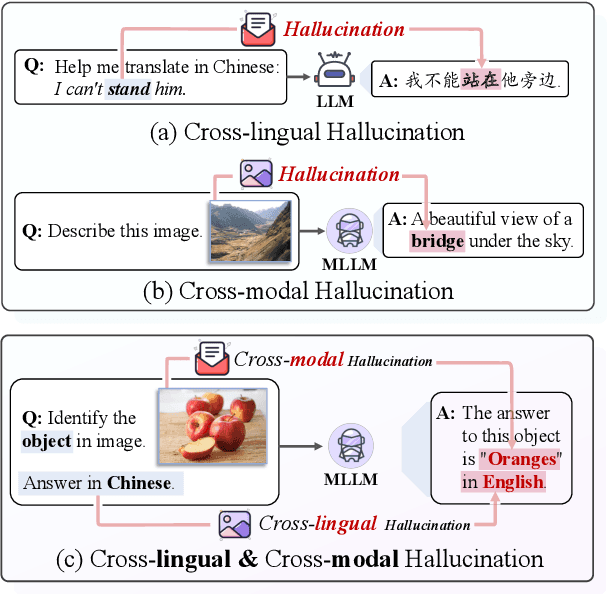
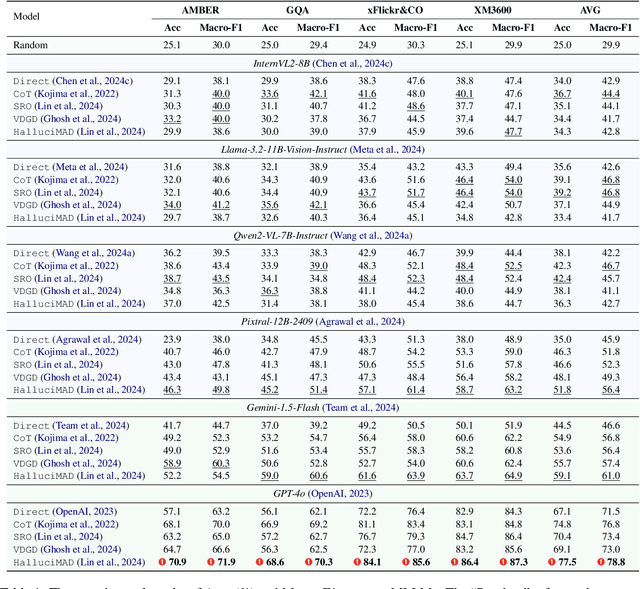
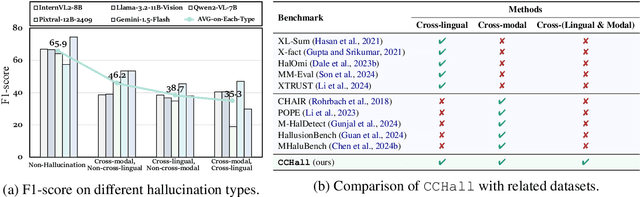
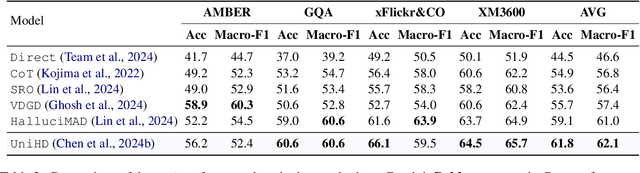
Investigating hallucination issues in large language models (LLMs) within cross-lingual and cross-modal scenarios can greatly advance the large-scale deployment in real-world applications. Nevertheless, the current studies are limited to a single scenario, either cross-lingual or cross-modal, leaving a gap in the exploration of hallucinations in the joint cross-lingual and cross-modal scenarios. Motivated by this, we introduce a novel joint Cross-lingual and Cross-modal Hallucinations benchmark (CCHall) to fill this gap. Specifically, CCHall simultaneously incorporates both cross-lingual and cross-modal hallucination scenarios, which can be used to assess the cross-lingual and cross-modal capabilities of LLMs. Furthermore, we conduct a comprehensive evaluation on CCHall, exploring both mainstream open-source and closed-source LLMs. The experimental results highlight that current LLMs still struggle with CCHall. We hope CCHall can serve as a valuable resource to assess LLMs in joint cross-lingual and cross-modal scenarios.