 Add to Chrome
 Add to Firefox
 Add to Edge
HOLMES: Evaluating Higher-Order Logical Reasoning in LLMs
Jun 23, 2026
Logical reasoning is essential for reliable AI, yet existing benchmarks are largely first-order-logic-centric, focusing on object-level deduction over fixed predicates. This misses many realistic scenarios where models must reason over rules, predicates, functions, constraints, and decision procedures themselves. We introduce HOLMES (Higher-Order Logic Meets real-world Explainable Symbolic reasoning), the first real-world benchmark for higher-order symbolic reasoning in LLMs, containing 1379 instances. Built on higher-order logic, HOLMES pairs natural-language problems with HOL formalizations, ground-truth answers, verifiable reasoning traces, and fine-grained controllable reasoning factors across law and finance. Experiments show that current LLMs still struggle on HOLMES, with an average accuracy of only 50.64% and the best model reaching 59.54%. Our analyses further reveal that high final-answer accuracy can mask shortcut reasoning in conflict-resolution settings, while performance drops sharply under scope-conditioned and compositional reasoning. These findings identify higher-order symbolic reasoning as a key bottleneck for building reliable and verifiable LLMs. The project code and dataset are publicly available at https://github.com/wuyucheng2002/HOLMES.

EvoArena: Tracking Memory Evolution for Robust LLM Agents in Dynamic Environments
Jun 11, 2026Large language model (LLM) agents have achieved strong performance on a wide range of benchmarks, yet most evaluations assume static environments. In contrast, real-world deployment is inherently dynamic, requiring agents to continually align their knowledge, skills, and behavior with changing environments and updated task conditions. To address this gap, we introduce EvoArena, a benchmark suite that models environment changes as sequences of progressive updates across terminal, software, and social domains. We further propose EvoMem, a patch-based memory paradigm that records memory evolution as structured update histories, enabling agents to reason about environmental evolution through changes in their memory. Experiments show that current agents struggle on EvoArena, achieving an average accuracy of 39.6% across evolving terminal, software, and social-preference domains. EvoMem consistently improves performance, yielding an average gain of 1.5% on EvoArena and also improving standard benchmarks such as GAIA and LoCoMo by 6.1% and 4.8%. Beyond individual tasks, EvoMem further improves chain-level accuracy by 3.7% on EvoArena, where success requires completing a consecutive sequence of related evolutionary subtasks. Mechanistic analysis shows that EvoMem improves evidence capture in the memory, indicating better preservation of complete evolving environment states. Our results highlight the importance of modeling evolution in both evaluation and memory for reliable agent deployment.
Training LLMs with LogicReward for Faithful and Rigorous Reasoning
Dec 20, 2025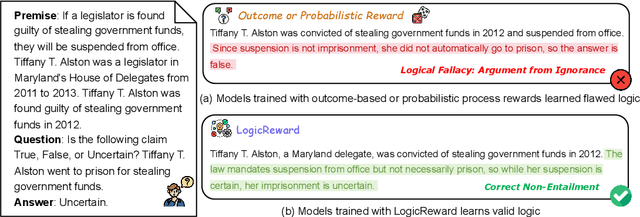
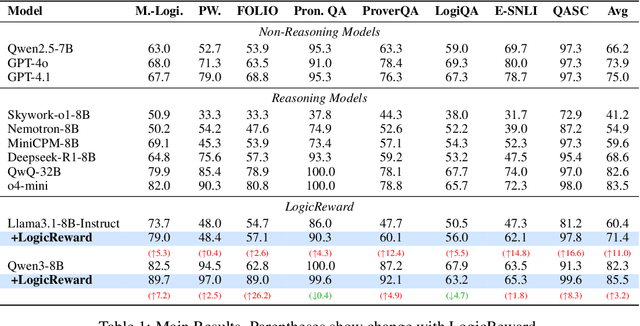
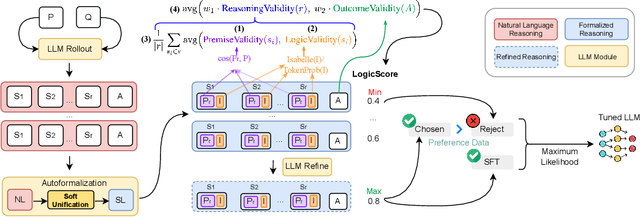

Although LLMs exhibit strong reasoning capabilities, existing training methods largely depend on outcome-based feedback, which can produce correct answers with flawed reasoning. Prior work introduces supervision on intermediate steps but still lacks guarantees of logical soundness, which is crucial in high-stakes scenarios where logical consistency is paramount. To address this, we propose LogicReward, a novel reward system that guides model training by enforcing step-level logical correctness with a theorem prover. We further introduce Autoformalization with Soft Unification, which reduces natural language ambiguity and improves formalization quality, enabling more effective use of the theorem prover. An 8B model trained on data constructed with LogicReward surpasses GPT-4o and o4-mini by 11.6\% and 2\% on natural language inference and logical reasoning tasks with simple training procedures. Further analysis shows that LogicReward enhances reasoning faithfulness, improves generalizability to unseen tasks such as math and commonsense reasoning, and provides a reliable reward signal even without ground-truth labels. We will release all data and code at https://llm-symbol.github.io/LogicReward.
Aristotle: Mastering Logical Reasoning with A Logic-Complete Decompose-Search-Resolve Framework
Dec 22, 2024In the context of large language models (LLMs), current advanced reasoning methods have made impressive strides in various reasoning tasks. However, when it comes to logical reasoning tasks, major challenges remain in both efficacy and efficiency. This is rooted in the fact that these systems fail to fully leverage the inherent structure of logical tasks throughout the reasoning processes such as decomposition, search, and resolution. To address this, we propose a logic-complete reasoning framework, Aristotle, with three key components: Logical Decomposer, Logical Search Router, and Logical Resolver. In our framework, symbolic expressions and logical rules are comprehensively integrated into the entire reasoning process, significantly alleviating the bottlenecks of logical reasoning, i.e., reducing sub-task complexity, minimizing search errors, and resolving logical contradictions. The experimental results on several datasets demonstrate that Aristotle consistently outperforms state-of-the-art reasoning frameworks in both accuracy and efficiency, particularly excelling in complex logical reasoning scenarios. We will open-source all our code at https://github.com/Aiden0526/Aristotle.
Faithful Logical Reasoning via Symbolic Chain-of-Thought
May 28, 2024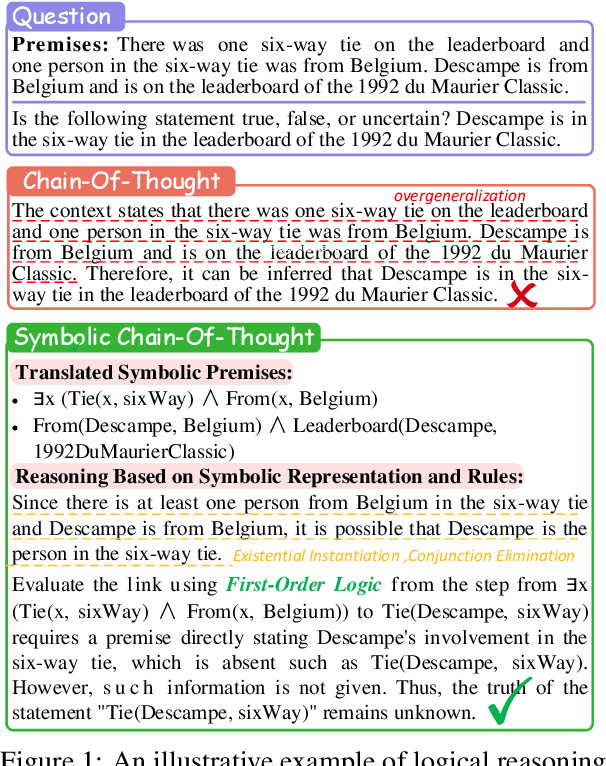
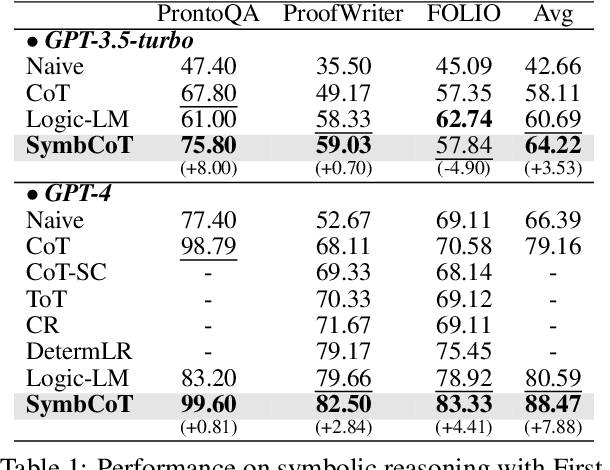
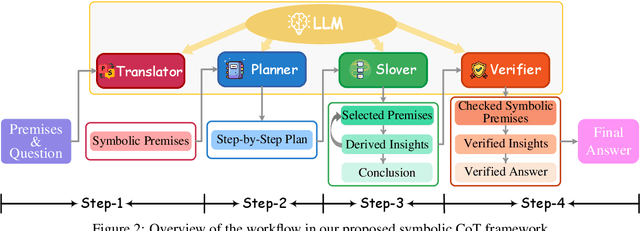
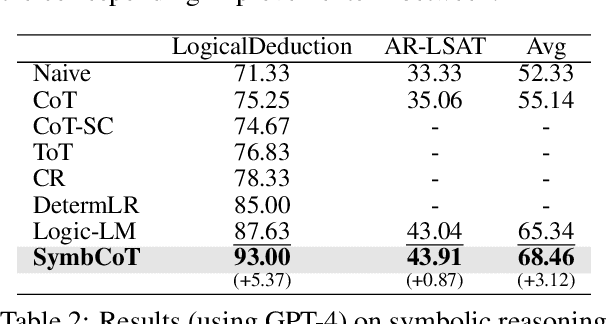
While the recent Chain-of-Thought (CoT) technique enhances the reasoning ability of large language models (LLMs) with the theory of mind, it might still struggle in handling logical reasoning that relies much on symbolic expressions and rigid deducing rules. To strengthen the logical reasoning capability of LLMs, we propose a novel Symbolic Chain-of-Thought, namely SymbCoT, a fully LLM-based framework that integrates symbolic expressions and logic rules with CoT prompting. Technically, building upon an LLM, SymbCoT 1) first translates the natural language context into the symbolic format, and then 2) derives a step-by-step plan to solve the problem with symbolic logical rules, 3) followed by a verifier to check the translation and reasoning chain. Via thorough evaluations on 5 standard datasets with both First-Order Logic and Constraint Optimization symbolic expressions, SymbCoT shows striking improvements over the CoT method consistently, meanwhile refreshing the current state-of-the-art performances. We further demonstrate that our system advances in more faithful, flexible, and explainable logical reasoning. To our knowledge, this is the first to combine symbolic expressions and rules into CoT for logical reasoning with LLMs. Code is open at https://github.com/Aiden0526/SymbCoT.