 Add to Chrome
 Add to Firefox
 Add to Edge
Foundation Protocol: A Coordination Layer for Agentic Society
May 22, 2026
Autonomous agents are moving from tools into a layer of social infrastructure: they browse, purchase, deploy software, manage systems, and increasingly interact with one another. As these systems scale, the bottleneck shifts away from raw model capability toward coordination. Agents need to form reliable relationships, organize multi-agent work, exchange value, support an AI economy, and stay safe and accountable under real-world oversight. This paper introduces the Foundation Protocol (FP), a graph-first coordination layer for an emerging human-AI society. FP unifies heterogeneous entities, including agents, tools, resources, humans, institutions, and organizations, and supports native multi-party organization and event-based collaboration. It also provides economic primitives for metering, receipts, and settlement, and treats policy, provenance, and audit as first-class concerns. FP is designed to wrap and bridge existing protocols rather than replace them, enabling incremental adoption while reducing integration and governance overhead. The aim is to keep autonomous agency composable while keeping accountability non-negotiable, so that coordination itself can become shared infrastructure for a human-AI society that is open, pluralistic, and governable.

To Fuse or to Drop? Dual-Path Learning for Resolving Modality Conflicts in Multimodal Emotion Recognition
May 06, 2026Multimodal emotion recognition (MER) benefits from combining text, audio, and vision, yet standard fusion often fails when modalities conflict. Crucially, conflicts differ in resolvability: benign conflicts stem from missing, weak, or ambiguous cues and can be mitigated by cross-modal calibration, while severe conflicts arise from intrinsically contradictory (e.g., sarcasm) or misleading signals, for which forced fusion may amplify errors. Recognizing this, we propose Dual-Path Conflict Resolution (DCR), a unified framework that learns when to fuse and when to drop modalities. Path I (Affective Fusion Distiller, AFD) performs reverse distillation from audio/visual teachers to a textual student using temporally weighted class evidence, thereby enhancing representation-level calibration and improving fusion when alignment is beneficial. Path II (Affective Discernment Agent, ADA) formulates MER as a contextual bandit that selects among fusion and unimodal predictions based on a dual-view state and a calibration-aware reward, enabling decision-level arbitration under irreconcilable conflicts without requiring per-modality reliability labels. By taking into account the full multimodal context and coupling soft calibration with hard arbitration, DCR reconciles conflicts that can be aligned while bypassing misleading modalities when fusion is harmful. Across five benchmarks covering both dialogue-level and clip-level MER, DCR consistently outperforms competitive baselines or achieves highly competitive results. Further ablations, conflict-specific subset evaluation, and modality-selection analysis verify that AFD and ADA are complementary and jointly improve robust conflict-aware emotion recognition.
Aligned Multi-View Scripts for Universal Chart-to-Code Generation
Apr 27, 2026Chart-to-code generation converts a chart image into an executable plotting script, enabling faithful reproduction and editable visualizations. Existing methods are largely Python-centric, limiting practical use and overlooking a critical source of supervision: the same chart can be expressed by semantically equivalent scripts in different plotting languages. To fill this gap, we introduce Chart2NCode, a dataset of 176K charts paired with aligned scripts in Python, R, and LaTeX that render visually equivalent outputs, constructed via a metadata-to-template pipeline with rendering verification and human quality checks. Building on a LLaVA-style architecture, we further propose CharLuMA, a parameter-efficient adaptation module that augments the multimodal projector with a language-conditioned mixture of low-rank subspaces, allowing the model to share core chart understanding while specializing code generation to the target language through lightweight routing. Extensive experiments show consistent gains in executability and visual fidelity across all languages, outperforming strong open-source baselines and remaining competitive with proprietary systems. Further analyses reveal that balanced multi-language supervision benefits all languages and that the adapter allocates a compact shared core plus language-specific capacity. Codes and data are available at https://github.com/Zhihan72/CharLuMA.
Look, Compare and Draw: Differential Query Transformer for Automatic Oil Painting
Mar 29, 2026This work introduces a new approach to automatic oil painting that emphasizes the creation of dynamic and expressive brushstrokes. A pivotal challenge lies in mitigating the duplicate and common-place strokes, which often lead to less aesthetic outcomes. Inspired by the human painting process, \ie, observing, comparing, and drawing, we incorporate differential image analysis into a neural oil painting model, allowing the model to effectively concentrate on the incremental impact of successive brushstrokes. To operationalize this concept, we propose the Differential Query Transformer (DQ-Transformer), a new architecture that leverages differentially derived image representations enriched with positional encoding to guide the stroke prediction process. This integration enables the model to maintain heightened sensitivity to local details, resulting in more refined and nuanced stroke generation. Furthermore, we incorporate adversarial training into our framework, enhancing the accuracy of stroke prediction and thereby improving the overall realism and fidelity of the synthesized paintings. Extensive qualitative evaluations, complemented by a controlled user study, validate that our DQ-Transformer surpasses existing methods in both visual realism and artistic authenticity, typically achieving these results with fewer strokes. The stroke-by-stroke painting animations are available on our project website.
Spectral Surgery: Training-Free Refinement of LoRA via Gradient-Guided Singular Value Reweighting
Mar 04, 2026Low-Rank Adaptation (LoRA) improves downstream performance by restricting task updates to a low-rank parameter subspace, yet how this limited capacity is allocated within a trained adapter remains unclear. Through a geometric and empirical study across multiple tasks and backbones, we find that trained LoRA updates often exhibit an inefficient spectrum: task effects concentrate in a small subset of singular directions, while many remaining components are neutral or detrimental, motivating post-hoc refinement within the learned subspace. We propose Spectral Surgery, a training-free refinement that decomposes a LoRA update with SVD, estimates per-component sensitivity using gradients on a small calibration set, and reweights singular values under a magnitude constraint while keeping the learned directions fixed. Across Llama-3.1-8B and Qwen3-8B on four benchmarks, Spectral Surgery yields consistent gains (up to +4.4 points on CommonsenseQA and +2.4 pass@1 on HumanEval) by adjusting only $\approx 1{,}000$ scalar coefficients. These results demonstrate that SVD-structured, low-cost parameter editing can serve as a practical route to improving trained LoRA adapters in a purely post-hoc manner.
Towards Agentic Intelligence for Materials Science
Jan 29, 2026The convergence of artificial intelligence and materials science presents a transformative opportunity, but achieving true acceleration in discovery requires moving beyond task-isolated, fine-tuned models toward agentic systems that plan, act, and learn across the full discovery loop. This survey advances a unique pipeline-centric view that spans from corpus curation and pretraining, through domain adaptation and instruction tuning, to goal-conditioned agents interfacing with simulation and experimental platforms. Unlike prior reviews, we treat the entire process as an end-to-end system to be optimized for tangible discovery outcomes rather than proxy benchmarks. This perspective allows us to trace how upstream design choices-such as data curation and training objectives-can be aligned with downstream experimental success through effective credit assignment. To bridge communities and establish a shared frame of reference, we first present an integrated lens that aligns terminology, evaluation, and workflow stages across AI and materials science. We then analyze the field through two focused lenses: From the AI perspective, the survey details LLM strengths in pattern recognition, predictive analytics, and natural language processing for literature mining, materials characterization, and property prediction; from the materials science perspective, it highlights applications in materials design, process optimization, and the acceleration of computational workflows via integration with external tools (e.g., DFT, robotic labs). Finally, we contrast passive, reactive approaches with agentic design, cataloging current contributions while motivating systems that pursue long-horizon goals with autonomy, memory, and tool use. This survey charts a practical roadmap towards autonomous, safety-aware LLM agents aimed at discovering novel and useful materials.
Video-BrowseComp: Benchmarking Agentic Video Research on Open Web
Dec 28, 2025The evolution of autonomous agents is redefining information seeking, transitioning from passive retrieval to proactive, open-ended web research. However, while textual and static multimodal agents have seen rapid progress, a significant modality gap remains in processing the web's most dynamic modality: video. Existing video benchmarks predominantly focus on passive perception, feeding curated clips to models without requiring external retrieval. They fail to evaluate agentic video research, which necessitates actively interrogating video timelines, cross-referencing dispersed evidence, and verifying claims against the open web. To bridge this gap, we present \textbf{Video-BrowseComp}, a challenging benchmark comprising 210 questions tailored for open-web agentic video reasoning. Unlike prior benchmarks, Video-BrowseComp enforces a mandatory dependency on temporal visual evidence, ensuring that answers cannot be derived solely through text search but require navigating video timelines to verify external claims. Our evaluation of state-of-the-art models reveals a critical bottleneck: even advanced search-augmented models like GPT-5.1 (w/ Search) achieve only 15.24\% accuracy. Our analysis reveals that these models largely rely on textual proxies, excelling in metadata-rich domains (e.g., TV shows with plot summaries) but collapsing in metadata-sparse, dynamic environments (e.g., sports, gameplay) where visual grounding is essential. As the first open-web video research benchmark, Video-BrowseComp advances the field beyond passive perception toward proactive video reasoning.
UniVA: Universal Video Agent towards Open-Source Next-Generation Video Generalist
Nov 11, 2025While specialized AI models excel at isolated video tasks like generation or understanding, real-world applications demand complex, iterative workflows that combine these capabilities. To bridge this gap, we introduce UniVA, an open-source, omni-capable multi-agent framework for next-generation video generalists that unifies video understanding, segmentation, editing, and generation into cohesive workflows. UniVA employs a Plan-and-Act dual-agent architecture that drives a highly automated and proactive workflow: a planner agent interprets user intentions and decomposes them into structured video-processing steps, while executor agents execute these through modular, MCP-based tool servers (for analysis, generation, editing, tracking, etc.). Through a hierarchical multi-level memory (global knowledge, task context, and user-specific preferences), UniVA sustains long-horizon reasoning, contextual continuity, and inter-agent communication, enabling interactive and self-reflective video creation with full traceability. This design enables iterative and any-conditioned video workflows (e.g., text/image/video-conditioned generation $\rightarrow$ multi-round editing $\rightarrow$ object segmentation $\rightarrow$ compositional synthesis) that were previously cumbersome to achieve with single-purpose models or monolithic video-language models. We also introduce UniVA-Bench, a benchmark suite of multi-step video tasks spanning understanding, editing, segmentation, and generation, to rigorously evaluate such agentic video systems. Both UniVA and UniVA-Bench are fully open-sourced, aiming to catalyze research on interactive, agentic, and general-purpose video intelligence for the next generation of multimodal AI systems. (https://univa.online/)
Overconfidence in LLM-as-a-Judge: Diagnosis and Confidence-Driven Solution
Aug 08, 2025Large Language Models (LLMs) are widely used as automated judges, where practical value depends on both accuracy and trustworthy, risk-aware judgments. Existing approaches predominantly focus on accuracy, overlooking the necessity of well-calibrated confidence, which is vital for adaptive and reliable evaluation pipelines. In this work, we advocate a shift from accuracy-centric evaluation to confidence-driven, risk-aware LLM-as-a-Judge systems, emphasizing the necessity of well-calibrated confidence for trustworthy and adaptive evaluation. We systematically identify the **Overconfidence Phenomenon** in current LLM-as-a-Judges, where predicted confidence significantly overstates actual correctness, undermining reliability in practical deployment. To quantify this phenomenon, we introduce **TH-Score**, a novel metric measuring confidence-accuracy alignment. Furthermore, we propose **LLM-as-a-Fuser**, an ensemble framework that transforms LLMs into reliable, risk-aware evaluators. Extensive experiments demonstrate that our approach substantially improves calibration and enables adaptive, confidence-driven evaluation pipelines, achieving superior reliability and accuracy compared to existing baselines.
Simulating Before Planning: Constructing Intrinsic User World Model for User-Tailored Dialogue Policy Planning
Apr 18, 2025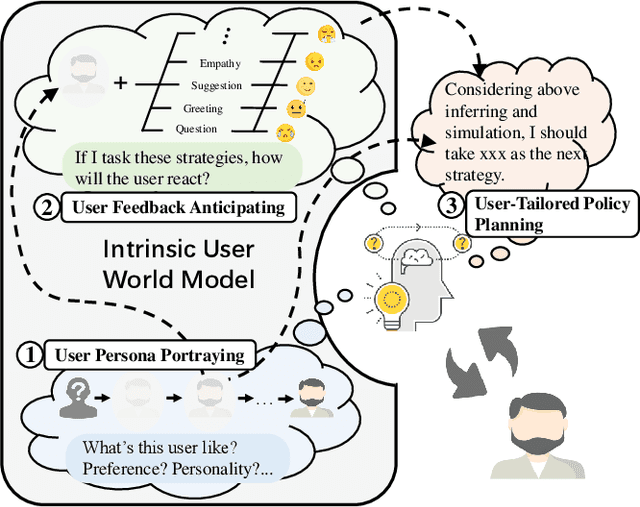
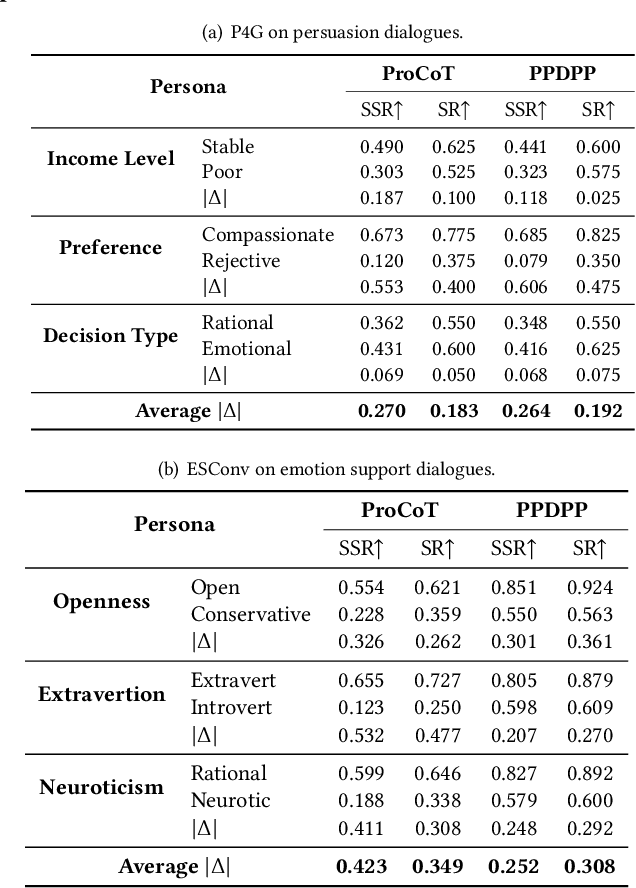
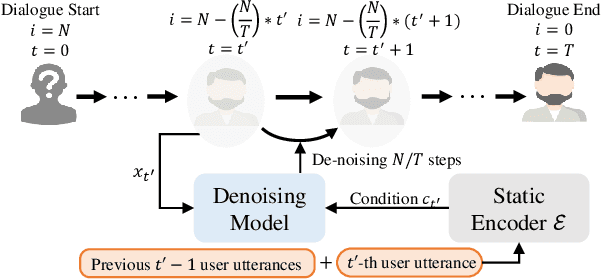
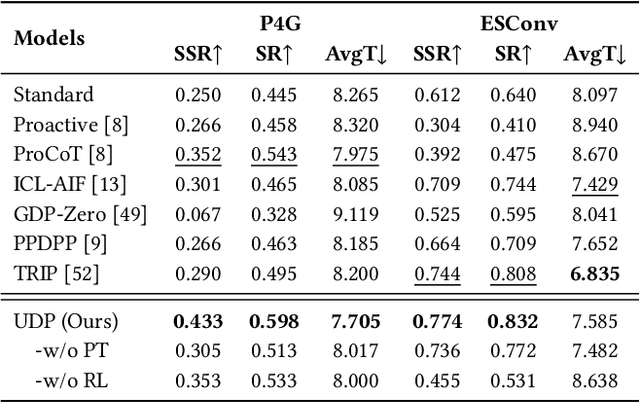
Recent advancements in dialogue policy planning have emphasized optimizing system agent policies to achieve predefined goals, focusing on strategy design, trajectory acquisition, and efficient training paradigms. However, these approaches often overlook the critical role of user characteristics, which are essential in real-world scenarios like conversational search and recommendation, where interactions must adapt to individual user traits such as personality, preferences, and goals. To address this gap, we first conduct a comprehensive study utilizing task-specific user personas to systematically assess dialogue policy planning under diverse user behaviors. By leveraging realistic user profiles for different tasks, our study reveals significant limitations in existing approaches, highlighting the need for user-tailored dialogue policy planning. Building on this foundation, we present the User-Tailored Dialogue Policy Planning (UDP) framework, which incorporates an Intrinsic User World Model to model user traits and feedback. UDP operates in three stages: (1) User Persona Portraying, using a diffusion model to dynamically infer user profiles; (2) User Feedback Anticipating, leveraging a Brownian Bridge-inspired anticipator to predict user reactions; and (3) User-Tailored Policy Planning, integrating these insights to optimize response strategies. To ensure robust performance, we further propose an active learning approach that prioritizes challenging user personas during training. Comprehensive experiments on benchmarks, including collaborative and non-collaborative settings, demonstrate the effectiveness of UDP in learning user-specific dialogue strategies. Results validate the protocol's utility and highlight UDP's robustness, adaptability, and potential to advance user-centric dialogue systems.