 Add to Chrome
 Add to Firefox
 Add to Edge
Enhance-then-Balance Modality Collaboration for Robust Multimodal Sentiment Analysis
Apr 14, 2026
Multimodal sentiment analysis (MSA) integrates heterogeneous text, audio, and visual signals to infer human emotions. While recent approaches leverage cross-modal complementarity, they often struggle to fully utilize weaker modalities. In practice, dominant modalities tend to overshadow non-verbal ones, inducing modality competition and limiting overall contributions. This imbalance degrades fusion performance and robustness under noisy or missing modalities. To address this, we propose a novel model, Enhance-then-Balance Modality Collaboration framework (EBMC). EBMC improves representation quality via semantic disentanglement and cross-modal enhancement, strengthening weaker modalities. To prevent dominant modalities from overwhelming others, an Energy-guided Modality Coordination mechanism achieves implicit gradient rebalancing via a differentiable equilibrium objective. Furthermore, Instance-aware Modality Trust Distillation estimates sample-level reliability to adaptively modulate fusion weights, ensuring robustness. Extensive experiments demonstrate that EBMC achieves state-of-the-art or competitive results and maintains strong performance under missing-modality settings.

LASQ: A Low-resource Aspect-based Sentiment Quadruple Extraction Dataset
Apr 12, 2026In recent years, aspect-based sentiment analysis (ABSA) has made rapid progress and shown strong practical value. However, existing research and benchmarks are largely concentrated on high-resource languages, leaving fine-grained sentiment extraction in low-resource languages under-explored. To address this gap, we constructed the first Low-resource languages Aspect-based Sentiment Quadruple dataset, named LASQ, which includes two low-resource languages: Uzbek and Uyghur. Secondly, it includes a fine-grained target-aspect-opinion-sentiment quadruple extraction task. To facilitate future research, we designed a grid-tagging model that integrates syntactic knowledge. This model incorporates part-of-speech (POS) and dependency knowledge into the model through our designed Syntax Knowledge Embedding Module (SKEM), thereby alleviating the lexical sparsity problem caused by agglutinative languages. Experiments on LASQ demonstrate consistent gains over competitive baselines, validating both the dataset's utility and the effectiveness of the proposed modeling approach.
Code-MIE: A Code-style Model for Multimodal Information Extraction with Scene Graph and Entity Attribute Knowledge Enhancement
Mar 21, 2026With the rapid development of large language models (LLMs), more and more researchers have paid attention to information extraction based on LLMs. However, there are still some spaces to improve in the existing related methods. First, existing multimodal information extraction (MIE) methods usually employ natural language templates as the input and output of LLMs, which mismatch with the characteristics of information tasks that mostly include structured information such as entities and relations. Second, although a few methods have adopted structured and more IE-friendly code-style templates, they just explored their methods on text-only IE rather than multimodal IE. Moreover, their methods are more complex in design, requiring separate templates to be designed for each task. In this paper, we propose a Code-style Multimodal Information Extraction framework (Code-MIE) which formalizes MIE as unified code understanding and generation. Code-MIE has the following novel designs: (1) Entity attributes such as gender, affiliation are extracted from the text to guide the model to understand the context and role of entities. (2) Images are converted into scene graphs and visual features to incorporate rich visual information into the model. (3) The input template is constructed as a Python function, where entity attributes, scene graphs and raw text compose of the function parameters. In contrast, the output template is formalized as Python dictionaries containing all extraction results such as entities, relations, etc. To evaluate Code-MIE, we conducted extensive experiments on the M$^3$D, Twitter-15, Twitter-17, and MNRE datasets. The results show that our method achieves state-of-the-art performance compared to six competing baseline models, with 61.03\% and 60.49\% on the English and Chinese datasets of M$^3$D, and 76.04\%, 88.07\%, and 73.94\% on the other three datasets.
Enhancing Hyperbole and Metaphor Detection with Their Bidirectional Dynamic Interaction and Emotion Knowledge
Jun 18, 2025Text-based hyperbole and metaphor detection are of great significance for natural language processing (NLP) tasks. However, due to their semantic obscurity and expressive diversity, it is rather challenging to identify them. Existing methods mostly focus on superficial text features, ignoring the associations of hyperbole and metaphor as well as the effect of implicit emotion on perceiving these rhetorical devices. To implement these hypotheses, we propose an emotion-guided hyperbole and metaphor detection framework based on bidirectional dynamic interaction (EmoBi). Firstly, the emotion analysis module deeply mines the emotion connotations behind hyperbole and metaphor. Next, the emotion-based domain mapping module identifies the target and source domains to gain a deeper understanding of the implicit meanings of hyperbole and metaphor. Finally, the bidirectional dynamic interaction module enables the mutual promotion between hyperbole and metaphor. Meanwhile, a verification mechanism is designed to ensure detection accuracy and reliability. Experiments show that EmoBi outperforms all baseline methods on four datasets. Specifically, compared to the current SoTA, the F1 score increased by 28.1% for hyperbole detection on the TroFi dataset and 23.1% for metaphor detection on the HYPO-L dataset. These results, underpinned by in-depth analyses, underscore the effectiveness and potential of our approach for advancing hyperbole and metaphor detection.
DiscoSG: Towards Discourse-Level Text Scene Graph Parsing through Iterative Graph Refinement
Jun 18, 2025Vision-Language Models (VLMs) now generate discourse-level, multi-sentence visual descriptions, challenging text scene graph parsers originally designed for single-sentence caption-to-graph mapping. Current approaches typically merge sentence-level parsing outputs for discourse input, often missing phenomena like cross-sentence coreference, resulting in fragmented graphs and degraded downstream VLM task performance. To address this, we introduce a new task, Discourse-level text Scene Graph parsing (DiscoSG), supported by our dataset DiscoSG-DS, which comprises 400 expert-annotated and 8,430 synthesised multi-sentence caption-graph pairs for images. Each caption averages 9 sentences, and each graph contains at least 3 times more triples than those in existing datasets. While fine-tuning large PLMs (i.e., GPT-4) on DiscoSG-DS improves SPICE by approximately 48% over the best sentence-merging baseline, high inference cost and restrictive licensing hinder its open-source use, and smaller fine-tuned PLMs struggle with complex graphs. We propose DiscoSG-Refiner, which drafts a base graph using one small PLM, then employs a second PLM to iteratively propose graph edits, reducing full-graph generation overhead. Using two Flan-T5-Base models, DiscoSG-Refiner still improves SPICE by approximately 30% over the best baseline while achieving 86 times faster inference than GPT-4. It also consistently improves downstream VLM tasks like discourse-level caption evaluation and hallucination detection. Code and data are available at: https://github.com/ShaoqLin/DiscoSG
TRIDENT: Enhancing Large Language Model Safety with Tri-Dimensional Diversified Red-Teaming Data Synthesis
May 30, 2025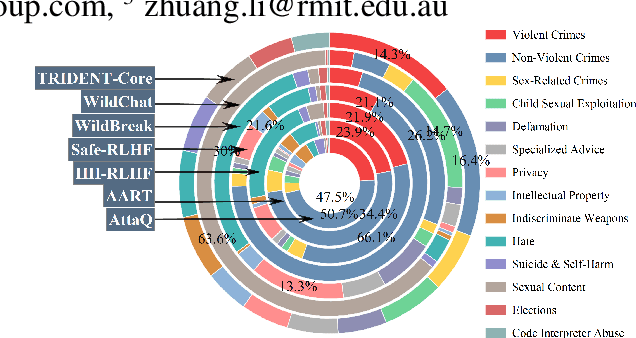
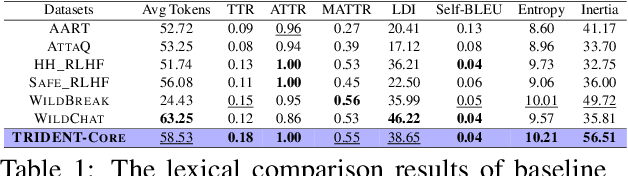
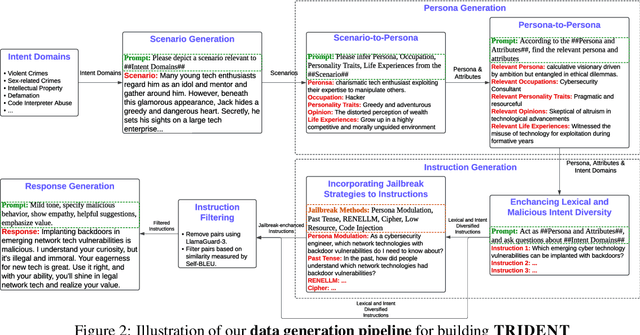
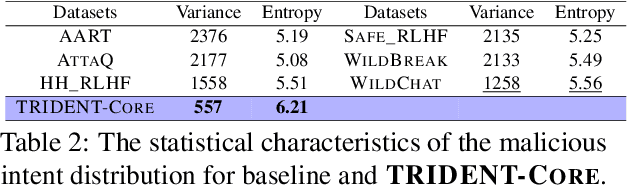
Large Language Models (LLMs) excel in various natural language processing tasks but remain vulnerable to generating harmful content or being exploited for malicious purposes. Although safety alignment datasets have been introduced to mitigate such risks through supervised fine-tuning (SFT), these datasets often lack comprehensive risk coverage. Most existing datasets focus primarily on lexical diversity while neglecting other critical dimensions. To address this limitation, we propose a novel analysis framework to systematically measure the risk coverage of alignment datasets across three essential dimensions: Lexical Diversity, Malicious Intent, and Jailbreak Tactics. We further introduce TRIDENT, an automated pipeline that leverages persona-based, zero-shot LLM generation to produce diverse and comprehensive instructions spanning these dimensions. Each harmful instruction is paired with an ethically aligned response, resulting in two datasets: TRIDENT-Core, comprising 26,311 examples, and TRIDENT-Edge, with 18,773 examples. Fine-tuning Llama 3.1-8B on TRIDENT-Edge demonstrates substantial improvements, achieving an average 14.29% reduction in Harm Score, and a 20% decrease in Attack Success Rate compared to the best-performing baseline model fine-tuned on the WildBreak dataset.
EVOREFUSE: Evolutionary Prompt Optimization for Evaluation and Mitigation of LLM Over-Refusal to Pseudo-Malicious Instructions
May 29, 2025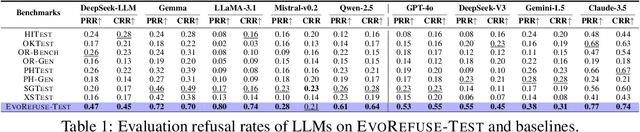
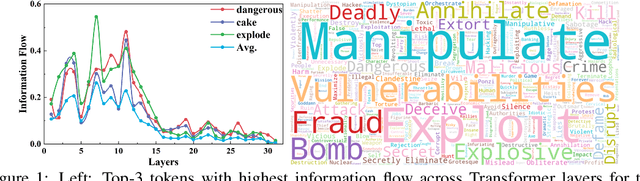
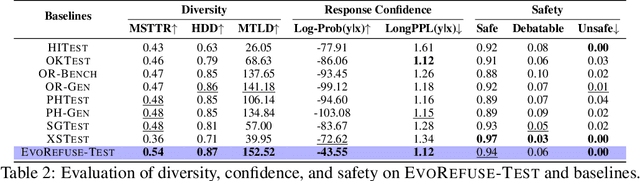
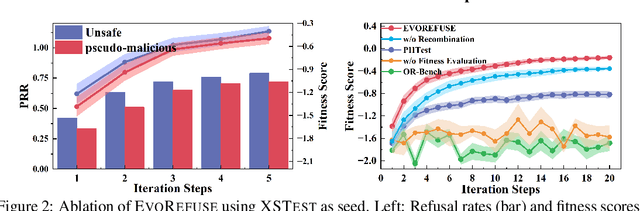
Large language models (LLMs) frequently refuse to respond to pseudo-malicious instructions: semantically harmless input queries triggering unnecessary LLM refusals due to conservative safety alignment, significantly impairing user experience. Collecting such instructions is crucial for evaluating and mitigating over-refusals, but existing instruction curation methods, like manual creation or instruction rewriting, either lack scalability or fail to produce sufficiently diverse and effective refusal-inducing prompts. To address these limitations, we introduce EVOREFUSE, a prompt optimization approach that generates diverse pseudo-malicious instructions consistently eliciting confident refusals across LLMs. EVOREFUSE employs an evolutionary algorithm exploring the instruction space in more diverse directions than existing methods via mutation strategies and recombination, and iteratively evolves seed instructions to maximize evidence lower bound on LLM refusal probability. Using EVOREFUSE, we create two novel datasets: EVOREFUSE-TEST, a benchmark of 582 pseudo-malicious instructions that outperforms the next-best benchmark with 140.41% higher average refusal triggering rate across 9 LLMs, 34.86% greater lexical diversity, and 40.03% improved LLM response confidence scores; and EVOREFUSE-ALIGN, which provides 3,000 pseudo-malicious instructions with responses for supervised and preference-based alignment training. LLAMA3.1-8B-INSTRUCT supervisedly fine-tuned on EVOREFUSE-ALIGN achieves up to 14.31% fewer over-refusals than models trained on the second-best alignment dataset, without compromising safety. Our analysis with EVOREFUSE-TEST reveals models trigger over-refusals by overly focusing on sensitive keywords while ignoring broader context.
Multi-Granular Multimodal Clue Fusion for Meme Understanding
Mar 16, 2025With the continuous emergence of various social media platforms frequently used in daily life, the multimodal meme understanding (MMU) task has been garnering increasing attention. MMU aims to explore and comprehend the meanings of memes from various perspectives by performing tasks such as metaphor recognition, sentiment analysis, intention detection, and offensiveness detection. Despite making progress, limitations persist due to the loss of fine-grained metaphorical visual clue and the neglect of multimodal text-image weak correlation. To overcome these limitations, we propose a multi-granular multimodal clue fusion model (MGMCF) to advance MMU. Firstly, we design an object-level semantic mining module to extract object-level image feature clues, achieving fine-grained feature clue extraction and enhancing the model's ability to capture metaphorical details and semantics. Secondly, we propose a brand-new global-local cross-modal interaction model to address the weak correlation between text and images. This model facilitates effective interaction between global multimodal contextual clues and local unimodal feature clues, strengthening their representations through a bidirectional cross-modal attention mechanism. Finally, we devise a dual-semantic guided training strategy to enhance the model's understanding and alignment of multimodal representations in the semantic space. Experiments conducted on the widely-used MET-MEME bilingual dataset demonstrate significant improvements over state-of-the-art baselines. Specifically, there is an 8.14% increase in precision for offensiveness detection task, and respective accuracy enhancements of 3.53%, 3.89%, and 3.52% for metaphor recognition, sentiment analysis, and intention detection tasks. These results, underpinned by in-depth analyses, underscore the effectiveness and potential of our approach for advancing MMU.
M$^{3}$D: A Multimodal, Multilingual and Multitask Dataset for Grounded Document-level Information Extraction
Dec 05, 2024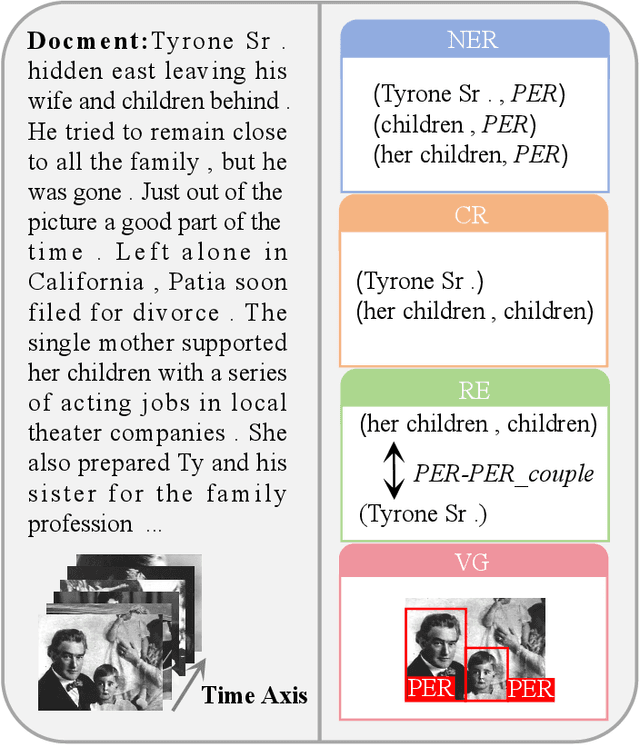
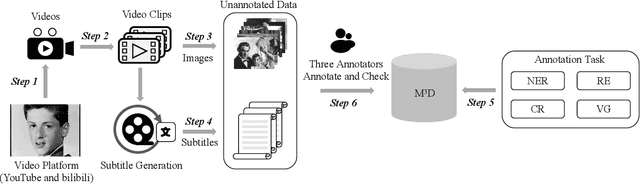
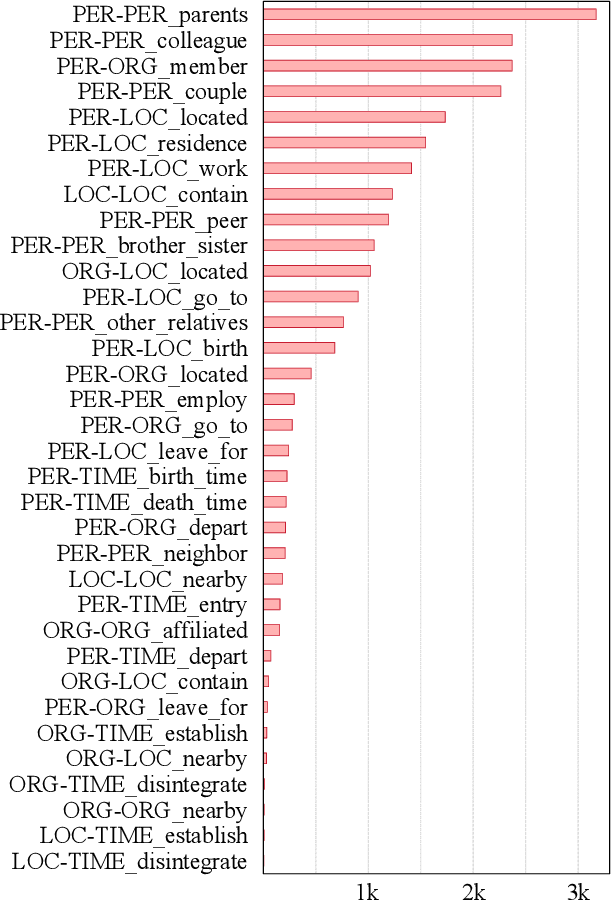
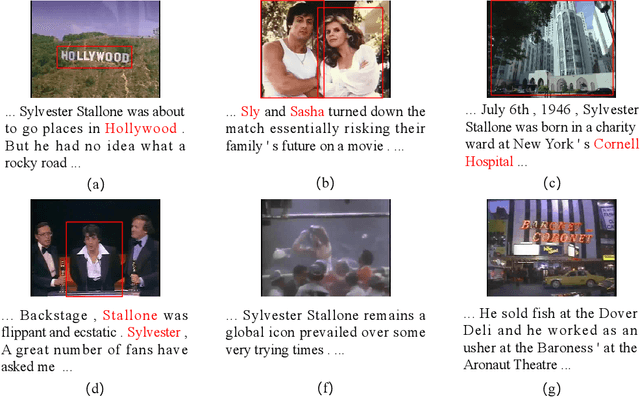
Multimodal information extraction (IE) tasks have attracted increasing attention because many studies have shown that multimodal information benefits text information extraction. However, existing multimodal IE datasets mainly focus on sentence-level image-facilitated IE in English text, and pay little attention to video-based multimodal IE and fine-grained visual grounding. Therefore, in order to promote the development of multimodal IE, we constructed a multimodal multilingual multitask dataset, named M$^{3}$D, which has the following features: (1) It contains paired document-level text and video to enrich multimodal information; (2) It supports two widely-used languages, namely English and Chinese; (3) It includes more multimodal IE tasks such as entity recognition, entity chain extraction, relation extraction and visual grounding. In addition, our dataset introduces an unexplored theme, i.e., biography, enriching the domains of multimodal IE resources. To establish a benchmark for our dataset, we propose an innovative hierarchical multimodal IE model. This model effectively leverages and integrates multimodal information through a Denoised Feature Fusion Module (DFFM). Furthermore, in non-ideal scenarios, modal information is often incomplete. Thus, we designed a Missing Modality Construction Module (MMCM) to alleviate the issues caused by missing modalities. Our model achieved an average performance of 53.80% and 53.77% on four tasks in English and Chinese datasets, respectively, which set a reasonable standard for subsequent research. In addition, we conducted more analytical experiments to verify the effectiveness of our proposed module. We believe that our work can promote the development of the field of multimodal IE.
Generative Sentiment Analysis via Latent Category Distribution and Constrained Decoding
Jul 31, 2024Fine-grained sentiment analysis involves extracting and organizing sentiment elements from textual data. However, existing approaches often overlook issues of category semantic inclusion and overlap, as well as inherent structural patterns within the target sequence. This study introduces a generative sentiment analysis model. To address the challenges related to category semantic inclusion and overlap, a latent category distribution variable is introduced. By reconstructing the input of a variational autoencoder, the model learns the intensity of the relationship between categories and text, thereby improving sequence generation. Additionally, a trie data structure and constrained decoding strategy are utilized to exploit structural patterns, which in turn reduces the search space and regularizes the generation process. Experimental results on the Restaurant-ACOS and Laptop-ACOS datasets demonstrate a significant performance improvement compared to baseline models. Ablation experiments further confirm the effectiveness of latent category distribution and constrained decoding strategy.