 Add to Chrome
 Add to Firefox
 Add to Edge
StaMo: Unsupervised Learning of Generalizable Robot Motion from Compact State Representation
Oct 06, 2025
A fundamental challenge in embodied intelligence is developing expressive and compact state representations for efficient world modeling and decision making. However, existing methods often fail to achieve this balance, yielding representations that are either overly redundant or lacking in task-critical information. We propose an unsupervised approach that learns a highly compressed two-token state representation using a lightweight encoder and a pre-trained Diffusion Transformer (DiT) decoder, capitalizing on its strong generative prior. Our representation is efficient, interpretable, and integrates seamlessly into existing VLA-based models, improving performance by 14.3% on LIBERO and 30% in real-world task success with minimal inference overhead. More importantly, we find that the difference between these tokens, obtained via latent interpolation, naturally serves as a highly effective latent action, which can be further decoded into executable robot actions. This emergent capability reveals that our representation captures structured dynamics without explicit supervision. We name our method StaMo for its ability to learn generalizable robotic Motion from compact State representation, which is encoded from static images, challenging the prevalent dependence to learning latent action on complex architectures and video data. The resulting latent actions also enhance policy co-training, outperforming prior methods by 10.4% with improved interpretability. Moreover, our approach scales effectively across diverse data sources, including real-world robot data, simulation, and human egocentric video.

GenAR: Next-Scale Autoregressive Generation for Spatial Gene Expression Prediction
Oct 05, 2025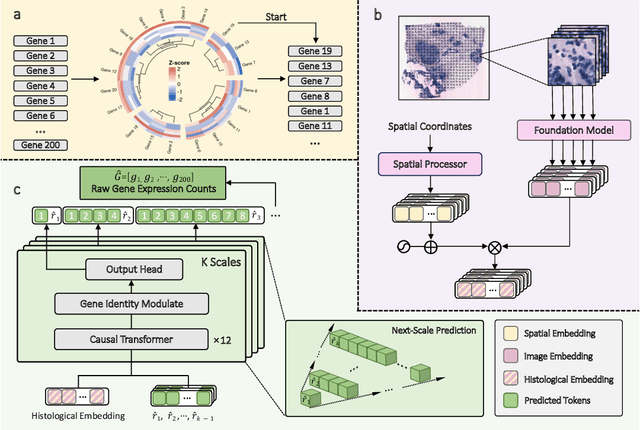

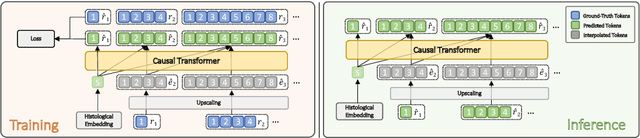

Spatial Transcriptomics (ST) offers spatially resolved gene expression but remains costly. Predicting expression directly from widely available Hematoxylin and Eosin (H&E) stained images presents a cost-effective alternative. However, most computational approaches (i) predict each gene independently, overlooking co-expression structure, and (ii) cast the task as continuous regression despite expression being discrete counts. This mismatch can yield biologically implausible outputs and complicate downstream analyses. We introduce GenAR, a multi-scale autoregressive framework that refines predictions from coarse to fine. GenAR clusters genes into hierarchical groups to expose cross-gene dependencies, models expression as codebook-free discrete token generation to directly predict raw counts, and conditions decoding on fused histological and spatial embeddings. From an information-theoretic perspective, the discrete formulation avoids log-induced biases and the coarse-to-fine factorization aligns with a principled conditional decomposition. Extensive experimental results on four Spatial Transcriptomics datasets across different tissue types demonstrate that GenAR achieves state-of-the-art performance, offering potential implications for precision medicine and cost-effective molecular profiling. Code is publicly available at https://github.com/oyjr/genar.
Growing Visual Generative Capacity for Pre-Trained MLLMs
Oct 02, 2025Multimodal large language models (MLLMs) extend the success of language models to visual understanding, and recent efforts have sought to build unified MLLMs that support both understanding and generation. However, constructing such models remains challenging: hybrid approaches combine continuous embeddings with diffusion or flow-based objectives, producing high-quality images but breaking the autoregressive paradigm, while pure autoregressive approaches unify text and image prediction over discrete visual tokens but often face trade-offs between semantic alignment and pixel-level fidelity. In this work, we present Bridge, a pure autoregressive unified MLLM that augments pre-trained visual understanding models with generative ability through a Mixture-of-Transformers architecture, enabling both image understanding and generation within a single next-token prediction framework. To further improve visual generation fidelity, we propose a semantic-to-pixel discrete representation that integrates compact semantic tokens with fine-grained pixel tokens, achieving strong language alignment and precise description of visual details with only a 7.9% increase in sequence length. Extensive experiments across diverse multimodal benchmarks demonstrate that Bridge achieves competitive or superior results in both understanding and generation benchmarks, while requiring less training data and reduced training time compared to prior unified MLLMs.
MLA: A Multisensory Language-Action Model for Multimodal Understanding and Forecasting in Robotic Manipulation
Sep 30, 2025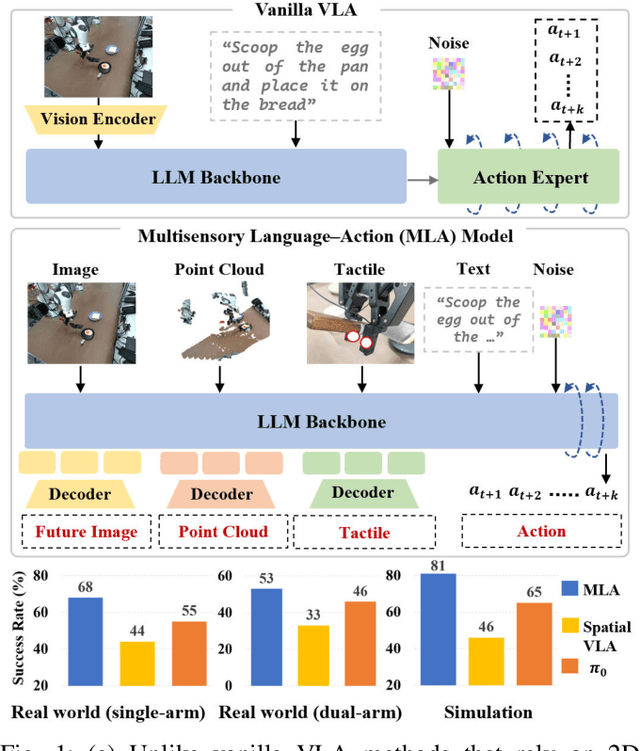
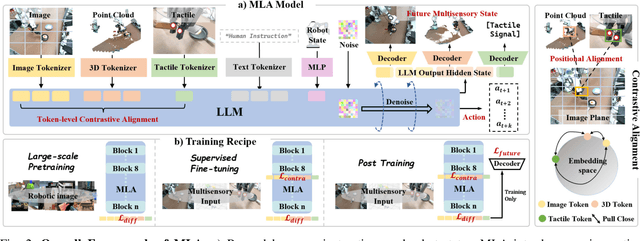
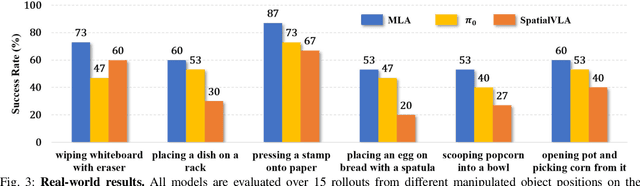
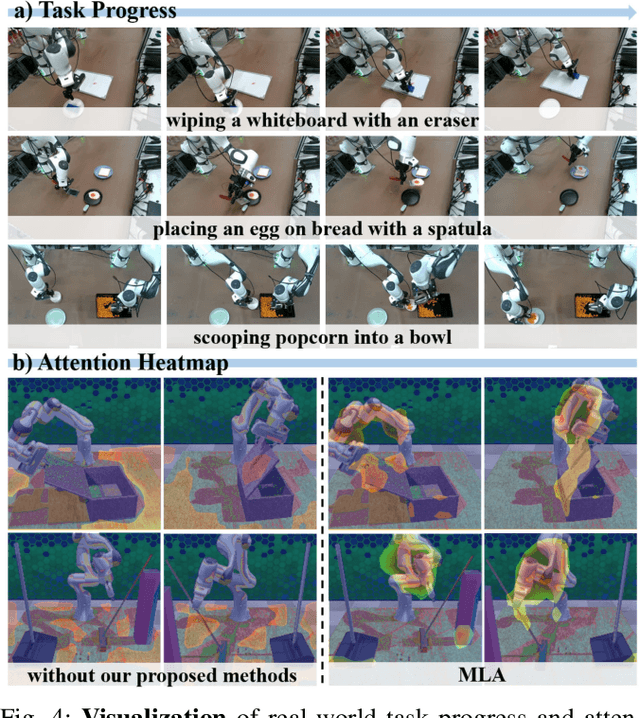
Vision-language-action models (VLAs) have shown generalization capabilities in robotic manipulation tasks by inheriting from vision-language models (VLMs) and learning action generation. Most VLA models focus on interpreting vision and language to generate actions, whereas robots must perceive and interact within the spatial-physical world. This gap highlights the need for a comprehensive understanding of robotic-specific multisensory information, which is crucial for achieving complex and contact-rich control. To this end, we introduce a multisensory language-action (MLA) model that collaboratively perceives heterogeneous sensory modalities and predicts future multisensory objectives to facilitate physical world modeling. Specifically, to enhance perceptual representations, we propose an encoder-free multimodal alignment scheme that innovatively repurposes the large language model itself as a perception module, directly interpreting multimodal cues by aligning 2D images, 3D point clouds, and tactile tokens through positional correspondence. To further enhance MLA's understanding of physical dynamics, we design a future multisensory generation post-training strategy that enables MLA to reason about semantic, geometric, and interaction information, providing more robust conditions for action generation. For evaluation, the MLA model outperforms the previous state-of-the-art 2D and 3D VLA methods by 12% and 24% in complex, contact-rich real-world tasks, respectively, while also demonstrating improved generalization to unseen configurations. Project website: https://sites.google.com/view/open-mla
Linear Causal Representation Learning by Topological Ordering, Pruning, and Disentanglement
Sep 26, 2025Causal representation learning (CRL) has garnered increasing interests from the causal inference and artificial intelligence community, due to its capability of disentangling potentially complex data-generating mechanism into causally interpretable latent features, by leveraging the heterogeneity of modern datasets. In this paper, we further contribute to the CRL literature, by focusing on the stylized linear structural causal model over the latent features and assuming a linear mixing function that maps latent features to the observed data or measurements. Existing linear CRL methods often rely on stringent assumptions, such as accessibility to single-node interventional data or restrictive distributional constraints on latent features and exogenous measurement noise. However, these prerequisites can be challenging to satisfy in certain scenarios. In this work, we propose a novel linear CRL algorithm that, unlike most existing linear CRL methods, operates under weaker assumptions about environment heterogeneity and data-generating distributions while still recovering latent causal features up to an equivalence class. We further validate our new algorithm via synthetic experiments and an interpretability analysis of large language models (LLMs), demonstrating both its superiority over competing methods in finite samples and its potential in integrating causality into AI.
FoBa: A Foreground-Background co-Guided Method and New Benchmark for Remote Sensing Semantic Change Detection
Sep 19, 2025
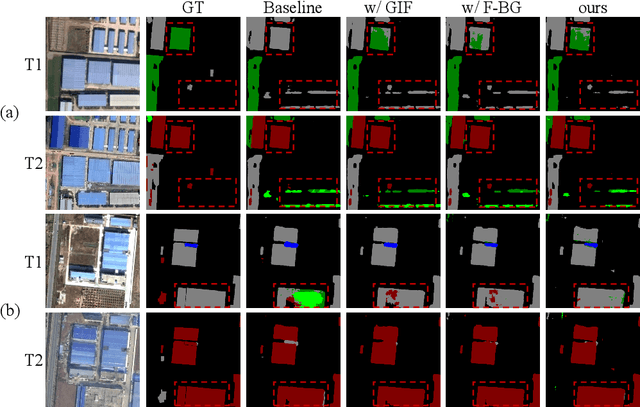
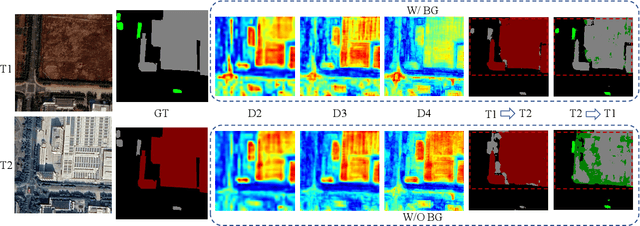
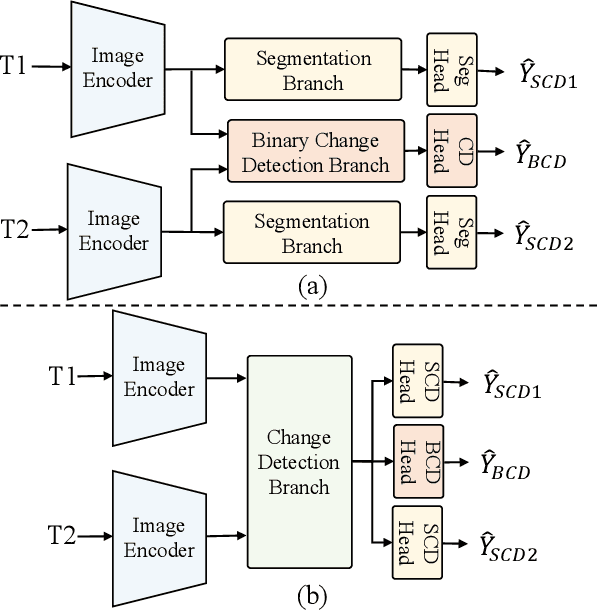
Despite the remarkable progress achieved in remote sensing semantic change detection (SCD), two major challenges remain. At the data level, existing SCD datasets suffer from limited change categories, insufficient change types, and a lack of fine-grained class definitions, making them inadequate to fully support practical applications. At the methodological level, most current approaches underutilize change information, typically treating it as a post-processing step to enhance spatial consistency, which constrains further improvements in model performance. To address these issues, we construct a new benchmark for remote sensing SCD, LevirSCD. Focused on the Beijing area, the dataset covers 16 change categories and 210 specific change types, with more fine-grained class definitions (e.g., roads are divided into unpaved and paved roads). Furthermore, we propose a foreground-background co-guided SCD (FoBa) method, which leverages foregrounds that focus on regions of interest and backgrounds enriched with contextual information to guide the model collaboratively, thereby alleviating semantic ambiguity while enhancing its ability to detect subtle changes. Considering the requirements of bi-temporal interaction and spatial consistency in SCD, we introduce a Gated Interaction Fusion (GIF) module along with a simple consistency loss to further enhance the model's detection performance. Extensive experiments on three datasets (SECOND, JL1, and the proposed LevirSCD) demonstrate that FoBa achieves competitive results compared to current SOTA methods, with improvements of 1.48%, 3.61%, and 2.81% in the SeK metric, respectively. Our code and dataset are available at https://github.com/zmoka-zht/FoBa.
Generative AI for Misalignment-Resistant Virtual Staining to Accelerate Histopathology Workflows
Sep 17, 2025Accurate histopathological diagnosis often requires multiple differently stained tissue sections, a process that is time-consuming, labor-intensive, and environmentally taxing due to the use of multiple chemical stains. Recently, virtual staining has emerged as a promising alternative that is faster, tissue-conserving, and environmentally friendly. However, existing virtual staining methods face significant challenges in clinical applications, primarily due to their reliance on well-aligned paired data. Obtaining such data is inherently difficult because chemical staining processes can distort tissue structures, and a single tissue section cannot undergo multiple staining procedures without damage or loss of information. As a result, most available virtual staining datasets are either unpaired or roughly paired, making it difficult for existing methods to achieve accurate pixel-level supervision. To address this challenge, we propose a robust virtual staining framework featuring cascaded registration mechanisms to resolve spatial mismatches between generated outputs and their corresponding ground truth. Experimental results demonstrate that our method significantly outperforms state-of-the-art models across five datasets, achieving an average improvement of 3.2% on internal datasets and 10.1% on external datasets. Moreover, in datasets with substantial misalignment, our approach achieves a remarkable 23.8% improvement in peak signal-to-noise ratio compared to baseline models. The exceptional robustness of the proposed method across diverse datasets simplifies the data acquisition process for virtual staining and offers new insights for advancing its development.
Learning by Imagining: Debiased Feature Augmentation for Compositional Zero-Shot Learning
Sep 16, 2025Compositional Zero-Shot Learning (CZSL) aims to recognize unseen attribute-object compositions by learning prior knowledge of seen primitives, \textit{i.e.}, attributes and objects. Learning generalizable compositional representations in CZSL remains challenging due to the entangled nature of attributes and objects as well as the prevalence of long-tailed distributions in real-world data. Inspired by neuroscientific findings that imagination and perception share similar neural processes, we propose a novel approach called Debiased Feature Augmentation (DeFA) to address these challenges. The proposed DeFA integrates a disentangle-and-reconstruct framework for feature augmentation with a debiasing strategy. DeFA explicitly leverages the prior knowledge of seen attributes and objects by synthesizing high-fidelity composition features to support compositional generalization. Extensive experiments on three widely used datasets demonstrate that DeFA achieves state-of-the-art performance in both \textit{closed-world} and \textit{open-world} settings.
A Multimodal Foundation Model to Enhance Generalizability and Data Efficiency for Pan-cancer Prognosis Prediction
Sep 16, 2025Multimodal data provides heterogeneous information for a holistic understanding of the tumor microenvironment. However, existing AI models often struggle to harness the rich information within multimodal data and extract poorly generalizable representations. Here we present MICE (Multimodal data Integration via Collaborative Experts), a multimodal foundation model that effectively integrates pathology images, clinical reports, and genomics data for precise pan-cancer prognosis prediction. Instead of conventional multi-expert modules, MICE employs multiple functionally diverse experts to comprehensively capture both cross-cancer and cancer-specific insights. Leveraging data from 11,799 patients across 30 cancer types, we enhanced MICE's generalizability by coupling contrastive and supervised learning. MICE outperformed both unimodal and state-of-the-art multi-expert-based multimodal models, demonstrating substantial improvements in C-index ranging from 3.8% to 11.2% on internal cohorts and 5.8% to 8.8% on independent cohorts, respectively. Moreover, it exhibited remarkable data efficiency across diverse clinical scenarios. With its enhanced generalizability and data efficiency, MICE establishes an effective and scalable foundation for pan-cancer prognosis prediction, holding strong potential to personalize tailored therapies and improve treatment outcomes.
Image Tokenizer Needs Post-Training
Sep 15, 2025Recent image generative models typically capture the image distribution in a pre-constructed latent space, relying on a frozen image tokenizer. However, there exists a significant discrepancy between the reconstruction and generation distribution, where current tokenizers only prioritize the reconstruction task that happens before generative training without considering the generation errors during sampling. In this paper, we comprehensively analyze the reason for this discrepancy in a discrete latent space, and, from which, we propose a novel tokenizer training scheme including both main-training and post-training, focusing on improving latent space construction and decoding respectively. During the main training, a latent perturbation strategy is proposed to simulate sampling noises, \ie, the unexpected tokens generated in generative inference. Specifically, we propose a plug-and-play tokenizer training scheme, which significantly enhances the robustness of tokenizer, thus boosting the generation quality and convergence speed, and a novel tokenizer evaluation metric, \ie, pFID, which successfully correlates the tokenizer performance to generation quality. During post-training, we further optimize the tokenizer decoder regarding a well-trained generative model to mitigate the distribution difference between generated and reconstructed tokens. With a $\sim$400M generator, a discrete tokenizer trained with our proposed main training achieves a notable 1.60 gFID and further obtains 1.36 gFID with the additional post-training. Further experiments are conducted to broadly validate the effectiveness of our post-training strategy on off-the-shelf discrete and continuous tokenizers, coupled with autoregressive and diffusion-based generators.