 Add to Chrome
 Add to Firefox
 Add to Edge
HarnessEval-W: Agentifying the Evaluation of Visual Worlds
Aug 17, 2026
A benchmark should deliver more than a scalar score: what makes an evaluation trustworthy is the reasoning that justifies the score. This is especially critical for world models, where judging a rollout requires understanding whether physics, causality, and world state evolve correctly. Humans spot such violations naturally, yet no existing benchmark automates this capability: metrics are computed brute-force, leaving no reasoning chain that can be examined or verified. We introduce HarnessEval-W, an agentified evaluation pipeline that brings the harness paradigm from the LLM ecosystem to world model benchmarking. Rather than applying a fixed rubric, HarnessEval-W interprets the context of each evaluation case, decomposes the evaluation question into measurable subproblems, and spawns specialized sub-agents, each equipped with tailored context and diagnostic tools to reason over its own subproblem. The parent agent then validates the gathered evidence and summarizes it into the final verdict. This hierarchical workflow turns every evaluation into a transparent evidence tree whose complete reasoning chain justifies the result. We apply HarnessEval-W to 18 representative world models over 330 evaluation cases. Its judgments closely align with human preferences while providing verifiable, fine-grained diagnoses of every generated rollout. We open-source the full pipeline as a live benchmark and invite the broad community to contribute to grow new skills and evaluation cases as world models evolve.

DreamAvoid: Critical-Phase Test-Time Dreaming to Avoid Failures in VLA Policies
May 12, 2026Vision-Language-Action (VLA) models are often brittle in fine-grained manipulation, where minor action errors during the critical phases can rapidly escalate into irrecoverable failures. Since existing VLA models rely predominantly on successful demonstrations for training, they lack an explicit awareness of failure during these critical phases. To address this, we propose DreamAvoid, a critical-phase test-time dreaming framework that enables VLA models to anticipate and avoid failures. We also introduce an autonomous boundary learning paradigm to refine the system's understanding of the subtle boundary between success and failure. Specifically, we (1) utilize a Dream Trigger to determine whether the execution has entered a critical phase, (2) sample multiple candidate action chunks from the VLA via an Action Proposer, and (3) employ a Dream Evaluator, jointly trained on mixed data (success, failure, and boundary cases), to "dream" the short-horizon futures corresponding to the candidate actions, evaluate their values, and select the optimal action. We conduct extensive evaluations on real-world manipulation tasks and simulation benchmarks. The results demonstrate that DreamAvoid can effectively avoid failures, thereby improving the overall task success rate. Our code is available at https://github.com/XianzheFan/DreamAvoid.
Seeing Farther and Smarter: Value-Guided Multi-Path Reflection for VLM Policy Optimization
Feb 22, 2026Solving complex, long-horizon robotic manipulation tasks requires a deep understanding of physical interactions, reasoning about their long-term consequences, and precise high-level planning. Vision-Language Models (VLMs) offer a general perceive-reason-act framework for this goal. However, previous approaches using reflective planning to guide VLMs in correcting actions encounter significant limitations. These methods rely on inefficient and often inaccurate implicit learning of state-values from noisy foresight predictions, evaluate only a single greedy future, and suffer from substantial inference latency. To address these limitations, we propose a novel test-time computation framework that decouples state evaluation from action generation. This provides a more direct and fine-grained supervisory signal for robust decision-making. Our method explicitly models the advantage of an action plan, quantified by its reduction in distance to the goal, and uses a scalable critic to estimate. To address the stochastic nature of single-trajectory evaluation, we employ beam search to explore multiple future paths and aggregate them during decoding to model their expected long-term returns, leading to more robust action generation. Additionally, we introduce a lightweight, confidence-based trigger that allows for early exit when direct predictions are reliable, invoking reflection only when necessary. Extensive experiments on diverse, unseen multi-stage robotic manipulation tasks demonstrate a 24.6% improvement in success rate over state-of-the-art baselines, while significantly reducing inference time by 56.5%.
World Action Models are Zero-shot Policies
Feb 17, 2026State-of-the-art Vision-Language-Action (VLA) models excel at semantic generalization but struggle to generalize to unseen physical motions in novel environments. We introduce DreamZero, a World Action Model (WAM) built upon a pretrained video diffusion backbone. Unlike VLAs, WAMs learn physical dynamics by predicting future world states and actions, using video as a dense representation of how the world evolves. By jointly modeling video and action, DreamZero learns diverse skills effectively from heterogeneous robot data without relying on repetitive demonstrations. This results in over 2x improvement in generalization to new tasks and environments compared to state-of-the-art VLAs in real robot experiments. Crucially, through model and system optimizations, we enable a 14B autoregressive video diffusion model to perform real-time closed-loop control at 7Hz. Finally, we demonstrate two forms of cross-embodiment transfer: video-only demonstrations from other robots or humans yield a relative improvement of over 42% on unseen task performance with just 10-20 minutes of data. More surprisingly, DreamZero enables few-shot embodiment adaptation, transferring to a new embodiment with only 30 minutes of play data while retaining zero-shot generalization.
DreamDojo: A Generalist Robot World Model from Large-Scale Human Videos
Feb 06, 2026Being able to simulate the outcomes of actions in varied environments will revolutionize the development of generalist agents at scale. However, modeling these world dynamics, especially for dexterous robotics tasks, poses significant challenges due to limited data coverage and scarce action labels. As an endeavor towards this end, we introduce DreamDojo, a foundation world model that learns diverse interactions and dexterous controls from 44k hours of egocentric human videos. Our data mixture represents the largest video dataset to date for world model pretraining, spanning a wide range of daily scenarios with diverse objects and skills. To address the scarcity of action labels, we introduce continuous latent actions as unified proxy actions, enhancing interaction knowledge transfer from unlabeled videos. After post-training on small-scale target robot data, DreamDojo demonstrates a strong understanding of physics and precise action controllability. We also devise a distillation pipeline that accelerates DreamDojo to a real-time speed of 10.81 FPS and further improves context consistency. Our work enables several important applications based on generative world models, including live teleoperation, policy evaluation, and model-based planning. Systematic evaluation on multiple challenging out-of-distribution (OOD) benchmarks verifies the significance of our method for simulating open-world, contact-rich tasks, paving the way for general-purpose robot world models.
StaMo: Unsupervised Learning of Generalizable Robot Motion from Compact State Representation
Oct 06, 2025A fundamental challenge in embodied intelligence is developing expressive and compact state representations for efficient world modeling and decision making. However, existing methods often fail to achieve this balance, yielding representations that are either overly redundant or lacking in task-critical information. We propose an unsupervised approach that learns a highly compressed two-token state representation using a lightweight encoder and a pre-trained Diffusion Transformer (DiT) decoder, capitalizing on its strong generative prior. Our representation is efficient, interpretable, and integrates seamlessly into existing VLA-based models, improving performance by 14.3% on LIBERO and 30% in real-world task success with minimal inference overhead. More importantly, we find that the difference between these tokens, obtained via latent interpolation, naturally serves as a highly effective latent action, which can be further decoded into executable robot actions. This emergent capability reveals that our representation captures structured dynamics without explicit supervision. We name our method StaMo for its ability to learn generalizable robotic Motion from compact State representation, which is encoded from static images, challenging the prevalent dependence to learning latent action on complex architectures and video data. The resulting latent actions also enhance policy co-training, outperforming prior methods by 10.4% with improved interpretability. Moreover, our approach scales effectively across diverse data sources, including real-world robot data, simulation, and human egocentric video.
ReSim: Reliable World Simulation for Autonomous Driving
Jun 11, 2025How can we reliably simulate future driving scenarios under a wide range of ego driving behaviors? Recent driving world models, developed exclusively on real-world driving data composed mainly of safe expert trajectories, struggle to follow hazardous or non-expert behaviors, which are rare in such data. This limitation restricts their applicability to tasks such as policy evaluation. In this work, we address this challenge by enriching real-world human demonstrations with diverse non-expert data collected from a driving simulator (e.g., CARLA), and building a controllable world model trained on this heterogeneous corpus. Starting with a video generator featuring a diffusion transformer architecture, we devise several strategies to effectively integrate conditioning signals and improve prediction controllability and fidelity. The resulting model, ReSim, enables Reliable Simulation of diverse open-world driving scenarios under various actions, including hazardous non-expert ones. To close the gap between high-fidelity simulation and applications that require reward signals to judge different actions, we introduce a Video2Reward module that estimates a reward from ReSim's simulated future. Our ReSim paradigm achieves up to 44% higher visual fidelity, improves controllability for both expert and non-expert actions by over 50%, and boosts planning and policy selection performance on NAVSIM by 2% and 25%, respectively.
UniVLA: Learning to Act Anywhere with Task-centric Latent Actions
May 09, 2025A generalist robot should perform effectively across various environments. However, most existing approaches heavily rely on scaling action-annotated data to enhance their capabilities. Consequently, they are often limited to single physical specification and struggle to learn transferable knowledge across different embodiments and environments. To confront these limitations, we propose UniVLA, a new framework for learning cross-embodiment vision-language-action (VLA) policies. Our key innovation is to derive task-centric action representations from videos with a latent action model. This enables us to exploit extensive data across a wide spectrum of embodiments and perspectives. To mitigate the effect of task-irrelevant dynamics, we incorporate language instructions and establish a latent action model within the DINO feature space. Learned from internet-scale videos, the generalist policy can be deployed to various robots through efficient latent action decoding. We obtain state-of-the-art results across multiple manipulation and navigation benchmarks, as well as real-robot deployments. UniVLA achieves superior performance over OpenVLA with less than 1/20 of pretraining compute and 1/10 of downstream data. Continuous performance improvements are observed as heterogeneous data, even including human videos, are incorporated into the training pipeline. The results underscore UniVLA's potential to facilitate scalable and efficient robot policy learning.
AdaWorld: Learning Adaptable World Models with Latent Actions
Mar 24, 2025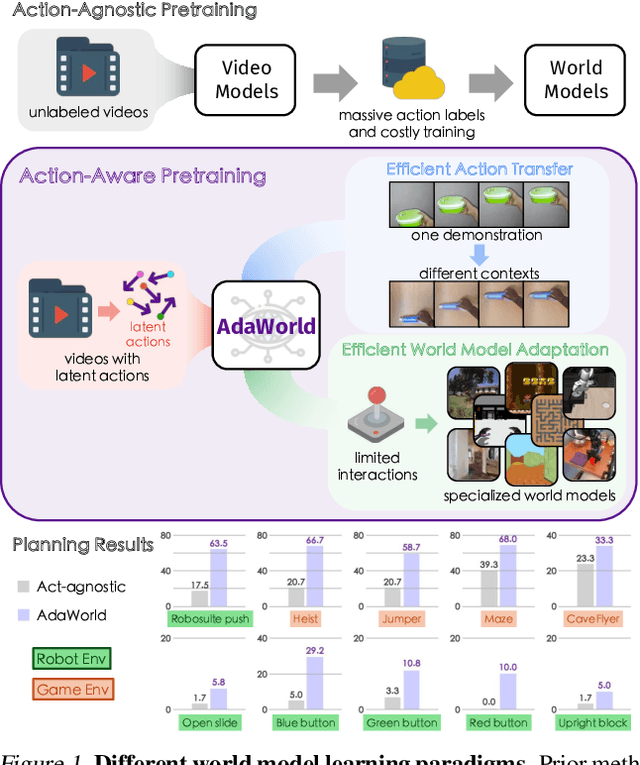
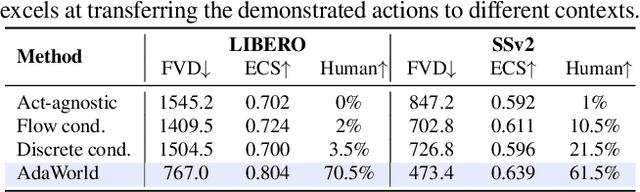
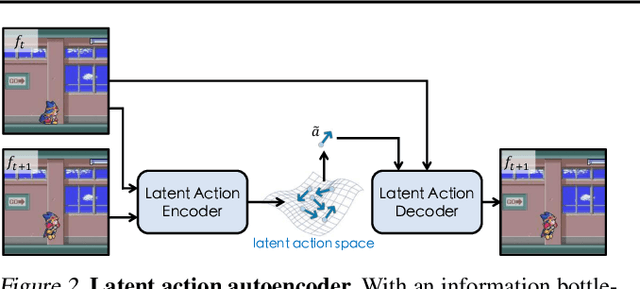

World models aim to learn action-controlled prediction models and have proven essential for the development of intelligent agents. However, most existing world models rely heavily on substantial action-labeled data and costly training, making it challenging to adapt to novel environments with heterogeneous actions through limited interactions. This limitation can hinder their applicability across broader domains. To overcome this challenge, we propose AdaWorld, an innovative world model learning approach that enables efficient adaptation. The key idea is to incorporate action information during the pretraining of world models. This is achieved by extracting latent actions from videos in a self-supervised manner, capturing the most critical transitions between frames. We then develop an autoregressive world model that conditions on these latent actions. This learning paradigm enables highly adaptable world models, facilitating efficient transfer and learning of new actions even with limited interactions and finetuning. Our comprehensive experiments across multiple environments demonstrate that AdaWorld achieves superior performance in both simulation quality and visual planning.
AgiBot World Colosseo: A Large-scale Manipulation Platform for Scalable and Intelligent Embodied Systems
Mar 09, 2025We explore how scalable robot data can address real-world challenges for generalized robotic manipulation. Introducing AgiBot World, a large-scale platform comprising over 1 million trajectories across 217 tasks in five deployment scenarios, we achieve an order-of-magnitude increase in data scale compared to existing datasets. Accelerated by a standardized collection pipeline with human-in-the-loop verification, AgiBot World guarantees high-quality and diverse data distribution. It is extensible from grippers to dexterous hands and visuo-tactile sensors for fine-grained skill acquisition. Building on top of data, we introduce Genie Operator-1 (GO-1), a novel generalist policy that leverages latent action representations to maximize data utilization, demonstrating predictable performance scaling with increased data volume. Policies pre-trained on our dataset achieve an average performance improvement of 30% over those trained on Open X-Embodiment, both in in-domain and out-of-distribution scenarios. GO-1 exhibits exceptional capability in real-world dexterous and long-horizon tasks, achieving over 60% success rate on complex tasks and outperforming prior RDT approach by 32%. By open-sourcing the dataset, tools, and models, we aim to democratize access to large-scale, high-quality robot data, advancing the pursuit of scalable and general-purpose intelligence.