 Add to Chrome
 Add to Firefox
 Add to Edge
MemoBench: Benchmarking World Modeling in Dynamically Changing Environments
Jul 01, 2026
Video generation models aspire to simulate dynamic environments, and several benchmarks now evaluate memory consistency across frames. However, most assess consistency only while the target remains in view, and the few that force objects out of view evaluate static scenes where nothing changes during occlusion. To bridge this gap, we introduce MemoBench, a diagnostic benchmark built around the disappear-and-reappear paradigm in dynamically changing environments: a target object undergoes a physical process, disappears from view, and must be correctly recovered in its updated state upon reappearance. We curate 360 ground-truth clips spanning synthetic and real-world scenes, and design an evaluation suite combining automated metrics with VQA-based assessment across four diagnostic pillars. Evaluation of eight state-of-the-art models reveals key insights and open challenges regarding memory consistency under the disappear-and-reappear paradigm.

Stream3D: Sequential Multi-View 3D Generation via Evidential Memory
May 20, 2026View-conditioned 3D generators such as SAM 3D, TRELLIS and Hunyuan3D produce high-quality object reconstructions from a single view, but real-world visual observation often arrives as long monocular streams. Naively applying these generators to each streaming frame independently leads to severe temporal inconsistency in the generated results. To address this problem, we propose Stream3D, the first training-free streaming mechanism that turns a frozen view-conditioned 3D generator into a streaming generator with constant cross-chunk memory. Stream3D achieves this by maintaining a compact evidential memory, which selectively caches the most informative historical frames based on a proposed evidence score mechanism. As the stream progresses, the memory dynamically updates to retain a fixed number of informative frames, preventing the memory footprint from growing linearly with sequence length. This also prevents degradation over long sequences and keeps the underlying generator completely unchanged without retraining, architectural modifications, or auxiliary losses. Evaluated on both realistic and synthetic streaming benchmarks, Stream3D outperforms latent-transport baselines, including KV-cache reuse and flow-based feature editing, across both photometric and geometric metrics. More details can be found at: https://anonymous-submission-20.github.io/streaming3D.github.io/.
CORAL: Towards Autonomous Multi-Agent Evolution for Open-Ended Discovery
Apr 02, 2026Large language model (LLM)-based evolution is a promising approach for open-ended discovery, where progress requires sustained search and knowledge accumulation. Existing methods still rely heavily on fixed heuristics and hard-coded exploration rules, which limit the autonomy of LLM agents. We present CORAL, the first framework for autonomous multi-agent evolution on open-ended problems. CORAL replaces rigid control with long-running agents that explore, reflect, and collaborate through shared persistent memory, asynchronous multi-agent execution, and heartbeat-based interventions. It also provides practical safeguards, including isolated workspaces, evaluator separation, resource management, and agent session and health management. Evaluated on diverse mathematical, algorithmic, and systems optimization tasks, CORAL sets new state-of-the-art results on 10 tasks, achieving 3-10 times higher improvement rates with far fewer evaluations than fixed evolutionary search baselines across tasks. On Anthropic's kernel engineering task, four co-evolving agents improve the best known score from 1363 to 1103 cycles. Mechanistic analyses further show how these gains arise from knowledge reuse and multi-agent exploration and communication. Together, these results suggest that greater agent autonomy and multi-agent evolution can substantially improve open-ended discovery. Code is available at https://github.com/Human-Agent-Society/CORAL.
Memorization in 3D Shape Generation: An Empirical Study
Dec 29, 2025Generative models are increasingly used in 3D vision to synthesize novel shapes, yet it remains unclear whether their generation relies on memorizing training shapes. Understanding their memorization could help prevent training data leakage and improve the diversity of generated results. In this paper, we design an evaluation framework to quantify memorization in 3D generative models and study the influence of different data and modeling designs on memorization. We first apply our framework to quantify memorization in existing methods. Next, through controlled experiments with a latent vector-set (Vecset) diffusion model, we find that, on the data side, memorization depends on data modality, and increases with data diversity and finer-grained conditioning; on the modeling side, it peaks at a moderate guidance scale and can be mitigated by longer Vecsets and simple rotation augmentation. Together, our framework and analysis provide an empirical understanding of memorization in 3D generative models and suggest simple yet effective strategies to reduce it without degrading generation quality. Our code is available at https://github.com/zlab-princeton/3d_mem.
OPENTOUCH: Bringing Full-Hand Touch to Real-World Interaction
Dec 18, 2025The human hand is our primary interface to the physical world, yet egocentric perception rarely knows when, where, or how forcefully it makes contact. Robust wearable tactile sensors are scarce, and no existing in-the-wild datasets align first-person video with full-hand touch. To bridge the gap between visual perception and physical interaction, we present OpenTouch, the first in-the-wild egocentric full-hand tactile dataset, containing 5.1 hours of synchronized video-touch-pose data and 2,900 curated clips with detailed text annotations. Using OpenTouch, we introduce retrieval and classification benchmarks that probe how touch grounds perception and action. We show that tactile signals provide a compact yet powerful cue for grasp understanding, strengthen cross-modal alignment, and can be reliably retrieved from in-the-wild video queries. By releasing this annotated vision-touch-pose dataset and benchmark, we aim to advance multimodal egocentric perception, embodied learning, and contact-rich robotic manipulation.
RISE: Single Static Radar-based Indoor Scene Understanding
Nov 18, 2025Robust and privacy-preserving indoor scene understanding remains a fundamental open problem. While optical sensors such as RGB and LiDAR offer high spatial fidelity, they suffer from severe occlusions and introduce privacy risks in indoor environments. In contrast, millimeter-wave (mmWave) radar preserves privacy and penetrates obstacles, but its inherently low spatial resolution makes reliable geometric reasoning difficult. We introduce RISE, the first benchmark and system for single-static-radar indoor scene understanding, jointly targeting layout reconstruction and object detection. RISE is built upon the key insight that multipath reflections, traditionally treated as noise, encode rich geometric cues. To exploit this, we propose a Bi-Angular Multipath Enhancement that explicitly models Angle-of-Arrival and Angle-of-Departure to recover secondary (ghost) reflections and reveal invisible structures. On top of these enhanced observations, a simulation-to-reality Hierarchical Diffusion framework transforms fragmented radar responses into complete layout reconstruction and object detection. Our benchmark contains 50,000 frames collected across 100 real indoor trajectories, forming the first large-scale dataset dedicated to radar-based indoor scene understanding. Extensive experiments show that RISE reduces the Chamfer Distance by 60% (down to 16 cm) compared to the state of the art in layout reconstruction, and delivers the first mmWave-based object detection, achieving 58% IoU. These results establish RISE as a new foundation for geometry-aware and privacy-preserving indoor scene understanding using a single static radar.
Abstract 3D Perception for Spatial Intelligence in Vision-Language Models
Nov 14, 2025Vision-language models (VLMs) struggle with 3D-related tasks such as spatial cognition and physical understanding, which are crucial for real-world applications like robotics and embodied agents. We attribute this to a modality gap between the 3D tasks and the 2D training of VLM, which led to inefficient retrieval of 3D information from 2D input. To bridge this gap, we introduce SandboxVLM, a simple yet effective framework that leverages abstract bounding boxes to encode geometric structure and physical kinematics for VLM. Specifically, we design a 3D Sandbox reconstruction and perception pipeline comprising four stages: generating multi-view priors with abstract control, proxy elevation, multi-view voting and clustering, and 3D-aware reasoning. Evaluated in zero-shot settings across multiple benchmarks and VLM backbones, our approach consistently improves spatial intelligence, achieving an 8.3\% gain on SAT Real compared with baseline methods for instance. These results demonstrate that equipping VLMs with a 3D abstraction substantially enhances their 3D reasoning ability without additional training, suggesting new possibilities for general-purpose embodied intelligence.
MLA: A Multisensory Language-Action Model for Multimodal Understanding and Forecasting in Robotic Manipulation
Sep 30, 2025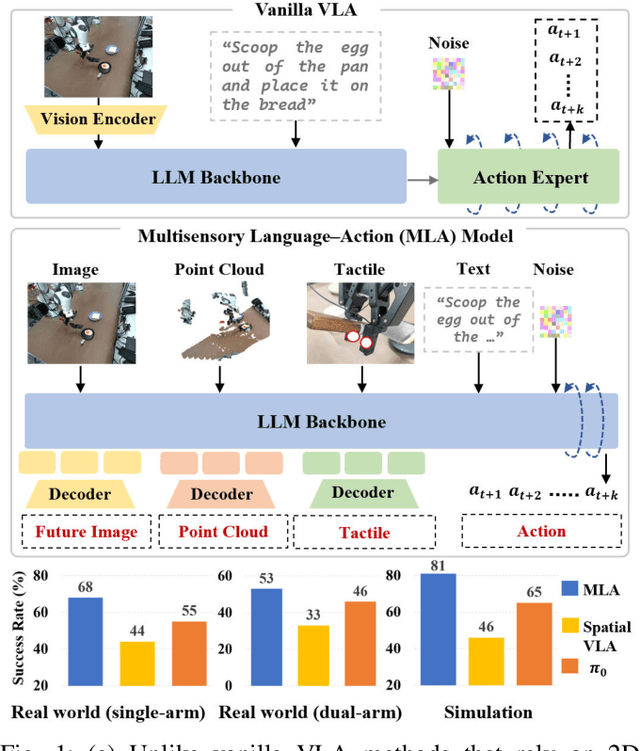
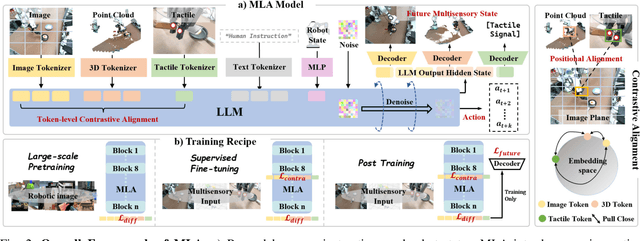
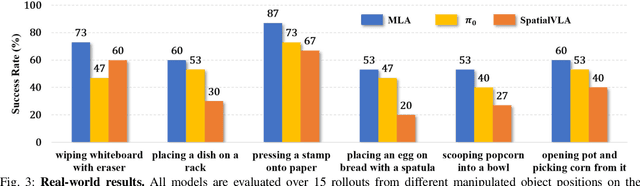
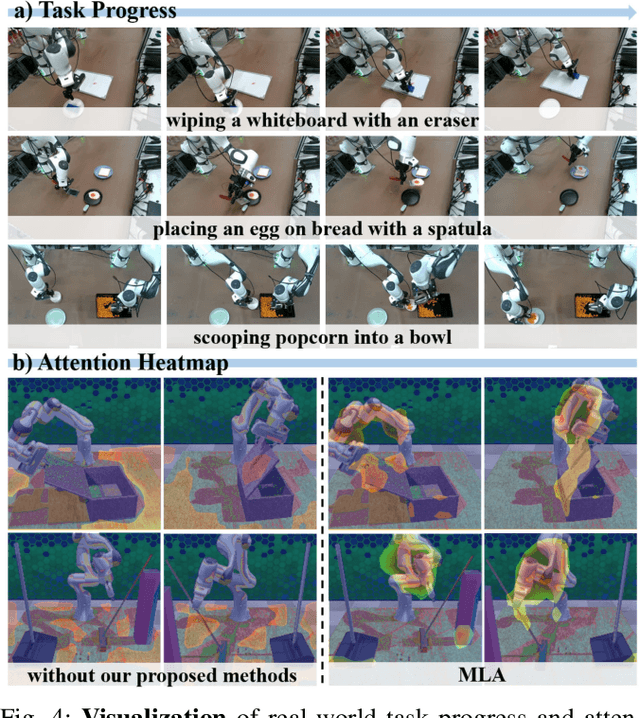
Vision-language-action models (VLAs) have shown generalization capabilities in robotic manipulation tasks by inheriting from vision-language models (VLMs) and learning action generation. Most VLA models focus on interpreting vision and language to generate actions, whereas robots must perceive and interact within the spatial-physical world. This gap highlights the need for a comprehensive understanding of robotic-specific multisensory information, which is crucial for achieving complex and contact-rich control. To this end, we introduce a multisensory language-action (MLA) model that collaboratively perceives heterogeneous sensory modalities and predicts future multisensory objectives to facilitate physical world modeling. Specifically, to enhance perceptual representations, we propose an encoder-free multimodal alignment scheme that innovatively repurposes the large language model itself as a perception module, directly interpreting multimodal cues by aligning 2D images, 3D point clouds, and tactile tokens through positional correspondence. To further enhance MLA's understanding of physical dynamics, we design a future multisensory generation post-training strategy that enables MLA to reason about semantic, geometric, and interaction information, providing more robust conditions for action generation. For evaluation, the MLA model outperforms the previous state-of-the-art 2D and 3D VLA methods by 12% and 24% in complex, contact-rich real-world tasks, respectively, while also demonstrating improved generalization to unseen configurations. Project website: https://sites.google.com/view/open-mla
SR3D: Unleashing Single-view 3D Reconstruction for Transparent and Specular Object Grasping
May 30, 2025Recent advancements in 3D robotic manipulation have improved grasping of everyday objects, but transparent and specular materials remain challenging due to depth sensing limitations. While several 3D reconstruction and depth completion approaches address these challenges, they suffer from setup complexity or limited observation information utilization. To address this, leveraging the power of single view 3D object reconstruction approaches, we propose a training free framework SR3D that enables robotic grasping of transparent and specular objects from a single view observation. Specifically, given single view RGB and depth images, SR3D first uses the external visual models to generate 3D reconstructed object mesh based on RGB image. Then, the key idea is to determine the 3D object's pose and scale to accurately localize the reconstructed object back into its original depth corrupted 3D scene. Therefore, we propose view matching and keypoint matching mechanisms,which leverage both the 2D and 3D's inherent semantic and geometric information in the observation to determine the object's 3D state within the scene, thereby reconstructing an accurate 3D depth map for effective grasp detection. Experiments in both simulation and real world show the reconstruction effectiveness of SR3D.
TransDiff: Diffusion-Based Method for Manipulating Transparent Objects Using a Single RGB-D Image
Mar 17, 2025Manipulating transparent objects presents significant challenges due to the complexities introduced by their reflection and refraction properties, which considerably hinder the accurate estimation of their 3D shapes. To address these challenges, we propose a single-view RGB-D-based depth completion framework, TransDiff, that leverages the Denoising Diffusion Probabilistic Models(DDPM) to achieve material-agnostic object grasping in desktop. Specifically, we leverage features extracted from RGB images, including semantic segmentation, edge maps, and normal maps, to condition the depth map generation process. Our method learns an iterative denoising process that transforms a random depth distribution into a depth map, guided by initially refined depth information, ensuring more accurate depth estimation in scenarios involving transparent objects. Additionally, we propose a novel training method to better align the noisy depth and RGB image features, which are used as conditions to refine depth estimation step by step. Finally, we utilized an improved inference process to accelerate the denoising procedure. Through comprehensive experimental validation, we demonstrate that our method significantly outperforms the baselines in both synthetic and real-world benchmarks with acceptable inference time. The demo of our method can be found on https://wang-haoxiao.github.io/TransDiff/