 Add to Chrome
 Add to Firefox
 Add to Edge
Contrastive Action-Image Pre-training for Visuomotor Control
Jun 15, 2026
Existing vision encoders for robotics face a fundamental bottleneck: robotic datasets lack the scale necessary for large-scale pre-training. Prior work circumvents this data scarcity by turning to internet-scale image and language data or egocentric human video. While these models show promise, neither paradigm learns from paired vision and action data, which downstream visuomotor control policies require. However, robot trajectories, the most direct source of this paired signal, are not available at pre-training scale, motivating us to extract action signals from abundant human video instead. To this end, we introduce CAIP (Contrastive Action-Image Pre-training), a vision encoder that treats human hand poses from large-scale egocentric video as a proxy for end-effector actions. By extracting 3D hand keypoints, a representation that aligns naturally with downstream robot action spaces, CAIP learns a unified action-image representation through a contrastive objective. Leveraging 32,041 hours of egocentric human video and only 88 hours of robotic manipulation data, CAIP outperforms state-of-the-art vision encoders including DINOv2, SigLIP, MVP, and R3M. Evaluated on a challenging real-world dexterous manipulation setup using Dexmate Vega and Sharpa Wave hands, CAIP yields performance gains of more than 30% on tasks involving folding, pouring, and fine-grained manipulation. Our results show that our method of contrastive action-centric pre-training yields a scalable path to achieving robust visual representations better suited for physical interaction.

T-Rex: Tactile-Reactive Dexterous Manipulation
Jun 15, 2026The ability to react dynamically to tactile signals has long been considered crucial to agile human-level dexterity. Yet contemporary learning-based Vision-Language-Action (VLA) models for robotic manipulation generally either overlook the tactile modality or are limited to encoders with static cues, due in part to the scarcity of diverse training data and standardized evaluation, architectural constraints in current VLA models, and limitations of static tactile encoders. In this paper, we push the frontier of tactile-reactive manipulation by addressing all of these limitations. We propose a large-scale, 100-hour tactile-rich dataset collected via a novel, data-efficient recipe that prioritizes elementary motor primitives. To effectively exploit naturally high-frequency touch signals without sacrificing the existing capabilities of existing VLAs, we introduce a variable-rate Mixture-of-Transformers (MoT) architecture equipped with a novel temporal tactile VQ-VAE encoder. We demonstrate the effectiveness of tactile-reactive policies on 12 manipulation tasks requiring delicate force control and deformable object manipulation, achieving over 30% higher average success rate than the strongest baseline.
FTP-1: A Generalist Foundation Tactile Policy Across Tactile Sensors for Contact-Rich Manipulation
Jun 11, 2026Despite the success of vision-based generalist robotic policies, existing tactile-based policies remain tied to fixed embodiments and sensor setups. This is because tactile signals are highly heterogeneous across hardware, making cross-sensor generalization difficult. We present FTP-1,the first generalist foundation tactile policy pretrained to acquire transferable tactile manipulation abilities across diverse sensors and embodiments. FTP-1 supports varied tactile inputs, including image-, array-, and state-based signals, by using heterogeneous encoders to project them into unified morphology-aware latent tokens that are jointly modeled by a shared tactile Transformer expert. Pretrained on around 3,000 hours of tactile manipulation data aggregated from 26 data sources, spanning human and robot demonstrations across 21 sensors, FTP-1 learns tactile skills that transfer beyond the sensors seen during pretraining. Across downstream finetuning experiments spanning 5 hardware configurations, FTP-1 improves contact-rich manipulation on seen sensor setups by +17.2% and, surprisingly, transfers to two previously unseen tactile-sensor setups, achieving a +31% gain in success rate. FTP-1 establishes the first unified foundation baseline for tactile manipulation, providing future tactile policies with a shared model-level starting point. Pretrained models, datasets, training code and more visualization at https://ftp1-policy.github.io.
ZoomSpec: A Physics-Guided Coarse-to-Fine Framework for Wideband Spectrum Sensing
Apr 15, 2026Wideband spectrum sensing for low-altitude monitoring is critical yet challenging due to heterogeneous protocols,large bandwidths, and non-stationary SNR. Existing data-driven approaches treat spectrograms as natural images,suffering from domain mismatch: they neglect time-frequency resolution constraints and spectral leakage, leading topoor narrowband visibility. This paper proposes ZoomSpec, a physics-guided coarse-to-fine framework integrating signal processing priors with deep learning. We introduce a Log-Space STFT (LS-STFT) to overcome the geometric bottleneck of linear spectrograms, sharpening narrowband structures while maintaining constant relative resolution. A lightweight Coarse Proposal Net (CPN) rapidly screens the full band. To bridge coarse detection and fine recognition, we design an Adaptive Heterodyne Low-Pass (AHLP) module that executes center-frequency aligning, bandwidth-matched filtering, and safe decimation, purifying signals of out-of-band interference. A Fine Recognition Net (FRN) fuses purified time-domain I/Q with spectral magnitude via dual-domain attention to jointly refine temporal boundaries and modulation classification. Evaluations on the SpaceNet real-world dataset demonstrate state-of-the-art 78.1 mAP@0.5:0.95, surpassing existing leaderboard systems with superior stability across diverse modulation bandwidths.
Look Before Acting: Enhancing Vision Foundation Representations for Vision-Language-Action Models
Mar 17, 2026Vision-Language-Action (VLA) models have recently emerged as a promising paradigm for robotic manipulation, in which reliable action prediction critically depends on accurately interpreting and integrating visual observations conditioned on language instructions. Although recent works have sought to enhance the visual capabilities of VLA models, most approaches treat the LLM backbone as a black box, providing limited insight into how visual information is grounded into action generation. Therefore, we perform a systematic analysis of multiple VLA models across different action-generation paradigms and observe that sensitivity to visual tokens progressively decreases in deeper layers during action generation. Motivated by this observation, we propose \textbf{DeepVision-VLA}, built on a \textbf{Vision-Language Mixture-of-Transformers (VL-MoT)} framework. This framework enables shared attention between the vision foundation model and the VLA backbone, injecting multi-level visual features from the vision expert into deeper layers of the VLA backbone to enhance visual representations for precise and complex manipulation. In addition, we introduce \textbf{Action-Guided Visual Pruning (AGVP)}, which leverages shallow-layer attention to prune irrelevant visual tokens while preserving task-relevant ones, reinforcing critical visual cues for manipulation with minimal computational overhead. DeepVision-VLA outperforms prior state-of-the-art methods by 9.0\% and 7.5\% on simulated and real-world tasks, respectively, providing new insights for the design of visually enhanced VLA models.
Learnable Template Matching Approach for Micro-Deformation Monitoring based on Integrated Sensing and Communication Platform
Mar 12, 2026Existing integrated sensing and communication (ISAC) platforms fail to fully utilize the shared spectrum and aperture resources for sensing, resulting in poor sensing performance. Specifically, weak target sensing on the ISAC platform, such as micro-deformation monitoring (mDM), suffers from inaccurate measurements due to poor sensing quality. In this paper, we propose an AI-assisted approach to alleviate the effect of poor sensing quality in the ISAC system by effectively removing the clutter. We begin by modeling the environment clutter model as a combination of the deterministic and stochastic signals to represent urban coverage scenarios around the base station (BS). A clutter suppression optimization problem is formulated to extract the micro-deformation displacement (mDD) from the original ISAC signals. We then propose a learnable template-matching (LTM) approach to mitigate the influences of clutters, thereby enhancing sensing quality. In particular, the electromagnetic (EM) signal feature of the mDD is embedded into the network to strengthen the mDM signal, and clutter filters are incorporated to suppress environmental clutter. Numerical results illustrate the superiority of our proposed approach concerning convergence speed and accuracy in mDD prediction. By deploying our approach to the BS measurement, the simulation-only trained LTM exhibits impressive performance in environment clutter separation and mDD estimation.
TwinRL-VLA: Digital Twin-Driven Reinforcement Learning for Real-World Robotic Manipulation
Feb 09, 2026Despite strong generalization capabilities, Vision-Language-Action (VLA) models remain constrained by the high cost of expert demonstrations and insufficient real-world interaction. While online reinforcement learning (RL) has shown promise in improving general foundation models, applying RL to VLA manipulation in real-world settings is still hindered by low exploration efficiency and a restricted exploration space. Through systematic real-world experiments, we observe that the effective exploration space of online RL is closely tied to the data distribution of supervised fine-tuning (SFT). Motivated by this observation, we propose TwinRL, a digital twin-real-world collaborative RL framework designed to scale and guide exploration for VLA models. First, a high-fidelity digital twin is efficiently reconstructed from smartphone-captured scenes, enabling realistic bidirectional transfer between real and simulated environments. During the SFT warm-up stage, we introduce an exploration space expansion strategy using digital twins to broaden the support of the data trajectory distribution. Building on this enhanced initialization, we propose a sim-to-real guided exploration strategy to further accelerate online RL. Specifically, TwinRL performs efficient and parallel online RL in the digital twin prior to deployment, effectively bridging the gap between offline and online training stages. Subsequently, we exploit efficient digital twin sampling to identify failure-prone yet informative configurations, which are used to guide targeted human-in-the-loop rollouts on the real robot. In our experiments, TwinRL approaches 100% success in both in-distribution regions covered by real-world demonstrations and out-of-distribution regions, delivering at least a 30% speedup over prior real-world RL methods and requiring only about 20 minutes on average across four tasks.
RoboMIND 2.0: A Multimodal, Bimanual Mobile Manipulation Dataset for Generalizable Embodied Intelligence
Dec 31, 2025While data-driven imitation learning has revolutionized robotic manipulation, current approaches remain constrained by the scarcity of large-scale, diverse real-world demonstrations. Consequently, the ability of existing models to generalize across long-horizon bimanual tasks and mobile manipulation in unstructured environments remains limited. To bridge this gap, we present RoboMIND 2.0, a comprehensive real-world dataset comprising over 310K dual-arm manipulation trajectories collected across six distinct robot embodiments and 739 complex tasks. Crucially, to support research in contact-rich and spatially extended tasks, the dataset incorporates 12K tactile-enhanced episodes and 20K mobile manipulation trajectories. Complementing this physical data, we construct high-fidelity digital twins of our real-world environments, releasing an additional 20K-trajectory simulated dataset to facilitate robust sim-to-real transfer. To fully exploit the potential of RoboMIND 2.0, we propose MIND-2 system, a hierarchical dual-system frame-work optimized via offline reinforcement learning. MIND-2 integrates a high-level semantic planner (MIND-2-VLM) to decompose abstract natural language instructions into grounded subgoals, coupled with a low-level Vision-Language-Action executor (MIND-2-VLA), which generates precise, proprioception-aware motor actions.
Aerial Vision-Language Navigation with a Unified Framework for Spatial, Temporal and Embodied Reasoning
Dec 09, 2025Aerial Vision-and-Language Navigation (VLN) aims to enable unmanned aerial vehicles (UAVs) to interpret natural language instructions and navigate complex urban environments using onboard visual observation. This task holds promise for real-world applications such as low-altitude inspection, search-and-rescue, and autonomous aerial delivery. Existing methods often rely on panoramic images, depth inputs, or odometry to support spatial reasoning and action planning. These requirements increase system cost and integration complexity, thus hindering practical deployment for lightweight UAVs. We present a unified aerial VLN framework that operates solely on egocentric monocular RGB observations and natural language instructions. The model formulates navigation as a next-token prediction problem, jointly optimizing spatial perception, trajectory reasoning, and action prediction through prompt-guided multi-task learning. Moreover, we propose a keyframe selection strategy to reduce visual redundancy by retaining semantically informative frames, along with an action merging and label reweighting mechanism that mitigates long-tailed supervision imbalance and facilitates stable multi-task co-training. Extensive experiments on the Aerial VLN benchmark validate the effectiveness of our method. Under the challenging monocular RGB-only setting, our model achieves strong results across both seen and unseen environments. It significantly outperforms existing RGB-only baselines and narrows the performance gap with state-of-the-art panoramic RGB-D counterparts. Comprehensive ablation studies further demonstrate the contribution of our task design and architectural choices.
MLA: A Multisensory Language-Action Model for Multimodal Understanding and Forecasting in Robotic Manipulation
Sep 30, 2025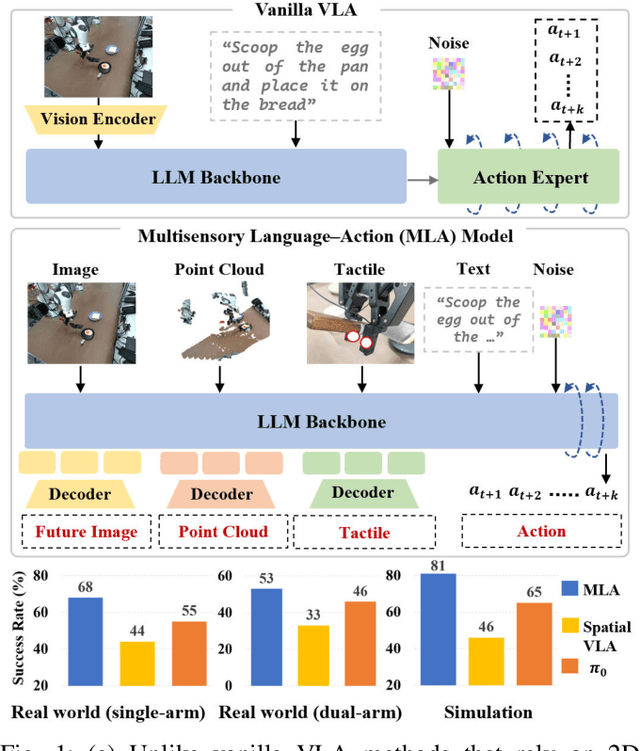
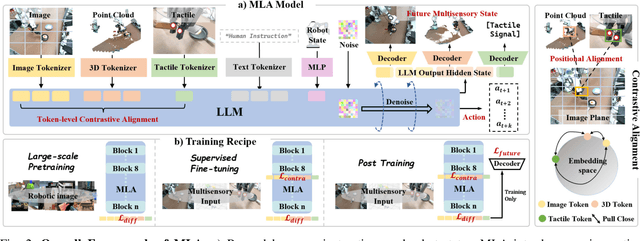
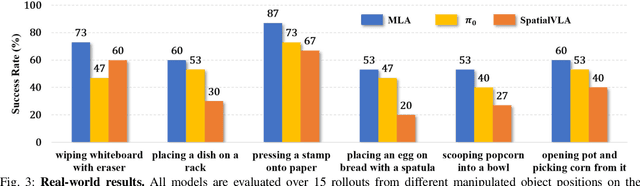
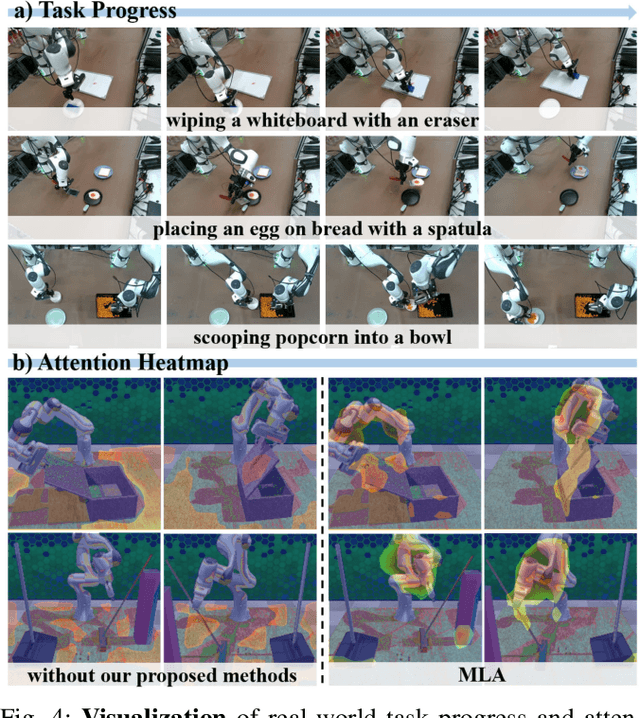
Vision-language-action models (VLAs) have shown generalization capabilities in robotic manipulation tasks by inheriting from vision-language models (VLMs) and learning action generation. Most VLA models focus on interpreting vision and language to generate actions, whereas robots must perceive and interact within the spatial-physical world. This gap highlights the need for a comprehensive understanding of robotic-specific multisensory information, which is crucial for achieving complex and contact-rich control. To this end, we introduce a multisensory language-action (MLA) model that collaboratively perceives heterogeneous sensory modalities and predicts future multisensory objectives to facilitate physical world modeling. Specifically, to enhance perceptual representations, we propose an encoder-free multimodal alignment scheme that innovatively repurposes the large language model itself as a perception module, directly interpreting multimodal cues by aligning 2D images, 3D point clouds, and tactile tokens through positional correspondence. To further enhance MLA's understanding of physical dynamics, we design a future multisensory generation post-training strategy that enables MLA to reason about semantic, geometric, and interaction information, providing more robust conditions for action generation. For evaluation, the MLA model outperforms the previous state-of-the-art 2D and 3D VLA methods by 12% and 24% in complex, contact-rich real-world tasks, respectively, while also demonstrating improved generalization to unseen configurations. Project website: https://sites.google.com/view/open-mla