 Add to Chrome
 Add to Firefox
 Add to Edge
Similarity Is Not Logic: Factored Inference for Dual-Encoder Vision-Language Models
Jul 25, 2026
Dual-encoder vision-language models (VLMs) expose a similarity interface that enables zero-shot retrieval but fails compositional constraints: queries like "umbrella and no person" retrieve images containing both, even when concept detection is reliable. We trace this to an interface-level Bag-of-Concepts effect, where similarity scores approximate mean pooling of concept evidence regardless of operators. Although operator-dependent signals exist in text embeddings, they are too weak or misaligned to affect rankings. Fine-tuning does not reliably resolve this failure because the dominant bottleneck is how similarity aggregates evidence rather than what encoders represent. We propose factored inference, which separates evidence extraction from constraint execution, and introduce LCSE (Logic-Constrained Score Editing), a training-free method that executes constraints externally using concept scores from frozen encoders. We also introduce FACTOR-Bench, where LCSE achieves 85.5% accuracy versus 73.2% for the best fine-tuned baseline, 90.7% when applied to SigLIP 2, and improves NegBench COCO MCQ accuracy from 27.2% to 65.2% while preserving retrieval performance.

When to Re-Commit: Temporal Abstraction Discovery for Long-Horizon Vision-Language Reasoning
May 11, 2026Long-horizon reasoning requires deciding not only what actions to take, but how deeply to commit before the next observation. We formalize this as \emph{commitment depth}: the number of primitive actions executed open-loop between replans. Commitment depth induces a trade-off between replanning cost and compounding execution error, yet most existing long-horizon systems fix it as a hand-designed scalar. In this work, we instead treat commitment depth as a learnable, state-conditioned variable of the policy itself. We instantiate this within a model-native vision--language policy that jointly predicts both what to execute and for how long. Across Sliding Puzzle and Sokoban, the resulting adaptive policy Pareto-dominates every non-degenerate fixed-depth baseline, achieving up to 12.5 percentage points higher solve rate while using approximately 25\% fewer primitive actions per episode. Despite using a 7B backbone, our method outperforms GPT-5.5 and Claude Sonnet on both tasks, while every tested open-weight vision--language model achieves 0\% zero-shot success. We further present a theoretical analysis showing that, under the standard commitment-depth surrogate, state-conditioned commitment strictly dominates any fixed depth whenever the locally optimal depth varies across states.
TorchUMM: A Unified Multimodal Model Codebase for Evaluation, Analysis, and Post-training
Apr 12, 2026Recent advances in unified multimodal models (UMMs) have led to a proliferation of architectures capable of understanding, generating, and editing across visual and textual modalities. However, developing a unified framework for UMMs remains challenging due to the diversity of model architectures and the heterogeneity of training paradigms and implementation details. In this paper, we present TorchUMM, the first unified codebase for comprehensive evaluation, analysis, and post-training across diverse UMM backbones, tasks, and datasets. TorchUMM supports a broad spectrum of models covering a wide range of scales and design paradigms. Our benchmark encompasses three core task dimensions: multimodal understanding, generation, and editing, and integrates both established and novel datasets to evaluate perception, reasoning, compositionality, and instruction-following abilities. By providing a unified interface and standardized evaluation protocols, TorchUMM enables fair and reproducible comparisons across heterogeneous models and fosters deeper insights into their strengths and limitations, facilitating the development of more capable unified multimodal systems. Code is available at: https://github.com/AIFrontierLab/TorchUMM.
Self-Corrected Image Generation with Explainable Latent Rewards
Mar 26, 2026Despite significant progress in text-to-image generation, aligning outputs with complex prompts remains challenging, particularly for fine-grained semantics and spatial relations. This difficulty stems from the feed-forward nature of generation, which requires anticipating alignment without fully understanding the output. In contrast, evaluating generated images is more tractable. Motivated by this asymmetry, we propose xLARD, a self-correcting framework that uses multimodal large language models to guide generation through Explainable LAtent RewarDs. xLARD introduces a lightweight corrector that refines latent representations based on structured feedback from model-generated references. A key component is a differentiable mapping from latent edits to interpretable reward signals, enabling continuous latent-level guidance from non-differentiable image-level evaluations. This mechanism allows the model to understand, assess, and correct itself during generation. Experiments across diverse generation and editing tasks show that xLARD improves semantic alignment and visual fidelity while maintaining generative priors. Code is available at https://yinyiluo.github.io/xLARD/.
Reward Evolution with Graph-of-Thoughts: A Bi-Level Language Model Framework for Reinforcement Learning
Sep 19, 2025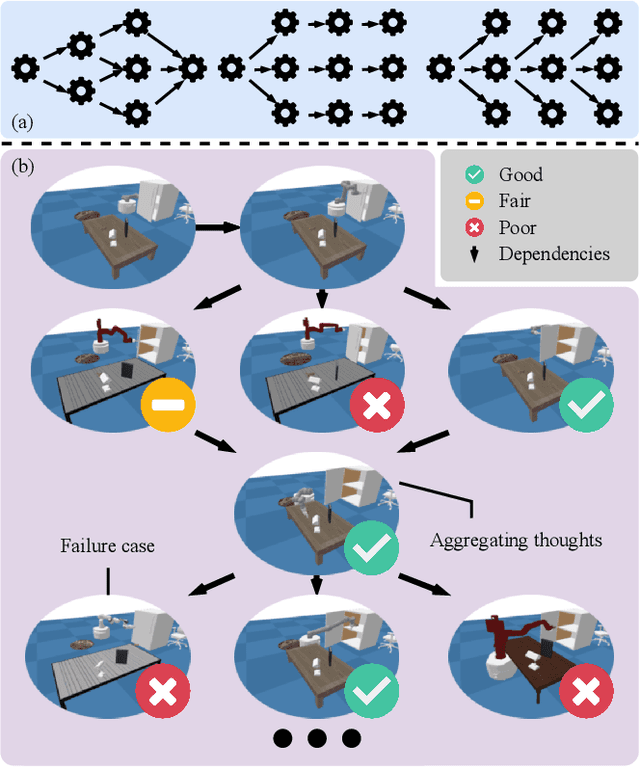
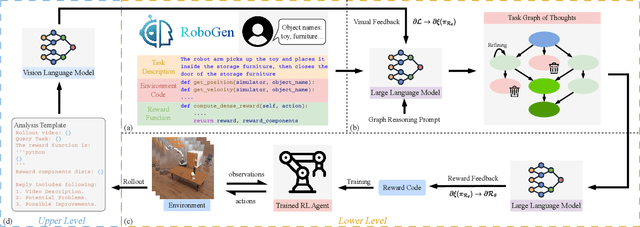
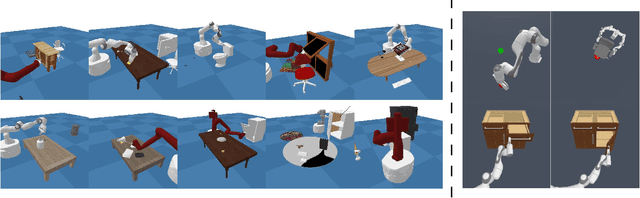
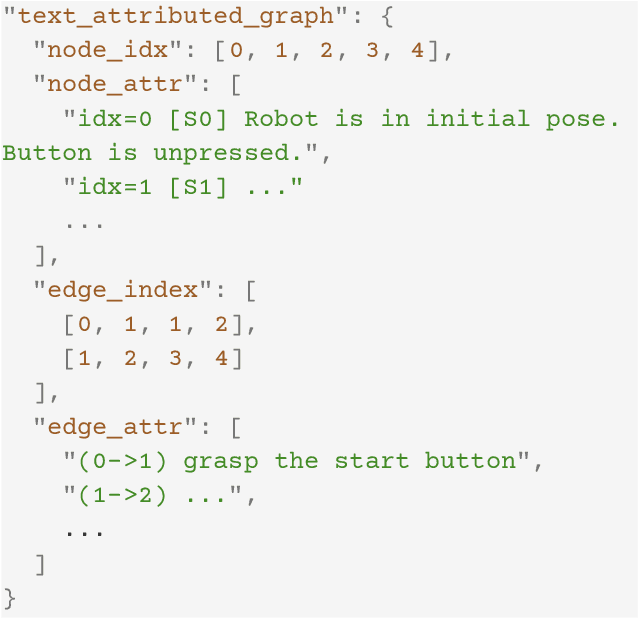
Designing effective reward functions remains a major challenge in reinforcement learning (RL), often requiring considerable human expertise and iterative refinement. Recent advances leverage Large Language Models (LLMs) for automated reward design, but these approaches are limited by hallucinations, reliance on human feedback, and challenges with handling complex, multi-step tasks. In this work, we introduce Reward Evolution with Graph-of-Thoughts (RE-GoT), a novel bi-level framework that enhances LLMs with structured graph-based reasoning and integrates Visual Language Models (VLMs) for automated rollout evaluation. RE-GoT first decomposes tasks into text-attributed graphs, enabling comprehensive analysis and reward function generation, and then iteratively refines rewards using visual feedback from VLMs without human intervention. Extensive experiments on 10 RoboGen and 4 ManiSkill2 tasks demonstrate that RE-GoT consistently outperforms existing LLM-based baselines. On RoboGen, our method improves average task success rates by 32.25%, with notable gains on complex multi-step tasks. On ManiSkill2, RE-GoT achieves an average success rate of 93.73% across four diverse manipulation tasks, significantly surpassing prior LLM-based approaches and even exceeding expert-designed rewards. Our results indicate that combining LLMs and VLMs with graph-of-thoughts reasoning provides a scalable and effective solution for autonomous reward evolution in RL.
Image Tokenizer Needs Post-Training
Sep 15, 2025Recent image generative models typically capture the image distribution in a pre-constructed latent space, relying on a frozen image tokenizer. However, there exists a significant discrepancy between the reconstruction and generation distribution, where current tokenizers only prioritize the reconstruction task that happens before generative training without considering the generation errors during sampling. In this paper, we comprehensively analyze the reason for this discrepancy in a discrete latent space, and, from which, we propose a novel tokenizer training scheme including both main-training and post-training, focusing on improving latent space construction and decoding respectively. During the main training, a latent perturbation strategy is proposed to simulate sampling noises, \ie, the unexpected tokens generated in generative inference. Specifically, we propose a plug-and-play tokenizer training scheme, which significantly enhances the robustness of tokenizer, thus boosting the generation quality and convergence speed, and a novel tokenizer evaluation metric, \ie, pFID, which successfully correlates the tokenizer performance to generation quality. During post-training, we further optimize the tokenizer decoder regarding a well-trained generative model to mitigate the distribution difference between generated and reconstructed tokens. With a $\sim$400M generator, a discrete tokenizer trained with our proposed main training achieves a notable 1.60 gFID and further obtains 1.36 gFID with the additional post-training. Further experiments are conducted to broadly validate the effectiveness of our post-training strategy on off-the-shelf discrete and continuous tokenizers, coupled with autoregressive and diffusion-based generators.
STELAR-VISION: Self-Topology-Aware Efficient Learning for Aligned Reasoning in Vision
Aug 12, 2025Vision-language models (VLMs) have made significant strides in reasoning, yet they often struggle with complex multimodal tasks and tend to generate overly verbose outputs. A key limitation is their reliance on chain-of-thought (CoT) reasoning, despite many tasks benefiting from alternative topologies like trees or graphs. To address this, we introduce STELAR-Vision, a training framework for topology-aware reasoning. At its core is TopoAug, a synthetic data pipeline that enriches training with diverse topological structures. Using supervised fine-tuning and reinforcement learning, we post-train Qwen2VL models with both accuracy and efficiency in mind. Additionally, we propose Frugal Learning, which reduces output length with minimal accuracy loss. On MATH-V and VLM-S2H, STELAR-Vision improves accuracy by 9.7% over its base model and surpasses the larger Qwen2VL-72B-Instruct by 7.3%. On five out-of-distribution benchmarks, it outperforms Phi-4-Multimodal-Instruct by up to 28.4% and LLaMA-3.2-11B-Vision-Instruct by up to 13.2%, demonstrating strong generalization. Compared to Chain-Only training, our approach achieves 4.3% higher overall accuracy on in-distribution datasets and consistently outperforms across all OOD benchmarks. We have released datasets, and code will be available.
Robust Latent Matters: Boosting Image Generation with Sampling Error
Mar 11, 2025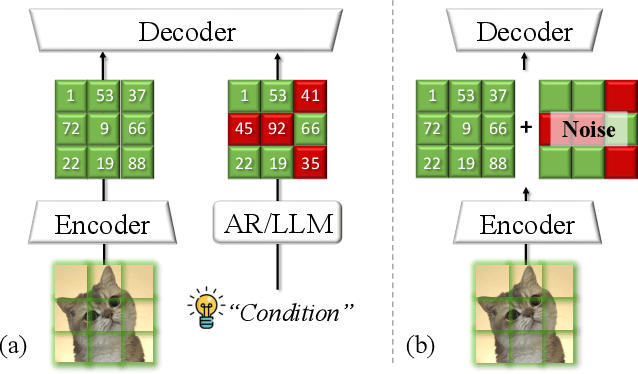
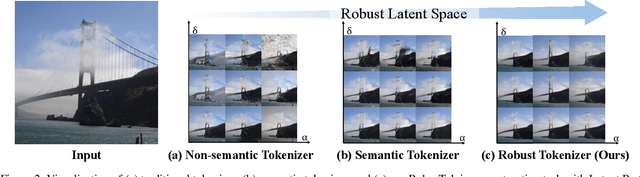
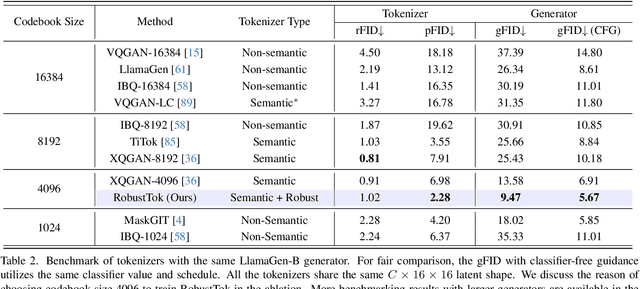
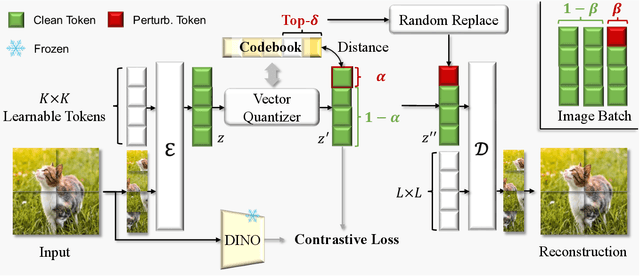
Recent image generation schemes typically capture image distribution in a pre-constructed latent space relying on a frozen image tokenizer. Though the performance of tokenizer plays an essential role to the successful generation, its current evaluation metrics (e.g. rFID) fail to precisely assess the tokenizer and correlate its performance to the generation quality (e.g. gFID). In this paper, we comprehensively analyze the reason for the discrepancy of reconstruction and generation qualities in a discrete latent space, and, from which, we propose a novel plug-and-play tokenizer training scheme to facilitate latent space construction. Specifically, a latent perturbation approach is proposed to simulate sampling noises, i.e., the unexpected tokens sampled, from the generative process. With the latent perturbation, we further propose (1) a novel tokenizer evaluation metric, i.e., pFID, which successfully correlates the tokenizer performance to generation quality and (2) a plug-and-play tokenizer training scheme, which significantly enhances the robustness of tokenizer thus boosting the generation quality and convergence speed. Extensive benchmarking are conducted with 11 advanced discrete image tokenizers with 2 autoregressive generation models to validate our approach. The tokenizer trained with our proposed latent perturbation achieve a notable 1.60 gFID with classifier-free guidance (CFG) and 3.45 gFID without CFG with a $\sim$400M generator. Code: https://github.com/lxa9867/ImageFolder.
SOLAR: Scalable Optimization of Large-scale Architecture for Reasoning
Mar 06, 2025Large Language Models (LLMs) excel in reasoning but remain constrained by their Chain-of-Thought (CoT) approach, which struggles with complex tasks requiring more nuanced topological reasoning. We introduce SOLAR, Scalable Optimization of Large-scale Architecture for Reasoning, a framework that dynamically optimizes various reasoning topologies to enhance accuracy and efficiency. Our Topological Annotation Generation (TAG) system automates topological dataset creation and segmentation, improving post-training and evaluation. Additionally, we propose Topological-Scaling, a reward-driven framework that aligns training and inference scaling, equipping LLMs with adaptive, task-aware reasoning. SOLAR achieves substantial gains on MATH and GSM8K: +5% accuracy with Topological Tuning, +9% with Topological Reward, and +10.02% with Hybrid Scaling. It also reduces response length by over 5% for complex problems, lowering inference latency. To foster the reward system, we train a multi-task Topological Reward Model (M-TRM), which autonomously selects the best reasoning topology and answer in a single pass, eliminating the need for training and inference on multiple single-task TRMs (S-TRMs), thus reducing both training cost and inference latency. In addition, in terms of performance, M-TRM surpasses all S-TRMs, improving accuracy by +10% and rank correlation by +9%. To the best of our knowledge, SOLAR sets a new benchmark for scalable, high-precision LLM reasoning while introducing an automated annotation process and a dynamic reasoning topology competition mechanism.
Hierarchical Knowledge Graph Construction from Images for Scalable E-Commerce
Oct 28, 2024

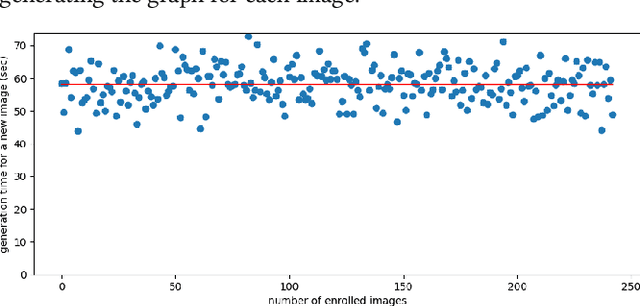
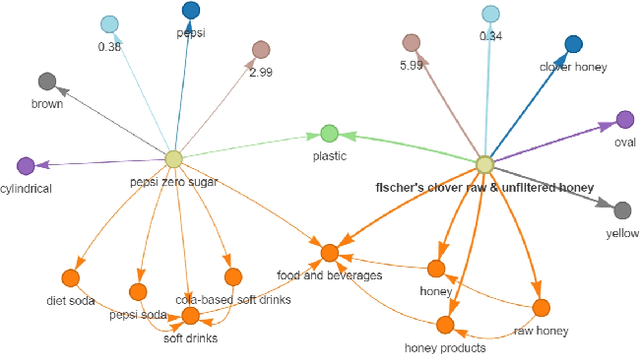
Knowledge Graph (KG) is playing an increasingly important role in various AI systems. For e-commerce, an efficient and low-cost automated knowledge graph construction method is the foundation of enabling various successful downstream applications. In this paper, we propose a novel method for constructing structured product knowledge graphs from raw product images. The method cooperatively leverages recent advances in the vision-language model (VLM) and large language model (LLM), fully automating the process and allowing timely graph updates. We also present a human-annotated e-commerce product dataset for benchmarking product property extraction in knowledge graph construction. Our method outperforms our baseline in all metrics and evaluated properties, demonstrating its effectiveness and bright usage potential.