 Add to Chrome
 Add to Firefox
 Add to Edge
AnchorVLA4D: an Anchor-Based Spatial-Temporal Vision-Language-Action Model for Robotic Manipulation
Mar 13, 2026
Since current Vision-Language-Action (VLA) systems suffer from limited spatial perception and the absence of memory throughout manipulation, we investigate visual anchors as a means to enhance spatial and temporal reasoning within VLA policies for robotic manipulation. Conventional VLAs generate actions by conditioning on a single current frame together with a language instruction. However, since the frame is encoded as a 2D image, it does not contain detailed spatial information, and the VLA similarly lacks any means to incorporate past context. As a result, it frequently forgets objects under occlusion and becomes spatially disoriented during the manipulation process. Thus, we propose AnchorVLA4D, a simple spatial-temporal VLA that augments the visual input with an anchor image to preserve the initial scene context throughout execution, and adds a lightweight spatial encoder that jointly processes the anchor and current frames to expose geometric relationships within an episode. Built on a Qwen2.5-VL backbone with a diffusion-based action head, AnchorVLA4D requires no additional sensing modalities (e.g., depth or point clouds) and introduces negligible inference overhead. Combining anchoring with a frozen pretrained spatial encoder yields further gains, realizing a 13.6% improvement on the Simpler WidowX benchmark and confirming the approach on real-world tasks, where it achieved an average success rate of 80%.

MLA: A Multisensory Language-Action Model for Multimodal Understanding and Forecasting in Robotic Manipulation
Sep 30, 2025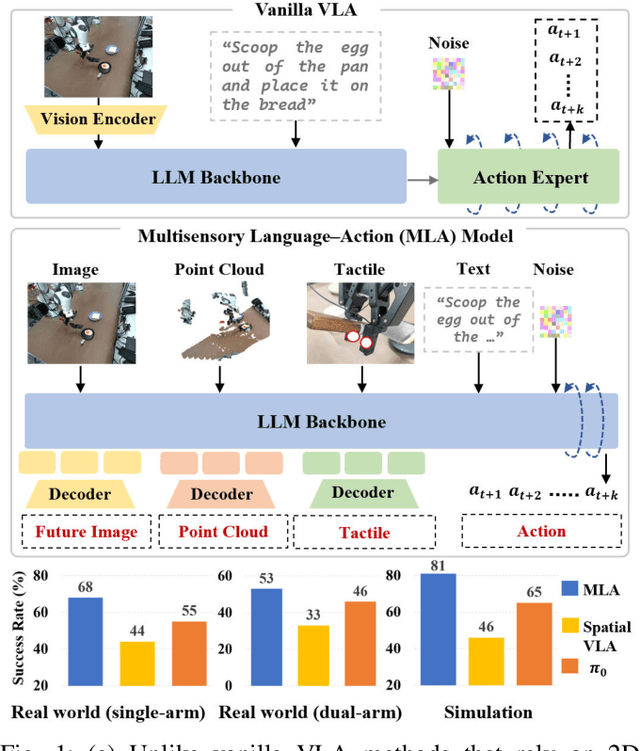
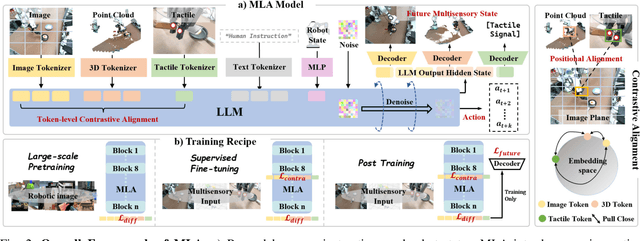
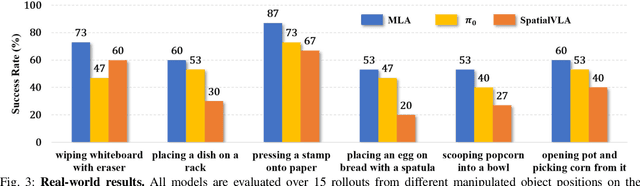
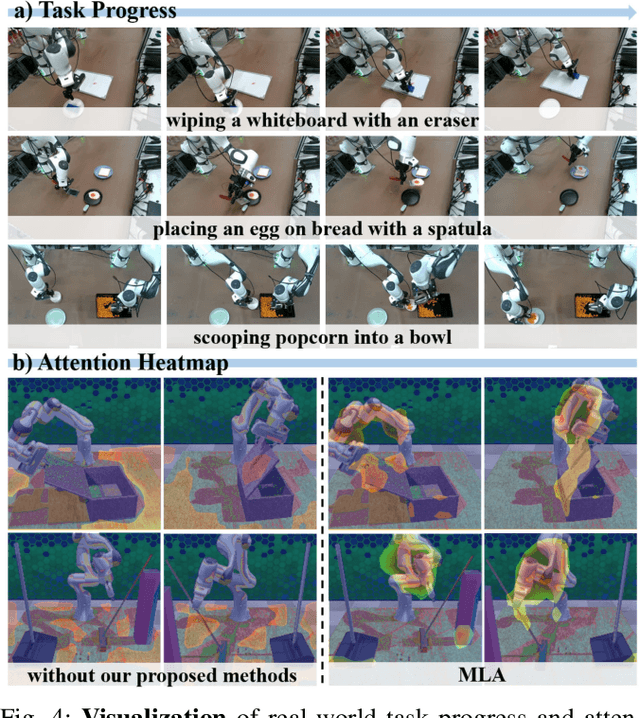
Vision-language-action models (VLAs) have shown generalization capabilities in robotic manipulation tasks by inheriting from vision-language models (VLMs) and learning action generation. Most VLA models focus on interpreting vision and language to generate actions, whereas robots must perceive and interact within the spatial-physical world. This gap highlights the need for a comprehensive understanding of robotic-specific multisensory information, which is crucial for achieving complex and contact-rich control. To this end, we introduce a multisensory language-action (MLA) model that collaboratively perceives heterogeneous sensory modalities and predicts future multisensory objectives to facilitate physical world modeling. Specifically, to enhance perceptual representations, we propose an encoder-free multimodal alignment scheme that innovatively repurposes the large language model itself as a perception module, directly interpreting multimodal cues by aligning 2D images, 3D point clouds, and tactile tokens through positional correspondence. To further enhance MLA's understanding of physical dynamics, we design a future multisensory generation post-training strategy that enables MLA to reason about semantic, geometric, and interaction information, providing more robust conditions for action generation. For evaluation, the MLA model outperforms the previous state-of-the-art 2D and 3D VLA methods by 12% and 24% in complex, contact-rich real-world tasks, respectively, while also demonstrating improved generalization to unseen configurations. Project website: https://sites.google.com/view/open-mla