 Add to Chrome
 Add to Firefox
 Add to Edge
One-Shot Segmentation
Papers and Code
Reinforcement Learning for Micro-Level Claims Reserving
Jan 12, 2026
Outstanding claim liabilities are revised repeatedly as claims develop, yet most modern reserving models are trained as one-shot predictors and typically learn only from settled claims. We formulate individual claims reserving as a claim-level Markov decision process in which an agent sequentially updates outstanding claim liability (OCL) estimates over development, using continuous actions and a reward design that balances accuracy with stable reserve revisions. A key advantage of this reinforcement learning (RL) approach is that it can learn from all observed claim trajectories, including claims that remain open at valuation, thereby avoiding the reduced sample size and selection effects inherent in supervised methods trained on ultimate outcomes only. We also introduce practical components needed for actuarial use -- initialisation of new claims, temporally consistent tuning via a rolling-settlement scheme, and an importance-weighting mechanism to mitigate portfolio-level underestimation driven by the rarity of large claims. On CAS and SPLICE synthetic general insurance datasets, the proposed Soft Actor-Critic implementation delivers competitive claim-level accuracy and strong aggregate OCL performance, particularly for the immature claim segments that drive most of the liability.

RSAgent: Learning to Reason and Act for Text-Guided Segmentation via Multi-Turn Tool Invocations
Dec 30, 2025Text-guided object segmentation requires both cross-modal reasoning and pixel grounding abilities. Most recent methods treat text-guided segmentation as one-shot grounding, where the model predicts pixel prompts in a single forward pass to drive an external segmentor, which limits verification, refocusing and refinement when initial localization is wrong. To address this limitation, we propose RSAgent, an agentic Multimodal Large Language Model (MLLM) which interleaves reasoning and action for segmentation via multi-turn tool invocations. RSAgent queries a segmentation toolbox, observes visual feedback, and revises its spatial hypothesis using historical observations to re-localize targets and iteratively refine masks. We further build a data pipeline to synthesize multi-turn reasoning segmentation trajectories, and train RSAgent with a two-stage framework: cold-start supervised fine-tuning followed by agentic reinforcement learning with fine-grained, task-specific rewards. Extensive experiments show that RSAgent achieves a zero-shot performance of 66.5% gIoU on ReasonSeg test, improving over Seg-Zero-7B by 9%, and reaches 81.5% cIoU on RefCOCOg, demonstrating state-of-the-art performance on both in-domain and out-of-domain benchmarks.
MisSpans: Fine-Grained False Span Identification in Cross-Domain Fake News
Jan 08, 2026Online misinformation is increasingly pervasive, yet most existing benchmarks and methods evaluate veracity at the level of whole claims or paragraphs using coarse binary labels, obscuring how true and false details often co-exist within single sentences. These simplifications also limit interpretability: global explanations cannot identify which specific segments are misleading or differentiate how a detail is false (e.g., distorted vs. fabricated). To address these gaps, we introduce MisSpans, the first multi-domain, human-annotated benchmark for span-level misinformation detection and analysis, consisting of paired real and fake news stories. MisSpans defines three complementary tasks: MisSpansIdentity for pinpointing false spans within sentences, MisSpansType for categorising false spans by misinformation type, and MisSpansExplanation for providing rationales grounded in identified spans. Together, these tasks enable fine-grained localisation, nuanced characterisation beyond true/false and actionable explanations. Expert annotators were guided by standardised guidelines and consistency checks, leading to high inter-annotator agreement. We evaluate 15 representative LLMs, including reasoning-enhanced and non-reasoning variants, under zero-shot and one-shot settings. Results reveal the challenging nature of fine-grained misinformation identification and analysis, and highlight the need for a deeper understanding of how performance may be influenced by multiple interacting factors, including model size and reasoning capabilities, along with domain-specific textual features. This project will be available at https://github.com/lzw108/MisSpans.
Atlas is Your Perfect Context: One-Shot Customization for Generalizable Foundational Medical Image Segmentation
Dec 20, 2025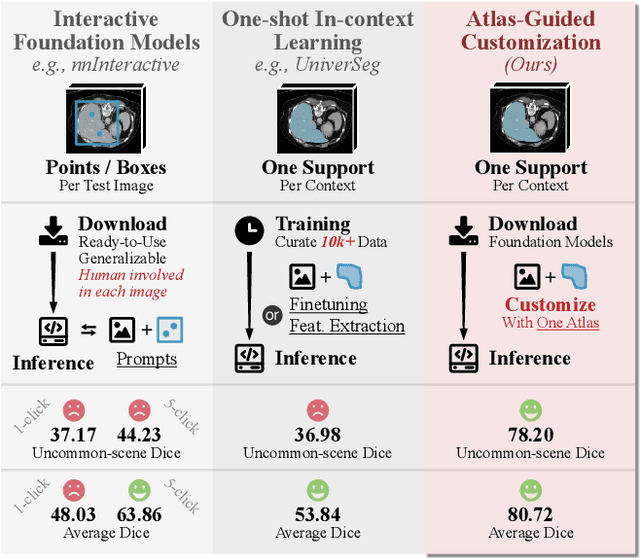
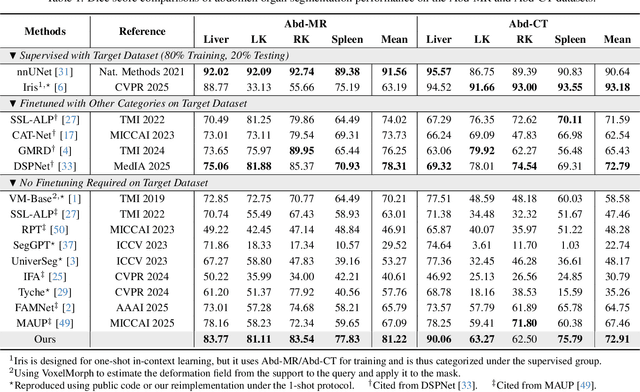
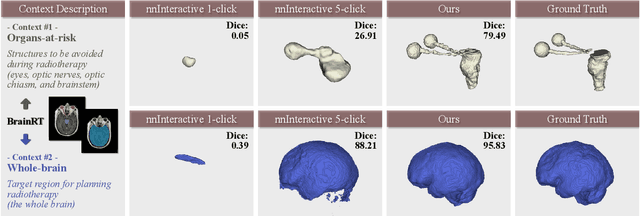
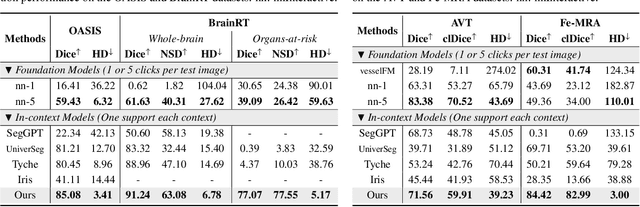
Accurate medical image segmentation is essential for clinical diagnosis and treatment planning. While recent interactive foundation models (e.g., nnInteractive) enhance generalization through large-scale multimodal pretraining, they still depend on precise prompts and often perform below expectations in contexts that are underrepresented in their training data. We present AtlasSegFM, an atlas-guided framework that customizes available foundation models to clinical contexts with a single annotated example. The core innovations are: 1) a pipeline that provides context-aware prompts for foundation models via registration between a context atlas and query images, and 2) a test-time adapter to fuse predictions from both atlas registration and the foundation model. Extensive experiments across public and in-house datasets spanning multiple modalities and organs demonstrate that AtlasSegFM consistently improves segmentation, particularly for small, delicate structures. AtlasSegFM provides a lightweight, deployable solution one-shot customization of foundation models in real-world clinical workflows. The code will be made publicly available.
Name That Part: 3D Part Segmentation and Naming
Dec 19, 2025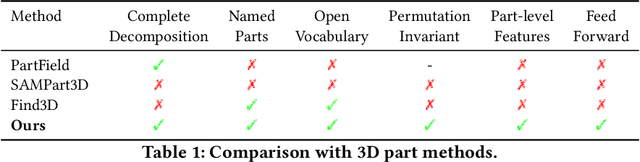
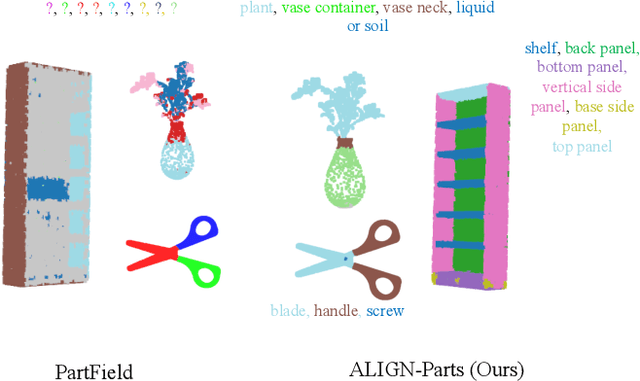

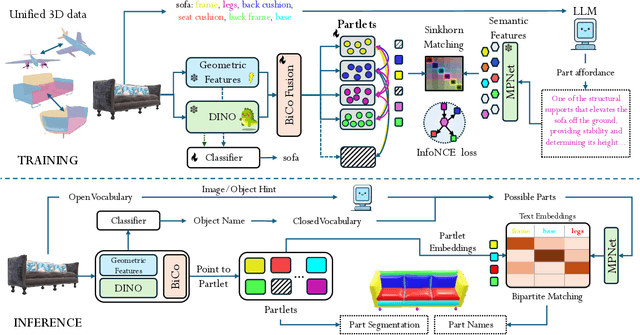
We address semantic 3D part segmentation: decomposing objects into parts with meaningful names. While datasets exist with part annotations, their definitions are inconsistent across datasets, limiting robust training. Previous methods produce unlabeled decompositions or retrieve single parts without complete shape annotations. We propose ALIGN-Parts, which formulates part naming as a direct set alignment task. Our method decomposes shapes into partlets - implicit 3D part representations - matched to part descriptions via bipartite assignment. We combine geometric cues from 3D part fields, appearance from multi-view vision features, and semantic knowledge from language-model-generated affordance descriptions. Text-alignment loss ensures partlets share embedding space with text, enabling a theoretically open-vocabulary matching setup, given sufficient data. Our efficient and novel, one-shot, 3D part segmentation and naming method finds applications in several downstream tasks, including serving as a scalable annotation engine. As our model supports zero-shot matching to arbitrary descriptions and confidence-calibrated predictions for known categories, with human verification, we create a unified ontology that aligns PartNet, 3DCoMPaT++, and Find3D, consisting of 1,794 unique 3D parts. We also show examples from our newly created Tex-Parts dataset. We also introduce 2 novel metrics appropriate for the named 3D part segmentation task.
Counterfactual VLA: Self-Reflective Vision-Language-Action Model with Adaptive Reasoning
Dec 30, 2025Recent reasoning-augmented Vision-Language-Action (VLA) models have improved the interpretability of end-to-end autonomous driving by generating intermediate reasoning traces. Yet these models primarily describe what they perceive and intend to do, rarely questioning whether their planned actions are safe or appropriate. This work introduces Counterfactual VLA (CF-VLA), a self-reflective VLA framework that enables the model to reason about and revise its planned actions before execution. CF-VLA first generates time-segmented meta-actions that summarize driving intent, and then performs counterfactual reasoning conditioned on both the meta-actions and the visual context. This step simulates potential outcomes, identifies unsafe behaviors, and outputs corrected meta-actions that guide the final trajectory generation. To efficiently obtain such self-reflective capabilities, we propose a rollout-filter-label pipeline that mines high-value scenes from a base (non-counterfactual) VLA's rollouts and labels counterfactual reasoning traces for subsequent training rounds. Experiments on large-scale driving datasets show that CF-VLA improves trajectory accuracy by up to 17.6%, enhances safety metrics by 20.5%, and exhibits adaptive thinking: it only enables counterfactual reasoning in challenging scenarios. By transforming reasoning traces from one-shot descriptions to causal self-correction signals, CF-VLA takes a step toward self-reflective autonomous driving agents that learn to think before they act.
DreaMontage: Arbitrary Frame-Guided One-Shot Video Generation
Dec 24, 2025The "one-shot" technique represents a distinct and sophisticated aesthetic in filmmaking. However, its practical realization is often hindered by prohibitive costs and complex real-world constraints. Although emerging video generation models offer a virtual alternative, existing approaches typically rely on naive clip concatenation, which frequently fails to maintain visual smoothness and temporal coherence. In this paper, we introduce DreaMontage, a comprehensive framework designed for arbitrary frame-guided generation, capable of synthesizing seamless, expressive, and long-duration one-shot videos from diverse user-provided inputs. To achieve this, we address the challenge through three primary dimensions. (i) We integrate a lightweight intermediate-conditioning mechanism into the DiT architecture. By employing an Adaptive Tuning strategy that effectively leverages base training data, we unlock robust arbitrary-frame control capabilities. (ii) To enhance visual fidelity and cinematic expressiveness, we curate a high-quality dataset and implement a Visual Expression SFT stage. In addressing critical issues such as subject motion rationality and transition smoothness, we apply a Tailored DPO scheme, which significantly improves the success rate and usability of the generated content. (iii) To facilitate the production of extended sequences, we design a Segment-wise Auto-Regressive (SAR) inference strategy that operates in a memory-efficient manner. Extensive experiments demonstrate that our approach achieves visually striking and seamlessly coherent one-shot effects while maintaining computational efficiency, empowering users to transform fragmented visual materials into vivid, cohesive one-shot cinematic experiences.
Chain-of-Generation: Progressive Latent Diffusion for Text-Guided Molecular Design
Nov 14, 2025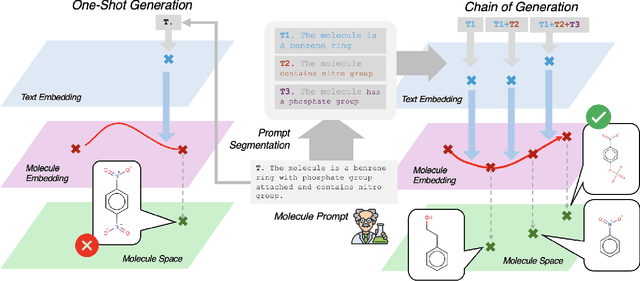
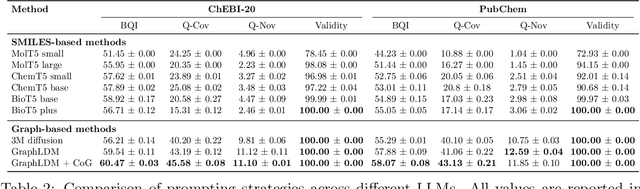
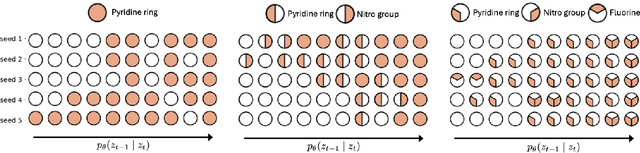
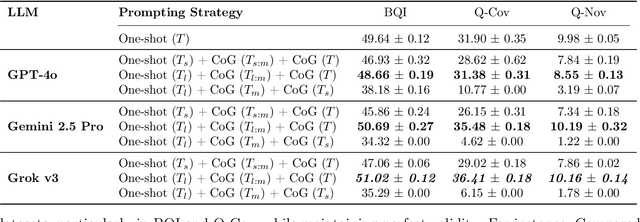
Text-conditioned molecular generation aims to translate natural-language descriptions into chemical structures, enabling scientists to specify functional groups, scaffolds, and physicochemical constraints without handcrafted rules. Diffusion-based models, particularly latent diffusion models (LDMs), have recently shown promise by performing stochastic search in a continuous latent space that compactly captures molecular semantics. Yet existing methods rely on one-shot conditioning, where the entire prompt is encoded once and applied throughout diffusion, making it hard to satisfy all the requirements in the prompt. We discuss three outstanding challenges of one-shot conditioning generation, including the poor interpretability of the generated components, the failure to generate all substructures, and the overambition in considering all requirements simultaneously. We then propose three principles to address those challenges, motivated by which we propose Chain-of-Generation (CoG), a training-free multi-stage latent diffusion framework. CoG decomposes each prompt into curriculum-ordered semantic segments and progressively incorporates them as intermediate goals, guiding the denoising trajectory toward molecules that satisfy increasingly rich linguistic constraints. To reinforce semantic guidance, we further introduce a post-alignment learning phase that strengthens the correspondence between textual and molecular latent spaces. Extensive experiments on benchmark and real-world tasks demonstrate that CoG yields higher semantic alignment, diversity, and controllability than one-shot baselines, producing molecules that more faithfully reflect complex, compositional prompts while offering transparent insight into the generation process.
Towards PerSense++: Advancing Training-Free Personalized Instance Segmentation in Dense Images
Aug 20, 2025Segmentation in dense visual scenes poses significant challenges due to occlusions, background clutter, and scale variations. To address this, we introduce PerSense, an end-to-end, training-free, and model-agnostic one-shot framework for Personalized instance Segmentation in dense images. PerSense employs a novel Instance Detection Module (IDM) that leverages density maps (DMs) to generate instance-level candidate point prompts, followed by a Point Prompt Selection Module (PPSM) that filters false positives via adaptive thresholding and spatial gating. A feedback mechanism further enhances segmentation by automatically selecting effective exemplars to improve DM quality. We additionally present PerSense++, an enhanced variant that incorporates three additional components to improve robustness in cluttered scenes: (i) a diversity-aware exemplar selection strategy that leverages feature and scale diversity for better DM generation; (ii) a hybrid IDM combining contour and peak-based prompt generation for improved instance separation within complex density patterns; and (iii) an Irrelevant Mask Rejection Module (IMRM) that discards spatially inconsistent masks using outlier analysis. Finally, to support this underexplored task, we introduce PerSense-D, a dedicated benchmark for personalized segmentation in dense images. Extensive experiments across multiple benchmarks demonstrate that PerSense++ outperforms existing methods in dense settings.
Recurrent Cross-View Object Geo-Localization
Sep 16, 2025Cross-view object geo-localization (CVOGL) aims to determine the location of a specific object in high-resolution satellite imagery given a query image with a point prompt. Existing approaches treat CVOGL as a one-shot detection task, directly regressing object locations from cross-view information aggregation, but they are vulnerable to feature noise and lack mechanisms for error correction. In this paper, we propose ReCOT, a Recurrent Cross-view Object geo-localization Transformer, which reformulates CVOGL as a recurrent localization task. ReCOT introduces a set of learnable tokens that encode task-specific intent from the query image and prompt embeddings, and iteratively attend to the reference features to refine the predicted location. To enhance this recurrent process, we incorporate two complementary modules: (1) a SAM-based knowledge distillation strategy that transfers segmentation priors from the Segment Anything Model (SAM) to provide clearer semantic guidance without additional inference cost, and (2) a Reference Feature Enhancement Module (RFEM) that introduces a hierarchical attention to emphasize object-relevant regions in the reference features. Extensive experiments on standard CVOGL benchmarks demonstrate that ReCOT achieves state-of-the-art (SOTA) performance while reducing parameters by 60% compared to previous SOTA approaches.