 Add to Chrome
 Add to Firefox
 Add to Edge
4DR360: State Reasoning for Joint 3D Detection and Occupancy Prediction in 4D Radar-Camera Full-Scene Perception
Jul 13, 2026
Reliable autonomous driving requires full-scene perception that couples foreground objects with dense semantic layout. Recently, 4D millimeter-wave radar has emerged as a robust and affordable sensor, yet its sparse returns make radar-camera fusion necessary for comprehensive scene understanding. Existing radar-camera methods mainly optimize detection, while dual-task systems usually decode boxes and occupancy with limited interaction. To address this gap and advance radar-based multi-task learning, we propose \method, a 4D radar-camera framework for 360$^\circ$ full-scene perception, which models semantic occupancy as a persistent scene state rather than a terminal output. \method{} follows a cross-modal state reasoning paradigm, where the occupancy state is modeled and propagated through stages for coarse-to-fine feature aggregation. Specifically, State-guided BEV Enhancement (SBE) strengthens intra-frame BEV representation, while Doppler-guided Temporal Fusion (DTF) preserves state evidence over longer temporal horizons. Beyond the model, we further extend ManTruckScenes with satellite-map-based generated occupancy labels and pair it with OmniHD-Scenes in a unified cross-dataset detection-and-occupancy protocol. The resulting experiments cover accuracy, robustness, ablation, and efficiency under one radar-camera multi-task evaluation framework. Code and labels will be released upon acceptance.

Recurrent Cross-View Object Geo-Localization
Sep 16, 2025Cross-view object geo-localization (CVOGL) aims to determine the location of a specific object in high-resolution satellite imagery given a query image with a point prompt. Existing approaches treat CVOGL as a one-shot detection task, directly regressing object locations from cross-view information aggregation, but they are vulnerable to feature noise and lack mechanisms for error correction. In this paper, we propose ReCOT, a Recurrent Cross-view Object geo-localization Transformer, which reformulates CVOGL as a recurrent localization task. ReCOT introduces a set of learnable tokens that encode task-specific intent from the query image and prompt embeddings, and iteratively attend to the reference features to refine the predicted location. To enhance this recurrent process, we incorporate two complementary modules: (1) a SAM-based knowledge distillation strategy that transfers segmentation priors from the Segment Anything Model (SAM) to provide clearer semantic guidance without additional inference cost, and (2) a Reference Feature Enhancement Module (RFEM) that introduces a hierarchical attention to emphasize object-relevant regions in the reference features. Extensive experiments on standard CVOGL benchmarks demonstrate that ReCOT achieves state-of-the-art (SOTA) performance while reducing parameters by 60% compared to previous SOTA approaches.
InterNet: Unsupervised Cross-modal Homography Estimation Based on Interleaved Modality Transfer and Self-supervised Homography Prediction
Sep 26, 2024
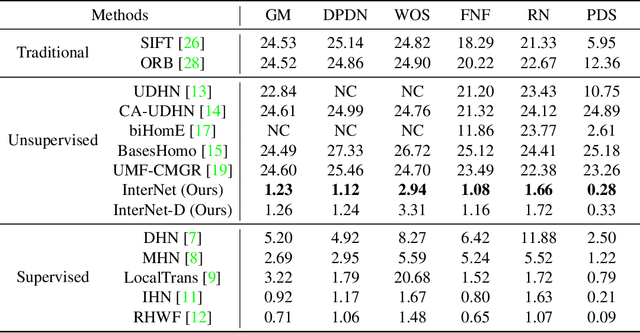
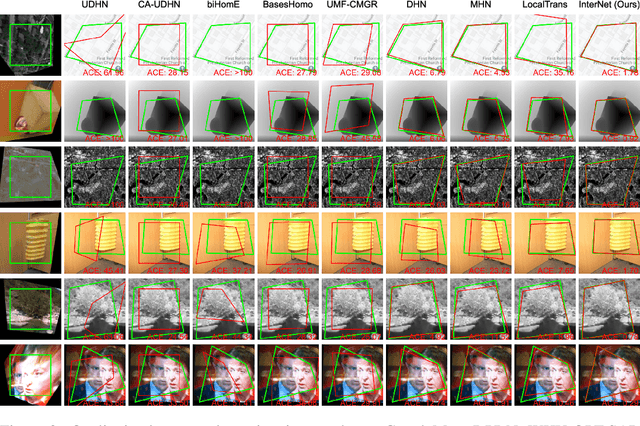
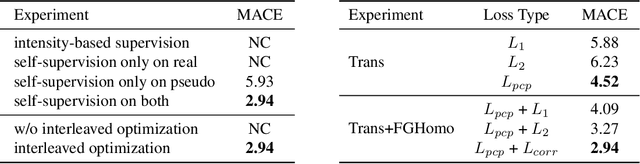
We propose a novel unsupervised cross-modal homography estimation framework, based on interleaved modality transfer and self-supervised homography prediction, named InterNet. InterNet integrates modality transfer and self-supervised homography estimation, introducing an innovative interleaved optimization framework to alternately promote both components. The modality transfer gradually narrows the modality gaps, facilitating the self-supervised homography estimation to fully leverage the synthetic intra-modal data. The self-supervised homography estimation progressively achieves reliable predictions, thereby providing robust cross-modal supervision for the modality transfer. To further boost the estimation accuracy, we also formulate a fine-grained homography feature loss to improve the connection between two components. Furthermore, we employ a simple yet effective distillation training technique to reduce model parameters and improve cross-domain generalization ability while maintaining comparable performance. Experiments reveal that InterNet achieves the state-of-the-art (SOTA) performance among unsupervised methods, and even outperforms many supervised methods such as MHN and LocalTrans.