 Add to Chrome
 Add to Firefox
 Add to Edge
RSAgent: Learning to Reason and Act for Text-Guided Segmentation via Multi-Turn Tool Invocations
Dec 30, 2025
Text-guided object segmentation requires both cross-modal reasoning and pixel grounding abilities. Most recent methods treat text-guided segmentation as one-shot grounding, where the model predicts pixel prompts in a single forward pass to drive an external segmentor, which limits verification, refocusing and refinement when initial localization is wrong. To address this limitation, we propose RSAgent, an agentic Multimodal Large Language Model (MLLM) which interleaves reasoning and action for segmentation via multi-turn tool invocations. RSAgent queries a segmentation toolbox, observes visual feedback, and revises its spatial hypothesis using historical observations to re-localize targets and iteratively refine masks. We further build a data pipeline to synthesize multi-turn reasoning segmentation trajectories, and train RSAgent with a two-stage framework: cold-start supervised fine-tuning followed by agentic reinforcement learning with fine-grained, task-specific rewards. Extensive experiments show that RSAgent achieves a zero-shot performance of 66.5% gIoU on ReasonSeg test, improving over Seg-Zero-7B by 9%, and reaches 81.5% cIoU on RefCOCOg, demonstrating state-of-the-art performance on both in-domain and out-of-domain benchmarks.

NTIRE 2025 Challenge on Cross-Domain Few-Shot Object Detection: Methods and Results
Apr 14, 2025Cross-Domain Few-Shot Object Detection (CD-FSOD) poses significant challenges to existing object detection and few-shot detection models when applied across domains. In conjunction with NTIRE 2025, we organized the 1st CD-FSOD Challenge, aiming to advance the performance of current object detectors on entirely novel target domains with only limited labeled data. The challenge attracted 152 registered participants, received submissions from 42 teams, and concluded with 13 teams making valid final submissions. Participants approached the task from diverse perspectives, proposing novel models that achieved new state-of-the-art (SOTA) results under both open-source and closed-source settings. In this report, we present an overview of the 1st NTIRE 2025 CD-FSOD Challenge, highlighting the proposed solutions and summarizing the results submitted by the participants.
ProjectedEx: Enhancing Generation in Explainable AI for Prostate Cancer
Jan 02, 2025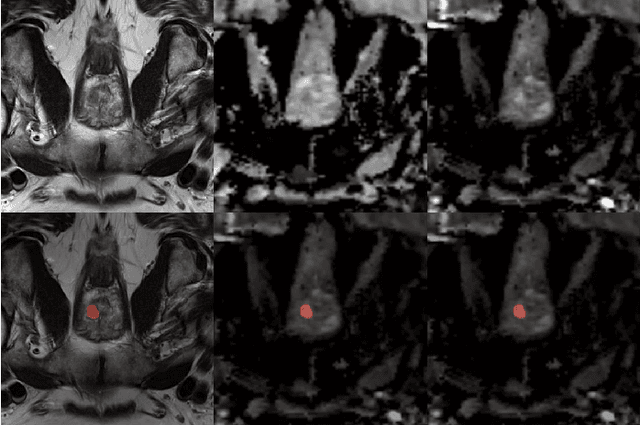
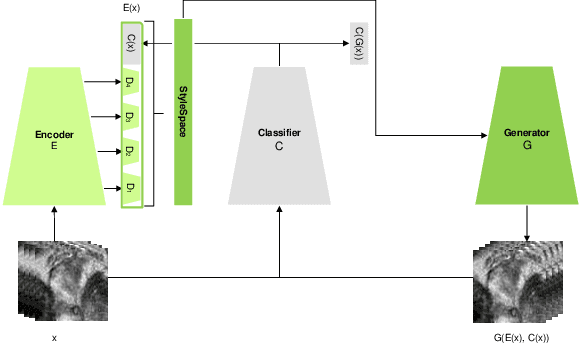
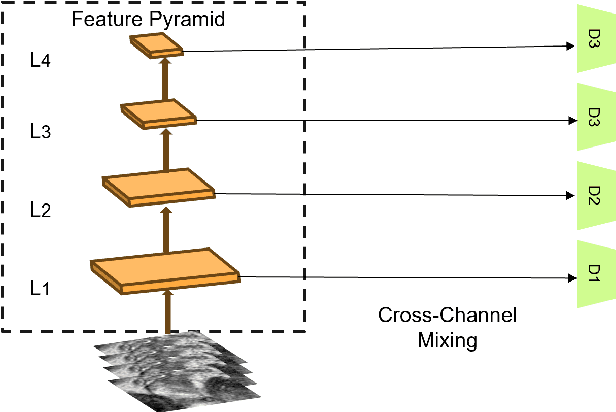
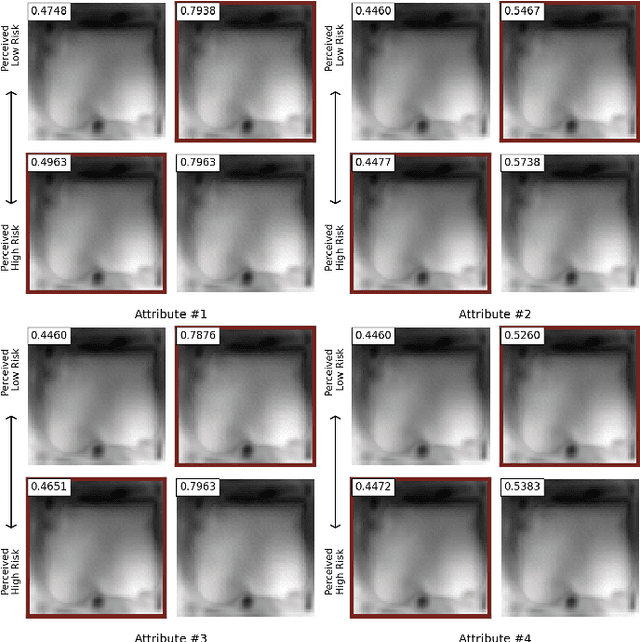
Prostate cancer, a growing global health concern, necessitates precise diagnostic tools, with Magnetic Resonance Imaging (MRI) offering high-resolution soft tissue imaging that significantly enhances diagnostic accuracy. Recent advancements in explainable AI and representation learning have significantly improved prostate cancer diagnosis by enabling automated and precise lesion classification. However, existing explainable AI methods, particularly those based on frameworks like generative adversarial networks (GANs), are predominantly developed for natural image generation, and their application to medical imaging often leads to suboptimal performance due to the unique characteristics and complexity of medical image. To address these challenges, our paper introduces three key contributions. First, we propose ProjectedEx, a generative framework that provides interpretable, multi-attribute explanations, effectively linking medical image features to classifier decisions. Second, we enhance the encoder module by incorporating feature pyramids, which enables multiscale feedback to refine the latent space and improves the quality of generated explanations. Additionally, we conduct comprehensive experiments on both the generator and classifier, demonstrating the clinical relevance and effectiveness of ProjectedEx in enhancing interpretability and supporting the adoption of AI in medical settings. Code will be released at https://github.com/Richardqiyi/ProjectedEx
JointViT: Modeling Oxygen Saturation Levels with Joint Supervision on Long-Tailed OCTA
Apr 18, 2024The oxygen saturation level in the blood (SaO2) is crucial for health, particularly in relation to sleep-related breathing disorders. However, continuous monitoring of SaO2 is time-consuming and highly variable depending on patients' conditions. Recently, optical coherence tomography angiography (OCTA) has shown promising development in rapidly and effectively screening eye-related lesions, offering the potential for diagnosing sleep-related disorders. To bridge this gap, our paper presents three key contributions. Firstly, we propose JointViT, a novel model based on the Vision Transformer architecture, incorporating a joint loss function for supervision. Secondly, we introduce a balancing augmentation technique during data preprocessing to improve the model's performance, particularly on the long-tail distribution within the OCTA dataset. Lastly, through comprehensive experiments on the OCTA dataset, our proposed method significantly outperforms other state-of-the-art methods, achieving improvements of up to 12.28% in overall accuracy. This advancement lays the groundwork for the future utilization of OCTA in diagnosing sleep-related disorders. See project website https://steve-zeyu-zhang.github.io/JointViT