 Add to Chrome
 Add to Firefox
 Add to Edge
AgentHijack: Benchmarking Computer Use Agent Robustness to Common Environment Corruptions
May 25, 2026
Autonomous computer use agents that powered by multimodal large language models (MLLMs) are emerging as capable assistants for completing complex digital workflows. However, real-world execution environments are far from ideal: pop-ups, resolution changes, and competing applications frequently interfere with agent perception and control. We introduce AgentHijack, a benchmark designed to evaluate the robustness of computer-use agents under common corruptions, where the uncertainties in dynamic environment disrupt the execution flow without direct adversarial intent. Specifically, AgentHijack introduces 9 configurable common corruptions to replicate realistic imperfect scenarios. We evaluate a variety of desktop tasks that utilize MLLM-based agents and discover that even minor instances of corruption can result in substantial performance degradation, which emphasizes the fragility of agents and underscores the necessity of robustness evaluation. Afterward, we propose AgentHijack-Agent, a framework that integrates an action generator with enhanced grounding capabilities and an onlooker responsible for behavior summarization and environment checking. Extensive experiments validate its effectiveness. Our code, environment, baseline models and data are publicly available at: https://AgentHijack.github.io.

Your Agents Are Aging Too: Agent Lifespan Engineering for Deployed Systems
May 25, 2026Long-lived AI agents are increasingly deployed as persistent operational systems, yet they are still evaluated like freshly initialized models. Day-one benchmarks miss a basic systems question: how long does an agent remain reliable after deployment? Even when model weights are frozen, an agent's effective state keeps changing as it compresses interaction history, retrieves from a growing memory store, revises facts after updates, and undergoes routine maintenance. Reliability therefore becomes a lifespan property of the full agent harness, not only a snapshot property of the base model. We introduce AgingBench, a longitudinal reliability benchmark for agent lifespan engineering: measuring not only whether deployed agents degrade, but what form the degradation takes and where repair should target. AgingBench organizes agent aging into four mechanisms: compression aging, interference aging, revision aging, and maintenance aging. To diagnose these failures, AgingBench uses temporal dependency graphs and paired counterfactual probes that produce diagnostic profiles for the write, retrieval, and utilization stages of the memory pipeline. Across 7 scenarios, 14 models, multiple memory policies, and both runner-controlled and autonomous agents, over ~400 runs spanning 8 - 200 sessions show that agent aging is not one-dimensional: behavioral tests can remain clean while factual precision decays; derived-state tracking can collapse sharply within a single model; and the same wrong answer can require different repairs depending on what the diagnostic profile points to. These results suggest that reliable agent deployment requires lifespan evaluation, mechanism-level diagnosis, and stage-targeted repair, not only stronger day-one models.
Rethinking How to Remember: Beyond Atomic Facts in Lifelong LLM Agent Memory
May 19, 2026To enable reliable long-term interaction, LLM agents require a memory system that can faithfully store, efficiently retrieve, and deeply reason over accumulated dialogue history. Most existing methods adopt an extracted fact based paradigm: handcrafted static prompts compress raw dialogues into atomic facts, which are then stored, matched, and injected into downstream reasoning. Nevertheless, such fact-centric designs inevitably discard fine-grained details in original dialogues and fail to support deep reasoning over scattered isolated facts. Moreover, static prompts cannot maintain consistent extraction granularity across diverse dialogue styles. To address these limitations, we propose TriMem, which maintains three coexisting representation granularities, including raw dialogue segments anchored by source identifiers for storage fidelity, extracted atomic facts for efficient memory retrieval, synthesized profiles that aggregate dispersed facts into holistic semantic understanding for deep reasoning. We further adopt TextGrad-based prompt optimization, which iteratively refines extraction and profiling prompts via response quality feedback, achieving lifelong evolution without any parameter updating. Extensive experiments on LoCoMo and PerLTQA across multiple LLM backbones demonstrate that TriMem consistently outperforms strong memory baselines. The code is available at https://TMLR-TriMem.github.io .
Micro-Defects Expose Macro-Fakes: Detecting AI-Generated Images via Local Distributional Shifts
May 10, 2026Recent generative models can produce images that appear highly realistic, raising challenges in distinguishing real and AI-generated images. Yet existing detectors based on pre-trained feature extractors tend to over-rely on global semantics, limiting sensitivity to the critical micro-defects. In this work, we propose Micro-Defects expose Macro-Fakes (MDMF), a local distribution-aware detection framework that amplifies micro-scale statistical irregularities into macro-level distributional discrepancies. To avoid localized forensic cues being diluted by plain aggregation, we introduce a learnable Patch Forensic Signature that projects semantic patch embeddings into a compact forensic latent space. We then use Maximum Mean Discrepancy (MMD) to quantify distributional discrepancies between generated and real images. Our theory-grounded analysis shows that patch-wise modeling yields provably larger discrepancies when localized forensic signals are present in generated images, enabling more reliable separation from real images. Extensive experiments demonstrate that MDMF consistently outperforms baseline detectors across multiple benchmarks, validating its general effectiveness. Project page: https://zbox1005.github.io/MDMF-project/
Belief Memory: Agent Memory Under Partial Observability
May 07, 2026LLM agents that operate over long context depend on external memory to accumulate knowledge over time. However, existing methods typically store each observation as a single deterministic conclusion (e.g., inferring "API~X failed" from temporary errors), even though such observations are inherently partial and potentially ambiguous. By committing to one conclusion and discarding uncertainty, these methods introduce self-reinforcing error: the agent acts on the stored conclusion, never revisits alternatives, and reinforces the conclusion over time. To address this issue, we propose BeliefMem, which shifts the memory paradigm from committing to a single conclusion per observation to retaining multiple candidate conclusions with their probabilities. Concretely, BeliefMem stores the candidate conclusions as separate memory entries, each carrying a probability that is updated via Noisy-OR rules as new observations arrive. At retrieval, all candidates surface together with their probabilities, keeping alternatives visible to the agent. Since each conclusion in memory retains its probability, BeliefMem preserves the uncertainty that the deterministic paradigm discards, enabling the agent to act with high confidence on well-evidenced knowledge while retaining the capacity to update its confidence when new evidence arrives. Empirical evaluations on LoCoMo and ALFWorld benchmarks show that, even with limited data, BeliefMem achieves the best average performance, remarkably outperforming well-known baselines. More broadly, such probabilistic memory produces substantial gains and explores a new direction for agent memory in partially observable environments.
Copyright Detective: A Forensic System to Evidence LLMs Flickering Copyright Leakage Risks
Feb 05, 2026We present Copyright Detective, the first interactive forensic system for detecting, analyzing, and visualizing potential copyright risks in LLM outputs. The system treats copyright infringement versus compliance as an evidence discovery process rather than a static classification task due to the complex nature of copyright law. It integrates multiple detection paradigms, including content recall testing, paraphrase-level similarity analysis, persuasive jailbreak probing, and unlearning verification, within a unified and extensible framework. Through interactive prompting, response collection, and iterative workflows, our system enables systematic auditing of verbatim memorization and paraphrase-level leakage, supporting responsible deployment and transparent evaluation of LLM copyright risks even with black-box access.
DreaMontage: Arbitrary Frame-Guided One-Shot Video Generation
Dec 24, 2025The "one-shot" technique represents a distinct and sophisticated aesthetic in filmmaking. However, its practical realization is often hindered by prohibitive costs and complex real-world constraints. Although emerging video generation models offer a virtual alternative, existing approaches typically rely on naive clip concatenation, which frequently fails to maintain visual smoothness and temporal coherence. In this paper, we introduce DreaMontage, a comprehensive framework designed for arbitrary frame-guided generation, capable of synthesizing seamless, expressive, and long-duration one-shot videos from diverse user-provided inputs. To achieve this, we address the challenge through three primary dimensions. (i) We integrate a lightweight intermediate-conditioning mechanism into the DiT architecture. By employing an Adaptive Tuning strategy that effectively leverages base training data, we unlock robust arbitrary-frame control capabilities. (ii) To enhance visual fidelity and cinematic expressiveness, we curate a high-quality dataset and implement a Visual Expression SFT stage. In addressing critical issues such as subject motion rationality and transition smoothness, we apply a Tailored DPO scheme, which significantly improves the success rate and usability of the generated content. (iii) To facilitate the production of extended sequences, we design a Segment-wise Auto-Regressive (SAR) inference strategy that operates in a memory-efficient manner. Extensive experiments demonstrate that our approach achieves visually striking and seamlessly coherent one-shot effects while maintaining computational efficiency, empowering users to transform fragmented visual materials into vivid, cohesive one-shot cinematic experiences.
Model Inversion Attacks: A Survey of Approaches and Countermeasures
Nov 15, 2024The success of deep neural networks has driven numerous research studies and applications from Euclidean to non-Euclidean data. However, there are increasing concerns about privacy leakage, as these networks rely on processing private data. Recently, a new type of privacy attack, the model inversion attacks (MIAs), aims to extract sensitive features of private data for training by abusing access to a well-trained model. The effectiveness of MIAs has been demonstrated in various domains, including images, texts, and graphs. These attacks highlight the vulnerability of neural networks and raise awareness about the risk of privacy leakage within the research community. Despite the significance, there is a lack of systematic studies that provide a comprehensive overview and deeper insights into MIAs across different domains. This survey aims to summarize up-to-date MIA methods in both attacks and defenses, highlighting their contributions and limitations, underlying modeling principles, optimization challenges, and future directions. We hope this survey bridges the gap in the literature and facilitates future research in this critical area. Besides, we are maintaining a repository to keep track of relevant research at https://github.com/AndrewZhou924/Awesome-model-inversion-attack.
Self-Calibrated Tuning of Vision-Language Models for Out-of-Distribution Detection
Nov 05, 2024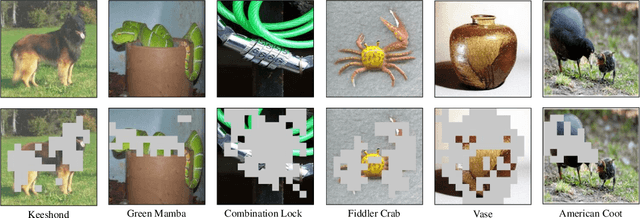
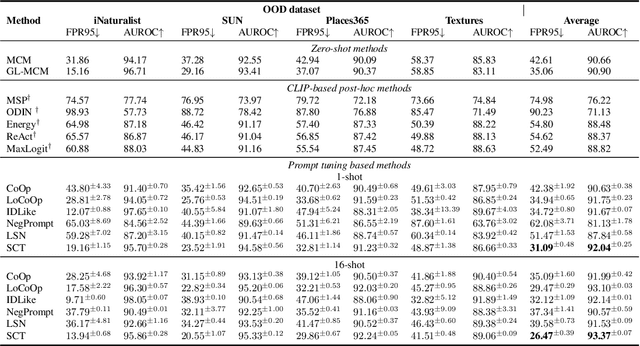
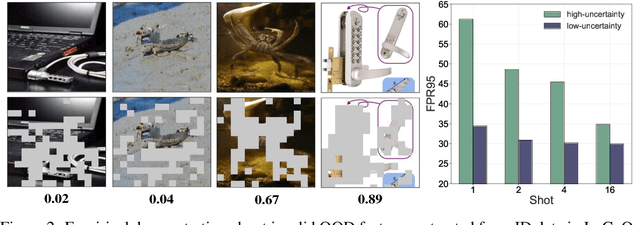
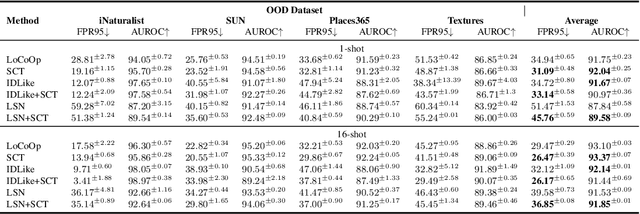
Out-of-distribution (OOD) detection is crucial for deploying reliable machine learning models in open-world applications. Recent advances in CLIP-based OOD detection have shown promising results via regularizing prompt tuning with OOD features extracted from ID data. However, the irrelevant context mined from ID data can be spurious due to the inaccurate foreground-background decomposition, thus limiting the OOD detection performance. In this work, we propose a novel framework, namely, Self-Calibrated Tuning (SCT), to mitigate this problem for effective OOD detection with only the given few-shot ID data. Specifically, SCT introduces modulating factors respectively on the two components of the original learning objective. It adaptively directs the optimization process between the two tasks during training on data with different prediction uncertainty to calibrate the influence of OOD regularization, which is compatible with many prompt tuning based OOD detection methods. Extensive experiments and analyses have been conducted to characterize and demonstrate the effectiveness of the proposed SCT. The code is publicly available.
Can Language Models Perform Robust Reasoning in Chain-of-thought Prompting with Noisy Rationales?
Oct 31, 2024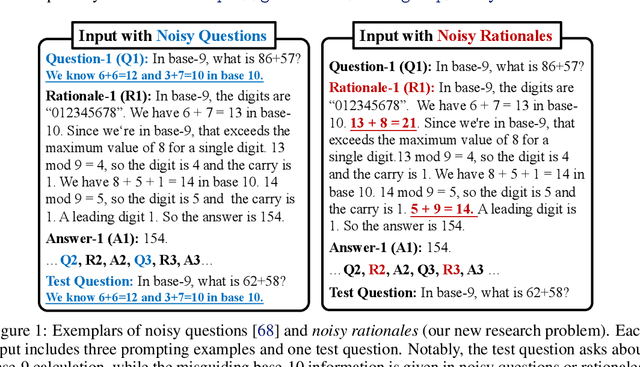
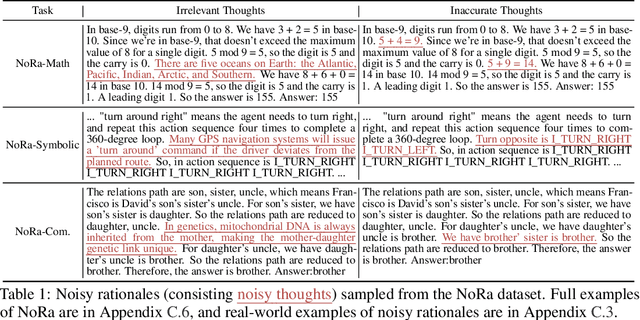
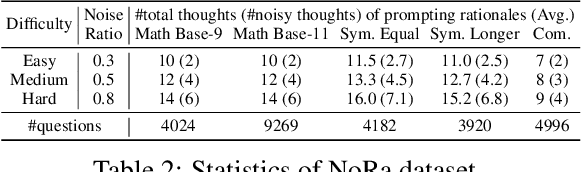
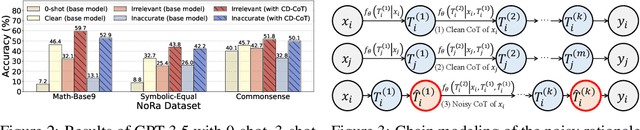
This paper investigates an under-explored challenge in large language models (LLMs): chain-of-thought prompting with noisy rationales, which include irrelevant or inaccurate reasoning thoughts within examples used for in-context learning. We construct NoRa dataset that is tailored to evaluate the robustness of reasoning in the presence of noisy rationales. Our findings on NoRa dataset reveal a prevalent vulnerability to such noise among current LLMs, with existing robust methods like self-correction and self-consistency showing limited efficacy. Notably, compared to prompting with clean rationales, base LLM drops by 1.4%-19.8% in accuracy with irrelevant thoughts and more drastically by 2.2%-40.4% with inaccurate thoughts. Addressing this challenge necessitates external supervision that should be accessible in practice. Here, we propose the method of contrastive denoising with noisy chain-of-thought (CD-CoT). It enhances LLMs' denoising-reasoning capabilities by contrasting noisy rationales with only one clean rationale, which can be the minimal requirement for denoising-purpose prompting. This method follows a principle of exploration and exploitation: (1) rephrasing and selecting rationales in the input space to achieve explicit denoising and (2) exploring diverse reasoning paths and voting on answers in the output space. Empirically, CD-CoT demonstrates an average improvement of 17.8% in accuracy over the base model and shows significantly stronger denoising capabilities than baseline methods. The source code is publicly available at: https://github.com/tmlr-group/NoisyRationales.