 Add to Chrome
 Add to Firefox
 Add to Edge
AdaCount: Training-Free Similarity-Guided Spatial and Feature Adaptation for Zero-Shot Object Counting
Jul 02, 2026
Zero-shot object counting (ZOC) aims to count instances of arbitrary object categories specified only through textual prompts. Recent training-free approaches leverage foundation models such as SAM to reformulate counting as a prompt-driven segmentation task, eliminating the need for costly counting-specific training data with point-level annotations. More recently, SAM3 introduced promptable concept segmentation, enabling the zero-shot segmentation of all instances corresponding to a text-defined concept. However, SAM3 struggles in densely populated scenes containing numerous small objects, where limited image resolution and insufficient attention to target-relevant regions often lead to missed instances and poor instance separation, hindering accurate object counting. To address this limitation, we propose AdaCount, a training-free framework for ZOC based on similarity-guided spatial and feature adaptation. AdaCount first estimates a prototype-driven similarity map that identifies target-relevant regions. This similarity map subsequently guides two complementary adaptations: (i) similarity-guided spatial warping, which reallocates image resolution toward target instances, and (ii) feature modulation, which amplifies target-relevant encoder representations. Together, these adaptations enable SAM3 to devote greater representational capacity to target-relevant regions while preserving global image context, without requiring any model retraining. Extensive experiments across six diverse counting benchmarks establish AdaCount as a new SOTA among training-free ZOC approaches.

CountZES: Counting via Zero-Shot Exemplar Selection
Dec 18, 2025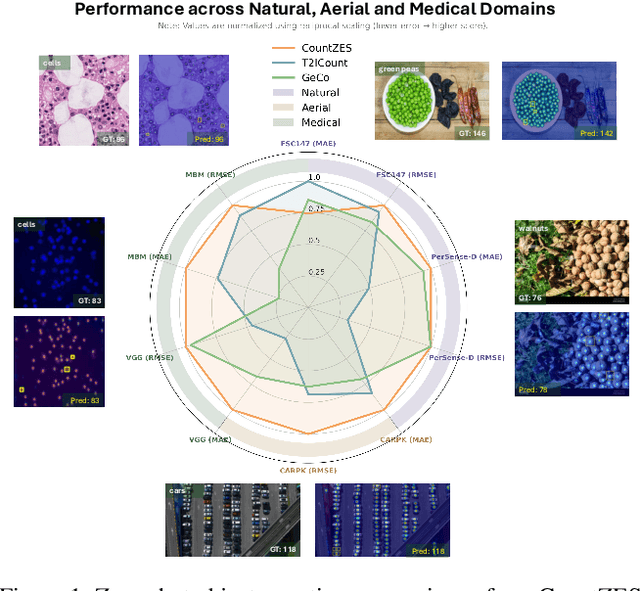
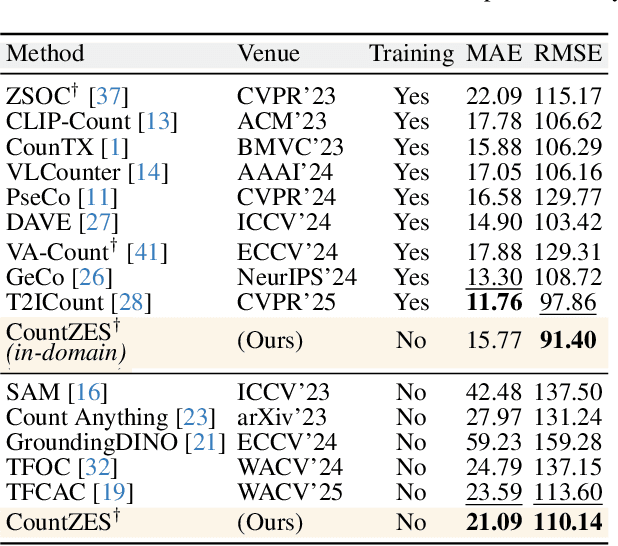
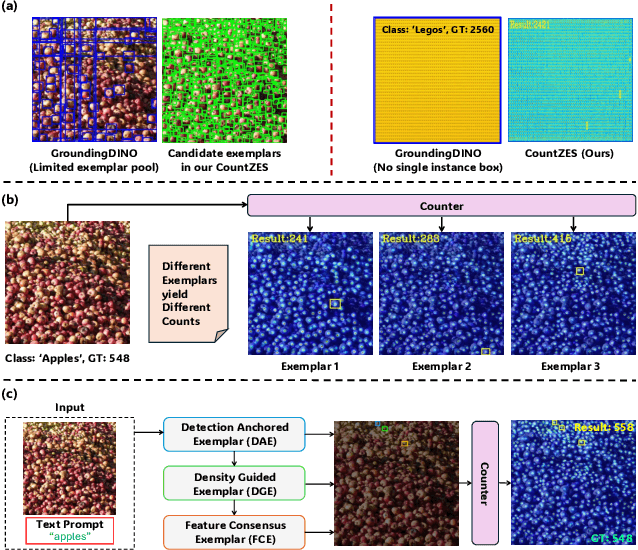
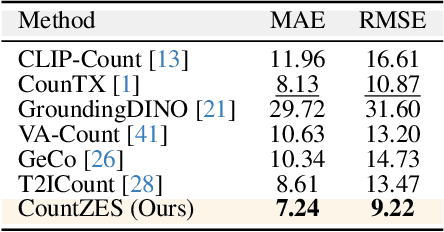
Object counting in complex scenes remains challenging, particularly in the zero-shot setting, where the goal is to count instances of unseen categories specified only by a class name. Existing zero-shot object counting (ZOC) methods that infer exemplars from text either rely on open-vocabulary detectors, which often yield multi-instance candidates, or on random patch sampling, which fails to accurately delineate object instances. To address this, we propose CountZES, a training-free framework for object counting via zero-shot exemplar selection. CountZES progressively discovers diverse exemplars through three synergistic stages: Detection-Anchored Exemplar (DAE), Density-Guided Exemplar (DGE), and Feature-Consensus Exemplar (FCE). DAE refines open-vocabulary detections to isolate precise single-instance exemplars. DGE introduces a density-driven, self-supervised paradigm to identify statistically consistent and semantically compact exemplars, while FCE reinforces visual coherence through feature-space clustering. Together, these stages yield a diverse, complementary exemplar set that balances textual grounding, count consistency, and feature representativeness. Experiments on diverse datasets demonstrate CountZES superior performance among ZOC methods while generalizing effectively across natural, aerial and medical domains.
Towards PerSense++: Advancing Training-Free Personalized Instance Segmentation in Dense Images
Aug 20, 2025Segmentation in dense visual scenes poses significant challenges due to occlusions, background clutter, and scale variations. To address this, we introduce PerSense, an end-to-end, training-free, and model-agnostic one-shot framework for Personalized instance Segmentation in dense images. PerSense employs a novel Instance Detection Module (IDM) that leverages density maps (DMs) to generate instance-level candidate point prompts, followed by a Point Prompt Selection Module (PPSM) that filters false positives via adaptive thresholding and spatial gating. A feedback mechanism further enhances segmentation by automatically selecting effective exemplars to improve DM quality. We additionally present PerSense++, an enhanced variant that incorporates three additional components to improve robustness in cluttered scenes: (i) a diversity-aware exemplar selection strategy that leverages feature and scale diversity for better DM generation; (ii) a hybrid IDM combining contour and peak-based prompt generation for improved instance separation within complex density patterns; and (iii) an Irrelevant Mask Rejection Module (IMRM) that discards spatially inconsistent masks using outlier analysis. Finally, to support this underexplored task, we introduce PerSense-D, a dedicated benchmark for personalized segmentation in dense images. Extensive experiments across multiple benchmarks demonstrate that PerSense++ outperforms existing methods in dense settings.
PerSense: Personalized Instance Segmentation in Dense Images
May 22, 2024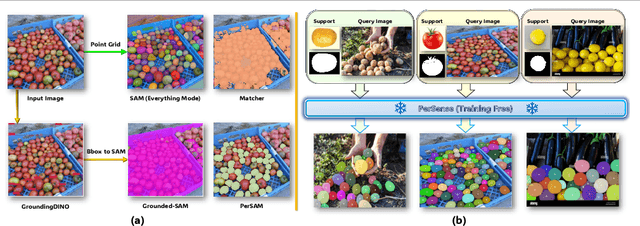
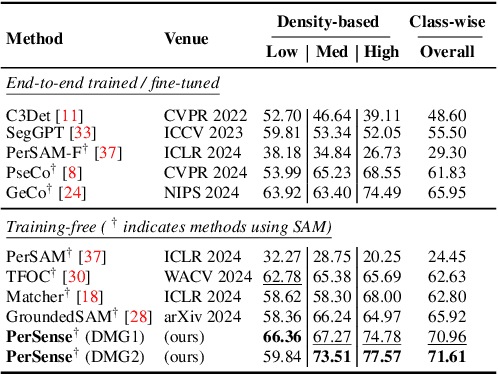
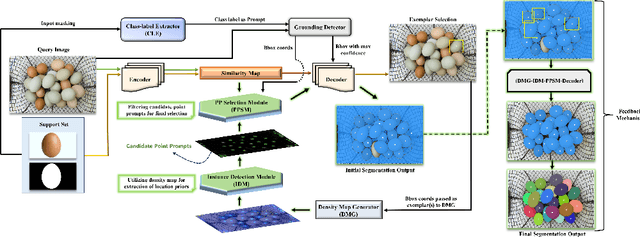
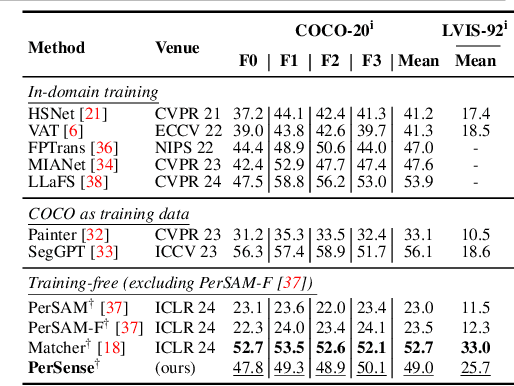
Leveraging large-scale pre-training, vision foundational models showcase notable performance benefits. While recent years have witnessed significant advancements in segmentation algorithms, existing models still face challenges to automatically segment personalized instances in dense and crowded scenarios. The primary factor behind this limitation stems from bounding box-based detections, which are constrained by occlusions, background clutter, and object orientation, particularly when dealing with dense images. To this end, we propose PerSense, an end-to-end, training-free, and model-agnostic one-shot framework to address the personalized instance segmentation in dense images. Towards developing this framework, we make following core contributions. (a) We propose an Instance Detection Module (IDM) and leverage a Vision-Language Model, a grounding object detector, and a few-shot object counter (FSOC) to realize a new baseline. (b) To tackle false positives within candidate point prompts, we design Point Prompt Selection Module (PPSM). Both IDM and PPSM transform density maps from FSOC into personalized instance-level point prompts for segmentation and offer a seamless integration in our model-agnostic framework. (c) We introduce a feedback mechanism which enables PerSense to harness the full potential of FSOC by automating the exemplar selection process. (d) To promote algorithmic advances and effective tools for this relatively underexplored task, we introduce PerSense-D, a dataset exclusive to personalized instance segmentation in dense images. We validate the effectiveness of PerSense on the task of personalized instance segmentation in dense images on PerSense-D and comparison with SOTA. Additionally, our qualitative findings demonstrate the adaptability of our framework to images captured in-the-wild.