 Add to Chrome
 Add to Firefox
 Add to Edge
Thinking in Boxes: 3D Editing in Real Images Made Easy
Jun 18, 2026
Text and 2D-conditioning interfaces provide weak, ambiguous control over spatial transformations in image editing -- particularly under large object motions and camera changes. Prior work has used 3D primitives such as boxes, but only as loose conditioning signals indicating approximate object location rather than specifying the transformation. We instead use 3D boxes as structured specifications: the user provides the input and output boxes of the edit, casting editing as a well-posed geometry problem. This ``thinking in boxes'' interface, where each box face is color-coded to convey 3D orientation, gives precise control over translation, rotation, scaling, and viewpoint changes in real images while preserving scene and object identity, and recovering previously unseen object regions. To ground transformations in scene appearance, we introduce a depth-aligned planar floor as a global reference frame, shaded with depth-aware cues. Conditioned on this structure, an image generator produces consistent results under large transformations. Trained in two stages -- on synthetic multi-object scenes and a small set of real-world videos from Objectron -- the system generalizes to complex, in-the-wild real images. Our method operates directly on real photographs and substantially outperforms recent state-of-the-art methods on large 3D edits.

RATS! Patches Talk Through Registers: Emergent Parts in Register Attention Transformers
Jun 12, 2026When humans see a bird, they recognize far more than just "bird" -- they see a head, wings, and talons, a structured assembly of reusable parts that can be identified across every bird they have ever seen. We ask whether a self-supervised visual model can discover the same compositional structure on its own. To this end, we propose RATS (Register Attention Transformers), which decomposes the classification token into N learnable register tokens that route patch information through an L->N->N->L bottleneck via a three-step compress-communicate-broadcast attention. The N registers are partitioned across the H attention heads, so that registers assigned to different heads do not interact with each other. Without auxiliary losses or part annotations, each register spontaneously specializes into a proto-semantic region whose emerging structure resembles object parts. RATS surpasses all baselines by +12 mIoU on average across five segmentation benchmarks, with consistent gains on ADE20K (+1.11 mIoU) and COCO (+0.2 AP^m). Its register dictionary further exhibits part-level consistency and semantic proximity across related categories. Our results suggest that RATS may provide a useful architectural prior for structured and interpretable visual representation learning.
SyncFix: Fixing 3D Reconstructions via Multi-View Synchronization
Apr 13, 2026We present SyncFix, a framework that enforces cross-view consistency during the diffusion-based refinement of reconstructed scenes. SyncFix formulates refinement as a joint latent bridge matching problem, synchronizing distorted and clean representations across multiple views to fix the semantic and geometric inconsistencies. This means SyncFix learns a joint conditional over multiple views to enforce consistency throughout the denoising trajectory. Our training is done only on image pairs, but it generalizes naturally to an arbitrary number of views during inference. Moreover, reconstruction quality improves with additional views, with diminishing returns at higher view counts. Qualitative and quantitative results demonstrate that SyncFix consistently generates high-quality reconstructions and surpasses current state-of-the-art baselines, even in the absence of clean reference images. SyncFix achieves even higher fidelity when sparse references are available.
ViT-5: Vision Transformers for The Mid-2020s
Feb 08, 2026This work presents a systematic investigation into modernizing Vision Transformer backbones by leveraging architectural advancements from the past five years. While preserving the canonical Attention-FFN structure, we conduct a component-wise refinement involving normalization, activation functions, positional encoding, gating mechanisms, and learnable tokens. These updates form a new generation of Vision Transformers, which we call ViT-5. Extensive experiments demonstrate that ViT-5 consistently outperforms state-of-the-art plain Vision Transformers across both understanding and generation benchmarks. On ImageNet-1k classification, ViT-5-Base reaches 84.2\% top-1 accuracy under comparable compute, exceeding DeiT-III-Base at 83.8\%. ViT-5 also serves as a stronger backbone for generative modeling: when plugged into an SiT diffusion framework, it achieves 1.84 FID versus 2.06 with a vanilla ViT backbone. Beyond headline metrics, ViT-5 exhibits improved representation learning and favorable spatial reasoning behavior, and transfers reliably across tasks. With a design aligned with contemporary foundation-model practices, ViT-5 offers a simple drop-in upgrade over vanilla ViT for mid-2020s vision backbones.
Stronger Semantic Encoders Can Harm Relighting Performance: Probing Visual Priors via Augmented Latent Intrinsics
Feb 01, 2026Image-to-image relighting requires representations that disentangle scene properties from illumination. Recent methods rely on latent intrinsic representations but remain under-constrained and often fail on challenging materials such as metal and glass. A natural hypothesis is that stronger pretrained visual priors should resolve these failures. We find the opposite: features from top-performing semantic encoders often degrade relighting quality, revealing a fundamental trade-off between semantic abstraction and photometric fidelity. We study this trade-off and introduce Augmented Latent Intrinsics (ALI), which balances semantic context and dense photometric structure by fusing features from a pixel-aligned visual encoder into a latent-intrinsic framework, together with a self-supervised refinement strategy to mitigate the scarcity of paired real-world data. Trained only on unlabeled real-world image pairs and paired with a dense, pixel-aligned visual prior, ALI achieves strong improvements in relighting, with the largest gains on complex, specular materials. Project page: https:\\augmented-latent-intrinsics.github.io
SyncLight: Controllable and Consistent Multi-View Relighting
Jan 23, 2026We present SyncLight, the first method to enable consistent, parametric relighting across multiple uncalibrated views of a static scene. While single-view relighting has advanced significantly, existing generative approaches struggle to maintain the rigorous lighting consistency essential for multi-camera broadcasts, stereoscopic cinema, and virtual production. SyncLight addresses this by enabling precise control over light intensity and color across a multi-view capture of a scene, conditioned on a single reference edit. Our method leverages a multi-view diffusion transformer trained using a latent bridge matching formulation, achieving high-fidelity relighting of the entire image set in a single inference step. To facilitate training, we introduce a large-scale hybrid dataset comprising diverse synthetic environments -- curated from existing sources and newly designed scenes -- alongside high-fidelity, real-world multi-view captures under calibrated illumination. Surprisingly, though trained only on image pairs, SyncLight generalizes zero-shot to an arbitrary number of viewpoints, effectively propagating lighting changes across all views, without requiring camera pose information. SyncLight enables practical relighting workflows for multi-view capture systems.
Name That Part: 3D Part Segmentation and Naming
Dec 19, 2025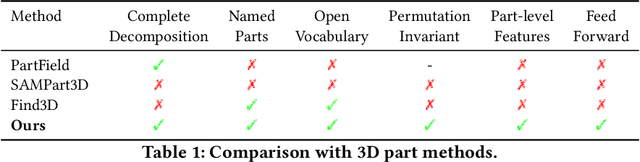
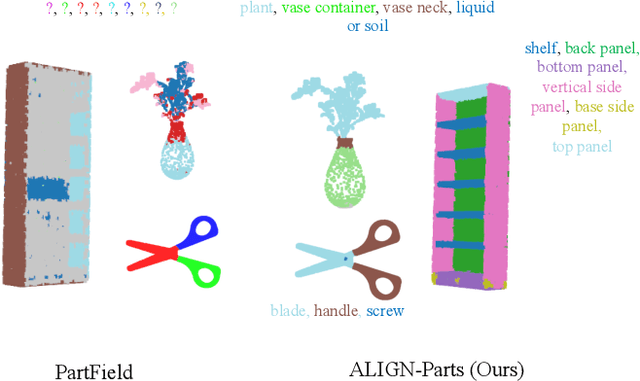

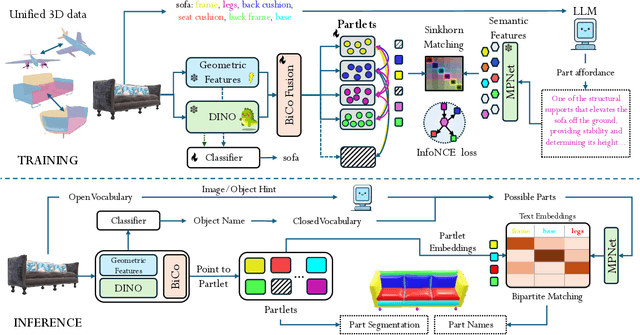
We address semantic 3D part segmentation: decomposing objects into parts with meaningful names. While datasets exist with part annotations, their definitions are inconsistent across datasets, limiting robust training. Previous methods produce unlabeled decompositions or retrieve single parts without complete shape annotations. We propose ALIGN-Parts, which formulates part naming as a direct set alignment task. Our method decomposes shapes into partlets - implicit 3D part representations - matched to part descriptions via bipartite assignment. We combine geometric cues from 3D part fields, appearance from multi-view vision features, and semantic knowledge from language-model-generated affordance descriptions. Text-alignment loss ensures partlets share embedding space with text, enabling a theoretically open-vocabulary matching setup, given sufficient data. Our efficient and novel, one-shot, 3D part segmentation and naming method finds applications in several downstream tasks, including serving as a scalable annotation engine. As our model supports zero-shot matching to arbitrary descriptions and confidence-calibrated predictions for known categories, with human verification, we create a unified ontology that aligns PartNet, 3DCoMPaT++, and Find3D, consisting of 1,794 unique 3D parts. We also show examples from our newly created Tex-Parts dataset. We also introduce 2 novel metrics appropriate for the named 3D part segmentation task.
Do You Know Where Your Camera Is? View-Invariant Policy Learning with Camera Conditioning
Oct 02, 2025We study view-invariant imitation learning by explicitly conditioning policies on camera extrinsics. Using Plucker embeddings of per-pixel rays, we show that conditioning on extrinsics significantly improves generalization across viewpoints for standard behavior cloning policies, including ACT, Diffusion Policy, and SmolVLA. To evaluate policy robustness under realistic viewpoint shifts, we introduce six manipulation tasks in RoboSuite and ManiSkill that pair "fixed" and "randomized" scene variants, decoupling background cues from camera pose. Our analysis reveals that policies without extrinsics often infer camera pose using visual cues from static backgrounds in fixed scenes; this shortcut collapses when workspace geometry or camera placement shifts. Conditioning on extrinsics restores performance and yields robust RGB-only control without depth. We release the tasks, demonstrations, and code at https://ripl.github.io/know_your_camera/ .
Generative Blocks World: Moving Things Around in Pictures
Jun 25, 2025We describe Generative Blocks World to interact with the scene of a generated image by manipulating simple geometric abstractions. Our method represents scenes as assemblies of convex 3D primitives, and the same scene can be represented by different numbers of primitives, allowing an editor to move either whole structures or small details. Once the scene geometry has been edited, the image is generated by a flow-based method which is conditioned on depth and a texture hint. Our texture hint takes into account the modified 3D primitives, exceeding texture-consistency provided by existing key-value caching techniques. These texture hints (a) allow accurate object and camera moves and (b) largely preserve the identity of objects depicted. Quantitative and qualitative experiments demonstrate that our approach outperforms prior works in visual fidelity, editability, and compositional generalization.
Visual Jenga: Discovering Object Dependencies via Counterfactual Inpainting
Mar 27, 2025This paper proposes a novel scene understanding task called Visual Jenga. Drawing inspiration from the game Jenga, the proposed task involves progressively removing objects from a single image until only the background remains. Just as Jenga players must understand structural dependencies to maintain tower stability, our task reveals the intrinsic relationships between scene elements by systematically exploring which objects can be removed while preserving scene coherence in both physical and geometric sense. As a starting point for tackling the Visual Jenga task, we propose a simple, data-driven, training-free approach that is surprisingly effective on a range of real-world images. The principle behind our approach is to utilize the asymmetry in the pairwise relationships between objects within a scene and employ a large inpainting model to generate a set of counterfactuals to quantify the asymmetry.