 Add to Chrome
 Add to Firefox
 Add to Edge
Learning Visual Spatial Planning from Symbolic State via Modality-Gap-Aware Self-Distillation
Jun 04, 2026
While vision-language models excel at general multimodal understanding, they still struggle with visual spatial planning. We attribute this to a perception-reasoning modality gap: visual planning requires models to infer latent state structures from pixels and then reason over the recovered structure to produce valid actions, whereas symbolic planning directly leverages explicit objects and constraints. This creates dual bottlenecks in visual state recovery and multi-step planning. To address this, we propose MGSD, a two-stage modality-gap-aware self-distillation framework. First, a cold-start grounding stage equips the visual student with reliable state representations, minimizing early perception noise. Second, a privileged teacher transfers planning capabilities via on-policy distillation, using explicit symbolic states to supervise the student's own visual rollout prefixes. Crucially, symbolic data is used strictly during training, leaving inference purely visual. Experiments on visual planning benchmarks show that MGSD consistently improves visual planning across both 4B and 8B backbones, raising the macro average by 19.3% and 18.4%, respectively. The resulting models narrow the gap to symbolic-input upper bounds, while ablations and diagnostics confirm that the improvement comes from both visual state recovery and optimal-path reasoning. These results suggest that modality-gap-aware self-distillation improves not only how models perceive actionable states, but also how they plan over the inferred structure. Code is available at https://github.com/Oranger-l/MGSD.

KVPO: ODE-Native GRPO for Autoregressive Video Alignment via KV Semantic Exploration
May 14, 2026Aligning streaming autoregressive (AR) video generators with human preferences is challenging. Existing reinforcement learning methods predominantly rely on noise-based exploration and SDE-based surrogate policies that are mismatched to the deterministic ODE dynamics of distilled AR models, and tend to perturb low-level appearance rather than the high-level semantic storyline progression critical for long-horizon coherence. To address these limitations, we present KVPO, an ODE-native online Group Relative Policy Optimization (GRPO) framework for aligning streaming video generators. For diversity exploration, KVPO introduces a causal-semantic exploration paradigm that relocates the source of variation from stochastic noise to the historical KV cache. By stochastically routing historical KV entries, it constructs semantically diverse generation branches that remain strictly on the data manifold. For policy modeling, KVPO introduces a velocity-field surrogate policy based on Trajectory Velocity Energy (TVE), which quantifies branch likelihood in flow-matching velocity space and yields a reward-weighted contrastive objective fully consistent with the native ODE formulation. Experiments on multiple distilled AR video generators demonstrate consistent gains in visual quality, motion quality, and text-video alignment across both single-prompt short-video and multi-prompt long-video settings.
EponaV2: Driving World Model with Comprehensive Future Reasoning
May 14, 2026Data scaling plays a pivotal role in the pursuit of general intelligence. However, the prevailing perception-planning paradigm in autonomous driving relies heavily on expensive manual annotations to supervise trajectory planning, which severely limits its scalability. Conversely, although existing perception-free driving world models achieve impressive driving performance, their real-world reasoning ability for planning is solely built on next frame image forecasting. Due to the lack of enough supervision, these models often struggle with comprehensive scene understanding, resulting in unsatisfactory trajectory planning. In this paper, we propose EponaV2, a novel paradigm of driving world models, which achieves high-quality planning with comprehensive future reasoning. Inspired by how human drivers anticipate 3D geometry and semantics, we train our model to forecast more comprehensive future representations, which can be additionally decoded to future geometry and semantic maps. Extracting the 3D and semantic modalities enables our model to deeply understand the surrounding environment, and the future prediction task significantly enhances the real-world reasoning capabilities of EponaV2, ultimately leading to improved trajectory planning. Moreover, inspired by the training recipe of Large Language Models (LLMs), we introduce a flow matching group relative policy optimization mechanism to further improve planning accuracy. The state-of-the-art (SOTA) performances of EponaV2 among perception-free models on three NAVSIM benchmarks (+1.3PDMS, +5.5EPDMS) demonstrate the effectiveness of our methods.
Forcing-KV: Hybrid KV Cache Compression for Efficient Autoregressive Video Diffusion Models
May 10, 2026Autoregressive (AR) video diffusion models adopt a streaming generation framework, enabling long-horizon video generation with real-time responsiveness, as exemplified by the Self Forcing training paradigm. However, existing AR video diffusion models still suffer from significant attention complexity and severe memory overhead due to the redundant key-value (KV) caches across historical frames, which limits scalability. In this paper, we tackle this challenge by introducing KV cache compression into autoregressive video diffusion. We observe that attention heads in mainstream AR diffusion models exhibit markedly distinct attention patterns and functional roles that remain stable across samples and denoising steps. Building on our empirical study of head-wise functional specialization, we divide the attention heads into two categories: static heads, which focus on transitions across autoregressive chunks and intra-frame fidelity, and dynamic heads, which govern inter-frame motion and consistency. We then propose Forcing-KV, a hybrid KV cache compression strategy that performs structured static pruning for static heads and dynamic pruning based on segment-wise similarity for dynamic heads. While maintaining output quality, our method achieves a generation speed of over 29 frames per second on a single NVIDIA H200 GPU along with 30% cache memory reduction, delivering up to 1.35x and 1.50x speedups on LongLive and Self Forcing at 480P resolution, and further scaling to 2.82x speedup at 1080P resolution. Code and demo videos are provided at https://zju-jiyicheng.github.io/Forcing-KV-Page.
RoboStereo: Dual-Tower 4D Embodied World Models for Unified Policy Optimization
Mar 13, 2026Scalable Embodied AI faces fundamental constraints due to prohibitive costs and safety risks of real-world interaction. While Embodied World Models (EWMs) offer promise through imagined rollouts, existing approaches suffer from geometric hallucinations and lack unified optimization frameworks for practical policy improvement. We introduce RoboStereo, a symmetric dual-tower 4D world model that employs bidirectional cross-modal enhancement to ensure spatiotemporal geometric consistency and alleviate physics hallucinations. Building upon this high-fidelity 4D simulator, we present the first unified framework for world-model-based policy optimization: (1) Test-Time Policy Augmentation (TTPA) for pre-execution verification, (2) Imitative-Evolutionary Policy Learning (IEPL) leveraging visual perceptual rewards to learn from expert demonstrations, and (3) Open-Exploration Policy Learning (OEPL) enabling autonomous skill discovery and self-correction. Comprehensive experiments demonstrate RoboStereo achieves state-of-the-art generation quality, with our unified framework delivering >97% average relative improvement on fine-grained manipulation tasks.
Beyond VLM-Based Rewards: Diffusion-Native Latent Reward Modeling
Feb 11, 2026Preference optimization for diffusion and flow-matching models relies on reward functions that are both discriminatively robust and computationally efficient. Vision-Language Models (VLMs) have emerged as the primary reward provider, leveraging their rich multimodal priors to guide alignment. However, their computation and memory cost can be substantial, and optimizing a latent diffusion generator through a pixel-space reward introduces a domain mismatch that complicates alignment. In this paper, we propose DiNa-LRM, a diffusion-native latent reward model that formulates preference learning directly on noisy diffusion states. Our method introduces a noise-calibrated Thurstone likelihood with diffusion-noise-dependent uncertainty. DiNa-LRM leverages a pretrained latent diffusion backbone with a timestep-conditioned reward head, and supports inference-time noise ensembling, providing a diffusion-native mechanism for test-time scaling and robust rewarding. Across image alignment benchmarks, DiNa-LRM substantially outperforms existing diffusion-based reward baselines and achieves performance competitive with state-of-the-art VLMs at a fraction of the computational cost. In preference optimization, we demonstrate that DiNa-LRM improves preference optimization dynamics, enabling faster and more resource-efficient model alignment.
NeRF-MIR: Towards High-Quality Restoration of Masked Images with Neural Radiance Fields
Jan 24, 2026Neural Radiance Fields (NeRF) have demonstrated remarkable performance in novel view synthesis. However, there is much improvement room on restoring 3D scenes based on NeRF from corrupted images, which are common in natural scene captures and can significantly impact the effectiveness of NeRF. This paper introduces NeRF-MIR, a novel neural rendering approach specifically proposed for the restoration of masked images, demonstrating the potential of NeRF in this domain. Recognizing that randomly emitting rays to pixels in NeRF may not effectively learn intricate image textures, we propose a \textbf{P}atch-based \textbf{E}ntropy for \textbf{R}ay \textbf{E}mitting (\textbf{PERE}) strategy to distribute emitted rays properly. This enables NeRF-MIR to fuse comprehensive information from images of different views. Additionally, we introduce a \textbf{P}rogressively \textbf{I}terative \textbf{RE}storation (\textbf{PIRE}) mechanism to restore the masked regions in a self-training process. Furthermore, we design a dynamically-weighted loss function that automatically recalibrates the loss weights for masked regions. As existing datasets do not support NeRF-based masked image restoration, we construct three masked datasets to simulate corrupted scenarios. Extensive experiments on real data and constructed datasets demonstrate the superiority of NeRF-MIR over its counterparts in masked image restoration.
IDDR-NGP: Incorporating Detectors for Distractor Removal with Instant Neural Radiance Field
Jan 16, 2026This paper presents the first unified distractor removal method, named IDDR-NGP, which directly operates on Instant-NPG. The method is able to remove a wide range of distractors in 3D scenes, such as snowflakes, confetti, defoliation and petals, whereas existing methods usually focus on a specific type of distractors. By incorporating implicit 3D representations with 2D detectors, we demonstrate that it is possible to efficiently restore 3D scenes from multiple corrupted images. We design the learned perceptual image patch similarity~( LPIPS) loss and the multi-view compensation loss (MVCL) to jointly optimize the rendering results of IDDR-NGP, which could aggregate information from multi-view corrupted images. All of them can be trained in an end-to-end manner to synthesize high-quality 3D scenes. To support the research on distractors removal in implicit 3D representations, we build a new benchmark dataset that consists of both synthetic and real-world distractors. To validate the effectiveness and robustness of IDDR-NGP, we provide a wide range of distractors with corresponding annotated labels added to both realistic and synthetic scenes. Extensive experimental results demonstrate the effectiveness and robustness of IDDR-NGP in removing multiple types of distractors. In addition, our approach achieves results comparable with the existing SOTA desnow methods and is capable of accurately removing both realistic and synthetic distractors.
* 8 pages, 7 figures, accepted by ACM-MM23
VISTA: Enhancing Vision-Text Alignment in MLLMs via Cross-Modal Mutual Information Maximization
May 19, 2025Current multimodal large language models (MLLMs) face a critical challenge in modality alignment, often exhibiting a bias towards textual information at the expense of other modalities like vision. This paper conducts a systematic information-theoretic analysis of the widely used cross-entropy loss in MLLMs, uncovering its implicit alignment objective. Our theoretical investigation reveals that this implicit objective has inherent limitations, leading to a degradation of cross-modal alignment as text sequence length increases, thereby hindering effective multimodal information fusion. To overcome these drawbacks, we propose Vision-Text Alignment (VISTA), a novel approach guided by our theoretical insights. VISTA introduces an explicit alignment objective designed to maximize cross-modal mutual information, preventing the degradation of visual alignment. Notably, VISTA enhances the visual understanding capabilities of existing MLLMs without requiring any additional trainable modules or extra training data, making it both efficient and practical. Our method significantly outperforms baseline models across more than a dozen benchmark datasets, including VQAv2, MMStar, and MME, paving the way for new directions in MLLM modal alignment research.
Data Synthesis with Diverse Styles for Face Recognition via 3DMM-Guided Diffusion
Apr 01, 2025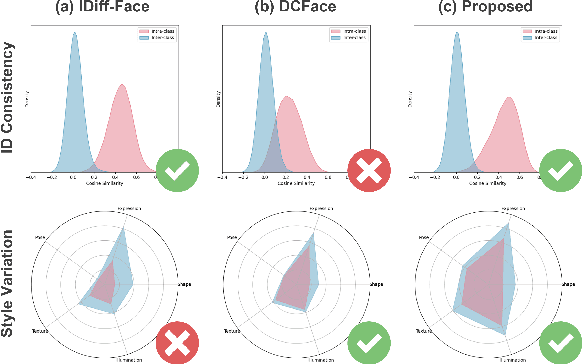
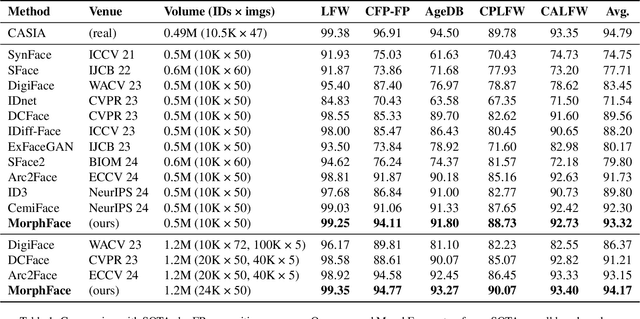
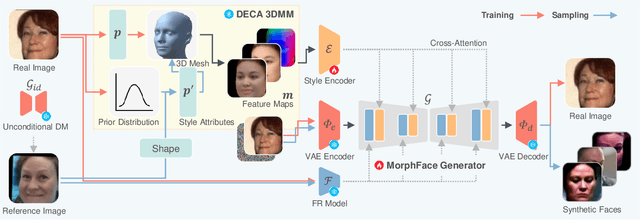
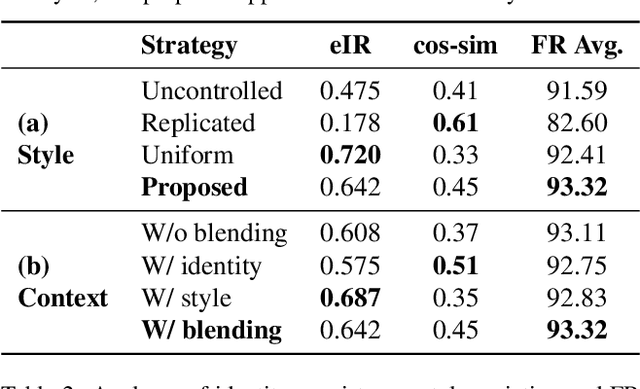
Identity-preserving face synthesis aims to generate synthetic face images of virtual subjects that can substitute real-world data for training face recognition models. While prior arts strive to create images with consistent identities and diverse styles, they face a trade-off between them. Identifying their limitation of treating style variation as subject-agnostic and observing that real-world persons actually have distinct, subject-specific styles, this paper introduces MorphFace, a diffusion-based face generator. The generator learns fine-grained facial styles, e.g., shape, pose and expression, from the renderings of a 3D morphable model (3DMM). It also learns identities from an off-the-shelf recognition model. To create virtual faces, the generator is conditioned on novel identities of unlabeled synthetic faces, and novel styles that are statistically sampled from a real-world prior distribution. The sampling especially accounts for both intra-subject variation and subject distinctiveness. A context blending strategy is employed to enhance the generator's responsiveness to identity and style conditions. Extensive experiments show that MorphFace outperforms the best prior arts in face recognition efficacy.