 Add to Chrome
 Add to Firefox
 Add to Edge
Beyond VLM-Based Rewards: Diffusion-Native Latent Reward Modeling
Feb 11, 2026
Preference optimization for diffusion and flow-matching models relies on reward functions that are both discriminatively robust and computationally efficient. Vision-Language Models (VLMs) have emerged as the primary reward provider, leveraging their rich multimodal priors to guide alignment. However, their computation and memory cost can be substantial, and optimizing a latent diffusion generator through a pixel-space reward introduces a domain mismatch that complicates alignment. In this paper, we propose DiNa-LRM, a diffusion-native latent reward model that formulates preference learning directly on noisy diffusion states. Our method introduces a noise-calibrated Thurstone likelihood with diffusion-noise-dependent uncertainty. DiNa-LRM leverages a pretrained latent diffusion backbone with a timestep-conditioned reward head, and supports inference-time noise ensembling, providing a diffusion-native mechanism for test-time scaling and robust rewarding. Across image alignment benchmarks, DiNa-LRM substantially outperforms existing diffusion-based reward baselines and achieves performance competitive with state-of-the-art VLMs at a fraction of the computational cost. In preference optimization, we demonstrate that DiNa-LRM improves preference optimization dynamics, enabling faster and more resource-efficient model alignment.

Stable and Efficient Single-Rollout RL for Multimodal Reasoning
Dec 20, 2025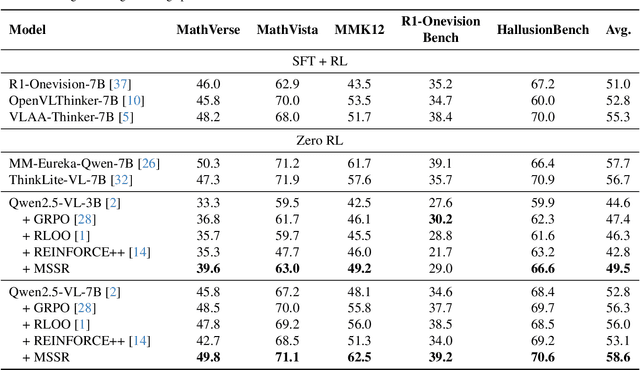
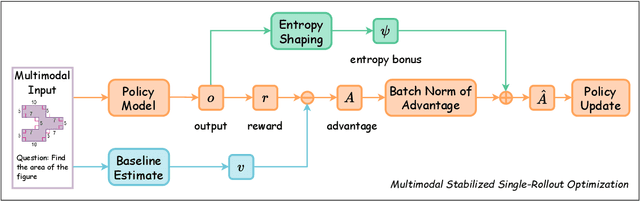

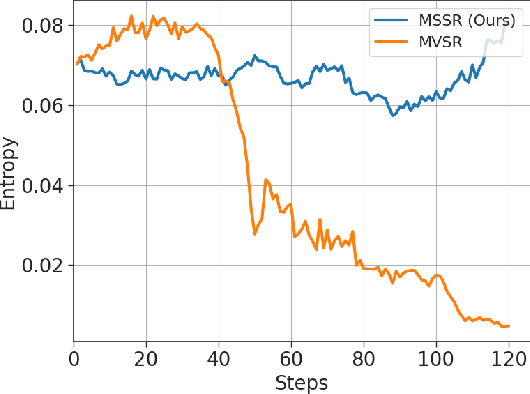
Reinforcement Learning with Verifiable Rewards (RLVR) has become a key paradigm to improve the reasoning capabilities of Multimodal Large Language Models (MLLMs). However, prevalent group-based algorithms such as GRPO require multi-rollout sampling for each prompt. While more efficient single-rollout variants have recently been explored in text-only settings, we find that they suffer from severe instability in multimodal contexts, often leading to training collapse. To address this training efficiency-stability trade-off, we introduce $\textbf{MSSR}$ (Multimodal Stabilized Single-Rollout), a group-free RLVR framework that achieves both stable optimization and effective multimodal reasoning performance. MSSR achieves this via an entropy-based advantage-shaping mechanism that adaptively regularizes advantage magnitudes, preventing collapse and maintaining training stability. While such mechanisms have been used in group-based RLVR, we show that in the multimodal single-rollout setting they are not merely beneficial but essential for stability. In in-distribution evaluations, MSSR demonstrates superior training compute efficiency, achieving similar validation accuracy to the group-based baseline with half the training steps. When trained for the same number of steps, MSSR's performance surpasses the group-based baseline and shows consistent generalization improvements across five diverse reasoning-intensive benchmarks. Together, these results demonstrate that MSSR enables stable, compute-efficient, and effective RLVR for complex multimodal reasoning tasks.
RePlan: Reasoning-guided Region Planning for Complex Instruction-based Image Editing
Dec 18, 2025


Instruction-based image editing enables natural-language control over visual modifications, yet existing models falter under Instruction-Visual Complexity (IV-Complexity), where intricate instructions meet cluttered or ambiguous scenes. We introduce RePlan (Region-aligned Planning), a plan-then-execute framework that couples a vision-language planner with a diffusion editor. The planner decomposes instructions via step-by-step reasoning and explicitly grounds them to target regions; the editor then applies changes using a training-free attention-region injection mechanism, enabling precise, parallel multi-region edits without iterative inpainting. To strengthen planning, we apply GRPO-based reinforcement learning using 1K instruction-only examples, yielding substantial gains in reasoning fidelity and format reliability. We further present IV-Edit, a benchmark focused on fine-grained grounding and knowledge-intensive edits. Across IV-Complex settings, RePlan consistently outperforms strong baselines trained on far larger datasets, improving regional precision and overall fidelity. Our project page: https://replan-iv-edit.github.io
N3D-VLM: Native 3D Grounding Enables Accurate Spatial Reasoning in Vision-Language Models
Dec 18, 2025While current multimodal models can answer questions based on 2D images, they lack intrinsic 3D object perception, limiting their ability to comprehend spatial relationships and depth cues in 3D scenes. In this work, we propose N3D-VLM, a novel unified framework that seamlessly integrates native 3D object perception with 3D-aware visual reasoning, enabling both precise 3D grounding and interpretable spatial understanding. Unlike conventional end-to-end models that directly predict answers from RGB/RGB-D inputs, our approach equips the model with native 3D object perception capabilities, enabling it to directly localize objects in 3D space based on textual descriptions. Building upon accurate 3D object localization, the model further performs explicit reasoning in 3D, achieving more interpretable and structured spatial understanding. To support robust training for these capabilities, we develop a scalable data construction pipeline that leverages depth estimation to lift large-scale 2D annotations into 3D space, significantly increasing the diversity and coverage for 3D object grounding data, yielding over six times larger than the largest existing single-image 3D detection dataset. Moreover, the pipeline generates spatial question-answering datasets that target chain-of-thought (CoT) reasoning in 3D, facilitating joint training for both 3D object localization and 3D spatial reasoning. Experimental results demonstrate that our unified framework not only achieves state-of-the-art performance on 3D grounding tasks, but also consistently surpasses existing methods in 3D spatial reasoning in vision-language model.
MotionEdit: Benchmarking and Learning Motion-Centric Image Editing
Dec 14, 2025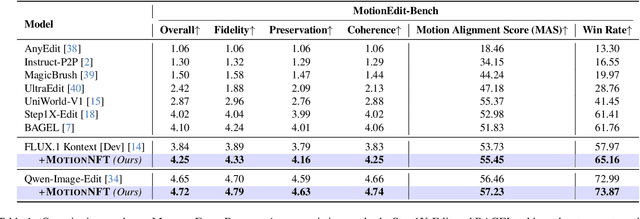
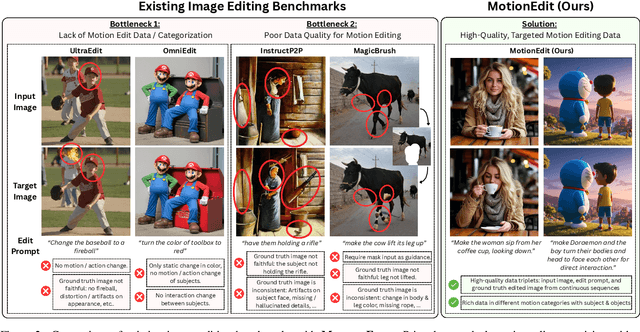
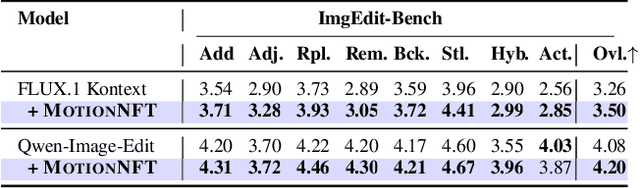
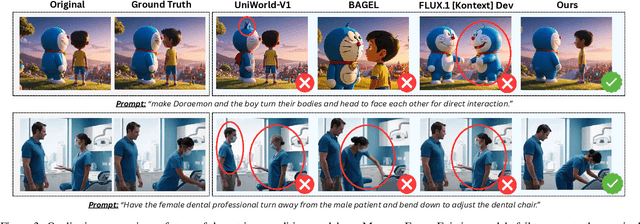
We introduce MotionEdit, a novel dataset for motion-centric image editing-the task of modifying subject actions and interactions while preserving identity, structure, and physical plausibility. Unlike existing image editing datasets that focus on static appearance changes or contain only sparse, low-quality motion edits, MotionEdit provides high-fidelity image pairs depicting realistic motion transformations extracted and verified from continuous videos. This new task is not only scientifically challenging but also practically significant, powering downstream applications such as frame-controlled video synthesis and animation. To evaluate model performance on the novel task, we introduce MotionEdit-Bench, a benchmark that challenges models on motion-centric edits and measures model performance with generative, discriminative, and preference-based metrics. Benchmark results reveal that motion editing remains highly challenging for existing state-of-the-art diffusion-based editing models. To address this gap, we propose MotionNFT (Motion-guided Negative-aware Fine Tuning), a post-training framework that computes motion alignment rewards based on how well the motion flow between input and model-edited images matches the ground-truth motion, guiding models toward accurate motion transformations. Extensive experiments on FLUX.1 Kontext and Qwen-Image-Edit show that MotionNFT consistently improves editing quality and motion fidelity of both base models on the motion editing task without sacrificing general editing ability, demonstrating its effectiveness. Our code is at https://github.com/elainew728/motion-edit/.
Multi-View 3D Point Tracking
Aug 28, 2025We introduce the first data-driven multi-view 3D point tracker, designed to track arbitrary points in dynamic scenes using multiple camera views. Unlike existing monocular trackers, which struggle with depth ambiguities and occlusion, or prior multi-camera methods that require over 20 cameras and tedious per-sequence optimization, our feed-forward model directly predicts 3D correspondences using a practical number of cameras (e.g., four), enabling robust and accurate online tracking. Given known camera poses and either sensor-based or estimated multi-view depth, our tracker fuses multi-view features into a unified point cloud and applies k-nearest-neighbors correlation alongside a transformer-based update to reliably estimate long-range 3D correspondences, even under occlusion. We train on 5K synthetic multi-view Kubric sequences and evaluate on two real-world benchmarks: Panoptic Studio and DexYCB, achieving median trajectory errors of 3.1 cm and 2.0 cm, respectively. Our method generalizes well to diverse camera setups of 1-8 views with varying vantage points and video lengths of 24-150 frames. By releasing our tracker alongside training and evaluation datasets, we aim to set a new standard for multi-view 3D tracking research and provide a practical tool for real-world applications. Project page available at https://ethz-vlg.github.io/mvtracker.
Generative 4D Scene Gaussian Splatting with Object View-Synthesis Priors
Jun 15, 2025We tackle the challenge of generating dynamic 4D scenes from monocular, multi-object videos with heavy occlusions, and introduce GenMOJO, a novel approach that integrates rendering-based deformable 3D Gaussian optimization with generative priors for view synthesis. While existing models perform well on novel view synthesis for isolated objects, they struggle to generalize to complex, cluttered scenes. To address this, GenMOJO decomposes the scene into individual objects, optimizing a differentiable set of deformable Gaussians per object. This object-wise decomposition allows leveraging object-centric diffusion models to infer unobserved regions in novel viewpoints. It performs joint Gaussian splatting to render the full scene, capturing cross-object occlusions, and enabling occlusion-aware supervision. To bridge the gap between object-centric priors and the global frame-centric coordinate system of videos, GenMOJO uses differentiable transformations that align generative and rendering constraints within a unified framework. The resulting model generates 4D object reconstructions over space and time, and produces accurate 2D and 3D point tracks from monocular input. Quantitative evaluations and perceptual human studies confirm that GenMOJO generates more realistic novel views of scenes and produces more accurate point tracks compared to existing approaches.
Zero-P-to-3: Zero-Shot Partial-View Images to 3D Object
May 29, 2025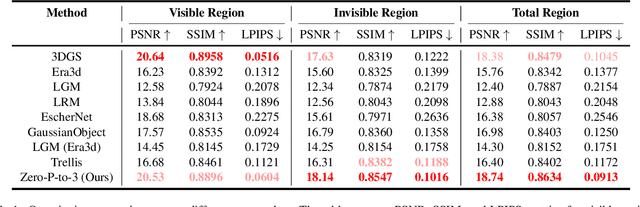
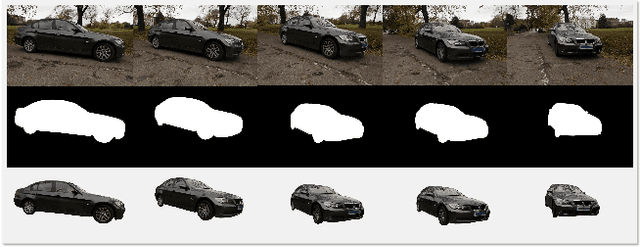
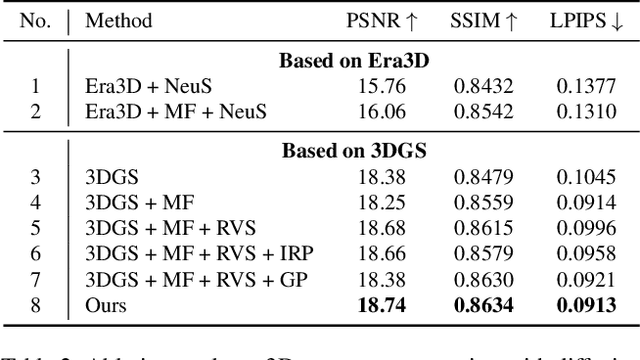
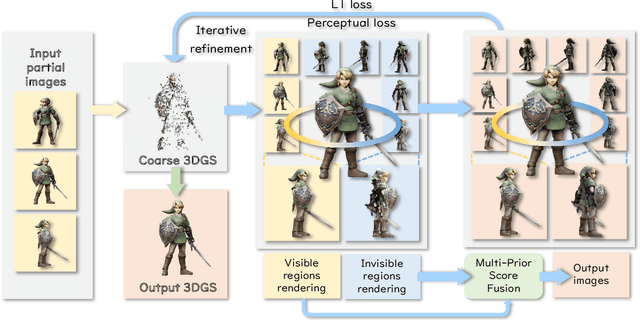
Generative 3D reconstruction shows strong potential in incomplete observations. While sparse-view and single-image reconstruction are well-researched, partial observation remains underexplored. In this context, dense views are accessible only from a specific angular range, with other perspectives remaining inaccessible. This task presents two main challenges: (i) limited View Range: observations confined to a narrow angular scope prevent effective traditional interpolation techniques that require evenly distributed perspectives. (ii) inconsistent Generation: views created for invisible regions often lack coherence with both visible regions and each other, compromising reconstruction consistency. To address these challenges, we propose \method, a novel training-free approach that integrates the local dense observations and multi-source priors for reconstruction. Our method introduces a fusion-based strategy to effectively align these priors in DDIM sampling, thereby generating multi-view consistent images to supervise invisible views. We further design an iterative refinement strategy, which uses the geometric structures of the object to enhance reconstruction quality. Extensive experiments on multiple datasets show the superiority of our method over SOTAs, especially in invisible regions.
TAPIP3D: Tracking Any Point in Persistent 3D Geometry
Apr 20, 2025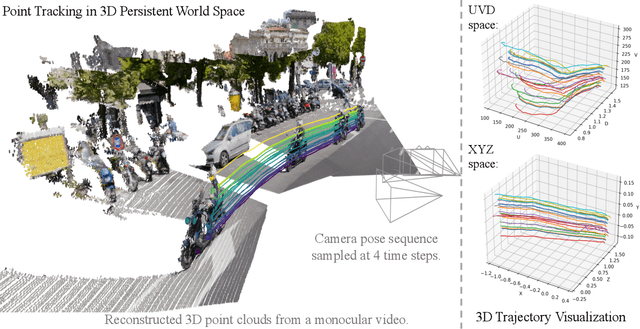

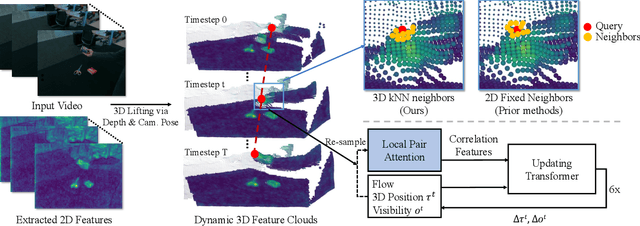
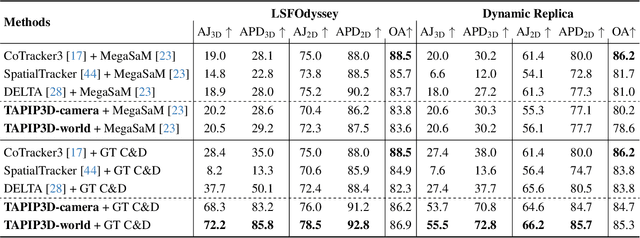
We introduce TAPIP3D, a novel approach for long-term 3D point tracking in monocular RGB and RGB-D videos. TAPIP3D represents videos as camera-stabilized spatio-temporal feature clouds, leveraging depth and camera motion information to lift 2D video features into a 3D world space where camera motion is effectively canceled. TAPIP3D iteratively refines multi-frame 3D motion estimates within this stabilized representation, enabling robust tracking over extended periods. To manage the inherent irregularities of 3D point distributions, we propose a Local Pair Attention mechanism. This 3D contextualization strategy effectively exploits spatial relationships in 3D, forming informative feature neighborhoods for precise 3D trajectory estimation. Our 3D-centric approach significantly outperforms existing 3D point tracking methods and even enhances 2D tracking accuracy compared to conventional 2D pixel trackers when accurate depth is available. It supports inference in both camera coordinates (i.e., unstabilized) and world coordinates, and our results demonstrate that compensating for camera motion improves tracking performance. Our approach replaces the conventional 2D square correlation neighborhoods used in prior 2D and 3D trackers, leading to more robust and accurate results across various 3D point tracking benchmarks. Project Page: https://tapip3d.github.io
M$^3$PC: Test-time Model Predictive Control for Pretrained Masked Trajectory Model
Dec 07, 2024
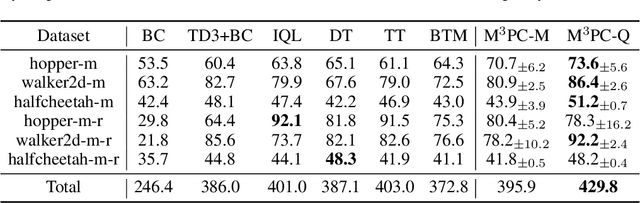

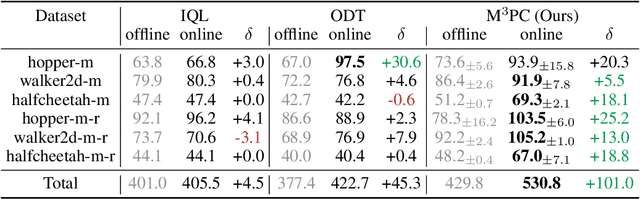
Recent work in Offline Reinforcement Learning (RL) has shown that a unified Transformer trained under a masked auto-encoding objective can effectively capture the relationships between different modalities (e.g., states, actions, rewards) within given trajectory datasets. However, this information has not been fully exploited during the inference phase, where the agent needs to generate an optimal policy instead of just reconstructing masked components from unmasked ones. Given that a pretrained trajectory model can act as both a Policy Model and a World Model with appropriate mask patterns, we propose using Model Predictive Control (MPC) at test time to leverage the model's own predictive capability to guide its action selection. Empirical results on D4RL and RoboMimic show that our inference-phase MPC significantly improves the decision-making performance of a pretrained trajectory model without any additional parameter training. Furthermore, our framework can be adapted to Offline to Online (O2O) RL and Goal Reaching RL, resulting in more substantial performance gains when an additional online interaction budget is provided, and better generalization capabilities when different task targets are specified. Code is available: https://github.com/wkh923/m3pc.