 Add to Chrome
 Add to Firefox
 Add to Edge
Image Quality Assessment of Identity Cards Using Measures from Open Face Image Quality
Jun 10, 2026
This paper addresses the challenge of assessing image quality in ID cards in remote verification systems by applying capture-related quality measures from the Open Face Image Quality (OFIQ) standard to ID card images. Our preprocessing pipeline includes corner detection, perspective normalization, and comprehensive foreground masking to ensure accurate and unbiased quality measure computation. We evaluate the effectiveness of these measures by analyzing their correlation with the performance of three presentation attack detection (PAD) algorithms across four diverse ID card datasets, where two datasets contain bona fide, i.e. pristine, images and two contain printed mock ID cards. Our results suggest that quality assessment based on some OFIQ measures can significantly improve PAD performance.

Detection of T-shirt Presentation Attacks in Face Recognition Systems
Apr 21, 2026Face recognition systems are often used for biometric authentication. Nevertheless, it is known that without any protective measures, face recognition systems are vulnerable to presentation attacks. To tackle this security problem, methods for detecting presentation attacks have been developed and shown good detection performance on several benchmark datasets. However, generalising presentation attack detection methods to new and novel types of attacks is an ongoing challenge. In this work, we employ 1,608 T-shirt attacks of the T-shirt Face Presentation Attack (TFPA) database using 100 unique presentation attack instruments together with 152 bona fide presentations. In a comprehensive evaluation, we show that this type of attack can compromise the security of face recognition systems. Furthermore, we propose a detection method based on spatial consistency checks in order to detect said T-shirt attacks. Precisely, state-of-the-art face and person detectors are combined to analyse the spatial positions of detected faces and persons based on which T-shirt attacks can be reliably detected.
DifFoundMAD: Foundation Models meet Differential Morphing Attack Detection
Apr 20, 2026In this work, we introduce DifFoundMAD, a parameter-efficient D-MAD framework that exploits the generalisation capabilities of vision foundation models (FM) to capture discrepancies between suspected morphs and live capture images. In contrast to conventional D-MAD systems that rely on face recognition embeddings or handcrafted feature differences, DifFoundMAD follows the standard differential paradigm while replacing the underlying representation space with embeddings extracted from FMs. By combining lightweight finetuning with class-balanced optimisation, the proposed method updates only a small subset of parameters while preserving the rich representational priors of the underlying FMs. Extensive cross-database evaluations on standard D-MAD benchmarks demonstrate that DifFoundMAD achieves consistent improvements over state-of-the-art systems, particularly at the strict security levels required in operational deployments such as border control: The error rates reported in the current state-of-the-art were reduced from 6.16% to 2.17% for high-security levels using DifFoundMAD.
AMB-FHE: Adaptive Multi-biometric Fusion with Fully Homomorphic Encryption
Mar 31, 2025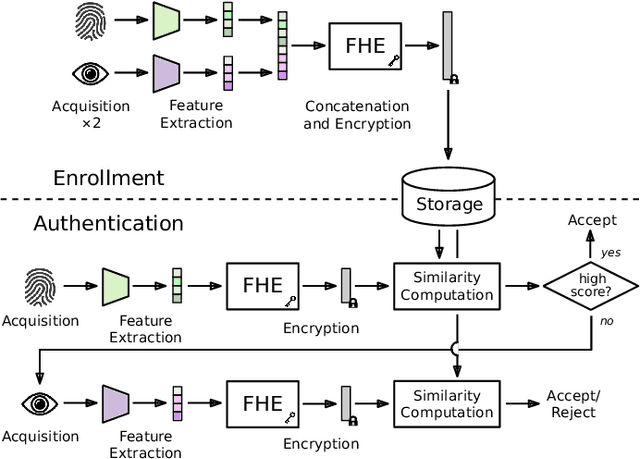
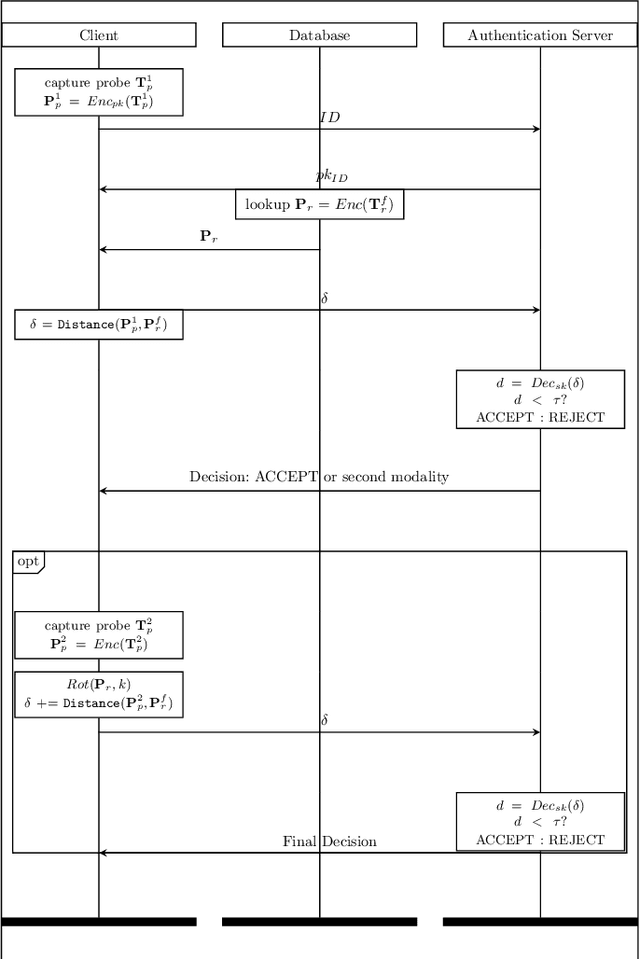

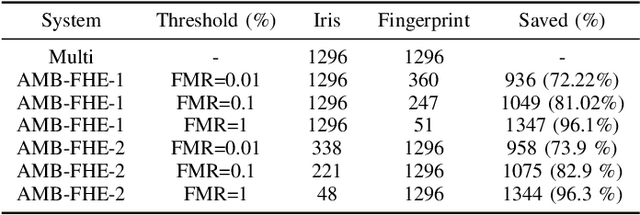
Biometric systems strive to balance security and usability. The use of multi-biometric systems combining multiple biometric modalities is usually recommended for high-security applications. However, the presentation of multiple biometric modalities can impair the user-friendliness of the overall system and might not be necessary in all cases. In this work, we present a simple but flexible approach to increase the privacy protection of homomorphically encrypted multi-biometric reference templates while enabling adaptation to security requirements at run-time: An adaptive multi-biometric fusion with fully homomorphic encryption (AMB-FHE). AMB-FHE is benchmarked against a bimodal biometric database consisting of the CASIA iris and MCYT fingerprint datasets using deep neural networks for feature extraction. Our contribution is easy to implement and increases the flexibility of biometric authentication while offering increased privacy protection through joint encryption of templates from multiple modalities.
Deep Learning-based Compression Detection for explainable Face Image Quality Assessment
Jan 07, 2025


The assessment of face image quality is crucial to ensure reliable face recognition. In order to provide data subjects and operators with explainable and actionable feedback regarding captured face images, relevant quality components have to be measured. Quality components that are known to negatively impact the utility of face images include JPEG and JPEG 2000 compression artefacts, among others. Compression can result in a loss of important image details which may impair the recognition performance. In this work, deep neural networks are trained to detect the compression artefacts in a face images. For this purpose, artefact-free facial images are compressed with the JPEG and JPEG 2000 compression algorithms. Subsequently, the PSNR and SSIM metrics are employed to obtain training labels based on which neural networks are trained using a single network to detect JPEG and JPEG 2000 artefacts, respectively. The evaluation of the proposed method shows promising results: in terms of detection accuracy, error rates of 2-3% are obtained for utilizing PSNR labels during training. In addition, we show that error rates of different open-source and commercial face recognition systems can be significantly reduced by discarding face images exhibiting severe compression artefacts. To minimize resource consumption, EfficientNetV2 serves as basis for the presented algorithm, which is available as part of the OFIQ software.
Second FRCSyn-onGoing: Winning Solutions and Post-Challenge Analysis to Improve Face Recognition with Synthetic Data
Dec 02, 2024Synthetic data is gaining increasing popularity for face recognition technologies, mainly due to the privacy concerns and challenges associated with obtaining real data, including diverse scenarios, quality, and demographic groups, among others. It also offers some advantages over real data, such as the large amount of data that can be generated or the ability to customize it to adapt to specific problem-solving needs. To effectively use such data, face recognition models should also be specifically designed to exploit synthetic data to its fullest potential. In order to promote the proposal of novel Generative AI methods and synthetic data, and investigate the application of synthetic data to better train face recognition systems, we introduce the 2nd FRCSyn-onGoing challenge, based on the 2nd Face Recognition Challenge in the Era of Synthetic Data (FRCSyn), originally launched at CVPR 2024. This is an ongoing challenge that provides researchers with an accessible platform to benchmark i) the proposal of novel Generative AI methods and synthetic data, and ii) novel face recognition systems that are specifically proposed to take advantage of synthetic data. We focus on exploring the use of synthetic data both individually and in combination with real data to solve current challenges in face recognition such as demographic bias, domain adaptation, and performance constraints in demanding situations, such as age disparities between training and testing, changes in the pose, or occlusions. Very interesting findings are obtained in this second edition, including a direct comparison with the first one, in which synthetic databases were restricted to DCFace and GANDiffFace.
Fairness measures for biometric quality assessment
Aug 21, 2024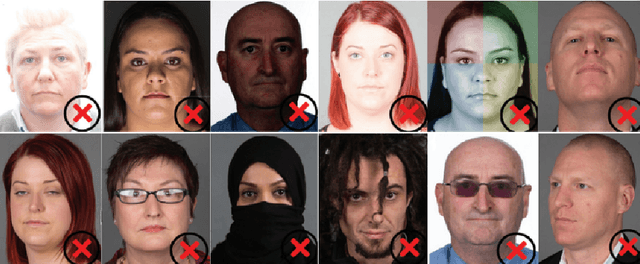
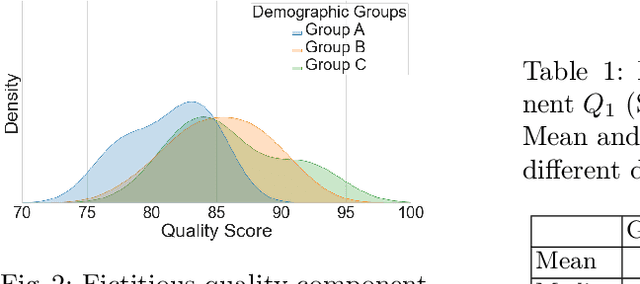

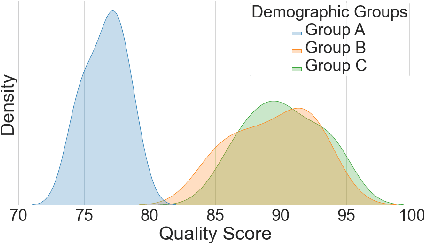
Quality assessment algorithms measure the quality of a captured biometric sample. Since the sample quality strongly affects the recognition performance of a biometric system, it is essential to only process samples of sufficient quality and discard samples of low-quality. Even though quality assessment algorithms are not intended to yield very different quality scores across demographic groups, quality score discrepancies are possible, resulting in different discard ratios. To ensure that quality assessment algorithms do not take demographic characteristics into account when assessing sample quality and consequently to ensure that the quality algorithms perform equally for all individuals, it is crucial to develop a fairness measure. In this work we propose and compare multiple fairness measures for evaluating quality components across demographic groups. Proposed measures, could be used as potential candidates for an upcoming standard in this important field.
Testing the Performance of Face Recognition for People with Down Syndrome
May 18, 2024
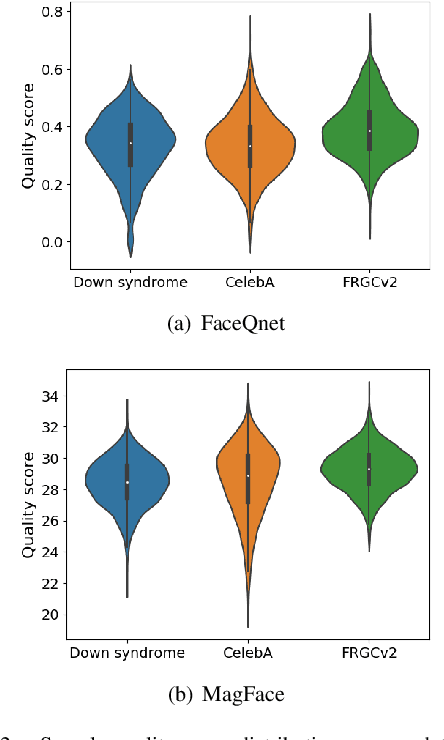

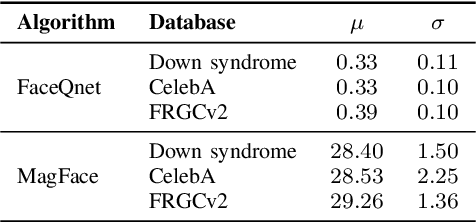
The fairness of biometric systems, in particular facial recognition, is often analysed for larger demographic groups, e.g. female vs. male or black vs. white. In contrast to this, minority groups are commonly ignored. This paper investigates the performance of facial recognition algorithms on individuals with Down syndrome, a common chromosomal abnormality that affects approximately one in 1,000 births per year. To do so, a database of 98 individuals with Down syndrome, each represented by at least five facial images, is semi-automatically collected from YouTube. Subsequently, two facial image quality assessment algorithms and five recognition algorithms are evaluated on the newly collected database and on the public facial image databases CelebA and FRGCv2. The results show that the quality scores of facial images for individuals with Down syndrome are comparable to those of individuals without Down syndrome captured under similar conditions. Furthermore, it is observed that face recognition performance decreases significantly for individuals with Down syndrome, which is largely attributed to the increased likelihood of false matches.
TattTRN: Template Reconstruction Network for Tattoo Retrieval
May 13, 2024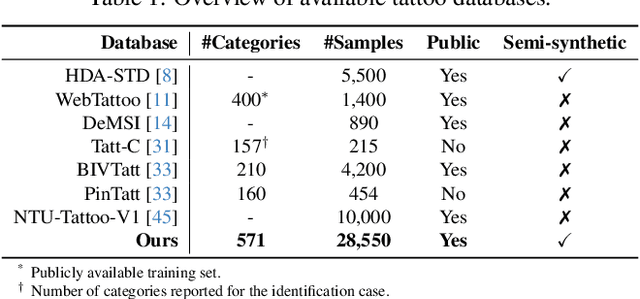
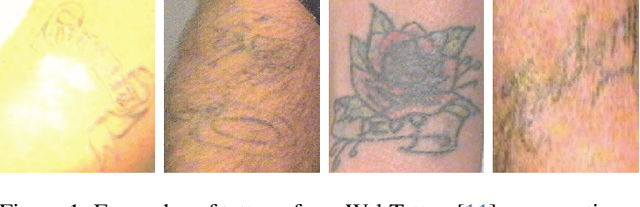
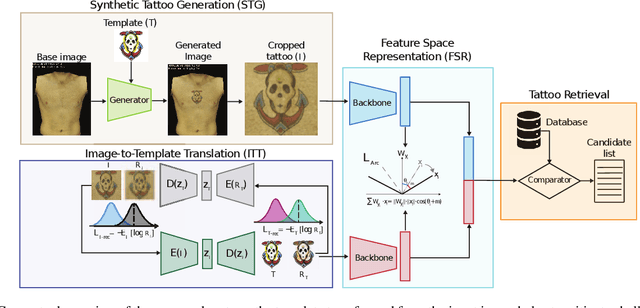

Tattoos have been used effectively as soft biometrics to assist law enforcement in the identification of offenders and victims, as they contain discriminative information, and are a useful indicator to locate members of a criminal gang or organisation. Due to various privacy issues in the acquisition of images containing tattoos, only a limited number of databases exists. This lack of databases has delayed the development of new methods to effectively retrieve a potential suspect's tattoo images from a candidate gallery. To mitigate this issue, in our work, we use an unsupervised generative approach to create a balanced database consisting of 28,550 semi-synthetic images with tattooed subjects from 571 tattoo categories. Further, we introduce a novel Tattoo Template Reconstruction Network (TattTRN), which learns to map the input tattoo sample to its respective tattoo template to enhance the distinguishing attributes of the final feature embedding. Experimental results with real data, i.e., WebTattoo and BIVTatt databases, demonstrate the soundness of the presented approach: an accuracy of up to 99% is achieved for checking at most the first 20 entries of the candidate list.
Second Edition FRCSyn Challenge at CVPR 2024: Face Recognition Challenge in the Era of Synthetic Data
Apr 16, 2024
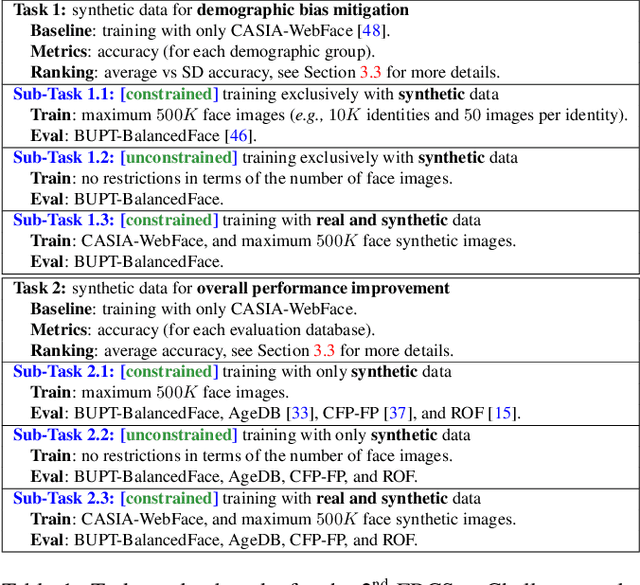

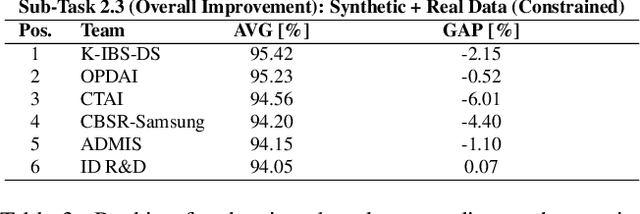
Synthetic data is gaining increasing relevance for training machine learning models. This is mainly motivated due to several factors such as the lack of real data and intra-class variability, time and errors produced in manual labeling, and in some cases privacy concerns, among others. This paper presents an overview of the 2nd edition of the Face Recognition Challenge in the Era of Synthetic Data (FRCSyn) organized at CVPR 2024. FRCSyn aims to investigate the use of synthetic data in face recognition to address current technological limitations, including data privacy concerns, demographic biases, generalization to novel scenarios, and performance constraints in challenging situations such as aging, pose variations, and occlusions. Unlike the 1st edition, in which synthetic data from DCFace and GANDiffFace methods was only allowed to train face recognition systems, in this 2nd edition we propose new sub-tasks that allow participants to explore novel face generative methods. The outcomes of the 2nd FRCSyn Challenge, along with the proposed experimental protocol and benchmarking contribute significantly to the application of synthetic data to face recognition.
* arXiv admin note: text overlap with arXiv:2311.10476