 Add to Chrome
 Add to Firefox
 Add to Edge
XPolicyLab: A Unified Standard and Open Ecosystem for Robot Policy Evaluation and Deployment
Aug 11, 2026
Robot policy evaluation and deployment remain fragmented by model-specific software dependencies, data representations, and runtime interfaces, so that connecting N policies to M evaluation environments requires O(NM) separate integrations. We present XPolicyLab, a unified standard and open ecosystem that reduces this cost to O(N+M). XPolicyLab specifies common observation, action, and trajectory schemas together with a minimal adapter interface for observation updates, action prediction, batched execution, and episode reset, while a dependency-isolated client/server architecture separates policy inference from environment execution, so that each side retains its native software stack and may run locally or remotely. The ecosystem integrates 42 robot policies and standardizes their installation, debugging, serving, and evaluation workflows. Across these adapters, model-specific code varies by an order of magnitude while the environment-facing loop stays within a few lines of a fixed reference, confirming that the contract confines heterogeneity to the policy side. In a controlled study, conforming to the standard reduces the integration effort of a representative policy from over five hours to two hours, and packaged agent skills reduce it further to thirty minutes. The same adapters serve RoboTwin, RoboDojo simulation, and standardized real-robot evaluation through one interface. XPolicyLab is released as shared infrastructure for reproducible policy comparison and standardized deployment across simulation and physical platforms. Project website: https://xpolicylab.github.io/.

Towards Trustworthy Embodied Intelligence: A Systems Framework and Graded Trustworthiness Levels
Jul 28, 2026Embodied intelligence integrates learned perception and decision making with real-time computation, control, and physical interaction. Because failures can cause immediate physical or operational harm, task completion alone does not establish trustworthiness. We define trustworthy embodied intelligence as the sustained capacity to execute specified tasks reliably under environmental and system variation while maintaining risk within acceptable bounds. We term this objective sustained safe success. Its supporting mechanisms are organized into four interdependent layers. The model layer generates task-competent action proposals with calibrated uncertainty and explicit safety preferences. The system layer realizes authorized actions dependably through integrated sensing, computation, control, hardware safeguards, fault containment, and fallback. The evidence layer substantiates bounded claims through evaluation, verification, validation, traceability, and structured assurance arguments. The deployment layer maintains claim validity through runtime monitoring, authority management, intervention, incident response, and controlled updates. Because assumptions and failures propagate across these layers, neither model capability, isolated safeguards, nor benchmark performance alone can establish end-to-end trustworthiness. Drawing on embodied AI, robotics, control, dependable computing, distributed systems, and autonomous driving, we further propose a non-normative hierarchy of trustworthiness levels. This hierarchy grades the strength of bounded deployment claims across task capability, safety, system assurance, operational governance, and supporting evidence, providing a basis for bounded deployment, comparative evaluation, research prioritization, and future standardization.
Kimi K3: Open Frontier Intelligence
Jul 27, 2026We introduce Kimi K3, a 2.8T parameter Mixture-of-Experts model with 104 billion activated parameters, native vision capabilities, and a 1-million-token context window. Kimi K3 is built on Kimi Delta Attention and Attention Residuals, which improve information flow across sequence length and model depth. Together with Stable LatentMoE, which effectively activates 16 of 896 routed experts per token, and refined training and data recipes, these advances yield an approximately 2.5x improvement in overall scaling efficiency over Kimi K2. Post-training highlights reinforcement learning across general, agentic, and coding domains and multiple reasoning-effort levels, enabling compositional generalization and robust long-horizon execution. At 2.8T scale, Kimi K3 is supported by infrastructure advances in multiple areas: algorithm-system co-design for KDA, perfectly balanced expert-parallel training with efficient memory management, million-token agentic RL with persistent rollout and sandbox states, and deployment innovations. Extensive evaluations show that Kimi K3 achieves frontier-level performance across long-horizon coding, agentic, knowledge, reasoning, and vision tasks. While its overall performance still trails the most powerful proprietary models, namely Claude Fable 5 and GPT-5.6 Sol, Kimi K3 consistently outperforms other open and proprietary models evaluated in our suite. We release the full Kimi K3 model weights to facilitate future research and accelerate the broader deployment and adoption of frontier intelligence.
Learning Human-Intention Priors from Large-Scale Human Demonstrations for Robotic Manipulation
Apr 27, 2026Human videos contain rich manipulation priors, but using them for robot learning remains difficult because raw observations entangle scene understanding, human motion, and embodiment-specific action. We introduce MoT-HRA, a hierarchical vision-language-action framework that learns human-intention priors from large-scale human demonstrations. We first curate HA-2.2M, a 2.2M-episode action-language dataset reconstructed from heterogeneous human videos through hand-centric filtering, spatial reconstruction, temporal segmentation, and language alignment. On top of this dataset, MoT-HRA factorizes manipulation into three coupled experts: a vision-language expert predicts an embodiment-agnostic 3D trajectory, an intention expert models MANO-style hand motion as a latent human-motion prior, and a fine expert maps the intention-aware representation to robot action chunks. A shared-attention trunk and read-only key-value transfer allow downstream control to use human priors while limiting interference with upstream representations. Experiments on hand motion generation, simulated manipulation, and real-world robot tasks show that MoT-HRA improves motion plausibility and robust control under distribution shift.
Attention Residuals
Mar 16, 2026Residual connections with PreNorm are standard in modern LLMs, yet they accumulate all layer outputs with fixed unit weights. This uniform aggregation causes uncontrolled hidden-state growth with depth, progressively diluting each layer's contribution. We propose Attention Residuals (AttnRes), which replaces this fixed accumulation with softmax attention over preceding layer outputs, allowing each layer to selectively aggregate earlier representations with learned, input-dependent weights. To address the memory and communication overhead of attending over all preceding layer outputs for large-scale model training, we introduce Block AttnRes, which partitions layers into blocks and attends over block-level representations, reducing the memory footprint while preserving most of the gains of full AttnRes. Combined with cache-based pipeline communication and a two-phase computation strategy, Block AttnRes becomes a practical drop-in replacement for standard residual connections with minimal overhead. Scaling law experiments confirm that the improvement is consistent across model sizes, and ablations validate the benefit of content-dependent depth-wise selection. We further integrate AttnRes into the Kimi Linear architecture (48B total / 3B activated parameters) and pre-train on 1.4T tokens, where AttnRes mitigates PreNorm dilution, yielding more uniform output magnitudes and gradient distribution across depth, and improves downstream performance across all evaluated tasks.
Master Micro Residual Correction with Adaptive Tactile Fusion and Force-Mixed Control for Contact-Rich Manipulation
Mar 16, 2026Robotic contact-rich and fine-grained manipulation remains a significant challenge due to complex interaction dynamics and the competing requirements of multi-timescale control. While current visual imitation learning methods excel at long-horizon planning, they often fail to perceive critical interaction cues like friction variations or incipient slip, and struggle to balance global task coherence with local reactive feedback. To address these challenges, we propose M2-ResiPolicy, a novel Master-Micro residual control architecture that synergizes high-level action guidance with low-level correction. The framework consists of a Master-Guidance Policy (MGP) operating at 10 Hz, which generates temporally consistent action chunks via a diffusion-based backbone and employs a tactile-intensity-driven adaptive fusion mechanism to dynamically modulate perceptual weights between vision and touch. Simultaneously, a high-frequency (60 Hz) Micro-Residual Corrector (MRC) utilizes a lightweight GRU to provide real-time action compensation based on TCP wrench feedback. This policy is further integrated with a force-mixed PBIC execution layer, effectively regulating contact forces to ensure interaction safety. Experiments across several demanding tasks including fragile object grasping and precision insertion, demonstrate that M2-ResiPolicy significantly outperforms standard Diffusion Policy (DP) and state-of-the-art Reactive Diffusion Policy (RDP), achieving a 93\% damage-free success rate in chip grasping and superior force regulation stability.
RoboStereo: Dual-Tower 4D Embodied World Models for Unified Policy Optimization
Mar 13, 2026Scalable Embodied AI faces fundamental constraints due to prohibitive costs and safety risks of real-world interaction. While Embodied World Models (EWMs) offer promise through imagined rollouts, existing approaches suffer from geometric hallucinations and lack unified optimization frameworks for practical policy improvement. We introduce RoboStereo, a symmetric dual-tower 4D world model that employs bidirectional cross-modal enhancement to ensure spatiotemporal geometric consistency and alleviate physics hallucinations. Building upon this high-fidelity 4D simulator, we present the first unified framework for world-model-based policy optimization: (1) Test-Time Policy Augmentation (TTPA) for pre-execution verification, (2) Imitative-Evolutionary Policy Learning (IEPL) leveraging visual perceptual rewards to learn from expert demonstrations, and (3) Open-Exploration Policy Learning (OEPL) enabling autonomous skill discovery and self-correction. Comprehensive experiments demonstrate RoboStereo achieves state-of-the-art generation quality, with our unified framework delivering >97% average relative improvement on fine-grained manipulation tasks.
Cell Behavior Video Classification Challenge, a benchmark for computer vision methods in time-lapse microscopy
Jan 15, 2026The classification of microscopy videos capturing complex cellular behaviors is crucial for understanding and quantifying the dynamics of biological processes over time. However, it remains a frontier in computer vision, requiring approaches that effectively model the shape and motion of objects without rigid boundaries, extract hierarchical spatiotemporal features from entire image sequences rather than static frames, and account for multiple objects within the field of view. To this end, we organized the Cell Behavior Video Classification Challenge (CBVCC), benchmarking 35 methods based on three approaches: classification of tracking-derived features, end-to-end deep learning architectures to directly learn spatiotemporal features from the entire video sequence without explicit cell tracking, or ensembling tracking-derived with image-derived features. We discuss the results achieved by the participants and compare the potential and limitations of each approach, serving as a basis to foster the development of computer vision methods for studying cellular dynamics.
Universal Visuo-Tactile Video Understanding for Embodied Interaction
May 28, 2025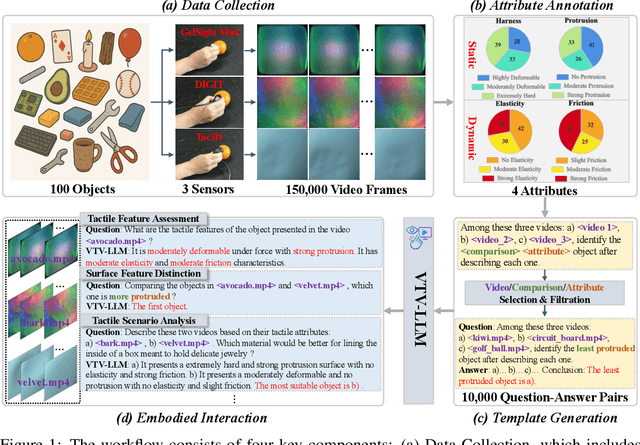
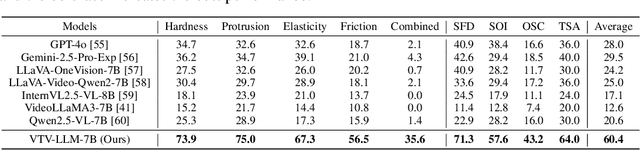
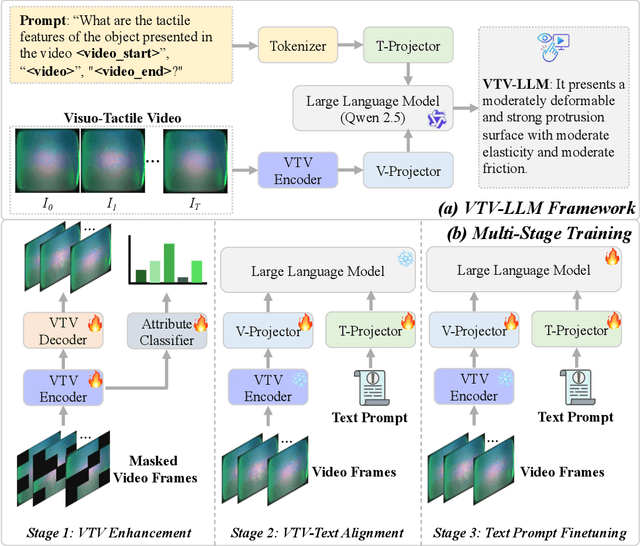

Tactile perception is essential for embodied agents to understand physical attributes of objects that cannot be determined through visual inspection alone. While existing approaches have made progress in visual and language modalities for physical understanding, they fail to effectively incorporate tactile information that provides crucial haptic feedback for real-world interaction. In this paper, we present VTV-LLM, the first multi-modal large language model for universal Visuo-Tactile Video (VTV) understanding that bridges the gap between tactile perception and natural language. To address the challenges of cross-sensor and cross-modal integration, we contribute VTV150K, a comprehensive dataset comprising 150,000 video frames from 100 diverse objects captured across three different tactile sensors (GelSight Mini, DIGIT, and Tac3D), annotated with four fundamental tactile attributes (hardness, protrusion, elasticity, and friction). We develop a novel three-stage training paradigm that includes VTV enhancement for robust visuo-tactile representation, VTV-text alignment for cross-modal correspondence, and text prompt finetuning for natural language generation. Our framework enables sophisticated tactile reasoning capabilities including feature assessment, comparative analysis, scenario-based decision making and so on. Experimental evaluations demonstrate that VTV-LLM achieves superior performance in tactile video understanding tasks, establishing a foundation for more intuitive human-machine interaction in tactile domains.
Securing the Skies: A Comprehensive Survey on Anti-UAV Methods, Benchmarking, and Future Directions
Apr 16, 2025Unmanned Aerial Vehicles (UAVs) are indispensable for infrastructure inspection, surveillance, and related tasks, yet they also introduce critical security challenges. This survey provides a wide-ranging examination of the anti-UAV domain, centering on three core objectives-classification, detection, and tracking-while detailing emerging methodologies such as diffusion-based data synthesis, multi-modal fusion, vision-language modeling, self-supervised learning, and reinforcement learning. We systematically evaluate state-of-the-art solutions across both single-modality and multi-sensor pipelines (spanning RGB, infrared, audio, radar, and RF) and discuss large-scale as well as adversarially oriented benchmarks. Our analysis reveals persistent gaps in real-time performance, stealth detection, and swarm-based scenarios, underscoring pressing needs for robust, adaptive anti-UAV systems. By highlighting open research directions, we aim to foster innovation and guide the development of next-generation defense strategies in an era marked by the extensive use of UAVs.