 Add to Chrome
 Add to Firefox
 Add to Edge
FlowMimic: Mask-free Visual Editing and Generation with Pixel-pair Warped Flow Field for Online Video Editing Data Generation and Modality Mimicry
Jul 20, 2026
In line with the prevailing direction of vision research, we explore the integration of both generation and editing capabilities for video and image modalities within a single model. Current approaches to collecting video editing data typically depend on labour-intensive, time-consuming curated procedures--involving object mask annotation, the use of error-introducing pair synthesis via I2V model and ControlNet-like guidance, and VLM-based quality filtering or refinement--and demonstrate limited task scalability. As a result, the diversity of editing tasks remains substantially narrower than that available for image editing models. We develop a pixel-pair temporal warped flow field that can directly generate corresponding video editing samples in real time from image editing samples, and we demonstrate across multiple levels of video editing tasks that a model can learn video editing using only such data. We regard the image modality as a particular form of the video modality. Accordingly, we design a modality mimic generation loss and a modality mimic editing loss to relatively align the capabilities--and thereby the output distributions--of the two modalities through mutual imitation. Moreover, language-based visual editing entails the comprehension of the editing instruction and the reference visual content, the localization of the region corresponding to that instruction within the reference visual contents, and the modification of that region alone. Existing approaches predominantly rely on external aids, such as fine-tuning an additional MLLM or explicitly supplying a mask sequence as auxiliary input during inference. In contrast, we aspire for the model to internalize this capability. To that end, we introduce sense-related tasks--for instance, referring expression segmentation--along with corresponding editing-region-aware latent-level loss and attention-level loss.

LivePortrait: Efficient Portrait Animation with Stitching and Retargeting Control
Jul 03, 2024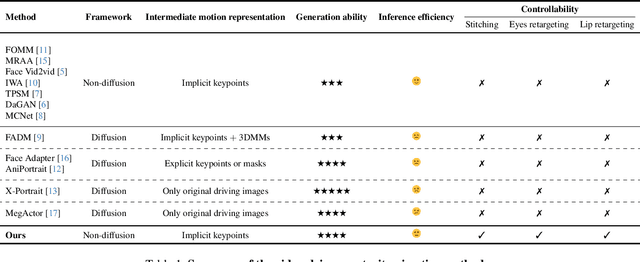
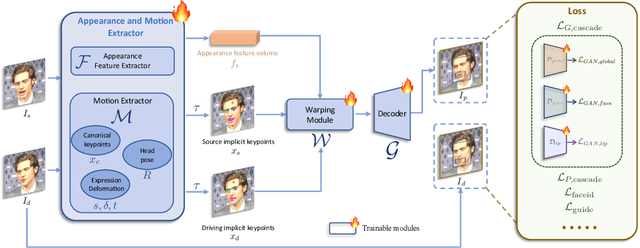
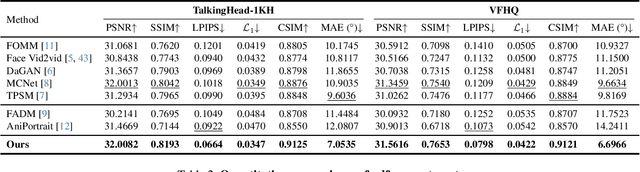
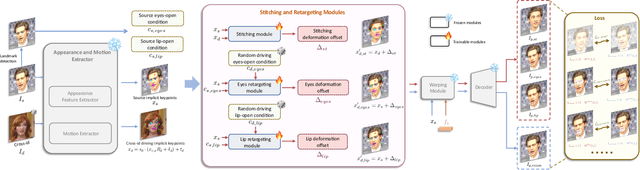
Portrait Animation aims to synthesize a lifelike video from a single source image, using it as an appearance reference, with motion (i.e., facial expressions and head pose) derived from a driving video, audio, text, or generation. Instead of following mainstream diffusion-based methods, we explore and extend the potential of the implicit-keypoint-based framework, which effectively balances computational efficiency and controllability. Building upon this, we develop a video-driven portrait animation framework named LivePortrait with a focus on better generalization, controllability, and efficiency for practical usage. To enhance the generation quality and generalization ability, we scale up the training data to about 69 million high-quality frames, adopt a mixed image-video training strategy, upgrade the network architecture, and design better motion transformation and optimization objectives. Additionally, we discover that compact implicit keypoints can effectively represent a kind of blendshapes and meticulously propose a stitching and two retargeting modules, which utilize a small MLP with negligible computational overhead, to enhance the controllability. Experimental results demonstrate the efficacy of our framework even compared to diffusion-based methods. The generation speed remarkably reaches 12.8ms on an RTX 4090 GPU with PyTorch. The inference code and models are available at https://github.com/KwaiVGI/LivePortrait
MetaHead: An Engine to Create Realistic Digital Head
Apr 03, 2023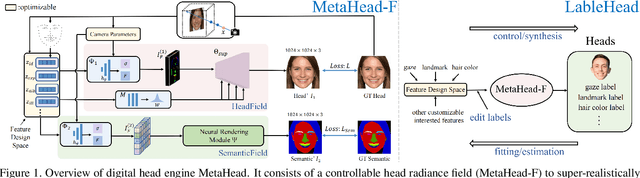
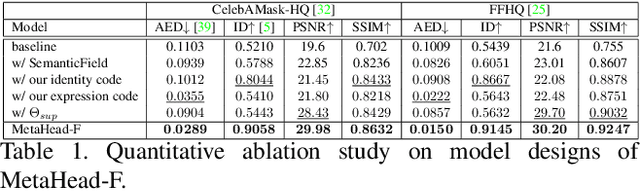
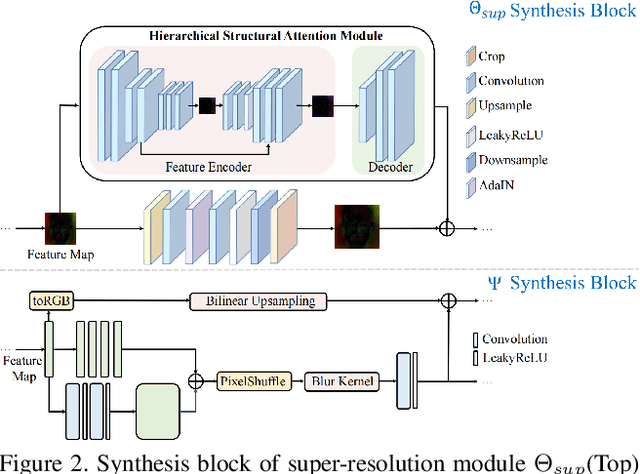
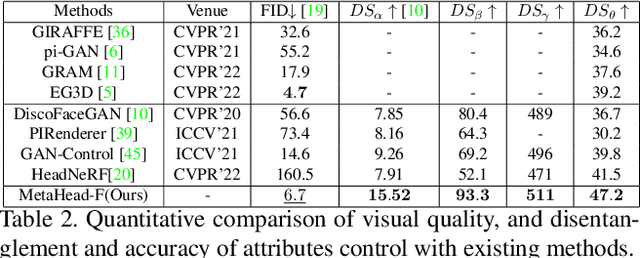
Collecting and labeling training data is one important step for learning-based methods because the process is time-consuming and biased. For face analysis tasks, although some generative models can be used to generate face data, they can only achieve a subset of generation diversity, reconstruction accuracy, 3D consistency, high-fidelity visual quality, and easy editability. One recent related work is the graphics-based generative method, but it can only render low realism head with high computation cost. In this paper, we propose MetaHead, a unified and full-featured controllable digital head engine, which consists of a controllable head radiance field(MetaHead-F) to super-realistically generate or reconstruct view-consistent 3D controllable digital heads and a generic top-down image generation framework LabelHead to generate digital heads consistent with the given customizable feature labels. Experiments validate that our controllable digital head engine achieves the state-of-the-art generation visual quality and reconstruction accuracy. Moreover, the generated labeled data can assist real training data and significantly surpass the labeled data generated by graphics-based methods in terms of training effect.