 Add to Chrome
 Add to Firefox
 Add to Edge
ContextDrag: Precise Drag-Based Image Editing via Context-Preserving Token Injection and Position-Consistent Attention
Dec 09, 2025
Drag-based image editing aims to modify visual content followed by user-specified drag operations. Despite existing methods having made notable progress, they still fail to fully exploit the contextual information in the reference image, including fine-grained texture details, leading to edits with limited coherence and fidelity. To address this challenge, we introduce ContextDrag, a new paradigm for drag-based editing that leverages the strong contextual modeling capability of editing models, such as FLUX-Kontext. By incorporating VAE-encoded features from the reference image, ContextDrag can leverage rich contextual cues and preserve fine-grained details, without the need for finetuning or inversion. Specifically, ContextDrag introduced a novel Context-preserving Token Injection (CTI) that injects noise-free reference features into their correct destination locations via a Latent-space Reverse Mapping (LRM) algorithm. This strategy enables precise drag control while preserving consistency in both semantics and texture details. Second, ContextDrag adopts a novel Position-Consistent Attention (PCA), which positional re-encodes the reference tokens and applies overlap-aware masking to eliminate interference from irrelevant reference features. Extensive experiments on DragBench-SR and DragBench-DR demonstrate that our approach surpasses all existing SOTA methods. Code will be publicly available.

MATAI: A Generalist Machine Learning Framework for Property Prediction and Inverse Design of Advanced Alloys
Nov 13, 2025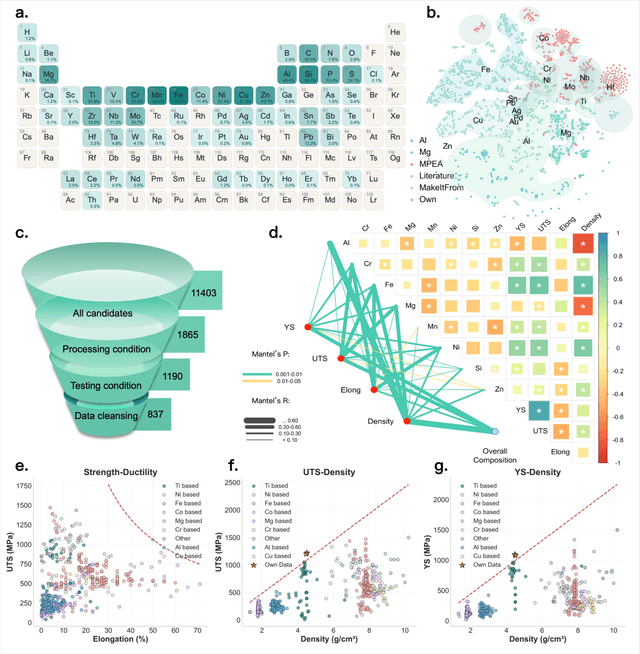
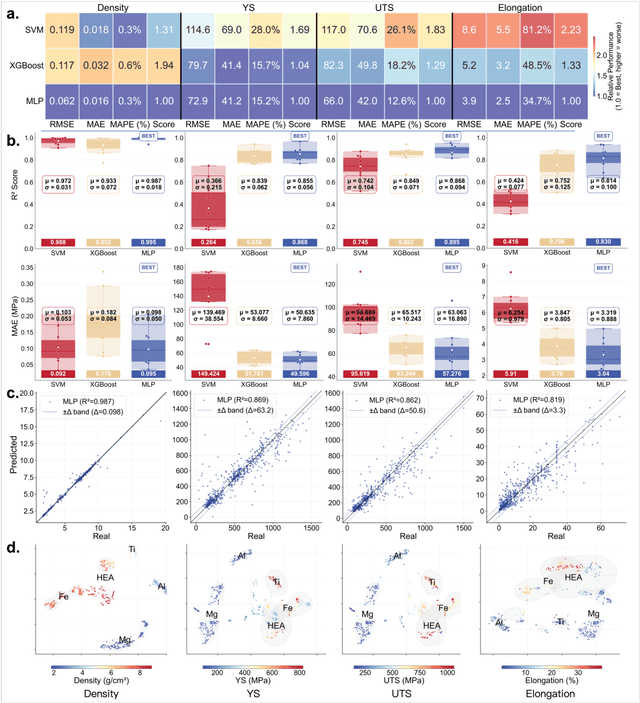
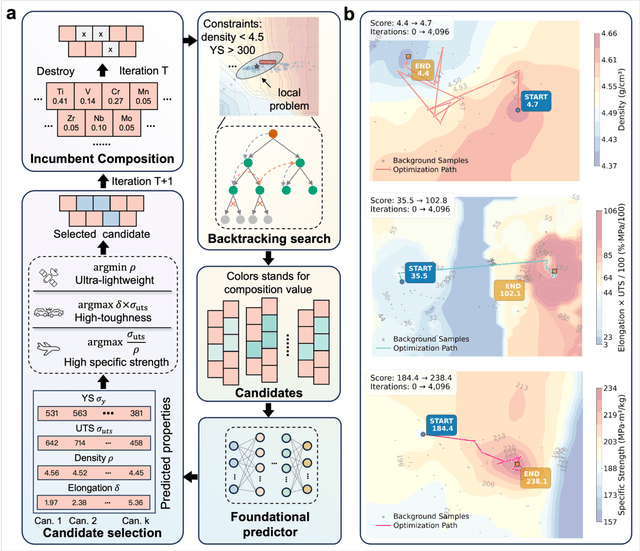
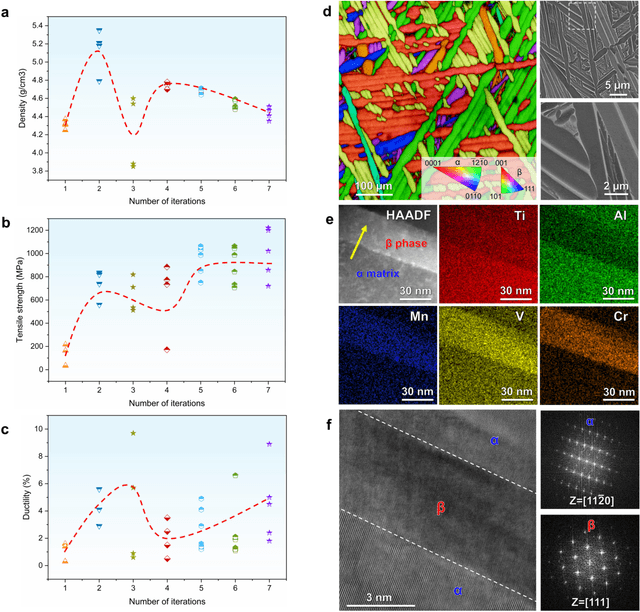
The discovery of advanced metallic alloys is hindered by vast composition spaces, competing property objectives, and real-world constraints on manufacturability. Here we introduce MATAI, a generalist machine learning framework for property prediction and inverse design of as-cast alloys. MATAI integrates a curated alloy database, deep neural network-based property predictors, a constraint-aware optimization engine, and an iterative AI-experiment feedback loop. The framework estimates key mechanical propertie, sincluding density, yield strength, ultimate tensile strength, and elongation, directly from composition, using multi-task learning and physics-informed inductive biases. Alloy design is framed as a constrained optimization problem and solved using a bi-level approach that combines local search with symbolic constraint programming. We demonstrate MATAI's capabilities on the Ti-based alloy system, a canonical class of lightweight structural materials, where it rapidly identifies candidates that simultaneously achieve lower density (<4.45 g/cm3), higher strength (>1000 MPa) and appreciable ductility (>5%) through only seven iterations. Experimental validation confirms that MATAI-designed alloys outperform commercial references such as TC4, highlighting the framework's potential to accelerate the discovery of lightweight, high-performance materials under real-world design constraints.
InfoFlow: Reinforcing Search Agent Via Reward Density Optimization
Oct 30, 2025Reinforcement Learning with Verifiable Rewards (RLVR) is a promising approach for enhancing agentic deep search. However, its application is often hindered by low \textbf{Reward Density} in deep search scenarios, where agents expend significant exploratory costs for infrequent and often null final rewards. In this paper, we formalize this challenge as the \textbf{Reward Density Optimization} problem, which aims to improve the reward obtained per unit of exploration cost. This paper introduce \textbf{InfoFlow}, a systematic framework that tackles this problem from three aspects. 1) \textbf{Subproblem decomposition}: breaking down long-range tasks to assign process rewards, thereby providing denser learning signals. 2) \textbf{Failure-guided hints}: injecting corrective guidance into stalled trajectories to increase the probability of successful outcomes. 3) \textbf{Dual-agent refinement}: employing a dual-agent architecture to offload the cognitive burden of deep exploration. A refiner agent synthesizes the search history, which effectively compresses the researcher's perceived trajectory, thereby reducing exploration cost and increasing the overall reward density. We evaluate InfoFlow on multiple agentic search benchmarks, where it significantly outperforms strong baselines, enabling lightweight LLMs to achieve performance comparable to advanced proprietary LLMs.
Non-Linear Trajectory Modeling for Multi-Step Gradient Inversion Attacks in Federated Learning
Sep 26, 2025Federated Learning (FL) preserves privacy by keeping raw data local, yet Gradient Inversion Attacks (GIAs) pose significant threats. In FedAVG multi-step scenarios, attackers observe only aggregated gradients, making data reconstruction challenging. Existing surrogate model methods like SME assume linear parameter trajectories, but we demonstrate this severely underestimates SGD's nonlinear complexity, fundamentally limiting attack effectiveness. We propose Non-Linear Surrogate Model Extension (NL-SME), the first method to introduce nonlinear parametric trajectory modeling for GIAs. Our approach replaces linear interpolation with learnable quadratic B\'ezier curves that capture SGD's curved characteristics through control points, combined with regularization and dvec scaling mechanisms for enhanced expressiveness. Extensive experiments on CIFAR-100 and FEMNIST datasets show NL-SME significantly outperforms baselines across all metrics, achieving order-of-magnitude improvements in cosine similarity loss while maintaining computational efficiency.This work exposes heightened privacy vulnerabilities in FL's multi-step update paradigm and offers novel perspectives for developing robust defense strategies.
MinerU2.5: A Decoupled Vision-Language Model for Efficient High-Resolution Document Parsing
Sep 26, 2025We introduce MinerU2.5, a 1.2B-parameter document parsing vision-language model that achieves state-of-the-art recognition accuracy while maintaining exceptional computational efficiency. Our approach employs a coarse-to-fine, two-stage parsing strategy that decouples global layout analysis from local content recognition. In the first stage, the model performs efficient layout analysis on downsampled images to identify structural elements, circumventing the computational overhead of processing high-resolution inputs. In the second stage, guided by the global layout, it performs targeted content recognition on native-resolution crops extracted from the original image, preserving fine-grained details in dense text, complex formulas, and tables. To support this strategy, we developed a comprehensive data engine that generates diverse, large-scale training corpora for both pretraining and fine-tuning. Ultimately, MinerU2.5 demonstrates strong document parsing ability, achieving state-of-the-art performance on multiple benchmarks, surpassing both general-purpose and domain-specific models across various recognition tasks, while maintaining significantly lower computational overhead.
A biologically inspired separable learning vision model for real-time traffic object perception in Dark
Sep 05, 2025Fast and accurate object perception in low-light traffic scenes has attracted increasing attention. However, due to severe illumination degradation and the lack of reliable visual cues, existing perception models and methods struggle to quickly adapt to and accurately predict in low-light environments. Moreover, there is the absence of available large-scale benchmark specifically focused on low-light traffic scenes. To bridge this gap, we introduce a physically grounded illumination degradation method tailored to real-world low-light settings and construct Dark-traffic, the largest densely annotated dataset to date for low-light traffic scenes, supporting object detection, instance segmentation, and optical flow estimation. We further propose the Separable Learning Vision Model (SLVM), a biologically inspired framework designed to enhance perception under adverse lighting. SLVM integrates four key components: a light-adaptive pupillary mechanism for illumination-sensitive feature extraction, a feature-level separable learning strategy for efficient representation, task-specific decoupled branches for multi-task separable learning, and a spatial misalignment-aware fusion module for precise multi-feature alignment. Extensive experiments demonstrate that SLVM achieves state-of-the-art performance with reduced computational overhead. Notably, it outperforms RT-DETR by 11.2 percentage points in detection, YOLOv12 by 6.1 percentage points in instance segmentation, and reduces endpoint error (EPE) of baseline by 12.37% on Dark-traffic. On the LIS benchmark, the end-to-end trained SLVM surpasses Swin Transformer+EnlightenGAN and ConvNeXt-T+EnlightenGAN by an average of 11 percentage points across key metrics, and exceeds Mask RCNN (with light enhancement) by 3.1 percentage points. The Dark-traffic dataset and complete code is released at https://github.com/alanli1997/slvm.
A Survey of Deep Learning-based Point Cloud Denoising
Aug 23, 2025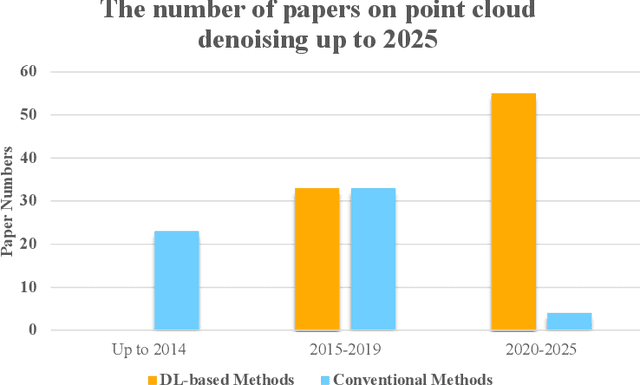
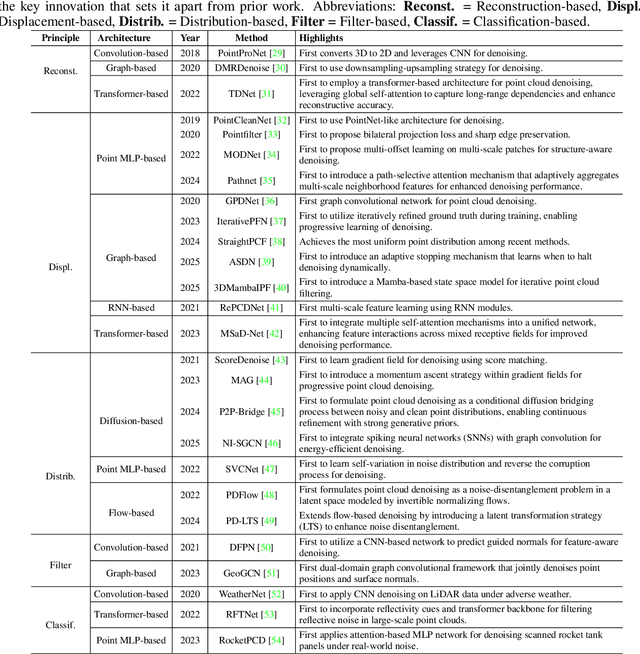
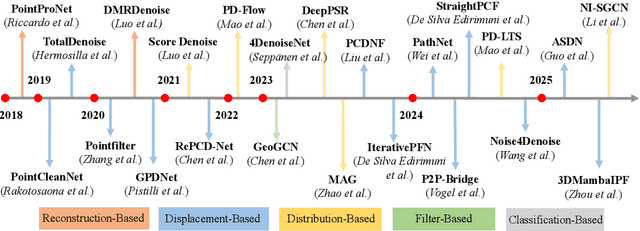
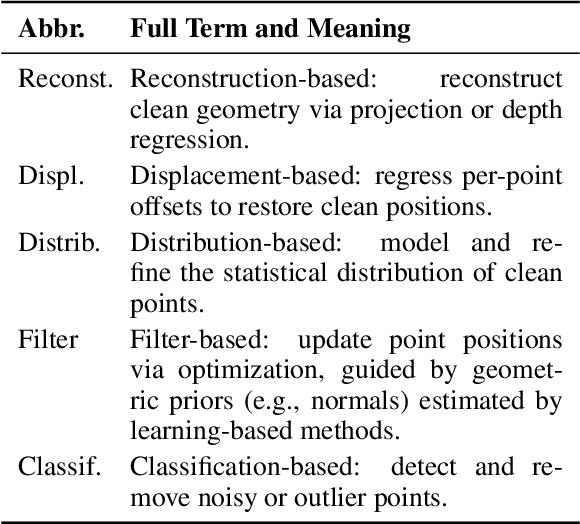
Accurate 3D geometry acquisition is essential for a wide range of applications, such as computer graphics, autonomous driving, robotics, and augmented reality. However, raw point clouds acquired in real-world environments are often corrupted with noise due to various factors such as sensor, lighting, material, environment etc, which reduces geometric fidelity and degrades downstream performance. Point cloud denoising is a fundamental problem, aiming to recover clean point sets while preserving underlying structures. Classical optimization-based methods, guided by hand-crafted filters or geometric priors, have been extensively studied but struggle to handle diverse and complex noise patterns. Recent deep learning approaches leverage neural network architectures to learn distinctive representations and demonstrate strong outcomes, particularly on complex and large-scale point clouds. Provided these significant advances, this survey provides a comprehensive and up-to-date review of deep learning-based point cloud denoising methods up to August 2025. We organize the literature from two perspectives: (1) supervision level (supervised vs. unsupervised), and (2) modeling perspective, proposing a functional taxonomy that unifies diverse approaches by their denoising principles. We further analyze architectural trends both structurally and chronologically, establish a unified benchmark with consistent training settings, and evaluate methods in terms of denoising quality, surface fidelity, point distribution, and computational efficiency. Finally, we discuss open challenges and outline directions for future research in this rapidly evolving field.
MetaAgent: Toward Self-Evolving Agent via Tool Meta-Learning
Aug 01, 2025In this work, we propose MetaAgent, an agentic paradigm inspired by the principle of learning-by-doing, where expertise is developed through hands-on practice and continual self-improvement. MetaAgent starts with a minimal workflow, equipped only with basic reasoning and adaptive help-seeking abilities. When a knowledge gap is encountered, MetaAgent generates natural language help requests, which are routed to the most suitable external tool by a dedicated tool router. As MetaAgent solves tasks, it continually conducts self-reflection and answer verification, distilling actionable experience into concise texts that are dynamically incorporated into future task contexts. Besides, MetaAgent autonomously builds in-house tools and a persistent knowledge base by organizing its tool-use history, further enhancing its ability to retrieve and integrate relevant information We term this continual, data-driven process as \textit{meta tool learning}, through which MetaAgent incrementally refines its reasoning and tool-use strategies, without changing model parameters or requiring further post-training. Evaluated on challenging knowledge discovery benchmarks, including GAIA, WebWalkerQA, and BrowseCamp, MetaAgent consistently outperforms workflow-based baselines and matches or exceeds end-to-end trained agents, demonstrating the promise of self-evolving agentic systems for robust, general-purpose knowledge discovery. We provide our source codes in https://github.com/qhjqhj00/MetaAgent.
Video-XL-2: Towards Very Long-Video Understanding Through Task-Aware KV Sparsification
Jun 24, 2025Multi-modal large language models (MLLMs) models have made significant progress in video understanding over the past few years. However, processing long video inputs remains a major challenge due to high memory and computational costs. This makes it difficult for current models to achieve both strong performance and high efficiency in long video understanding. To address this challenge, we propose Video-XL-2, a novel MLLM that delivers superior cost-effectiveness for long-video understanding based on task-aware KV sparsification. The proposed framework operates with two key steps: chunk-based pre-filling and bi-level key-value decoding. Chunk-based pre-filling divides the visual token sequence into chunks, applying full attention within each chunk and sparse attention across chunks. This significantly reduces computational and memory overhead. During decoding, bi-level key-value decoding selectively reloads either dense or sparse key-values for each chunk based on its relevance to the task. This approach further improves memory efficiency and enhances the model's ability to capture fine-grained information. Video-XL-2 achieves state-of-the-art performance on various long video understanding benchmarks, outperforming existing open-source lightweight models. It also demonstrates exceptional efficiency, capable of processing over 10,000 frames on a single NVIDIA A100 (80GB) GPU and thousands of frames in just a few seconds.
OmniGen2: Exploration to Advanced Multimodal Generation
Jun 23, 2025In this work, we introduce OmniGen2, a versatile and open-source generative model designed to provide a unified solution for diverse generation tasks, including text-to-image, image editing, and in-context generation. Unlike OmniGen v1, OmniGen2 features two distinct decoding pathways for text and image modalities, utilizing unshared parameters and a decoupled image tokenizer. This design enables OmniGen2 to build upon existing multimodal understanding models without the need to re-adapt VAE inputs, thereby preserving the original text generation capabilities. To facilitate the training of OmniGen2, we developed comprehensive data construction pipelines, encompassing image editing and in-context generation data. Additionally, we introduce a reflection mechanism tailored for image generation tasks and curate a dedicated reflection dataset based on OmniGen2. Despite its relatively modest parameter size, OmniGen2 achieves competitive results on multiple task benchmarks, including text-to-image and image editing. To further evaluate in-context generation, also referred to as subject-driven tasks, we introduce a new benchmark named OmniContext. OmniGen2 achieves state-of-the-art performance among open-source models in terms of consistency. We will release our models, training code, datasets, and data construction pipeline to support future research in this field. Project Page: https://vectorspacelab.github.io/OmniGen2; GitHub Link: https://github.com/VectorSpaceLab/OmniGen2