 Add to Chrome
 Add to Firefox
 Add to Edge
JieZi: A Large-Scale Expert-Audited Dataset and Benchmark for Ancient Chinese Character Exegesis
Aug 12, 2026
The scholarly exegesis of ancient Chinese characters demands integrating visual observation, linguistic analysis, and historical context. However, existing computational approaches focus narrowly on subtasks such as character recognition and retrieval, lacking the structured datasets and benchmarks required for comprehensive scholarly analysis. To address this limitation, we introduce Ancient Chinese Character Exegesis (ACCE), a vision-language question answering (VQA) task that models the scholarly exegesis process. ACCE is organized into four progressive levels: basic character identification, glyph-form analysis, meaning exegesis, and diachronic evolution analysis. To support this task, we construct two complementary resources. JieZi-Dataset is the first large-scale, expert-audited VQA training dataset for ACCE, comprising over 500K QA pairs. It is constructed via a pipeline that reduces factual errors by constraining generation with expert-designed templates and source-text references. Human verification is further applied at each key stage to ensure scholarly accuracy. JieZi-Bench is an evaluation benchmark aligned with the exegesis process, constructed and verified by human experts to ensure evaluation reliability. It consists of four levels with reference answers curated from authoritative lexicographic works held separate from the training data. Experiments on multimodal large language models show that current models perform well on basic identification but struggle with glyph analysis, semantic reasoning, and diachronic understanding. Fine-tuning on JieZi-Dataset substantially improves performance across all four levels. Code and dataset are available at https://github.com/Ran00w/JieZi.

TongGuOCR: A Layout-Aware and Token-Augmented OCR MLLM for Chinese Historical Documents
Aug 11, 2026Chinese historical documents preserve valuable cultural heritage, but many collections remain accessible only as scanned page images, preventing full-text retrieval, collation, and computational analysis. Optical character recognition (OCR) can bridge this gap, but accurate transcription remains challenging because historical documents often contain complex layouts, rare characters, and nontrivial reading orders. We propose TongGuOCR, a layout-aware and token-augmented multimodal large language model (MLLM) for OCR of Chinese historical documents. First, a Layout-Aware Preprocessing module constructs and refines locally coherent recognition blocks to preserve local context while reducing interference across regions. Second, a Token-Augmented Recognition module augments the transcription target at two complementary levels: character-level vocabulary expansion gives each rare glyph a direct one-token representation and shortens its decoding path, while line-to-line transition modeling injects discrete spatial displacement tokens that guide the decoder along complex reading paths without requiring precise coordinates. Experiments on two Chinese historical document OCR benchmarks show that TongGuOCR outperforms representative traditional task-specific OCR models, general-purpose MLLMs, and OCR-oriented MLLMs. On the more challenging M5HisDoc benchmark, TongGuOCR achieves 93.76 AR and reduces NED from 10.43 to 6.15 and RO-ED from 7.53 to 3.49 relative to the best competing score for each metric. An online demo is available at https://jzzh2004.github.io/TongGuOCR.
One Patch Is Enough: Reinforcement-Optimized Visual Token Grounding for MLLM-Based Scene Text Spotting
Jul 30, 2026Scene text spotting requires high-precision alignment between textual recognition and spatial localization. While visual-token grounding has emerged as a promising formulation for Multimodal Large Language Models (MLLMs), the previous multi-patch paradigm often introduces redundant noise and localization ambiguity, particularly for dense or small text instances. To address this, we propose Single-Patch Text Spotting (SPaTS), a vision-centric framework that routes each text instance through a single anchor visual token and then recovers geometry via full-image refinement. To accurately identify this anchor without oracle labels, we introduce Single-Patch Selective Optimization (SPaSO), a reinforcement learning framework that optimizes discrete visual-token selection using patch-level rewards. To further improve representation robustness and localization precision, we introduce Directional Embedding Alignment (DEA) to suppress unstable norm bias by decoupling feature magnitude and direction, and Patch-Enhanced Decoding (PED) to fuse the routed anchor with language semantics and cross-attend over the full-image feature map for geometry-aware boundary regression beyond coordinate-space surrogates. Extensive experiments demonstrate that SPaTS consistently and significantly outperforms both frontier closed-source MLLMs and OCR MLLMs. Code will be released soon.
* 15 pages, 11 figures. Accepted to ACM Multimedia 2026
DiffMath: Symbol- and Graph-Aware Latent Diffusion Transformer for Handwritten Mathematical Expression Generation
Jun 18, 2026Handwritten Mathematical Expression Generation (HMEG) is challenging due to the complex two-dimensional layouts and long-range structural dependencies of mathematical expressions. Existing methods typically rely on explicit spatial supervision, such as symbol-level bounding boxes, which incurs high annotation costs and limits scalability. In this work, we propose DiffMath, a symbol- and graph-aware latent diffusion framework that leverages the hierarchical structure inherent in LaTeX as a structural prior, eliminating the need for positional supervision. First, we design a Relational Abstract Syntax Tree (RelAST), a generation-oriented representation that distills MathML trees into compact triplet sequences [S, R, D], where each token directly encodes a symbol identity, spatial relation, or nesting depth. Second, we introduce MathVAE, which learns structure-preserving latent representations through symbol-aware and relation-aware perceptual regularization, ensuring that the latent space captures both character semantics and spatial topology. Third, MathDiT performs conditional denoising in this structured latent space, further guided by a global symbol-count prior via Adaptive Layer Normalization (AdaLN) to improve structural coherence. Experiments show that DiffMath produces structurally consistent handwritten expressions, achieves superior performance over existing methods, and improves the accuracy of downstream OCR models through synthetic data augmentation.
ContextDrag: Precise Drag-Based Image Editing via Context-Preserving Token Injection and Position-Consistent Attention
Dec 09, 2025Drag-based image editing aims to modify visual content followed by user-specified drag operations. Despite existing methods having made notable progress, they still fail to fully exploit the contextual information in the reference image, including fine-grained texture details, leading to edits with limited coherence and fidelity. To address this challenge, we introduce ContextDrag, a new paradigm for drag-based editing that leverages the strong contextual modeling capability of editing models, such as FLUX-Kontext. By incorporating VAE-encoded features from the reference image, ContextDrag can leverage rich contextual cues and preserve fine-grained details, without the need for finetuning or inversion. Specifically, ContextDrag introduced a novel Context-preserving Token Injection (CTI) that injects noise-free reference features into their correct destination locations via a Latent-space Reverse Mapping (LRM) algorithm. This strategy enables precise drag control while preserving consistency in both semantics and texture details. Second, ContextDrag adopts a novel Position-Consistent Attention (PCA), which positional re-encodes the reference tokens and applies overlap-aware masking to eliminate interference from irrelevant reference features. Extensive experiments on DragBench-SR and DragBench-DR demonstrate that our approach surpasses all existing SOTA methods. Code will be publicly available.
Mod-Adapter: Tuning-Free and Versatile Multi-concept Personalization via Modulation Adapter
May 24, 2025Personalized text-to-image generation aims to synthesize images of user-provided concepts in diverse contexts. Despite recent progress in multi-concept personalization, most are limited to object concepts and struggle to customize abstract concepts (e.g., pose, lighting). Some methods have begun exploring multi-concept personalization supporting abstract concepts, but they require test-time fine-tuning for each new concept, which is time-consuming and prone to overfitting on limited training images. In this work, we propose a novel tuning-free method for multi-concept personalization that can effectively customize both object and abstract concepts without test-time fine-tuning. Our method builds upon the modulation mechanism in pretrained Diffusion Transformers (DiTs) model, leveraging the localized and semantically meaningful properties of the modulation space. Specifically, we propose a novel module, Mod-Adapter, to predict concept-specific modulation direction for the modulation process of concept-related text tokens. It incorporates vision-language cross-attention for extracting concept visual features, and Mixture-of-Experts (MoE) layers that adaptively map the concept features into the modulation space. Furthermore, to mitigate the training difficulty caused by the large gap between the concept image space and the modulation space, we introduce a VLM-guided pretraining strategy that leverages the strong image understanding capabilities of vision-language models to provide semantic supervision signals. For a comprehensive comparison, we extend a standard benchmark by incorporating abstract concepts. Our method achieves state-of-the-art performance in multi-concept personalization, supported by quantitative, qualitative, and human evaluations.
Improving Multi-Subject Consistency in Open-Domain Image Generation with Isolation and Reposition Attention
Nov 28, 2024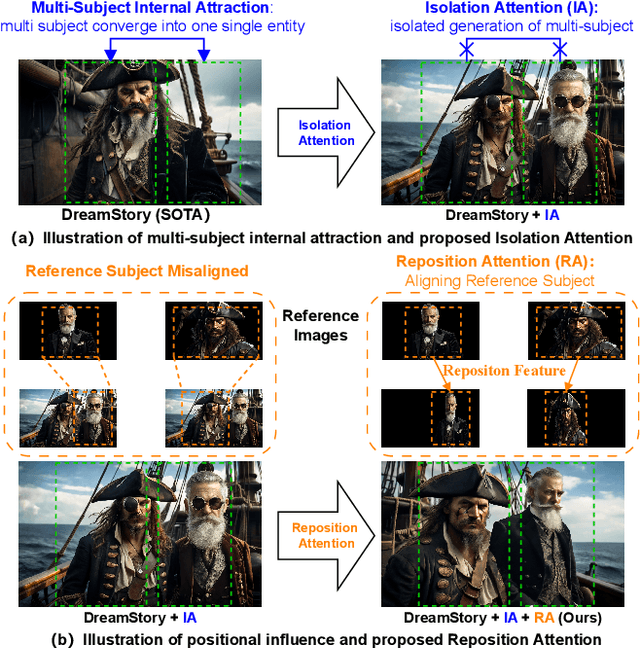
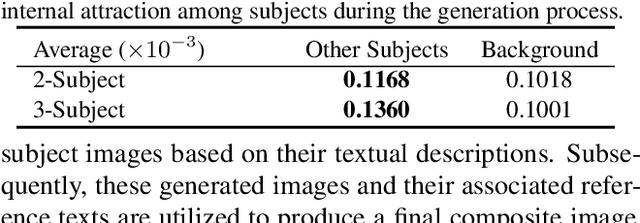
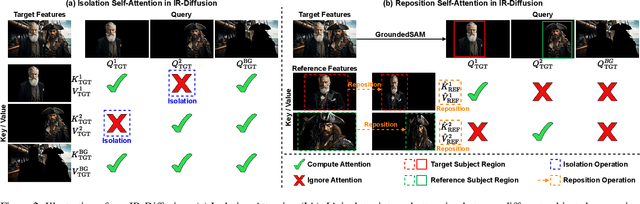
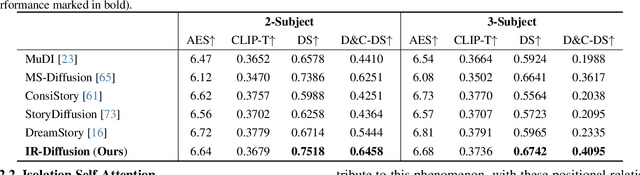
Training-free diffusion models have achieved remarkable progress in generating multi-subject consistent images within open-domain scenarios. The key idea of these methods is to incorporate reference subject information within the attention layer. However, existing methods still obtain suboptimal performance when handling numerous subjects. This paper reveals the two primary issues contributing to this deficiency. Firstly, there is undesired interference among different subjects within the target image. Secondly, tokens tend to reference nearby tokens, which reduces the effectiveness of the attention mechanism when there is a significant positional difference between subjects in reference and target images. To address these challenges, we propose a training-free diffusion model with Isolation and Reposition Attention, named IR-Diffusion. Specifically, Isolation Attention ensures that multiple subjects in the target image do not reference each other, effectively eliminating the subject fusion. On the other hand, Reposition Attention involves scaling and repositioning subjects in both reference and target images to the same position within the images. This ensures that subjects in the target image can better reference those in the reference image, thereby maintaining better consistency. Extensive experiments demonstrate that the proposed methods significantly enhance multi-subject consistency, outperforming all existing methods in open-domain scenarios.
DreamStory: Open-Domain Story Visualization by LLM-Guided Multi-Subject Consistent Diffusion
Jul 17, 2024


Story visualization aims to create visually compelling images or videos corresponding to textual narratives. Despite recent advances in diffusion models yielding promising results, existing methods still struggle to create a coherent sequence of subject-consistent frames based solely on a story. To this end, we propose DreamStory, an automatic open-domain story visualization framework by leveraging the LLMs and a novel multi-subject consistent diffusion model. DreamStory consists of (1) an LLM acting as a story director and (2) an innovative Multi-Subject consistent Diffusion model (MSD) for generating consistent multi-subject across the images. First, DreamStory employs the LLM to generate descriptive prompts for subjects and scenes aligned with the story, annotating each scene's subjects for subsequent subject-consistent generation. Second, DreamStory utilizes these detailed subject descriptions to create portraits of the subjects, with these portraits and their corresponding textual information serving as multimodal anchors (guidance). Finally, the MSD uses these multimodal anchors to generate story scenes with consistent multi-subject. Specifically, the MSD includes Masked Mutual Self-Attention (MMSA) and Masked Mutual Cross-Attention (MMCA) modules. MMSA and MMCA modules ensure appearance and semantic consistency with reference images and text, respectively. Both modules employ masking mechanisms to prevent subject blending. To validate our approach and promote progress in story visualization, we established a benchmark, DS-500, which can assess the overall performance of the story visualization framework, subject-identification accuracy, and the consistency of the generation model. Extensive experiments validate the effectiveness of DreamStory in both subjective and objective evaluations. Please visit our project homepage at https://dream-xyz.github.io/dreamstory.
MobileVidFactory: Automatic Diffusion-Based Social Media Video Generation for Mobile Devices from Text
Jul 31, 2023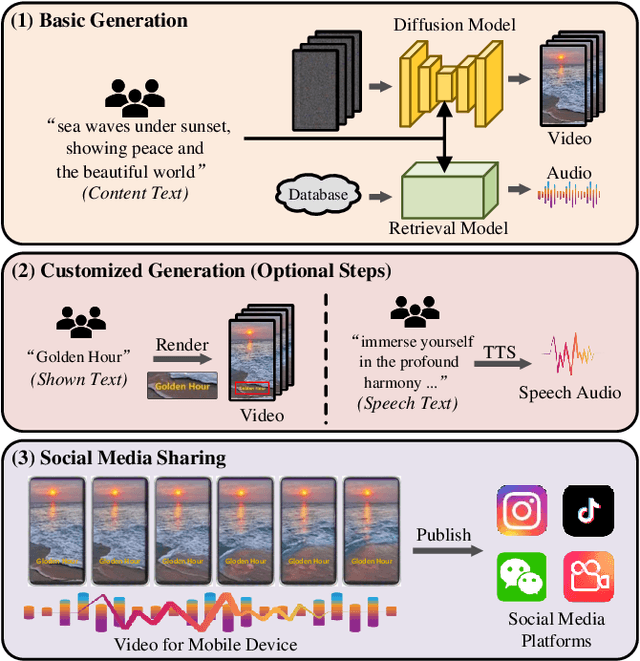

Videos for mobile devices become the most popular access to share and acquire information recently. For the convenience of users' creation, in this paper, we present a system, namely MobileVidFactory, to automatically generate vertical mobile videos where users only need to give simple texts mainly. Our system consists of two parts: basic and customized generation. In the basic generation, we take advantage of the pretrained image diffusion model, and adapt it to a high-quality open-domain vertical video generator for mobile devices. As for the audio, by retrieving from our big database, our system matches a suitable background sound for the video. Additionally to produce customized content, our system allows users to add specified screen texts to the video for enriching visual expression, and specify texts for automatic reading with optional voices as they like.
Learning Profitable NFT Image Diffusions via Multiple Visual-Policy Guided Reinforcement Learning
Jun 20, 2023


We study the task of generating profitable Non-Fungible Token (NFT) images from user-input texts. Recent advances in diffusion models have shown great potential for image generation. However, existing works can fall short in generating visually-pleasing and highly-profitable NFT images, mainly due to the lack of 1) plentiful and fine-grained visual attribute prompts for an NFT image, and 2) effective optimization metrics for generating high-quality NFT images. To solve these challenges, we propose a Diffusion-based generation framework with Multiple Visual-Policies as rewards (i.e., Diffusion-MVP) for NFT images. The proposed framework consists of a large language model (LLM), a diffusion-based image generator, and a series of visual rewards by design. First, the LLM enhances a basic human input (such as "panda") by generating more comprehensive NFT-style prompts that include specific visual attributes, such as "panda with Ninja style and green background." Second, the diffusion-based image generator is fine-tuned using a large-scale NFT dataset to capture fine-grained image styles and accessory compositions of popular NFT elements. Third, we further propose to utilize multiple visual-policies as optimization goals, including visual rarity levels, visual aesthetic scores, and CLIP-based text-image relevances. This design ensures that our proposed Diffusion-MVP is capable of minting NFT images with high visual quality and market value. To facilitate this research, we have collected the largest publicly available NFT image dataset to date, consisting of 1.5 million high-quality images with corresponding texts and market values. Extensive experiments including objective evaluations and user studies demonstrate that our framework can generate NFT images showing more visually engaging elements and higher market value, compared with SOTA approaches.