 Add to Chrome
 Add to Firefox
 Add to Edge
Consistency-Driven Co-Evolution for Self-Supervised Cross-Representation Learning
Aug 05, 2026
As chart images, tabular data, and visualization code play increasingly important roles across diverse domains, cross-representation understanding across these modalities poses fundamental challenges for AI systems: the relationships across representations are inherently \textit{one-to-many}, supervision is ambiguous and costly, and model optimization lacks a principled signal that is both direction-adaptive and representation-generalizable beyond task-specific objectives. We introduce CoCoEvolve to improve consistency across chart, table, and code representations. Instead of treating cross-representation mapping as a one-to-many problem, we define explicit one-to-one correspondences and optimize models using agreement between representations, without additional annotations. During training, CoCoEvolve@Train performs co-evolution across the chart-table-code cycle, while CoCoEvolve@Test applies the same consistency objective at inference time for test-time co-optimization. We also present CoCoEvolve@Eval, an evaluation suite covering all six cross-representation tasks. Across four benchmarks, CoCoEvolve improves performance in both training-time and test-time settings. Our project page: https://xhguo7.github.io/CoCoEvolve/.

SciFigPlag-Bench: A Benchmark for Provenance-Aware Scientific Figure Plagiarism Detection
Jul 31, 2026Scientific figures often encode the visual evidence behind scientific findings, yet figure plagiarism remains underexplored as a benchmarked multimodal evaluation problem. We present SciFigPlag-Bench, a benchmark for provenance-aware reasoning over scientific figures in scholarly documents. Unlike general image-similarity or image-forensics benchmarks, SciFigPlag-Bench evaluates whether a suspicious figure reuses evidence from a specific source figure, how the reused content has been transformed, and where the reused evidence appears. We introduce a factorized taxonomy that separates what is reused from how it is transformed, covering material-preserving reuse, such as full-figure and subfigure reuse, as well as abstract-content reuse, such as data re-expression and structural redraw. Guided by this taxonomy, we construct a hybrid benchmark with 2,582 positive pairs and 2,541 negative pairs, combining documented real-world cases, taxonomy-guided synthetic examples, and visually similar negatives. The benchmark supports four diagnostic tasks: pairwise detection, source attribution, hierarchical reuse-type classification, and reuse correspondence localization. Experiments with diverse vision-language models establish initial baselines and reveal persistent challenges in fine-grained provenance reasoning, reuse-type understanding, and spatial evidence grounding.
Learning User Simulators with Turing Rewards
Jun 17, 2026Learning to simulate human users in interactive settings could advance the training of agent assistants, evaluation of personalization systems, research in the social sciences, and more. Existing approaches generally do so by training a large language model (LLM) to match a single ground truth response, either by maximizing the log probability or by using a similarity reward. We instead propose {Turing-RL}: a Turing-Test-based reinforcement learning approach for training user simulator models. {Turing-RL} uses a discriminative Turing reward with an LLM judge to score how indistinguishable a generated response is from the real user's given the user's history, and the user simulator LLM learns to produce responses indistinguishable from what the user could have said with such rewards. Across two different domains--conversational chat and Reddit forum discussion--we find that {Turing-RL} consistently outperforms baseline methods on both LLM and human evaluation metrics. Our study suggests that optimizing for indistinguishability, rather than response matching, is effective for learning user simulators.
Aligning Quantum Operators with Large Language Models
Jun 11, 2026Can Large Language Models (LLMs) understand and reason about quantum operators? Despite their remarkable capabilities in mathematics and symbolic reasoning, LLMs remain inherently blind to quantum representations such as unitary matrices. In this work, we take a step toward bridging this gap by introducing an approach that maps unitary operators into the latent space of an LLM, enabling unified modeling over quantum and linguistic inputs. We instantiate this idea on Clifford+T circuit synthesis over a Pauli rotation gate set, where our model achieves results competitive with state-of-the-art methods and scales consistently with training data, with no signs of saturation. Our approach further enables language-conditioned synthesis, allowing gate constraints unseen during training to be specified directly in natural language. This work suggests a path toward quantum--aware foundation models that can natively interpret and reason about quantum operations, which could have broader implications reaching across quantum compilation and algorithm discovery.
Dr. DocBench: A Comprehensive Benchmark for Expert-Level and Difficult Document Parsing
May 31, 2026Document parsing and recognition are fundamental capabilities for vision-language models (VLMs) and document processing systems. However, existing Optical Character Recognition (OCR) and document parsing benchmarks are increasingly limited in coverage and difficulty: many focus on common document genres or uniformly sampled pages where modern parsers already perform strongly, while offering limited annotation for expert-domain structures such as chemical formula, music notation, complex tables, and cross-page layouts. We introduce Dr. DocBench, a difficulty-aware benchmark for expert-level document parsing. Built from a large-scale multilingual book corpus, Dr. DocBench spans 52 BISAC subject domains and selects challenging documents through parser-failure-based sampling, targeting cases where multiple state-of-the-art systems struggle. It contains 4,514 annotated pages from long documents averaging around 100 pages, with 65k high-quality page- and block-level annotations for layout, reading order, hierarchical relations, and domain-specific visual contents. Evaluations of pipeline-based parsers and general-purpose VLMs show that strong performance on existing benchmarks does not transfer to our expert-level document parsing. Our analysis reveals substantial failures across subjects, content types, and structural attributes, highlighting Dr. DocBench as a comprehensive testbed for diagnosing and advancing document intelligence.
WikiVQABench: A Knowledge-Grounded Visual Question Answering Benchmark from Wikipedia and Wikidata
May 20, 2026Visual Question Answering (VQA) benchmarks have largely emphasized perception-based tasks that can be solved from visual content alone. In contrast, many real-world scenarios require external knowledge that is not directly observable in the image to answer correctly. We introduce WikiVQABench, a human-curated knowledge-grounded VQA benchmark constructed by systematically combining Wikipedia images, their associated article captions, and structured knowledge from Wikidata. Our pipeline uses large language models (LLMs) to generate candidate multiple-choice image-question-answer sets. All generated instances are subsequently reviewed and curated by human annotators to ensure factual correctness, visual-text consistency, and that each question requires external knowledge in addition to visual evidence for correct resolution. WikiVQABench comprises a substantial collection of Wikipedia images with curated multiple-choice questions designed to benchmark knowledge-aware vision-language models (VLMs). Evaluation of fifteen VLMs (256M-90B parameters) reveals a wide performance range (24.7%-75.6% accuracy), demonstrating that the benchmark effectively discriminates model capabilities on knowledge-intensive reasoning. The dataset and benchmarking code are publicly available.
ChartNet: A Million-Scale, High-Quality Multimodal Dataset for Robust Chart Understanding
Mar 28, 2026Understanding charts requires models to jointly reason over geometric visual patterns, structured numerical data, and natural language -- a capability where current vision-language models (VLMs) remain limited. We introduce ChartNet, a high-quality, million-scale multimodal dataset designed to advance chart interpretation and reasoning. ChartNet leverages a novel code-guided synthesis pipeline to generate 1.5 million diverse chart samples spanning 24 chart types and 6 plotting libraries. Each sample consists of five aligned components: plotting code, rendered chart image, data table, natural language summary, and question-answering with reasoning, providing fine-grained cross-modal alignment. To capture the full spectrum of chart comprehension, ChartNet additionally includes specialized subsets encompassing human annotated data, real-world data, safety, and grounding. Moreover, a rigorous quality-filtering pipeline ensures visual fidelity, semantic accuracy, and diversity across chart representations. Fine-tuning on ChartNet consistently improves results across benchmarks, demonstrating its utility as large-scale supervision for multimodal models. As the largest open-source dataset of its kind, ChartNet aims to support the development of foundation models with robust and generalizable capabilities for data visualization understanding. The dataset is publicly available at https://huggingface.co/datasets/ibm-granite/ChartNet
MemEvo: Memory-Evolving Incremental Multi-view Clustering
Sep 18, 2025Incremental multi-view clustering aims to achieve stable clustering results while addressing the stability-plasticity dilemma (SPD) in incremental views. At the core of SPD is the challenge that the model must have enough plasticity to quickly adapt to new data, while maintaining sufficient stability to consolidate long-term knowledge and prevent catastrophic forgetting. Inspired by the hippocampal-prefrontal cortex collaborative memory mechanism in neuroscience, we propose a Memory-Evolving Incremental Multi-view Clustering method (MemEvo) to achieve this balance. First, we propose a hippocampus-inspired view alignment module that captures the gain information of new views by aligning structures in continuous representations. Second, we introduce a cognitive forgetting mechanism that simulates the decay patterns of human memory to modulate the weights of historical knowledge. Additionally, we design a prefrontal cortex-inspired knowledge consolidation memory module that leverages temporal tensor stability to gradually consolidate historical knowledge. By integrating these modules, MemEvo achieves strong knowledge retention capabilities in scenarios with a growing number of views. Extensive experiments demonstrate that MemEvo exhibits remarkable advantages over existing state-of-the-art methods.
Revisiting Radar Camera Alignment by Contrastive Learning for 3D Object Detection
Apr 23, 2025Recently, 3D object detection algorithms based on radar and camera fusion have shown excellent performance, setting the stage for their application in autonomous driving perception tasks. Existing methods have focused on dealing with feature misalignment caused by the domain gap between radar and camera. However, existing methods either neglect inter-modal features interaction during alignment or fail to effectively align features at the same spatial location across modalities. To alleviate the above problems, we propose a new alignment model called Radar Camera Alignment (RCAlign). Specifically, we design a Dual-Route Alignment (DRA) module based on contrastive learning to align and fuse the features between radar and camera. Moreover, considering the sparsity of radar BEV features, a Radar Feature Enhancement (RFE) module is proposed to improve the densification of radar BEV features with the knowledge distillation loss. Experiments show RCAlign achieves a new state-of-the-art on the public nuScenes benchmark in radar camera fusion for 3D Object Detection. Furthermore, the RCAlign achieves a significant performance gain (4.3\% NDS and 8.4\% mAP) in real-time 3D detection compared to the latest state-of-the-art method (RCBEVDet).
Decay Pruning Method: Smooth Pruning With a Self-Rectifying Procedure
Jun 06, 2024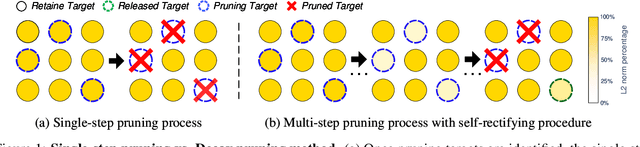
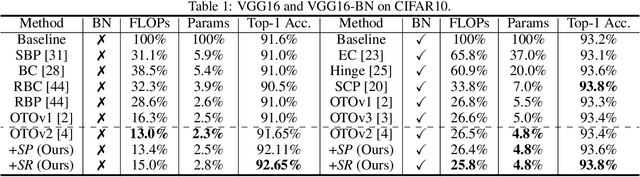
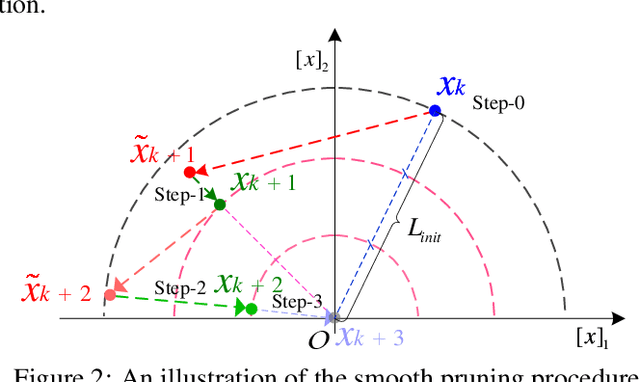
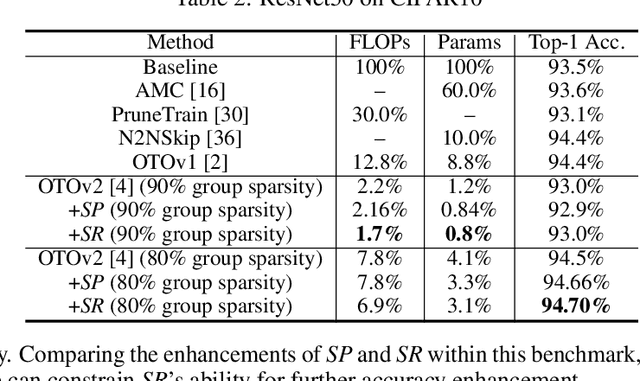
Current structured pruning methods often result in considerable accuracy drops due to abrupt network changes and loss of information from pruned structures. To address these issues, we introduce the Decay Pruning Method (DPM), a novel smooth pruning approach with a self-rectifying mechanism. DPM consists of two key components: (i) Smooth Pruning: It converts conventional single-step pruning into multi-step smooth pruning, gradually reducing redundant structures to zero over N steps with ongoing optimization. (ii) Self-Rectifying: This procedure further enhances the aforementioned process by rectifying sub-optimal pruning based on gradient information. Our approach demonstrates strong generalizability and can be easily integrated with various existing pruning methods. We validate the effectiveness of DPM by integrating it with three popular pruning methods: OTOv2, Depgraph, and Gate Decorator. Experimental results show consistent improvements in performance compared to the original pruning methods, along with further reductions of FLOPs in most scenarios.