 Add to Chrome
 Add to Firefox
 Add to Edge
ChartNet: A Million-Scale, High-Quality Multimodal Dataset for Robust Chart Understanding
Mar 28, 2026
Understanding charts requires models to jointly reason over geometric visual patterns, structured numerical data, and natural language -- a capability where current vision-language models (VLMs) remain limited. We introduce ChartNet, a high-quality, million-scale multimodal dataset designed to advance chart interpretation and reasoning. ChartNet leverages a novel code-guided synthesis pipeline to generate 1.5 million diverse chart samples spanning 24 chart types and 6 plotting libraries. Each sample consists of five aligned components: plotting code, rendered chart image, data table, natural language summary, and question-answering with reasoning, providing fine-grained cross-modal alignment. To capture the full spectrum of chart comprehension, ChartNet additionally includes specialized subsets encompassing human annotated data, real-world data, safety, and grounding. Moreover, a rigorous quality-filtering pipeline ensures visual fidelity, semantic accuracy, and diversity across chart representations. Fine-tuning on ChartNet consistently improves results across benchmarks, demonstrating its utility as large-scale supervision for multimodal models. As the largest open-source dataset of its kind, ChartNet aims to support the development of foundation models with robust and generalizable capabilities for data visualization understanding. The dataset is publicly available at https://huggingface.co/datasets/ibm-granite/ChartNet

Balanced Thinking: Improving Chain of Thought Training in Vision Language Models
Mar 19, 2026Multimodal reasoning in vision-language models (VLMs) typically relies on a two-stage process: supervised fine-tuning (SFT) and reinforcement learning (RL). In standard SFT, all tokens contribute equally to the loss, even though reasoning data are inherently token-imbalanced. Long <think> traces overshadow short but task-critical <answer> segments, leading to verbose reasoning and inaccurate answers. We propose SCALe (Scheduled Curriculum Adaptive Loss), which explicitly separates supervision over reasoning and answer segments using dynamic, length-independent weighting. Unlike vanilla SFT, which overweights the <think> segment, SCALe-SFT gradually shifts the focus from <think> to <answer> throughout training via a cosine scheduling policy, encouraging concise and well-grounded reasoning. We evaluate SCALe across diverse benchmarks and architectures. Results show that SCALe consistently improves accuracy over vanilla SFT and matches the performance of the full two-phase SFT + GRPO pipeline while requiring only about one-seventh of the training time, making it a lightweight yet effective alternative. When combined with GRPO, SCALe achieves the best overall performance, highlighting its value both as a standalone method and as a strong foundation for reinforcement refinement.
Look Where It Matters: High-Resolution Crops Retrieval for Efficient VLMs
Mar 14, 2026Vision-language models (VLMs) typically process images at a native high-resolution, forcing a trade-off between accuracy and computational efficiency: high-resolution inputs capture fine details but incur significant computational costs, while low-resolution inputs advocate for efficiency, they potentially miss critical visual information, like small text. We present AwaRes, a spatial-on-demand framework that resolves this accuracy-efficiency trade-off by operating on a low-resolution global view and using tool-calling to retrieve only high-resolution segments needed for a given query. We construct supervised data automatically: a judge compares low- vs.\ high-resolution answers to label whether cropping is needed, and an oracle grounding model localizes the evidence for the correct answer, which we map to a discrete crop set to form multi-turn tool-use trajectories. We train our framework with cold-start SFT followed by multi-turn GRPO with a composite reward that combines semantic answer correctness with explicit crop-cost penalties. Project page: https://nimrodshabtay.github.io/AwaRes
CLIMP: Contrastive Language-Image Mamba Pretraining
Jan 11, 2026Contrastive Language-Image Pre-training (CLIP) relies on Vision Transformers whose attention mechanism is susceptible to spurious correlations, and scales quadratically with resolution. To address these limitations, We present CLIMP, the first fully Mamba-based contrastive vision-language model that replaces both the vision and text encoders with Mamba. The new architecture encodes sequential structure in both vision and language, with VMamba capturing visual spatial inductive biases, reducing reliance on spurious correlations and producing an embedding space favorable for cross-modal retrieval and out-of-distribution robustness-surpassing OpenAI's CLIP-ViT-B by 7.5% on ImageNet-O. CLIMP naturally supports variable input resolutions without positional encoding interpolation or specialized training, achieving up to 6.6% higher retrieval accuracy at 16x training resolution while using 5x less memory and 1.8x fewer FLOPs. The autoregressive text encoder further overcomes CLIP's fixed context limitation, enabling dense captioning retrieval. Our findings suggest that Mamba exhibits advantageous properties for vision-language learning, making it a compelling alternative to Transformer-based CLIP.
DocReRank: Single-Page Hard Negative Query Generation for Training Multi-Modal RAG Rerankers
May 28, 2025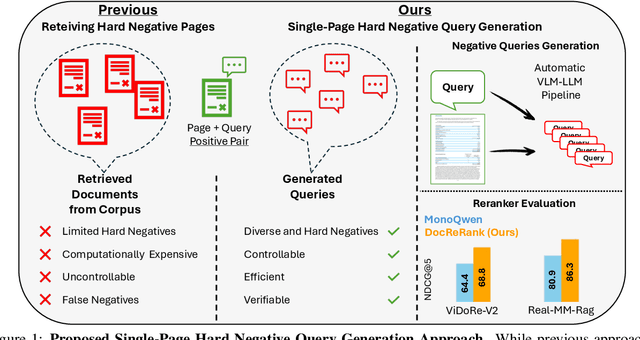
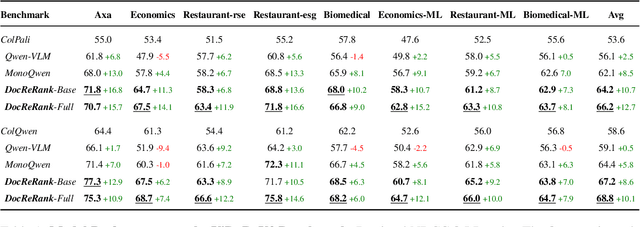

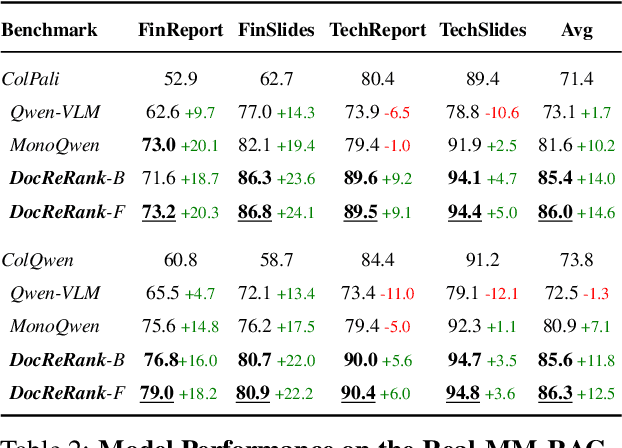
Rerankers play a critical role in multimodal Retrieval-Augmented Generation (RAG) by refining ranking of an initial set of retrieved documents. Rerankers are typically trained using hard negative mining, whose goal is to select pages for each query which rank high, but are actually irrelevant. However, this selection process is typically passive and restricted to what the retriever can find in the available corpus, leading to several inherent limitations. These include: limited diversity, negative examples which are often not hard enough, low controllability, and frequent false negatives which harm training. Our paper proposes an alternative approach: Single-Page Hard Negative Query Generation, which goes the other way around. Instead of retrieving negative pages per query, we generate hard negative queries per page. Using an automated LLM-VLM pipeline, and given a page and its positive query, we create hard negatives by rephrasing the query to be as similar as possible in form and context, yet not answerable from the page. This paradigm enables fine-grained control over the generated queries, resulting in diverse, hard, and targeted negatives. It also supports efficient false negative verification. Our experiments show that rerankers trained with data generated using our approach outperform existing models and significantly improve retrieval performance.
REAL-MM-RAG: A Real-World Multi-Modal Retrieval Benchmark
Feb 17, 2025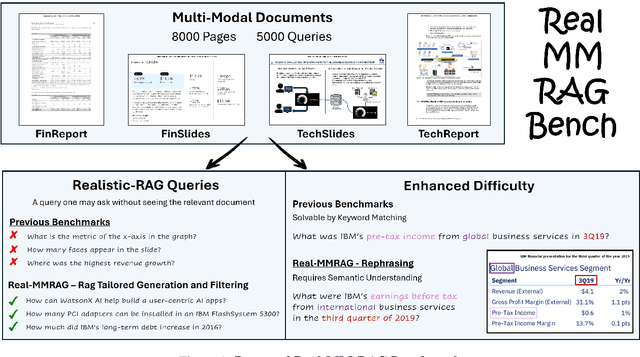
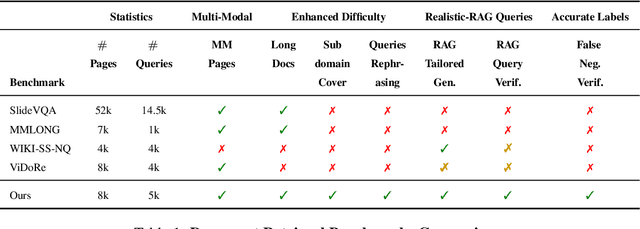

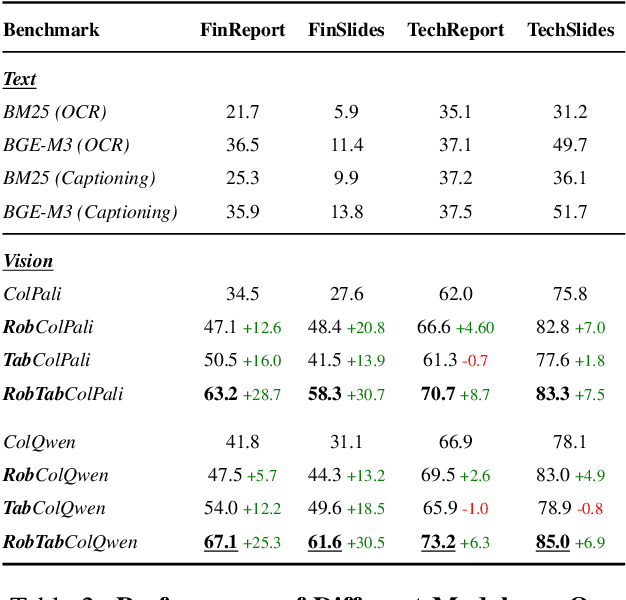
Accurate multi-modal document retrieval is crucial for Retrieval-Augmented Generation (RAG), yet existing benchmarks do not fully capture real-world challenges with their current design. We introduce REAL-MM-RAG, an automatically generated benchmark designed to address four key properties essential for real-world retrieval: (i) multi-modal documents, (ii) enhanced difficulty, (iii) Realistic-RAG queries and (iv) accurate labeling. Additionally, we propose a multi-difficulty-level scheme based on query rephrasing to evaluate models' semantic understanding beyond keyword matching. Our benchmark reveals significant model weaknesses, particularly in handling table-heavy documents and robustness to query rephrasing. To mitigate these shortcomings, we curate a rephrased training set and introduce a new finance-focused, table-heavy dataset. Fine-tuning on these datasets enables models to achieve state-of-the-art retrieval performance on REAL-MM-RAG benchmark. Our work offers a better way to evaluate and improve retrieval in multi-modal RAG systems while also providing training data and models that address current limitations.
Teaching VLMs to Localize Specific Objects from In-context Examples
Nov 20, 2024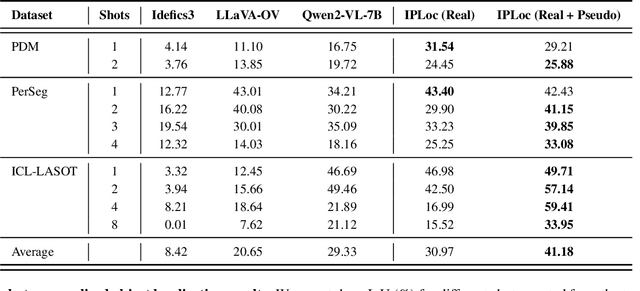
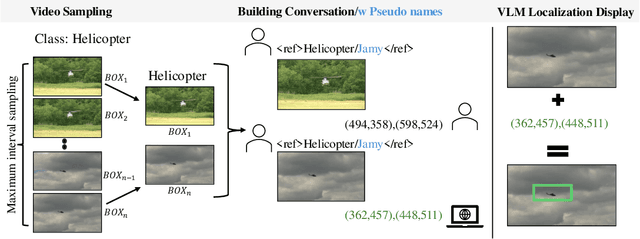
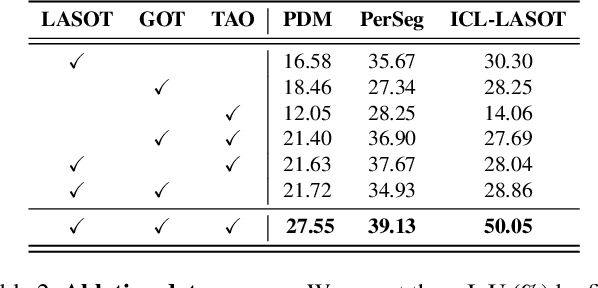
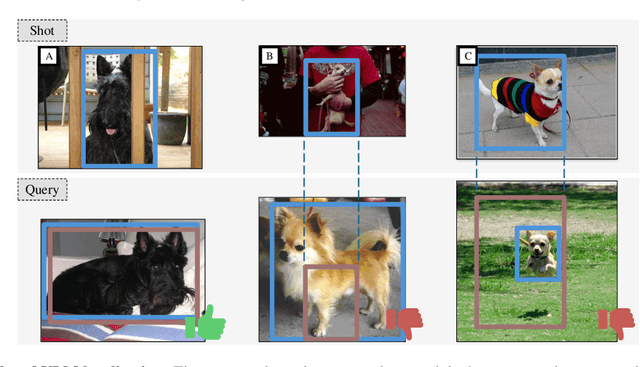
Vision-Language Models (VLMs) have shown remarkable capabilities across diverse visual tasks, including image recognition, video understanding, and Visual Question Answering (VQA) when explicitly trained for these tasks. Despite these advances, we find that current VLMs lack a fundamental cognitive ability: learning to localize objects in a scene by taking into account the context. In this work, we focus on the task of few-shot personalized localization, where a model is given a small set of annotated images (in-context examples) -- each with a category label and bounding box -- and is tasked with localizing the same object type in a query image. To provoke personalized localization abilities in models, we present a data-centric solution that fine-tunes them using carefully curated data from video object tracking datasets. By leveraging sequences of frames tracking the same object across multiple shots, we simulate instruction-tuning dialogues that promote context awareness. To reinforce this, we introduce a novel regularization technique that replaces object labels with pseudo-names, ensuring the model relies on visual context rather than prior knowledge. Our method significantly enhances few-shot localization performance without sacrificing generalization, as demonstrated on several benchmarks tailored to personalized localization. This work is the first to explore and benchmark personalized few-shot localization for VLMs, laying a foundation for future research in context-driven vision-language applications. The code for our project is available at https://github.com/SivanDoveh/IPLoc
Deep Phase Coded Image Prior
Apr 05, 2024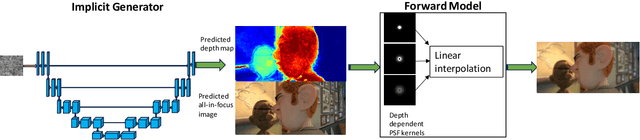
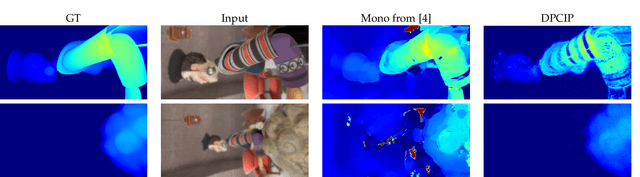
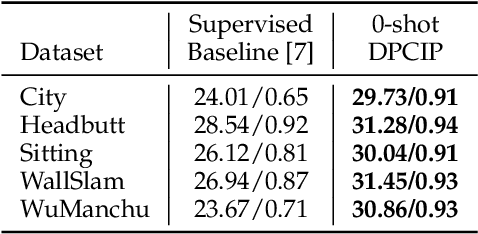
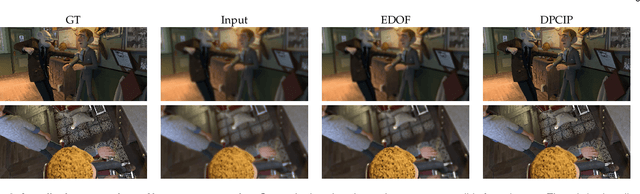
Phase-coded imaging is a computational imaging method designed to tackle tasks such as passive depth estimation and extended depth of field (EDOF) using depth cues inserted during image capture. Most of the current deep learning-based methods for depth estimation or all-in-focus imaging require a training dataset with high-quality depth maps and an optimal focus point at infinity for all-in-focus images. Such datasets are difficult to create, usually synthetic, and require external graphic programs. We propose a new method named "Deep Phase Coded Image Prior" (DPCIP) for jointly recovering the depth map and all-in-focus image from a coded-phase image using solely the captured image and the optical information of the imaging system. Our approach does not depend on any specific dataset and surpasses prior supervised techniques utilizing the same imaging system. This improvement is achieved through the utilization of a problem formulation based on implicit neural representation (INR) and deep image prior (DIP). Due to our zero-shot method, we overcome the barrier of acquiring accurate ground-truth data of depth maps and all-in-focus images for each new phase-coded system introduced. This allows focusing mainly on developing the imaging system, and not on ground-truth data collection.
NumeroLogic: Number Encoding for Enhanced LLMs' Numerical Reasoning
Mar 30, 2024
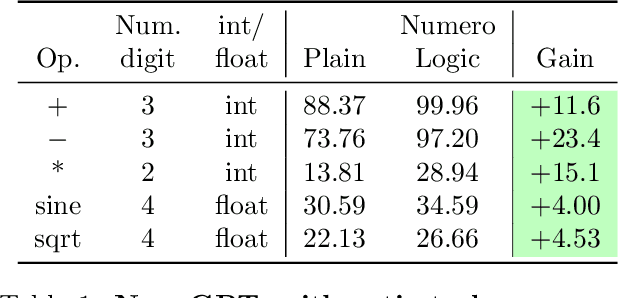
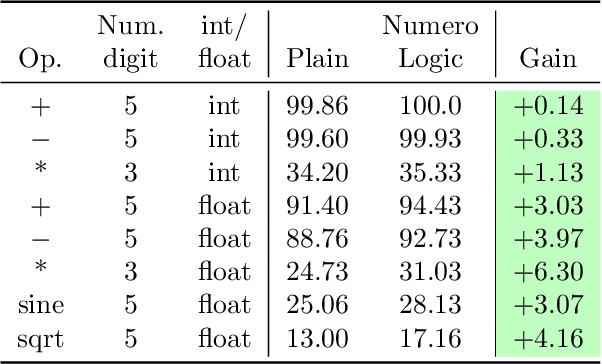
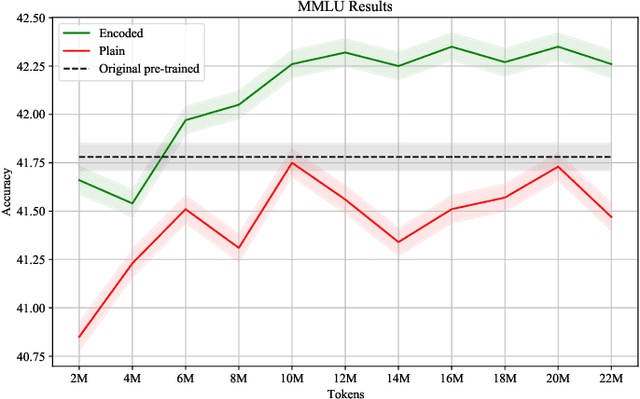
Language models struggle with handling numerical data and performing arithmetic operations. We hypothesize that this limitation can be partially attributed to non-intuitive textual numbers representation. When a digit is read or generated by a causal language model it does not know its place value (e.g. thousands vs. hundreds) until the entire number is processed. To address this issue, we propose a simple adjustment to how numbers are represented by including the count of digits before each number. For instance, instead of "42", we suggest using "{2:42}" as the new format. This approach, which we term NumeroLogic, offers an added advantage in number generation by serving as a Chain of Thought (CoT). By requiring the model to consider the number of digits first, it enhances the reasoning process before generating the actual number. We use arithmetic tasks to demonstrate the effectiveness of the NumeroLogic formatting. We further demonstrate NumeroLogic applicability to general natural language modeling, improving language understanding performance in the MMLU benchmark.
3D Masked Autoencoders with Application to Anomaly Detection in Non-Contrast Enhanced Breast MRI
Mar 10, 2023Self-supervised models allow (pre-)training on unlabeled data and therefore have the potential to overcome the need for large annotated cohorts. One leading self-supervised model is the masked autoencoder (MAE) which was developed on natural imaging data. The MAE is masking out a high fraction of visual transformer (ViT) input patches, to then recover the uncorrupted images as a pretraining task. In this work, we extend MAE to perform anomaly detection on breast magnetic resonance imaging (MRI). This new model, coined masked autoencoder for medical imaging (MAEMI) is trained on two non-contrast enhanced MRI sequences, aiming at lesion detection without the need for intravenous injection of contrast media and temporal image acquisition. During training, only non-cancerous images are presented to the model, with the purpose of localizing anomalous tumor regions during test time. We use a public dataset for model development. Performance of the architecture is evaluated in reference to subtraction images created from dynamic contrast enhanced (DCE)-MRI.