 Add to Chrome
 Add to Firefox
 Add to Edge
Workflow-GYM: Towards Long-Horizon Evaluation of Computer-use Agentic tasks in Real-World Professional Fields
Jun 09, 2026
Recent years have witnessed the rapid evolution of AI agents toward handling increasingly complex, real-world tasks. However, existing benchmarks rarely evaluate whether agents can operate graphical user interfaces to complete long-horizon, high-value professional workflows across diverse domains. Current GUI benchmarks still predominantly focus on general-purpose software, relatively simple applications, and short-horizon tasks, leaving it largely unknown whether modern agents can follow user instructions to autonomously operate domain-specific professional software and accomplish economically valuable work in an end-to-end manner. To bridge this gap, we introduce Workflow-GYM, a benchmark for long-horizon GUI tasks centered on professional domains and specialized software environments. Through extensive experiments on state-of-the-art models, we find that even the strongest models achieve only slightly above 30% success rates, highlighting that professional long-horizon GUI workflows remain highly challenging for current GUI agents. Further analysis reveals that current agents struggle to maintain long-horizon workflow consistency, frequently exhibiting workflow stage omission, error propagation, objective drift, and insufficient understanding of professional software environments. Our findings provide important insights into the limitations of current agent systems and suggest key directions for the next generation of GUI-agent research.

NL2Repo-Bench: Towards Long-Horizon Repository Generation Evaluation of Coding Agents
Dec 14, 2025Recent advances in coding agents suggest rapid progress toward autonomous software development, yet existing benchmarks fail to rigorously evaluate the long-horizon capabilities required to build complete software systems. Most prior evaluations focus on localized code generation, scaffolded completion, or short-term repair tasks, leaving open the question of whether agents can sustain coherent reasoning, planning, and execution over the extended horizons demanded by real-world repository construction. To address this gap, we present NL2Repo Bench, a benchmark explicitly designed to evaluate the long-horizon repository generation ability of coding agents. Given only a single natural-language requirements document and an empty workspace, agents must autonomously design the architecture, manage dependencies, implement multi-module logic, and produce a fully installable Python library. Our experiments across state-of-the-art open- and closed-source models reveal that long-horizon repository generation remains largely unsolved: even the strongest agents achieve below 40% average test pass rates and rarely complete an entire repository correctly. Detailed analysis uncovers fundamental long-horizon failure modes, including premature termination, loss of global coherence, fragile cross-file dependencies, and inadequate planning over hundreds of interaction steps. NL2Repo Bench establishes a rigorous, verifiable testbed for measuring sustained agentic competence and highlights long-horizon reasoning as a central bottleneck for the next generation of autonomous coding agents.
DiscoX: Benchmarking Discourse-Level Translation task in Expert Domains
Nov 14, 2025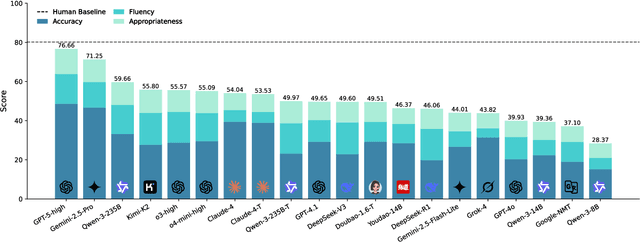

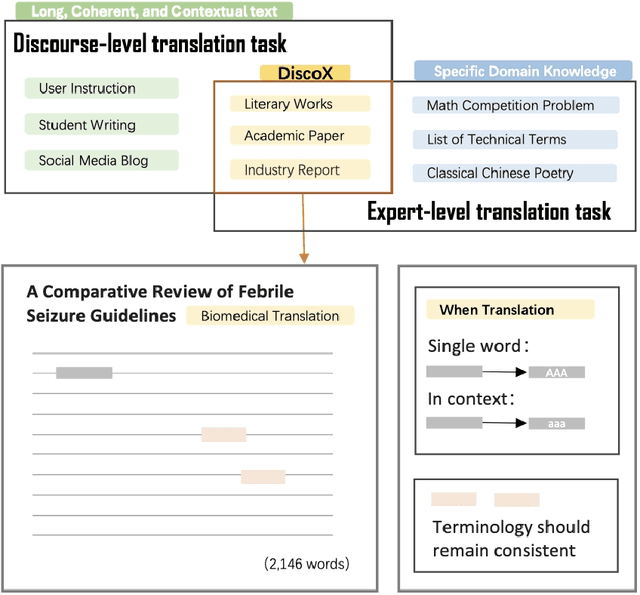
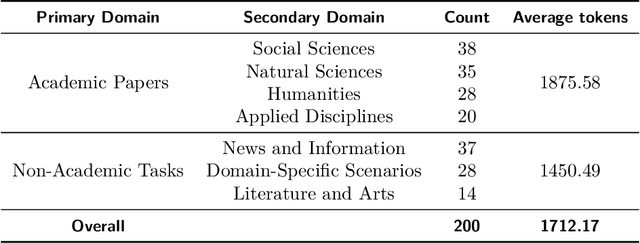
The evaluation of discourse-level translation in expert domains remains inadequate, despite its centrality to knowledge dissemination and cross-lingual scholarly communication. While these translations demand discourse-level coherence and strict terminological precision, current evaluation methods predominantly focus on segment-level accuracy and fluency. To address this limitation, we introduce DiscoX, a new benchmark for discourse-level and expert-level Chinese-English translation. It comprises 200 professionally-curated texts from 7 domains, with an average length exceeding 1700 tokens. To evaluate performance on DiscoX, we also develop Metric-S, a reference-free system that provides fine-grained automatic assessments across accuracy, fluency, and appropriateness. Metric-S demonstrates strong consistency with human judgments, significantly outperforming existing metrics. Our experiments reveal a remarkable performance gap: even the most advanced LLMs still trail human experts on these tasks. This finding validates the difficulty of DiscoX and underscores the challenges that remain in achieving professional-grade machine translation. The proposed benchmark and evaluation system provide a robust framework for more rigorous evaluation, facilitating future advancements in LLM-based translation.