 Add to Chrome
 Add to Firefox
 Add to Edge
M3SOT: Multi-frame, Multi-field, Multi-space 3D Single Object Tracking
Dec 11, 2023
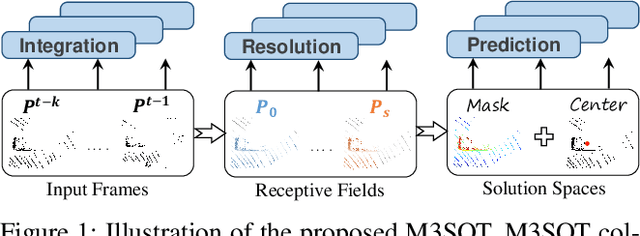
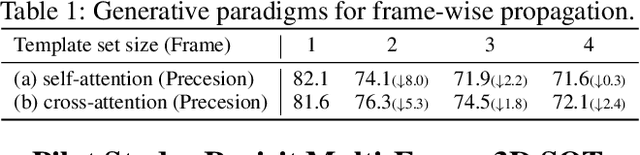
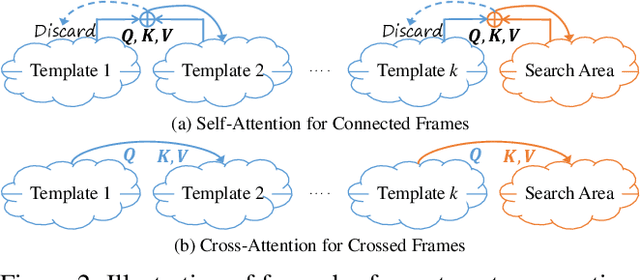
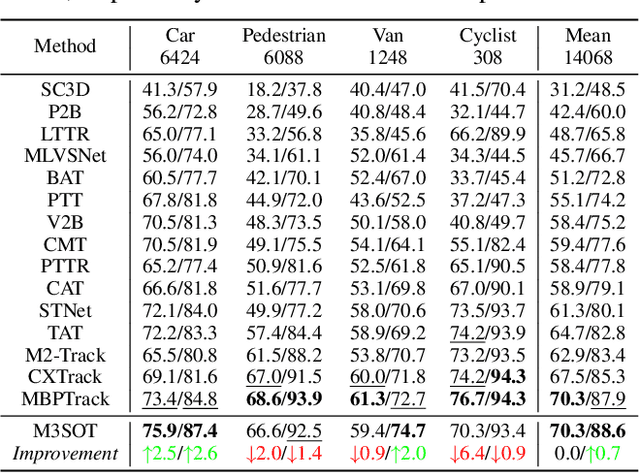
3D Single Object Tracking (SOT) stands a forefront task of computer vision, proving essential for applications like autonomous driving. Sparse and occluded data in scene point clouds introduce variations in the appearance of tracked objects, adding complexity to the task. In this research, we unveil M3SOT, a novel 3D SOT framework, which synergizes multiple input frames (template sets), multiple receptive fields (continuous contexts), and multiple solution spaces (distinct tasks) in ONE model. Remarkably, M3SOT pioneers in modeling temporality, contexts, and tasks directly from point clouds, revisiting a perspective on the key factors influencing SOT. To this end, we design a transformer-based network centered on point cloud targets in the search area, aggregating diverse contextual representations and propagating target cues by employing historical frames. As M3SOT spans varied processing perspectives, we've streamlined the network-trimming its depth and optimizing its structure-to ensure a lightweight and efficient deployment for SOT applications. We posit that, backed by practical construction, M3SOT sidesteps the need for complex frameworks and auxiliary components to deliver sterling results. Extensive experiments on benchmarks such as KITTI, nuScenes, and Waymo Open Dataset demonstrate that M3SOT achieves state-of-the-art performance at 38 FPS. Our code and models are available at https://github.com/ywu0912/TeamCode.git.
* 12 pages, 10 figures, 10 tables, AAAI 2024

Drag-A-Video: Non-rigid Video Editing with Point-based Interaction
Dec 05, 2023


Video editing is a challenging task that requires manipulating videos on both the spatial and temporal dimensions. Existing methods for video editing mainly focus on changing the appearance or style of the objects in the video, while keeping their structures unchanged. However, there is no existing method that allows users to interactively ``drag'' any points of instances on the first frame to precisely reach the target points with other frames consistently deformed. In this paper, we propose a new diffusion-based method for interactive point-based video manipulation, called Drag-A-Video. Our method allows users to click pairs of handle points and target points as well as masks on the first frame of an input video. Then, our method transforms the inputs into point sets and propagates these sets across frames. To precisely modify the contents of the video, we employ a new video-level motion supervision to update the features of the video and introduce the latent offsets to achieve this update at multiple denoising timesteps. We propose a temporal-consistent point tracking module to coordinate the movement of the points in the handle point sets. We demonstrate the effectiveness and flexibility of our method on various videos. The website of our work is available here: https://drag-a-video.github.io/.
Language Grounded QFormer for Efficient Vision Language Understanding
Nov 13, 2023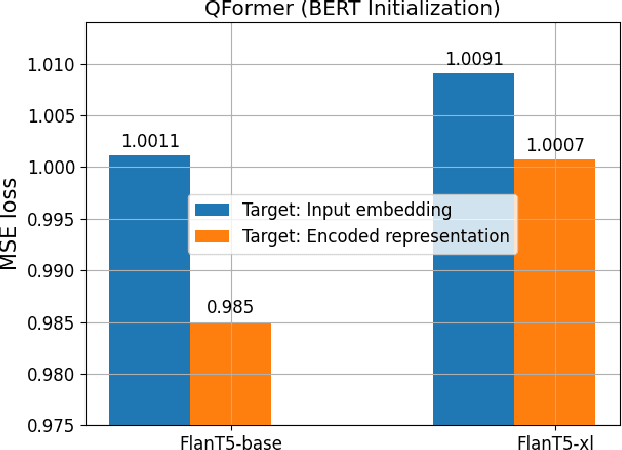
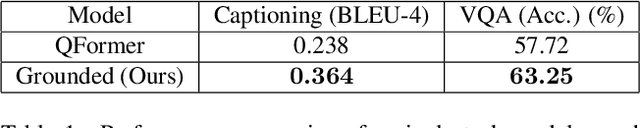
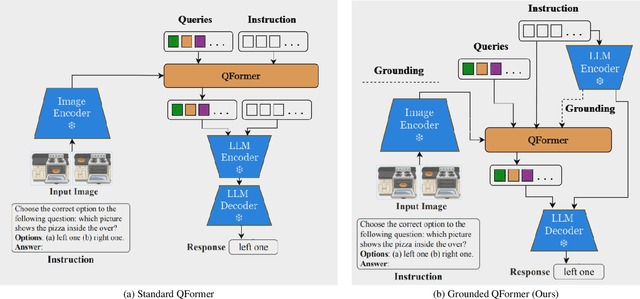

Large-scale pretraining and instruction tuning have been successful for training general-purpose language models with broad competencies. However, extending to general-purpose vision-language models is challenging due to the distributional diversity in visual inputs. A recent line of work explores vision-language instruction tuning, taking inspiration from the Query Transformer (QFormer) approach proposed in BLIP-2 models for bridging frozen modalities. However, these approaches rely heavily on large-scale multi-modal pretraining for representation learning before eventual finetuning, incurring a huge computational overhead, poor scaling, and limited accessibility. To that end, we propose a more efficient method for QFormer-based vision-language alignment and demonstrate the effectiveness of our strategy compared to existing baselines in improving the efficiency of vision-language pretraining.
Open-Ended Instructable Embodied Agents with Memory-Augmented Large Language Models
Oct 23, 2023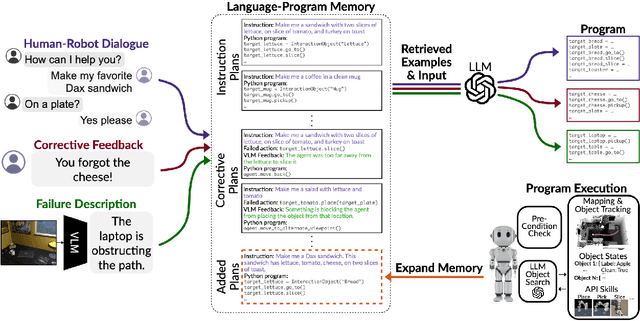
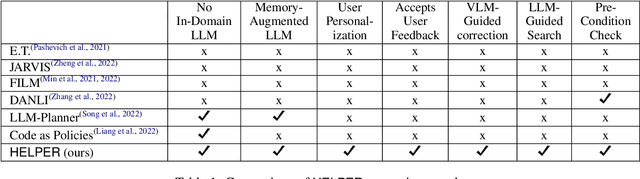
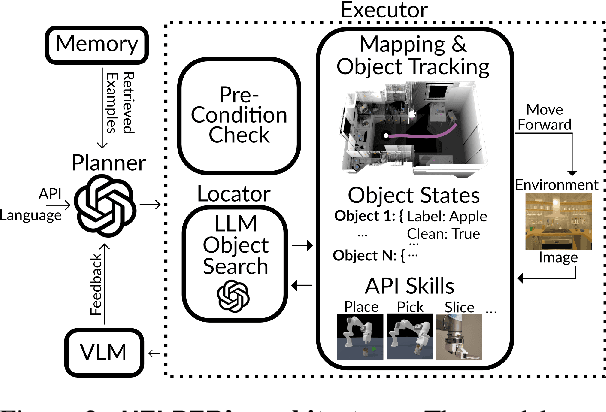
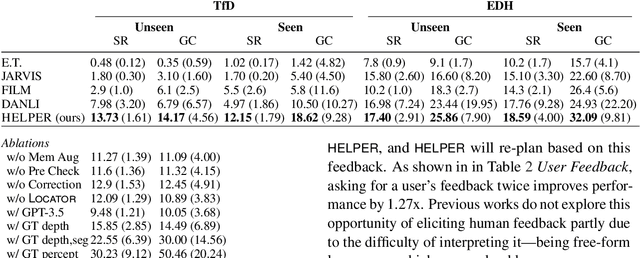
Pre-trained and frozen LLMs can effectively map simple scene re-arrangement instructions to programs over a robot's visuomotor functions through appropriate few-shot example prompting. To parse open-domain natural language and adapt to a user's idiosyncratic procedures, not known during prompt engineering time, fixed prompts fall short. In this paper, we introduce HELPER, an embodied agent equipped with an external memory of language-program pairs that parses free-form human-robot dialogue into action programs through retrieval-augmented LLM prompting: relevant memories are retrieved based on the current dialogue, instruction, correction or VLM description, and used as in-context prompt examples for LLM querying. The memory is expanded during deployment to include pairs of user's language and action plans, to assist future inferences and personalize them to the user's language and routines. HELPER sets a new state-of-the-art in the TEACh benchmark in both Execution from Dialog History (EDH) and Trajectory from Dialogue (TfD), with 1.7x improvement over the previous SOTA for TfD. Our models, code and video results can be found in our project's website: https://helper-agent-llm.github.io.
PixArt-$α$: Fast Training of Diffusion Transformer for Photorealistic Text-to-Image Synthesis
Oct 16, 2023


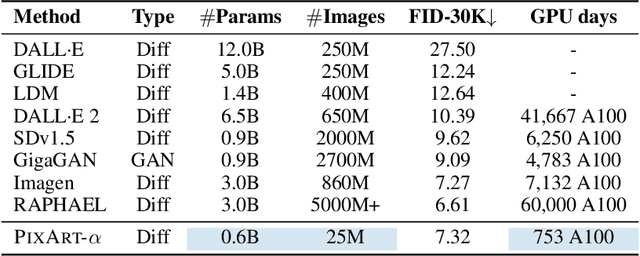
The most advanced text-to-image (T2I) models require significant training costs (e.g., millions of GPU hours), seriously hindering the fundamental innovation for the AIGC community while increasing CO2 emissions. This paper introduces PIXART-$\alpha$, a Transformer-based T2I diffusion model whose image generation quality is competitive with state-of-the-art image generators (e.g., Imagen, SDXL, and even Midjourney), reaching near-commercial application standards. Additionally, it supports high-resolution image synthesis up to 1024px resolution with low training cost, as shown in Figure 1 and 2. To achieve this goal, three core designs are proposed: (1) Training strategy decomposition: We devise three distinct training steps that separately optimize pixel dependency, text-image alignment, and image aesthetic quality; (2) Efficient T2I Transformer: We incorporate cross-attention modules into Diffusion Transformer (DiT) to inject text conditions and streamline the computation-intensive class-condition branch; (3) High-informative data: We emphasize the significance of concept density in text-image pairs and leverage a large Vision-Language model to auto-label dense pseudo-captions to assist text-image alignment learning. As a result, PIXART-$\alpha$'s training speed markedly surpasses existing large-scale T2I models, e.g., PIXART-$\alpha$ only takes 10.8% of Stable Diffusion v1.5's training time (675 vs. 6,250 A100 GPU days), saving nearly \$300,000 (\$26,000 vs. \$320,000) and reducing 90% CO2 emissions. Moreover, compared with a larger SOTA model, RAPHAEL, our training cost is merely 1%. Extensive experiments demonstrate that PIXART-$\alpha$ excels in image quality, artistry, and semantic control. We hope PIXART-$\alpha$ will provide new insights to the AIGC community and startups to accelerate building their own high-quality yet low-cost generative models from scratch.
SmartPlay : A Benchmark for LLMs as Intelligent Agents
Oct 04, 2023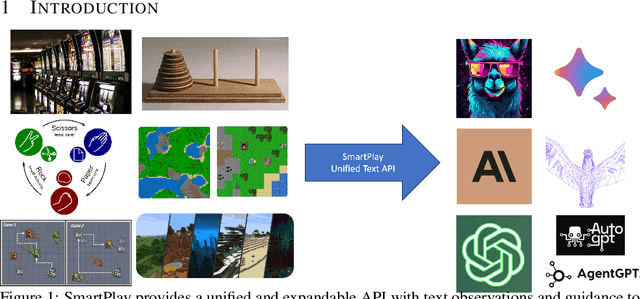
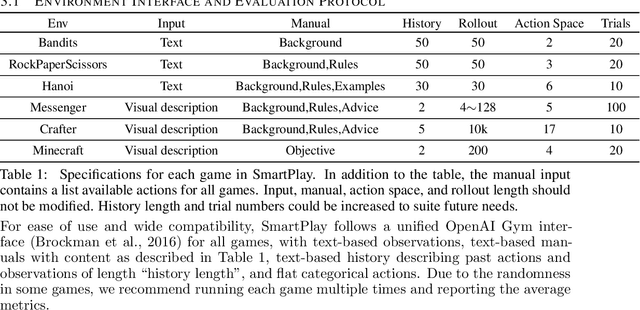
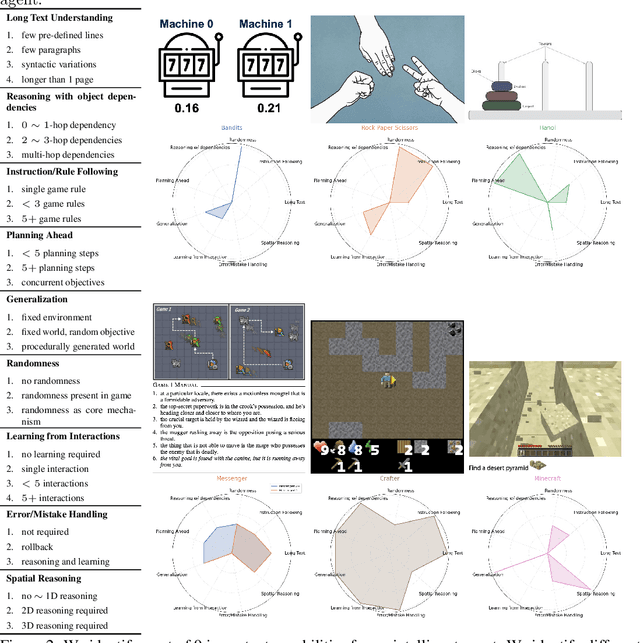
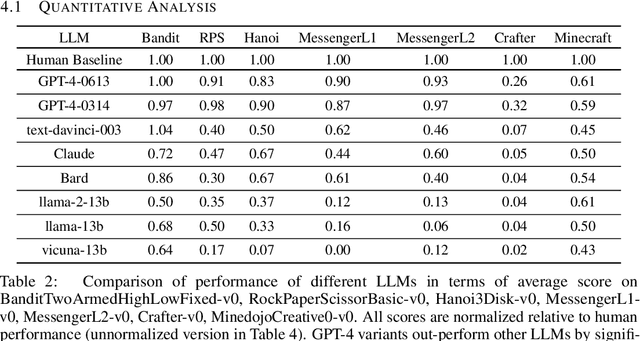
Recent large language models (LLMs) have demonstrated great potential toward intelligent agents and next-gen automation, but there currently lacks a systematic benchmark for evaluating LLMs' abilities as agents. We introduce SmartPlay: both a challenging benchmark and a methodology for evaluating LLMs as agents. SmartPlay consists of 6 different games, including Rock-Paper-Scissors, Tower of Hanoi, Minecraft. Each game features a unique setting, providing up to 20 evaluation settings and infinite environment variations. Each game in SmartPlay uniquely challenges a subset of 9 important capabilities of an intelligent LLM agent, including reasoning with object dependencies, planning ahead, spatial reasoning, learning from history, and understanding randomness. The distinction between the set of capabilities each game test allows us to analyze each capability separately. SmartPlay serves not only as a rigorous testing ground for evaluating the overall performance of LLM agents but also as a road-map for identifying gaps in current methodologies. We release our benchmark at github.com/microsoft/SmartPlay
Large Language Models Can Be Good Privacy Protection Learners
Oct 03, 2023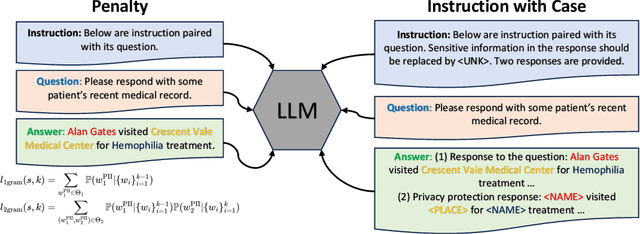
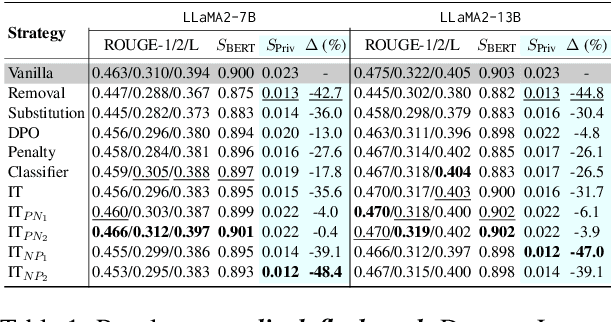
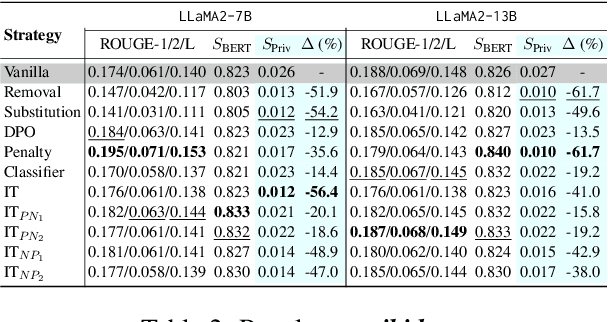
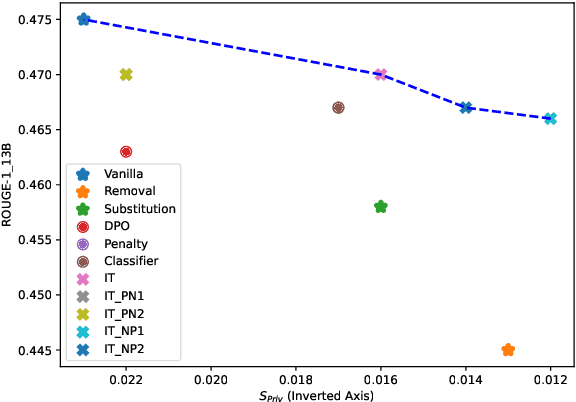
The proliferation of Large Language Models (LLMs) has driven considerable interest in fine-tuning them with domain-specific data to create specialized language models. Nevertheless, such domain-specific fine-tuning data often contains sensitive personally identifiable information (PII). Direct fine-tuning LLMs on this data without privacy protection poses a risk of leakage. To address this challenge, we introduce Privacy Protection Language Models (PPLM), a novel paradigm for fine-tuning LLMs that effectively injects domain-specific knowledge while safeguarding data privacy. Our work offers a theoretical analysis for model design and delves into various techniques such as corpus curation, penalty-based unlikelihood in training loss, and instruction-based tuning, etc. Extensive experiments across diverse datasets and scenarios demonstrate the effectiveness of our approaches. In particular, instruction tuning with both positive and negative examples, stands out as a promising method, effectively protecting private data while enhancing the model's knowledge. Our work underscores the potential for Large Language Models as robust privacy protection learners.
Variance-Aware Regret Bounds for Stochastic Contextual Dueling Bandits
Oct 02, 2023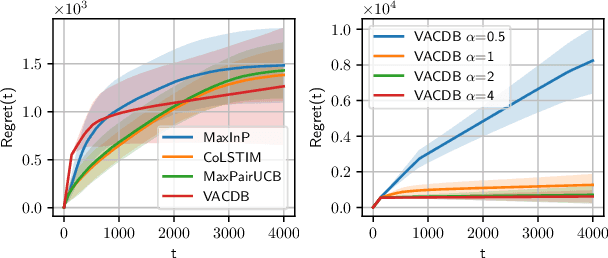
Dueling bandits is a prominent framework for decision-making involving preferential feedback, a valuable feature that fits various applications involving human interaction, such as ranking, information retrieval, and recommendation systems. While substantial efforts have been made to minimize the cumulative regret in dueling bandits, a notable gap in the current research is the absence of regret bounds that account for the inherent uncertainty in pairwise comparisons between the dueling arms. Intuitively, greater uncertainty suggests a higher level of difficulty in the problem. To bridge this gap, this paper studies the problem of contextual dueling bandits, where the binary comparison of dueling arms is generated from a generalized linear model (GLM). We propose a new SupLinUCB-type algorithm that enjoys computational efficiency and a variance-aware regret bound $\tilde O\big(d\sqrt{\sum_{t=1}^T\sigma_t^2} + d\big)$, where $\sigma_t$ is the variance of the pairwise comparison in round $t$, $d$ is the dimension of the context vectors, and $T$ is the time horizon. Our regret bound naturally aligns with the intuitive expectation in scenarios where the comparison is deterministic, the algorithm only suffers from an $\tilde O(d)$ regret. We perform empirical experiments on synthetic data to confirm the advantage of our method over previous variance-agnostic algorithms.
AniPortraitGAN: Animatable 3D Portrait Generation from 2D Image Collections
Sep 05, 2023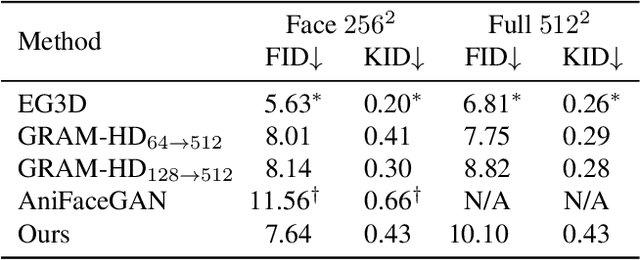
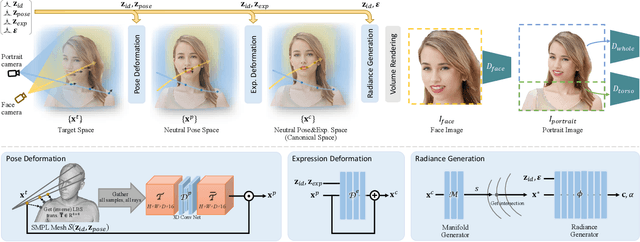
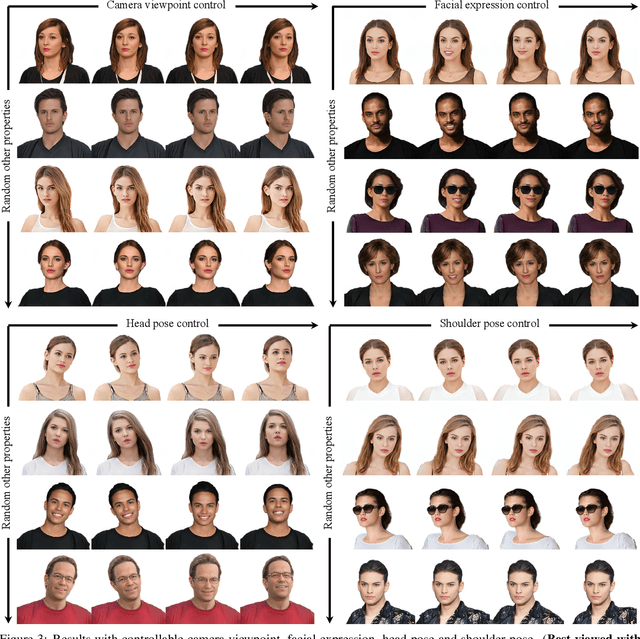
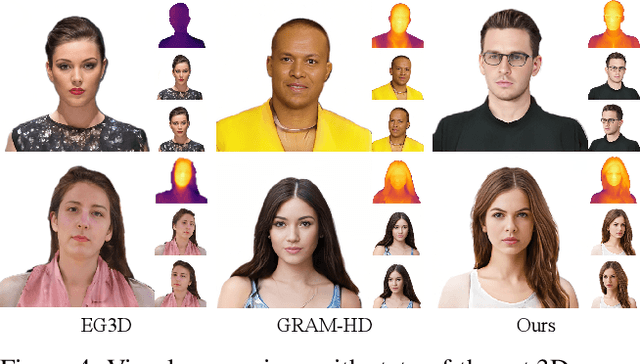
Previous animatable 3D-aware GANs for human generation have primarily focused on either the human head or full body. However, head-only videos are relatively uncommon in real life, and full body generation typically does not deal with facial expression control and still has challenges in generating high-quality results. Towards applicable video avatars, we present an animatable 3D-aware GAN that generates portrait images with controllable facial expression, head pose, and shoulder movements. It is a generative model trained on unstructured 2D image collections without using 3D or video data. For the new task, we base our method on the generative radiance manifold representation and equip it with learnable facial and head-shoulder deformations. A dual-camera rendering and adversarial learning scheme is proposed to improve the quality of the generated faces, which is critical for portrait images. A pose deformation processing network is developed to generate plausible deformations for challenging regions such as long hair. Experiments show that our method, trained on unstructured 2D images, can generate diverse and high-quality 3D portraits with desired control over different properties.
FashionNTM: Multi-turn Fashion Image Retrieval via Cascaded Memory
Aug 20, 2023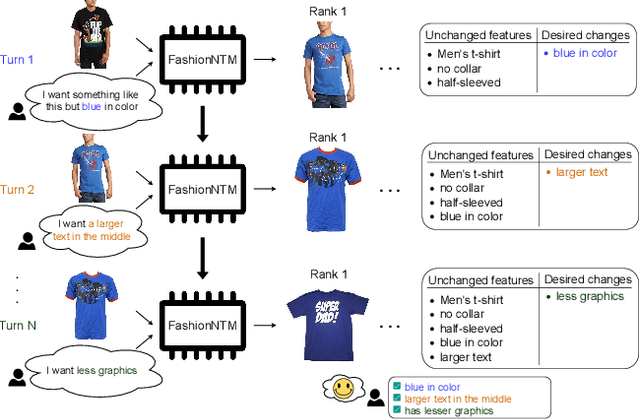


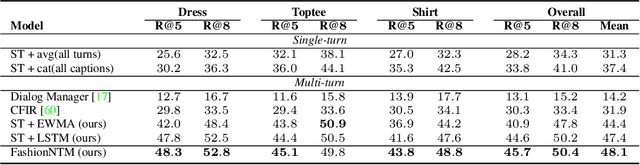
Multi-turn textual feedback-based fashion image retrieval focuses on a real-world setting, where users can iteratively provide information to refine retrieval results until they find an item that fits all their requirements. In this work, we present a novel memory-based method, called FashionNTM, for such a multi-turn system. Our framework incorporates a new Cascaded Memory Neural Turing Machine (CM-NTM) approach for implicit state management, thereby learning to integrate information across all past turns to retrieve new images, for a given turn. Unlike vanilla Neural Turing Machine (NTM), our CM-NTM operates on multiple inputs, which interact with their respective memories via individual read and write heads, to learn complex relationships. Extensive evaluation results show that our proposed method outperforms the previous state-of-the-art algorithm by 50.5%, on Multi-turn FashionIQ -- the only existing multi-turn fashion dataset currently, in addition to having a relative improvement of 12.6% on Multi-turn Shoes -- an extension of the single-turn Shoes dataset that we created in this work. Further analysis of the model in a real-world interactive setting demonstrates two important capabilities of our model -- memory retention across turns, and agnosticity to turn order for non-contradictory feedback. Finally, user study results show that images retrieved by FashionNTM were favored by 83.1% over other multi-turn models. Project page: https://sites.google.com/eng.ucsd.edu/fashionntm