 Add to Chrome
 Add to Firefox
 Add to Edge
Breaking the Total Variance Barrier: Sharp Sample Complexity for Linear Heteroscedastic Bandits with Fixed Action Set
Jul 26, 2026
Recent years have witnessed increasing interests in tackling heteroscedastic noise in bandits and reinforcement learning. In these works, the cumulative variance of the noise $Λ= \sum_{t=1}^T σ_t^2$, where $σ_t^2$ is the variance of the noise at round $t$, is used to characterize the statistical complexity of the problem, yielding \emph{simple regret} bounds of order $\tilde{\cal{O}}(d \sqrt{Λ/ T^2})$ for $d$-dimensional linear bandits with heteroscedastic noise. However, with a closer look, $Λ$ remains the same order even if the noise is close to zero at half of the rounds, which indicates that the $Λ$-dependence is not optimal. In this paper, we revisit the stochastic linear bandit problem with heteroscedastic noise, where the action set is prefixed throughout the learning process. We propose a novel variance-adaptive algorithm \texttt{VAEE} (Variance-Aware Exploration with Elimination) for large action set, which actively explores actions that maximizes the information gain among a candidate set of actions that are not eliminated. With the active-exploration strategy, we show that \texttt{VAEE} achieves a \emph{simple regret} with a nearly \emph{harmonic-mean} dependent rate. For finitely many actions, we propose a variance-aware variant of G-optimal design based exploration, which achieves a simple regret with sharper dependence on $d$. We also establish a nearly matching lower bound for the fixed action set setting indicating that \emph{harmonic-mean} dependent rate is unavoidable. To the best of our knowledge, this is the first work that breaks the $\sqrtΛ$ barrier for stochastic linear bandits with heteroscedastic noise.

Multi-Mask Diffusion Language Models for Few-Step Generation
Jul 24, 2026Masked diffusion models (MDMs) are a promising family of language generators, but achieving high-quality few-step generation remains challenging. In MDMs, all forward trajectories collapse to a single fully masked state, leaving no terminal entropy for consistency-style few-step generation. While recent few-step alternatives based on uniform-state diffusion avoid this degeneracy, it becomes harder to distinguish clean tokens from noise than MDMs, which usually harms modeling quality and training efficiency. In this work, we propose a multi-mask diffusion model (MultiMDM) that preserves the masking structure towards few-step generation. In the forward process, each clean token is first pushed towards a designated mask and then gradually mixes over the mask set. As a result, the backward process has a drafting capability by predicting a designated mask before refining to a clean token. We derive a closed-form ELBO training objective for MultiMDM that supports continual training from pretrained MDMs. In addition, we formulate a purely discrete-state consistency distillation scheme, with a shared-Gumbel coupling to reduce pathwise entropy. Experiments on pretraining and distillation show that MultiMDM provides an effective foundation for principled few-step generation.
Fast Rates for Offline Contextual Bandits with Forward-KL Regularization under Single-Policy Concentrability
May 09, 2026\emph{Kullback-Leibler} (KL) regularization is ubiquitous in reinforcement learning algorithms in the form of \emph{reverse} or \emph{forward} KL. Recent studies have demonstrated $ε^{-1}$-type fast rates for decision making under reverse KL regularization, in contrast to the standard $ε^{-2}$-type sample complexity. However, for forward-KL-regularized objectives, existing statistical analyses are either not applicable or result in $\tilde{O}(ε^{-2})$ slow rates. We take the first step towards addressing this problem via a streamlined analysis of forward-KL-regularized offline CBs. We give the first $\tilde{O}(ε^{-1})$ upper bounds in tabular and general function approximation settings, both under notions of \emph{single-policy concentrability}. In particular, our convex-analytical pipeline unifies these settings by exploiting the pessimism principle in a novel way and completely bypasses the proof routines in previous works based on the mean value theorem, which might be of independent interest. Moreover, we provide rate-optimal lower bounds, manifesting the tightness of our upper bounds in terms of statistical rates. Our lower bounds also demonstrate that the forward-KL-regularized sample complexity recovers the unregularized slow rate in the low-regularization regime, similarly to the reverse-KL regularization.
On the Optimal Sample Complexity of Offline Multi-Armed Bandits with KL Regularization
May 04, 2026Kullback-Leibler (KL) regularization is widely used in offline decision-making and offers several benefits, motivating recent work on the sample complexity of offline learning with respect to KL-regularized performance metrics. Nevertheless, the exact sample complexity of KL-regularized offline learning remains largely from fully characterized. In this paper, we study this question in the setting of multi-armed bandits (MABs). We provide a sharp analysis of KL-PCB (Zhao et al., 2026), showing that it achieves a sample complexity of $\tilde{O}(ηSAC^{π^*}/ε)$ under large regularization $η= \tilde{O}(ε^{-1})$, and a sample complexity of $\tildeΩ(SAC^{π^*}/ε^2)$ under small regularization $η= \tildeΩ(ε^{-1})$, where $η$ is the regularization parameter, $S$ is the number of contexts, $A$ is the number of arms, $C^{π^*}$ policy coverage coefficient at the optimal policy $π^*$, $ε$ is the desired sub-optimality, and $\tilde{O}$ and $\tildeΩ$ hide all poly-logarithmic factors. We further provide a pair of sharper sample complexity lower bounds, which matches the upper bounds over the entire range of regularization strengths. Overall, our results provide a nearly complete characterization of offline multi-armed bandits with KL regularization.
Near-Optimal Regret for KL-Regularized Multi-Armed Bandits
Mar 02, 2026Recent studies have shown that reinforcement learning with KL-regularized objectives can enjoy faster rates of convergence or logarithmic regret, in contrast to the classical $\sqrt{T}$-type regret in the unregularized setting. However, the statistical efficiency of online learning with respect to KL-regularized objectives remains far from completely characterized, even when specialized to multi-armed bandits (MABs). We address this problem for MABs via a sharp analysis of KL-UCB using a novel peeling argument, which yields a $\tilde{O}(ηK\log^2T)$ upper bound: the first high-probability regret bound with linear dependence on $K$. Here, $T$ is the time horizon, $K$ is the number of arms, $η^{-1}$ is the regularization intensity, and $\tilde{O}$ hides all logarithmic factors except those involving $\log T$. The near-tightness of our analysis is certified by the first non-constant lower bound $Ω(ηK \log T)$, which follows from subtle hard-instance constructions and a tailored decomposition of the Bayes prior. Moreover, in the low-regularization regime (i.e., large $η$), we show that the KL-regularized regret for MABs is $η$-independent and scales as $\tildeΘ(\sqrt{KT})$. Overall, our results provide a thorough understanding of KL-regularized MABs across all regimes of $η$ and yield nearly optimal bounds in terms of $K$, $η$, and $T$.
Logarithmic Regret for Online KL-Regularized Reinforcement Learning
Feb 11, 2025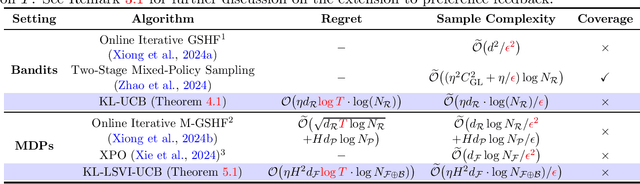
Recent advances in Reinforcement Learning from Human Feedback (RLHF) have shown that KL-regularization plays a pivotal role in improving the efficiency of RL fine-tuning for large language models (LLMs). Despite its empirical advantage, the theoretical difference between KL-regularized RL and standard RL remains largely under-explored. While there is a recent line of work on the theoretical analysis of KL-regularized objective in decision making \citep{xiong2024iterative, xie2024exploratory,zhao2024sharp}, these analyses either reduce to the traditional RL setting or rely on strong coverage assumptions. In this paper, we propose an optimism-based KL-regularized online contextual bandit algorithm, and provide a novel analysis of its regret. By carefully leveraging the benign optimization landscape induced by the KL-regularization and the optimistic reward estimation, our algorithm achieves an $\mathcal{O}\big(\eta\log (N_{\mathcal R} T)\cdot d_{\mathcal R}\big)$ logarithmic regret bound, where $\eta, N_{\mathcal R},T,d_{\mathcal R}$ denote the KL-regularization parameter, the cardinality of the reward function class, number of rounds, and the complexity of the reward function class. Furthermore, we extend our algorithm and analysis to reinforcement learning by developing a novel decomposition over transition steps and also obtain a similar logarithmic regret bound.
Nearly Optimal Sample Complexity of Offline KL-Regularized Contextual Bandits under Single-Policy Concentrability
Feb 09, 2025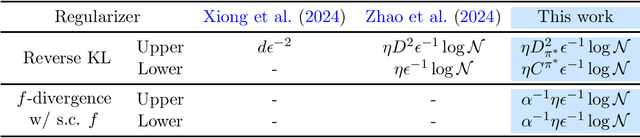
KL-regularized policy optimization has become a workhorse in learning-based decision making, while its theoretical understanding is still very limited. Although recent progress has been made towards settling the sample complexity of KL-regularized contextual bandits, existing sample complexity bounds are either $\tilde{O}(\epsilon^{-2})$ under single-policy concentrability or $\tilde{O}(\epsilon^{-1})$ under all-policy concentrability. In this paper, we propose the \emph{first} algorithm with $\tilde{O}(\epsilon^{-1})$ sample complexity under single-policy concentrability for offline contextual bandits. Our algorithm is designed for general function approximation and based on the principle of \emph{pessimism in the face of uncertainty}. The core of our proof leverages the strong convexity of the KL regularization, and the conditional non-negativity of the gap between the true reward and its pessimistic estimator to refine a mean-value-type risk upper bound to its extreme. This in turn leads to a novel covariance-based analysis, effectively bypassing the need for uniform control over the discrepancy between any two functions in the function class. The near-optimality of our algorithm is demonstrated by an $\tilde{\Omega}(\epsilon^{-1})$ lower bound. Furthermore, we extend our algorithm to contextual dueling bandits and achieve a similar nearly optimal sample complexity.
Sharp Analysis for KL-Regularized Contextual Bandits and RLHF
Nov 07, 2024
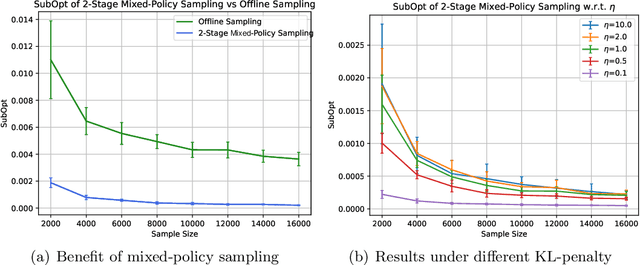
Reverse-Kullback-Leibler (KL) regularization has emerged to be a predominant technique used to enhance policy optimization in reinforcement learning (RL) and reinforcement learning from human feedback (RLHF), which forces the learned policy to stay close to a reference policy. While the effectiveness and necessity of KL-regularization have been empirically demonstrated in various practical scenarios, current theoretical analysis of KL-regularized RLHF still obtains the same $\mathcal{O}(1 / \epsilon^2)$ sample complexity as problems without KL-regularization. To understand the fundamental distinction between policy learning objectives with KL-regularization and ones without KL-regularization, we are the first to theoretically demonstrate the power of KL-regularization by providing a sharp analysis for KL-regularized contextual bandits and RLHF, revealing an $\mathcal{O}(1 / \epsilon)$ sample complexity when $\epsilon$ is sufficiently small. We further explore the role of data coverage in contextual bandits and RLHF. While the coverage assumption is commonly employed in offline RLHF to link the samples from the reference policy to the optimal policy, often at the cost of a multiplicative dependence on the coverage coefficient, its impact on the sample complexity of online RLHF remains unclear. Previous theoretical analyses of online RLHF typically require explicit exploration and additional structural assumptions on the reward function class. In contrast, we show that with sufficient coverage from the reference policy, a simple two-stage mixed sampling strategy can achieve a sample complexity with only an additive dependence on the coverage coefficient. Our results provide a comprehensive understanding of the roles of KL-regularization and data coverage in RLHF, shedding light on the design of more efficient RLHF algorithms.
Feel-Good Thompson Sampling for Contextual Dueling Bandits
Apr 09, 2024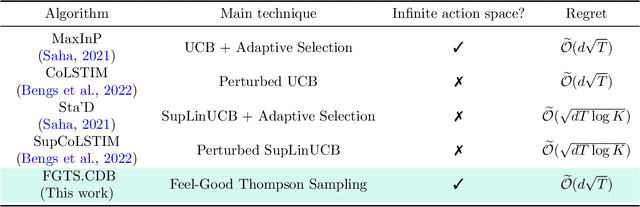
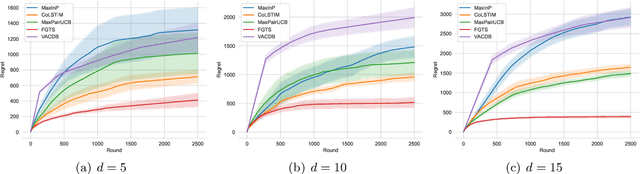
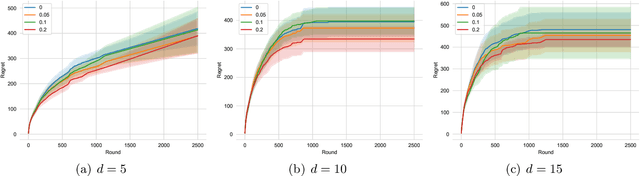
Contextual dueling bandits, where a learner compares two options based on context and receives feedback indicating which was preferred, extends classic dueling bandits by incorporating contextual information for decision-making and preference learning. Several algorithms based on the upper confidence bound (UCB) have been proposed for linear contextual dueling bandits. However, no algorithm based on posterior sampling has been developed in this setting, despite the empirical success observed in traditional contextual bandits. In this paper, we propose a Thompson sampling algorithm, named FGTS.CDB, for linear contextual dueling bandits. At the core of our algorithm is a new Feel-Good exploration term specifically tailored for dueling bandits. This term leverages the independence of the two selected arms, thereby avoiding a cross term in the analysis. We show that our algorithm achieves nearly minimax-optimal regret, i.e., $\tilde{\mathcal{O}}(d\sqrt T)$, where $d$ is the model dimension and $T$ is the time horizon. Finally, we evaluate our algorithm on synthetic data and observe that FGTS.CDB outperforms existing algorithms by a large margin.
A Nearly Optimal and Low-Switching Algorithm for Reinforcement Learning with General Function Approximation
Nov 26, 2023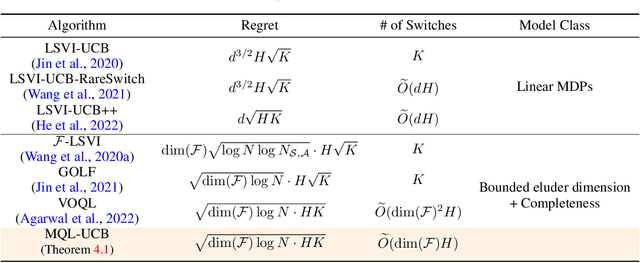
The exploration-exploitation dilemma has been a central challenge in reinforcement learning (RL) with complex model classes. In this paper, we propose a new algorithm, Monotonic Q-Learning with Upper Confidence Bound (MQL-UCB) for RL with general function approximation. Our key algorithmic design includes (1) a general deterministic policy-switching strategy that achieves low switching cost, (2) a monotonic value function structure with carefully controlled function class complexity, and (3) a variance-weighted regression scheme that exploits historical trajectories with high data efficiency. MQL-UCB achieves minimax optimal regret of $\tilde{O}(d\sqrt{HK})$ when $K$ is sufficiently large and near-optimal policy switching cost of $\tilde{O}(dH)$, with $d$ being the eluder dimension of the function class, $H$ being the planning horizon, and $K$ being the number of episodes. Our work sheds light on designing provably sample-efficient and deployment-efficient Q-learning with nonlinear function approximation.