 Add to Chrome
 Add to Firefox
 Add to Edge
Trajectory Design for UAV-Assisted Logistics Collection in Low-Altitude Economy
Nov 10, 2025
Low-altitude economy (LAE) is rapidly emerging as a key driver of innovation, encompassing economic activities taking place in airspace below 500 meters. Unmanned aerial vehicles (UAVs) provide valuable tools for logistics collection within LAE systems, offering the ability to navigate through complex environments, avoid obstacles, and improve operational efficiency. However, logistics collection tasks involve UAVs flying through complex three-dimensional (3D) environments while avoiding obstacles, where traditional UAV trajectory design methods,typically developed under free-space conditions without explicitly accounting for obstacles, are not applicable. This paper presents, we propose a novel algorithm that combines the Lin-Kernighan-Helsgaun (LKH) and Deep Deterministic Policy Gradient (DDPG) methods to minimize the total collection time. Specifically, the LKH algorithm determines the optimal order of item collection, while the DDPG algorithm designs the flight trajectory between collection points. Simulations demonstrate that the proposed LKH-DDPG algorithm significantly reduces collection time by approximately 49 percent compared to baseline approaches, thereby highlighting its effectiveness in optimizing UAV trajectories and enhancing operational efficiency for logistics collection tasks in the LAE paradigm.

Advancing Ocean State Estimation with efficient and scalable AI
Nov 08, 2025Accurate and efficient global ocean state estimation remains a grand challenge for Earth system science, hindered by the dual bottlenecks of computational scalability and degraded data fidelity in traditional data assimilation (DA) and deep learning (DL) approaches. Here we present an AI-driven Data Assimilation Framework for Ocean (ADAF-Ocean) that directly assimilates multi-source and multi-scale observations, ranging from sparse in-situ measurements to 4 km satellite swaths, without any interpolation or data thinning. Inspired by Neural Processes, ADAF-Ocean learns a continuous mapping from heterogeneous inputs to ocean states, preserving native data fidelity. Through AI-driven super-resolution, it reconstructs 0.25$^\circ$ mesoscale dynamics from coarse 1$^\circ$ fields, which ensures both efficiency and scalability, with just 3.7\% more parameters than the 1$^\circ$ configuration. When coupled with a DL forecasting system, ADAF-Ocean extends global forecast skill by up to 20 days compared to baselines without assimilation. This framework establishes a computationally viable and scientifically rigorous pathway toward real-time, high-resolution Earth system monitoring.
MRMR: A Realistic and Expert-Level Multidisciplinary Benchmark for Reasoning-Intensive Multimodal Retrieval
Oct 10, 2025We introduce MRMR, the first expert-level multidisciplinary multimodal retrieval benchmark requiring intensive reasoning. MRMR contains 1,502 queries spanning 23 domains, with positive documents carefully verified by human experts. Compared to prior benchmarks, MRMR introduces three key advancements. First, it challenges retrieval systems across diverse areas of expertise, enabling fine-grained model comparison across domains. Second, queries are reasoning-intensive, with images requiring deeper interpretation such as diagnosing microscopic slides. We further introduce Contradiction Retrieval, a novel task requiring models to identify conflicting concepts. Finally, queries and documents are constructed as image-text interleaved sequences. Unlike earlier benchmarks restricted to single images or unimodal documents, MRMR offers a realistic setting with multi-image queries and mixed-modality corpus documents. We conduct an extensive evaluation of 4 categories of multimodal retrieval systems and 14 frontier models on MRMR. The text embedding model Qwen3-Embedding with LLM-generated image captions achieves the highest performance, highlighting substantial room for improving multimodal retrieval models. Although latest multimodal models such as Ops-MM-Embedding perform competitively on expert-domain queries, they fall short on reasoning-intensive tasks. We believe that MRMR paves the way for advancing multimodal retrieval in more realistic and challenging scenarios.
SONAR: Self-Distilled Continual Pre-training for Domain Adaptive Audio Representation
Sep 19, 2025Self-supervised learning (SSL) on large-scale datasets like AudioSet has become the dominant paradigm for audio representation learning. While the continuous influx of new, unlabeled audio presents an opportunity to enrich these static representations, a naive approach is to retrain the model from scratch using all available data. However, this method is computationally prohibitive and discards the valuable knowledge embedded in the previously trained model weights. To address this inefficiency, we propose SONAR (Self-distilled cONtinual pre-training for domain adaptive Audio Representation), a continual pre-training framework built upon BEATs. SONAR effectively adapts to new domains while mitigating catastrophic forgetting by tackling three key challenges: implementing a joint sampling strategy for new and prior data, applying regularization to balance specificity and generality, and dynamically expanding the tokenizer codebook for novel acoustic patterns. Experiments across four distinct domains demonstrate that our method achieves both high adaptability and robust resistance to forgetting.
A Real-Time Multi-Model Parametric Representation of Point Clouds
Sep 18, 2025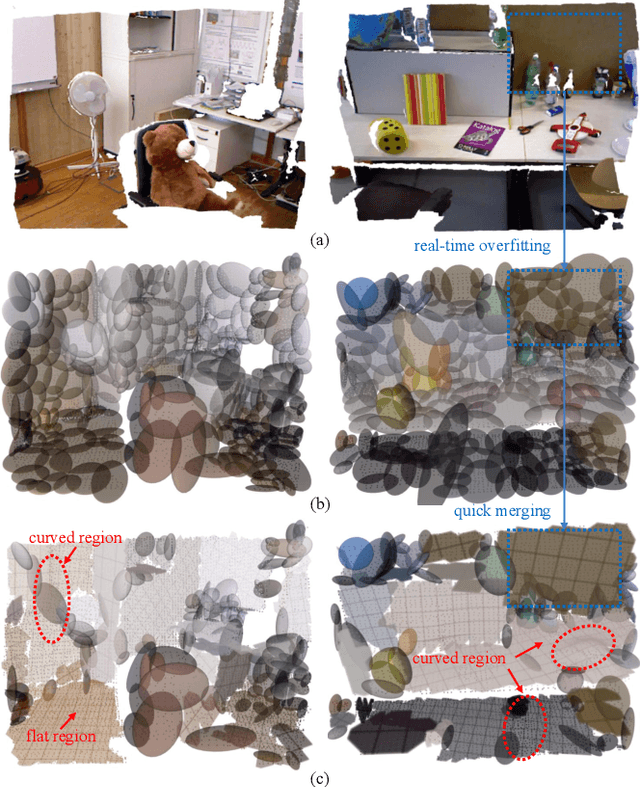

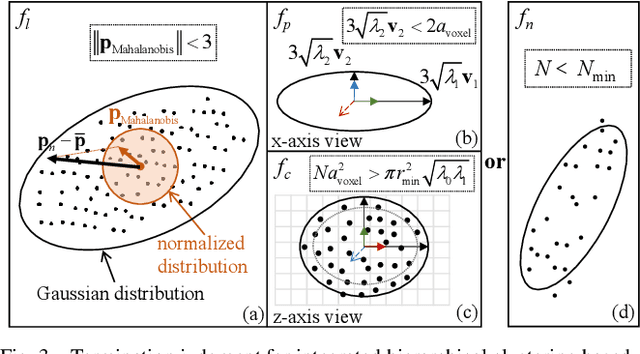
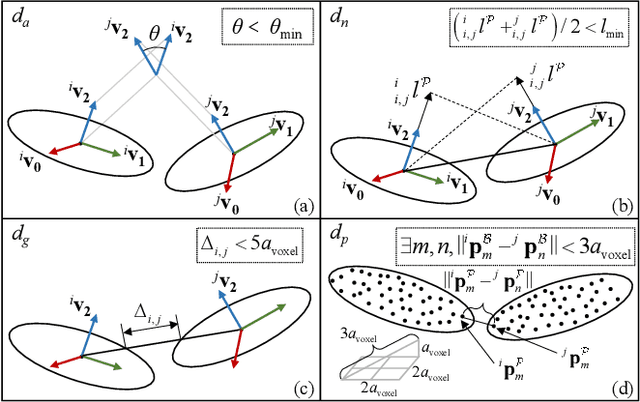
In recent years, parametric representations of point clouds have been widely applied in tasks such as memory-efficient mapping and multi-robot collaboration. Highly adaptive models, like spline surfaces or quadrics, are computationally expensive in detection or fitting. In contrast, real-time methods, such as Gaussian mixture models or planes, have low degrees of freedom, making high accuracy with few primitives difficult. To tackle this problem, a multi-model parametric representation with real-time surface detection and fitting is proposed. Specifically, the Gaussian mixture model is first employed to segment the point cloud into multiple clusters. Then, flat clusters are selected and merged into planes or curved surfaces. Planes can be easily fitted and delimited by a 2D voxel-based boundary description method. Surfaces with curvature are fitted by B-spline surfaces and the same boundary description method is employed. Through evaluations on multiple public datasets, the proposed surface detection exhibits greater robustness than the state-of-the-art approach, with 3.78 times improvement in efficiency. Meanwhile, this representation achieves a 2-fold gain in accuracy over Gaussian mixture models, operating at 36.4 fps on a low-power onboard computer.
Enabling Regulatory Multi-Agent Collaboration: Architecture, Challenges, and Solutions
Sep 11, 2025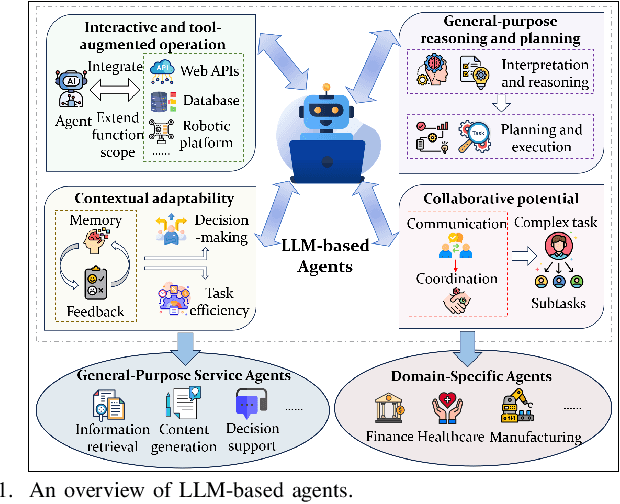
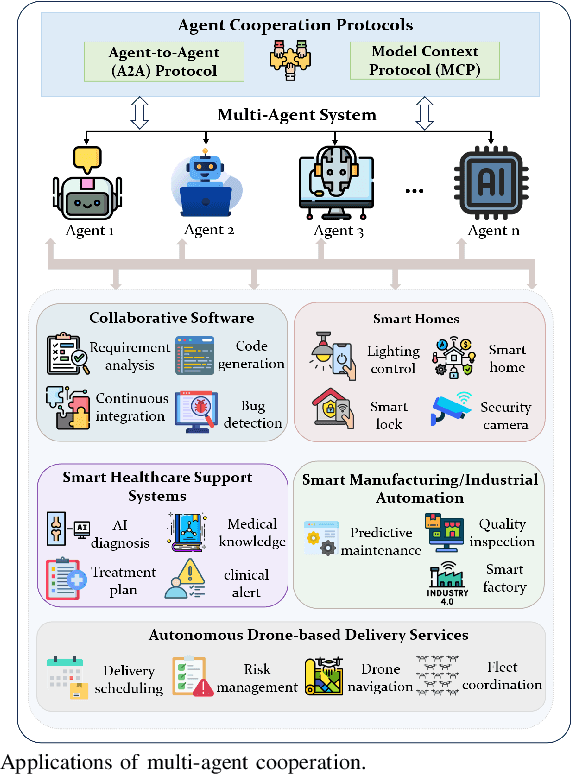
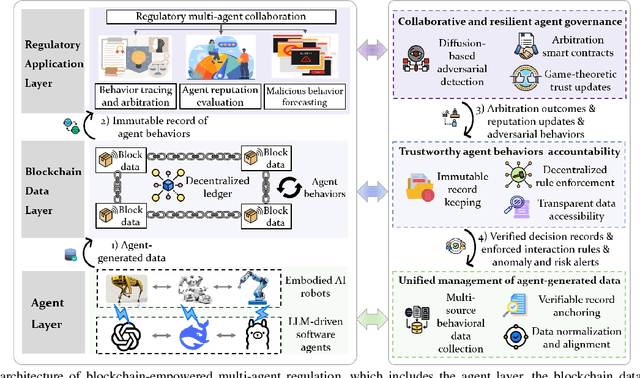
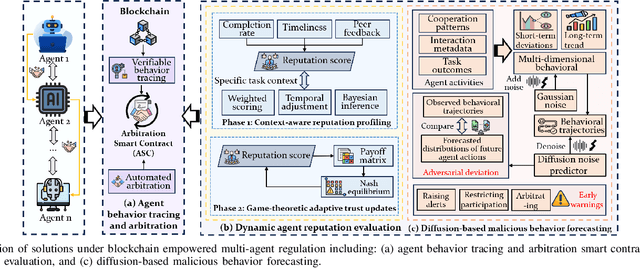
Large language models (LLMs)-empowered autonomous agents are transforming both digital and physical environments by enabling adaptive, multi-agent collaboration. While these agents offer significant opportunities across domains such as finance, healthcare, and smart manufacturing, their unpredictable behaviors and heterogeneous capabilities pose substantial governance and accountability challenges. In this paper, we propose a blockchain-enabled layered architecture for regulatory agent collaboration, comprising an agent layer, a blockchain data layer, and a regulatory application layer. Within this framework, we design three key modules: (i) an agent behavior tracing and arbitration module for automated accountability, (ii) a dynamic reputation evaluation module for trust assessment in collaborative scenarios, and (iii) a malicious behavior forecasting module for early detection of adversarial activities. Our approach establishes a systematic foundation for trustworthy, resilient, and scalable regulatory mechanisms in large-scale agent ecosystems. Finally, we discuss the future research directions for blockchain-enabled regulatory frameworks in multi-agent systems.
Score Augmentation for Diffusion Models
Aug 11, 2025Diffusion models have achieved remarkable success in generative modeling. However, this study confirms the existence of overfitting in diffusion model training, particularly in data-limited regimes. To address this challenge, we propose Score Augmentation (ScoreAug), a novel data augmentation framework specifically designed for diffusion models. Unlike conventional augmentation approaches that operate on clean data, ScoreAug applies transformations to noisy data, aligning with the inherent denoising mechanism of diffusion. Crucially, ScoreAug further requires the denoiser to predict the augmentation of the original target. This design establishes an equivariant learning objective, enabling the denoiser to learn scores across varied denoising spaces, thereby realizing what we term score augmentation. We also theoretically analyze the relationship between scores in different spaces under general transformations. In experiments, we extensively validate ScoreAug on multiple benchmarks including CIFAR-10, FFHQ, AFHQv2, and ImageNet, with results demonstrating significant performance improvements over baselines. Notably, ScoreAug effectively mitigates overfitting across diverse scenarios, such as varying data scales and model capacities, while exhibiting stable convergence properties. Another advantage of ScoreAug over standard data augmentation lies in its ability to circumvent data leakage issues under certain conditions. Furthermore, we show that ScoreAug can be synergistically combined with traditional data augmentation techniques to achieve additional performance gains.
DepR: Depth Guided Single-view Scene Reconstruction with Instance-level Diffusion
Jul 30, 2025We propose DepR, a depth-guided single-view scene reconstruction framework that integrates instance-level diffusion within a compositional paradigm. Instead of reconstructing the entire scene holistically, DepR generates individual objects and subsequently composes them into a coherent 3D layout. Unlike previous methods that use depth solely for object layout estimation during inference and therefore fail to fully exploit its rich geometric information, DepR leverages depth throughout both training and inference. Specifically, we introduce depth-guided conditioning to effectively encode shape priors into diffusion models. During inference, depth further guides DDIM sampling and layout optimization, enhancing alignment between the reconstruction and the input image. Despite being trained on limited synthetic data, DepR achieves state-of-the-art performance and demonstrates strong generalization in single-view scene reconstruction, as shown through evaluations on both synthetic and real-world datasets.
CKD-EHR:Clinical Knowledge Distillation for Electronic Health Records
Jun 18, 2025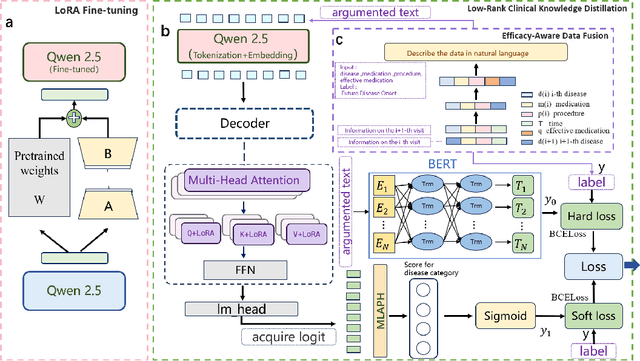
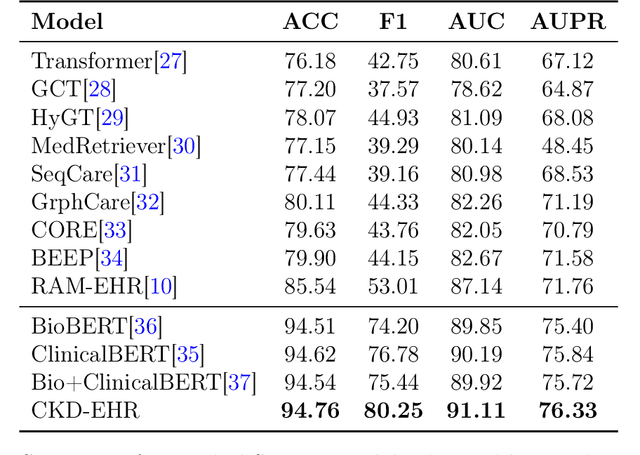

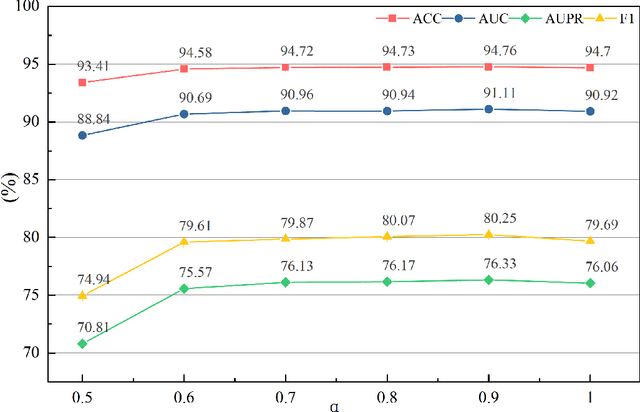
Electronic Health Records (EHR)-based disease prediction models have demonstrated significant clinical value in promoting precision medicine and enabling early intervention. However, existing large language models face two major challenges: insufficient representation of medical knowledge and low efficiency in clinical deployment. To address these challenges, this study proposes the CKD-EHR (Clinical Knowledge Distillation for EHR) framework, which achieves efficient and accurate disease risk prediction through knowledge distillation techniques. Specifically, the large language model Qwen2.5-7B is first fine-tuned on medical knowledge-enhanced data to serve as the teacher model.It then generates interpretable soft labels through a multi-granularity attention distillation mechanism. Finally, the distilled knowledge is transferred to a lightweight BERT student model. Experimental results show that on the MIMIC-III dataset, CKD-EHR significantly outperforms the baseline model:diagnostic accuracy is increased by 9%, F1-score is improved by 27%, and a 22.2 times inference speedup is achieved. This innovative solution not only greatly improves resource utilization efficiency but also significantly enhances the accuracy and timeliness of diagnosis, providing a practical technical approach for resource optimization in clinical settings. The code and data for this research are available athttps://github.com/209506702/CKD_EHR.
Limited-Angle CBCT Reconstruction via Geometry-Integrated Cycle-domain Denoising Diffusion Probabilistic Models
Jun 16, 2025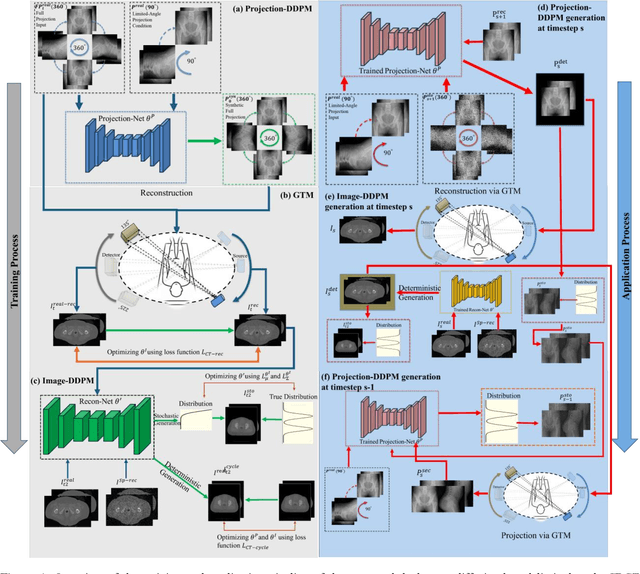
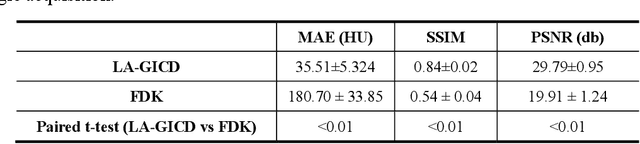
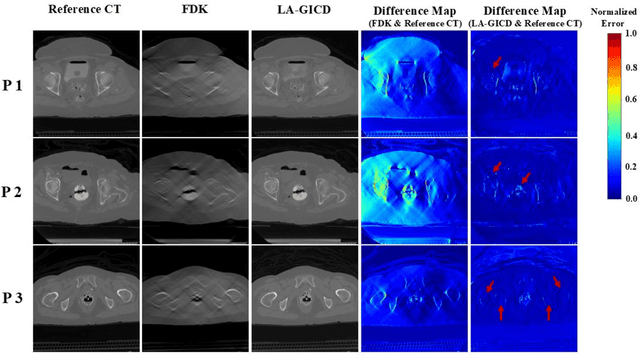
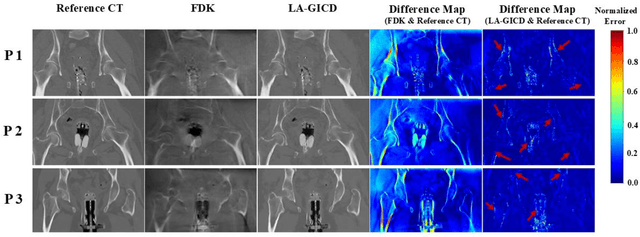
Cone-beam CT (CBCT) is widely used in clinical radiotherapy for image-guided treatment, improving setup accuracy, adaptive planning, and motion management. However, slow gantry rotation limits performance by introducing motion artifacts, blurring, and increased dose. This work aims to develop a clinically feasible method for reconstructing high-quality CBCT volumes from consecutive limited-angle acquisitions, addressing imaging challenges in time- or dose-constrained settings. We propose a limited-angle (LA) geometry-integrated cycle-domain (LA-GICD) framework for CBCT reconstruction, comprising two denoising diffusion probabilistic models (DDPMs) connected via analytic cone-beam forward and back projectors. A Projection-DDPM completes missing projections, followed by back-projection, and an Image-DDPM refines the volume. This dual-domain design leverages complementary priors from projection and image spaces to achieve high-quality reconstructions from limited-angle (<= 90 degrees) scans. Performance was evaluated against full-angle reconstruction. Four board-certified medical physicists conducted assessments. A total of 78 planning CTs in common CBCT geometries were used for training and evaluation. The method achieved a mean absolute error of 35.5 HU, SSIM of 0.84, and PSNR of 29.8 dB, with visibly reduced artifacts and improved soft-tissue clarity. LA-GICD's geometry-aware dual-domain learning, embedded in analytic forward/backward operators, enabled artifact-free, high-contrast reconstructions from a single 90-degree scan, reducing acquisition time and dose four-fold. LA-GICD improves limited-angle CBCT reconstruction with strong data fidelity and anatomical realism. It offers a practical solution for short-arc acquisitions, enhancing CBCT use in radiotherapy by providing clinically applicable images with reduced scan time and dose for more accurate, personalized treatments.