 Add to Chrome
 Add to Firefox
 Add to Edge
DeepVoyager-VL: Incentivizing Vision-in-the-Loop Search for Long-Horizon Multimodal Agents
Aug 03, 2026
Multimodal large language models (MLLMs) have advanced visual understanding and reasoning, yet their static parametric knowledge limits their ability to address knowledge-intensive and dynamically evolving open-world problems. To move beyond this limitation, multimodal deep search has emerged as a key direction for open-world information access, evolving from single-turn factual retrieval toward long-horizon, multi-turn search guided by visual evidence. However, existing methods typically confine vision to the input or answer stage, overlooking its role in intermediate reasoning, and lack designs tailored to long-horizon interaction. Consequently, visual evidence rarely drives continued retrieval, constraining both interaction depth and reasoning span. To address these limitations, we propose DeepVoyager-VL, a long-horizon multimodal deep-search framework for vision-in-the-loop search. Specifically, we construct a multimodal event graph to drive data synthesis, yielding problems with intermediate visual dependencies and long reasoning chains. We then design an agent framework for active visual acquisition and on-demand image loading. Finally, we fine-tune models on the synthesized data without reinforcement learning. Extensive experiments across ten multimodal search benchmarks demonstrate the effectiveness of our method.

REGEN: Replay-recycling for Expert-to-Generalist distillation with Offline Reinforcement Learning
Jul 21, 2026Large-scale online reinforcement learning (RL) is the predominant means of eliciting advanced abilities including long-term reasoning and agentic tool use in large language models (LLMs). However, continuing to scale it across vast task domains of interest remains challenging in both computational infrastructure and cost, especially when considering RL as merely a one-off learning stage. Recently, a widely used technique for distilling knowledge across various domains and training stages, multi-teacher on-policy distillation (MOPD), helps to decouple the RL stage, saving costs, while maintaining generality across vast domains. Nonetheless, similar to online RL, MOPD requires coupled inference and backward passes, which continues to limit its scalability and computational efficiency. To address these challenges, we propose REGEN: Replay-recycling for Expert-to-Generalist Distillation with Offline RL. Instead of distilling from multiple teacher models, REGEN trains a generalist by simply recycling the replay memory -- the free by-product of the teachers' specialized RL training -- and employing offline RL algorithms. REGEN completely decouples the rollout sampling from the backward training process and thus greatly reduces the training cost. Across mathematical reasoning, code generation, and instruction following, REGEN matches the accuracy of MOPD at substantially lower cost. It potentially turns online RL into a data synthesis process instead of a one-off learning stage, and can potentially be extended to large-scale post-training without requiring heavy computational load.
TRCGL-Net: A Long-Tailed Multi-Label Chest X-Ray Classification Framework with Generative Data Augmentation and Label Co-Occurrence Modeling
Jul 01, 2026Chest X-ray multi-label classification is a core task in intelligent medical imaging diagnosis. However, real clinical data often exhibit extreme long-tailed distributions, leading to degraded performance on rare diseases in tail classes. This issue is not only driven by data scarcity but also by two intrinsic factors:1) attenuation of tail-class lesion representations under complex anatomical backgrounds, and 2) dominance of head classes in modeling label co-occurrence relationships. To address these challenges, we propose TRCGL-Net. First, a learnable text-guided conditional diffusion model is employed to generate high-quality tail-class chest X-ray image samples under disease semantic constraints, improving data diversity and realism of rare disease patterns while alleviating class imbalance and preserving pathology-consistent semantics.Second, a channel reweighting mechanism is introduced to perform feature recalibration by emphasizing disease-relevant feature channels, thereby improving feature discriminability under long-tailed distributions.A class-aware attention mechanism is further applied to generate class-specific attention maps, enabling the model to localize disease-relevant regions and focus on fine-grained lesion areas.Finally, a graph convolution network based on label co occurrence is introduced to establish an information propagation mechanism among categories. Experiments on the PadChest dataset show that the proposed method achieves a tail-class mAP of 0.4904, an overall mAP of 0.4408, and an mAUC of 0.8989, outperforming state-of-the-art methods. TRCGL-Net effectively improves recognition performance for rare diseases under long-tailed distributions and mitigates the impact of extreme class imbalance in chest X-ray multi-label classification.
FeLoG: Scalable and Efficient Distributed Graph Embedding with Feedback Loop Mechanism
Jun 20, 2026Graph embedding maps graph nodes into low-dimensional vectors to support applications such as recommendation, fraud detection, and graph-based retrieval-augmented generation (GraphRAG). As graphs scale to billions of edges, scalable and efficient graph embedding has become increasingly important. Existing frameworks commonly adopt a sampling-training paradigm, in which mini-batches are constructed by sampling nodes and their neighbors. However, sampling is typically decoupled from evolving embedding quality, causing redundant exploration of well-trained regions while under-sampling undertrained nodes. At the system level, such decoupling further leads to excessive communication, serialized execution, and low resource utilization in distributed environments. We present FeLoG, a feedback loop-driven system for scalable distributed graph embedding. (1) FeLoG introduces feedback-coupled sampling and training, dynamically prioritizing undertrained nodes according to real-time embedding-quality feedback, thereby reducing redundant computation and accelerating convergence. (2) It employs activity-aware communication that compresses frequently occurring node sequences to reduce intra-machine PCIe traffic and selectively synchronizes frequently updated embeddings to reduce inter-machine communication. (3) It adopts a round-interleaved pipeline that overlaps next-round sampling with current-round training to improve CPU-GPU utilization. Experiments against six state-of-the-art baselines on large-scale graphs show that FeLoG achieves an average speedup of 27.9x, reduces communication cost by more than 53.1%, and sustains over 80% CPU-GPU utilization.
Graph Grounded Cross Attention Transformer Neural Network for Structurally Constrained Full Event Sequence Generation in Predictive Process Monitoring
Jun 17, 2026Structurally constrained event sequence generation remains challenging because generated paths must preserve transition feasibility, temporal order, termination, and attribute consistency. In predictive process monitoring (PPM), this challenge appears as full event sequence generation, whereas existing work mainly addresses component tasks such as next activity, remaining time, outcome, and attribute prediction. This paper proposes the Graph Grounded Cross Attention Transformer Neural Network (GGATN) for this unified PPM task. GGATN uses a global process graph as structured activity memory, contextualizes sequence positions through Transformer self attention, and injects process topology through graph grounded cross attention. Unlike autoregressive decoding, GGATN generates activities, timestamps, length, and event level and sequence level attributes in a single pass, followed by Viterbi style graph constrained decoding for feasible paths and explicit termination. Experiments on six benchmark event logs show more reliable generation quality than local instruction prompted LLM baselines. GGATN achieves strong performance on sequence similarity, Damerau Levenshtein similarity, bigram based control flow similarity, and duration distribution, while maintaining zero hallucinated activities and zero sequence level attribute inconsistency. Ablation analyses confirm the global graph encoder as a stable structural prior. Interpretability analyses show how graph structure, sequence context, feedback refinement, and constrained decoding shape generation.
EndPrompt: Efficient Long-Context Extension via Terminal Anchoring
May 14, 2026Extending the context window of large language models typically requires training on sequences at the target length, incurring quadratic memory and computational costs that make long-context adaptation expensive and difficult to reproduce. We propose EndPrompt, a method that achieves effective context extension using only short training sequences. The core insight is that exposing a model to long-range relative positional distances does not require constructing full-length inputs: we preserve the original short context as an intact first segment and append a brief terminal prompt as a second segment, assigning it positional indices near the target context length. This two-segment construction introduces both local and long-range relative distances within a short physical sequence while maintaining the semantic continuity of the training text--a property absent in chunk-based simulation approaches that split contiguous context. We provide a theoretical analysis grounded in Rotary Position Embedding and the Bernstein inequality, showing that position interpolation induces a rigorous smoothness constraint over the attention function, with shared Transformer parameters further suppressing unstable extrapolation to unobserved intermediate distances. Applied to LLaMA-family models extending the context window from 8K to 64K, EndPrompt achieves an average RULER score of 76.03 and the highest average on LongBench, surpassing LCEG (72.24), LongLoRA (72.95), and full-length fine-tuning (69.23) while requiring substantially less computation. These results demonstrate that long-context generalization can be induced from sparse positional supervision, challenging the prevailing assumption that dense long-sequence training is necessary for reliable context-window extension. The code is available at https://github.com/clx1415926/EndPrompt.
AGCD: Agent-Guided Cross-Modal Decoding for Weather Forecasting
Mar 16, 2026Accurate weather forecasting is more than grid-wise regression: it must preserve coherent synoptic structures and physical consistency of meteorological fields, especially under autoregressive rollouts where small one-step errors can amplify into structural bias. Existing physics-priors approaches typically impose global, once-for-all constraints via architectures, regularization, or NWP coupling, offering limited state-adaptive and sample-specific controllability at deployment. To bridge this gap, we propose Agent-Guided Cross-modal Decoding (AGCD), a plug-and-play decoding-time prior-injection paradigm that derives state-conditioned physics-priors from the current multivariate atmosphere and injects them into forecasters in a controllable and reusable way. Specifically, We design a multi-agent meteorological narration pipeline to generate state-conditioned physics-priors, utilizing MLLMs to extract various meteorological elements effectively. To effectively apply the priors, AGCD further introduce cross-modal region interaction decoding that performs region-aware multi-scale tokenization and efficient physics-priors injection to refine visual features without changing the backbone interface. Experiments on WeatherBench demonstrate consistent gains for 6-hour forecasting across two resolutions (5.625 degree and 1.40625 degree) and diverse backbones (generic and weather-specialized), including strictly causal 48-hour autoregressive rollouts that reduce early-stage error accumulation and improve long-horizon stability.
Boosting Instance Awareness via Cross-View Correlation with 4D Radar and Camera for 3D Object Detection
Feb 24, 20264D millimeter-wave radar has emerged as a promising sensing modality for autonomous driving due to its robustness and affordability. However, its sparse and weak geometric cues make reliable instance activation difficult, limiting the effectiveness of existing radar-camera fusion paradigms. BEV-level fusion offers global scene understanding but suffers from weak instance focus, while perspective-level fusion captures instance details but lacks holistic context. To address these limitations, we propose SIFormer, a scene-instance aware transformer for 3D object detection using 4D radar and camera. SIFormer first suppresses background noise during view transformation through segmentation- and depth-guided localization. It then introduces a cross-view activation mechanism that injects 2D instance cues into BEV space, enabling reliable instance awareness under weak radar geometry. Finally, a transformer-based fusion module aggregates complementary image semantics and radar geometry for robust perception. As a result, with the aim of enhancing instance awareness, SIFormer bridges the gap between the two paradigms, combining their complementary strengths to address inherent sparse nature of radar and improve detection accuracy. Experiments demonstrate that SIFormer achieves state-of-the-art performance on View-of-Delft, TJ4DRadSet and NuScenes datasets. Source code is available at github.com/shawnnnkb/SIFormer.
Logic-Guided Multistage Inference for Explainable Multidefendant Judgment Prediction
Jan 19, 2026Crime disrupts societal stability, making law essential for balance. In multidefendant cases, assigning responsibility is complex and challenges fairness, requiring precise role differentiation. However, judicial phrasing often obscures the roles of the defendants, hindering effective AI-driven analyses. To address this issue, we incorporate sentencing logic into a pretrained Transformer encoder framework to enhance the intelligent assistance in multidefendant cases while ensuring legal interpretability. Within this framework an oriented masking mechanism clarifies roles and a comparative data construction strategy improves the model's sensitivity to culpability distinctions between principals and accomplices. Predicted guilt labels are further incorporated into a regression model through broadcasting, consolidating crime descriptions and court views. Our proposed masked multistage inference (MMSI) framework, evaluated on the custom IMLJP dataset for intentional injury cases, achieves significant accuracy improvements, outperforming baselines in role-based culpability differentiation. This work offers a robust solution for enhancing intelligent judicial systems, with publicly code available.
E-ConvNeXt: A Lightweight and Efficient ConvNeXt Variant with Cross-Stage Partial Connections
Aug 28, 2025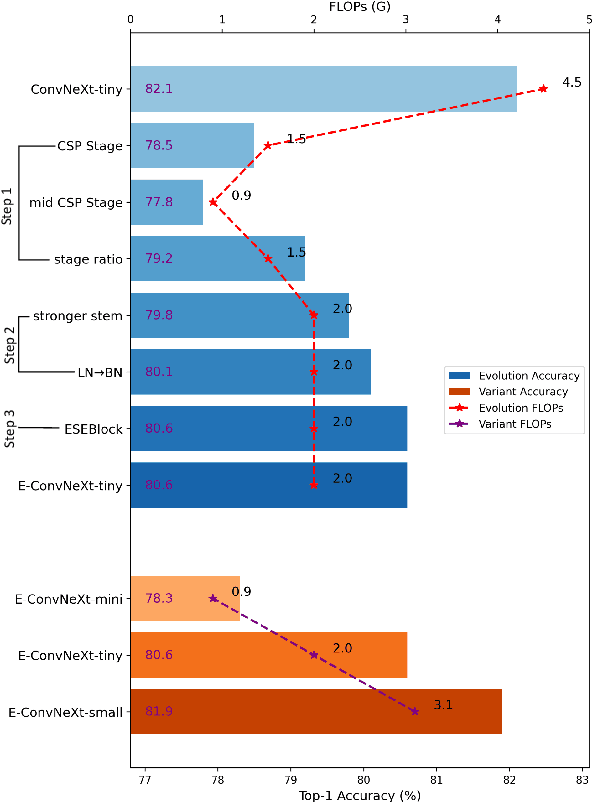
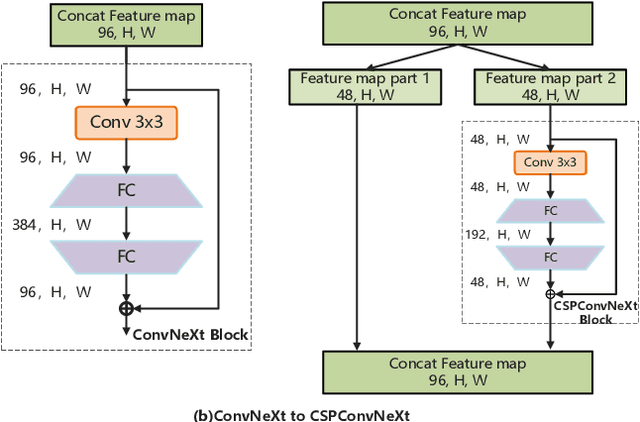
Many high-performance networks were not designed with lightweight application scenarios in mind from the outset, which has greatly restricted their scope of application. This paper takes ConvNeXt as the research object and significantly reduces the parameter scale and network complexity of ConvNeXt by integrating the Cross Stage Partial Connections mechanism and a series of optimized designs. The new network is named E-ConvNeXt, which can maintain high accuracy performance under different complexity configurations. The three core innovations of E-ConvNeXt are : (1) integrating the Cross Stage Partial Network (CSPNet) with ConvNeXt and adjusting the network structure, which reduces the model's network complexity by up to 80%; (2) Optimizing the Stem and Block structures to enhance the model's feature expression capability and operational efficiency; (3) Replacing Layer Scale with channel attention. Experimental validation on ImageNet classification demonstrates E-ConvNeXt's superior accuracy-efficiency balance: E-ConvNeXt-mini reaches 78.3% Top-1 accuracy at 0.9GFLOPs. E-ConvNeXt-small reaches 81.9% Top-1 accuracy at 3.1GFLOPs. Transfer learning tests on object detection tasks further confirm its generalization capability.