 Add to Chrome
 Add to Firefox
 Add to Edge
TRCGL-Net: A Long-Tailed Multi-Label Chest X-Ray Classification Framework with Generative Data Augmentation and Label Co-Occurrence Modeling
Jul 01, 2026
Chest X-ray multi-label classification is a core task in intelligent medical imaging diagnosis. However, real clinical data often exhibit extreme long-tailed distributions, leading to degraded performance on rare diseases in tail classes. This issue is not only driven by data scarcity but also by two intrinsic factors:1) attenuation of tail-class lesion representations under complex anatomical backgrounds, and 2) dominance of head classes in modeling label co-occurrence relationships. To address these challenges, we propose TRCGL-Net. First, a learnable text-guided conditional diffusion model is employed to generate high-quality tail-class chest X-ray image samples under disease semantic constraints, improving data diversity and realism of rare disease patterns while alleviating class imbalance and preserving pathology-consistent semantics.Second, a channel reweighting mechanism is introduced to perform feature recalibration by emphasizing disease-relevant feature channels, thereby improving feature discriminability under long-tailed distributions.A class-aware attention mechanism is further applied to generate class-specific attention maps, enabling the model to localize disease-relevant regions and focus on fine-grained lesion areas.Finally, a graph convolution network based on label co occurrence is introduced to establish an information propagation mechanism among categories. Experiments on the PadChest dataset show that the proposed method achieves a tail-class mAP of 0.4904, an overall mAP of 0.4408, and an mAUC of 0.8989, outperforming state-of-the-art methods. TRCGL-Net effectively improves recognition performance for rare diseases under long-tailed distributions and mitigates the impact of extreme class imbalance in chest X-ray multi-label classification.

CKD-EHR:Clinical Knowledge Distillation for Electronic Health Records
Jun 18, 2025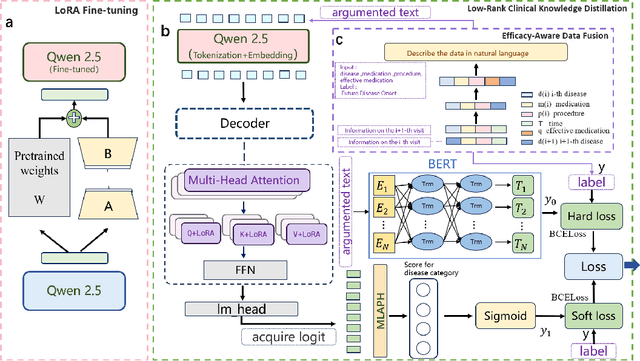
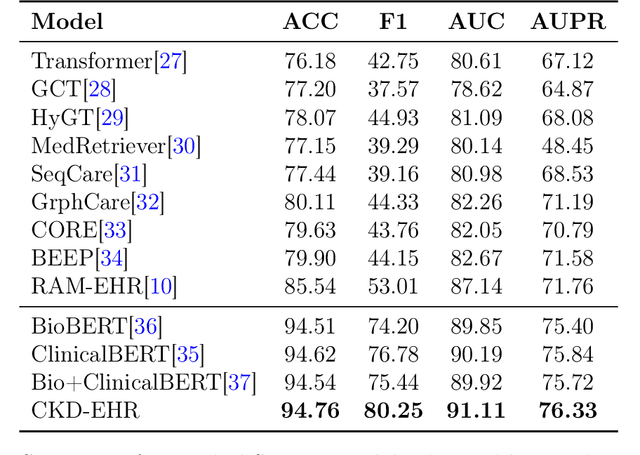

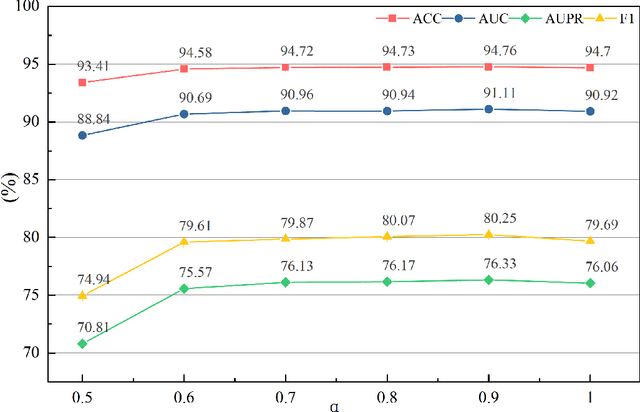
Electronic Health Records (EHR)-based disease prediction models have demonstrated significant clinical value in promoting precision medicine and enabling early intervention. However, existing large language models face two major challenges: insufficient representation of medical knowledge and low efficiency in clinical deployment. To address these challenges, this study proposes the CKD-EHR (Clinical Knowledge Distillation for EHR) framework, which achieves efficient and accurate disease risk prediction through knowledge distillation techniques. Specifically, the large language model Qwen2.5-7B is first fine-tuned on medical knowledge-enhanced data to serve as the teacher model.It then generates interpretable soft labels through a multi-granularity attention distillation mechanism. Finally, the distilled knowledge is transferred to a lightweight BERT student model. Experimental results show that on the MIMIC-III dataset, CKD-EHR significantly outperforms the baseline model:diagnostic accuracy is increased by 9%, F1-score is improved by 27%, and a 22.2 times inference speedup is achieved. This innovative solution not only greatly improves resource utilization efficiency but also significantly enhances the accuracy and timeliness of diagnosis, providing a practical technical approach for resource optimization in clinical settings. The code and data for this research are available athttps://github.com/209506702/CKD_EHR.