 Add to Chrome
 Add to Firefox
 Add to Edge
Sci-VBench: Evaluating Knowledge- and Reasoning-Intensive Video Generation in Science Domains
Aug 10, 2026
We introduce Sci-VBench, a comprehensive benchmark for evaluating knowledge- and reasoning-intensive video generation across scientific domains. It contains 1,253 expert-annotated examples spanning 60 subjects across four core disciplines: Natural Science, Healthcare, Humanities & Social Sciences, and Engineering. Each example requires models to generate temporally rich videos that demand scientific reasoning and knowledge-grounded synthesis, going beyond surface-level visual plausibility. We further establish a rubric-based evaluation protocol. Our analysis shows that, under this protocol, both non-expert human evaluators and MLLM-as-Judge systems can achieve relatively high agreement with expert judgments, supporting reproducible evaluation at scale. We benchmark 16 frontier proprietary and open-source models and find that, while automatic perceptual-quality scores cluster tightly across systems, performance on Prompt Grounding and Scientific and Causal Correctness varies substantially, with a pronounced proprietary-open-source gap. These findings show that advances in visual realism have not yet translated into reliable modeling of scientific and causal dynamics.

UEmbed: Unified Sparse and Dense Multimodal Embeddings
Aug 03, 2026Sparse retrieval underpins modern search systems, from web search to retrieval-augmented generation. Existing work has introduced Learned Sparse Retrieval (LSR) to push beyond exact lexical matching toward richer semantics. Yet LSR has so far remained tied to encoder-style bidirectional architectures, and its extension to multimodal settings still relies heavily on auxiliary cross-modal modules. To address these limitations, we introduce UEmbed (Unified Embedding), a decoder-only multimodal embedding model that produces both sparse lexical and dense representations in one causal forward pass. UEmbed appends N learnable special tokens to the input and partitions the vocabulary into N disjoint subsets. Each token's causal hidden state predicts sparse weights over its assigned subset, and the N subsets are concatenated into the full sparse vector. Trained on public data, we release UEmbed at 2B, 4B, and 9B scales. UEmbed-9B reaches 71.8 (dense) and 71.0 (sparse) on MMEB-v2, outperforming multimodal embedding models trained on publicly available data (e.g., RzenEmbed). On BEIR, UEmbed also remains competitive with strong dense and sparse baselines. Furthermore, we demonstrate the practical utility of UEmbed across three dimensions: effectiveness, efficiency, and agentic applications. Overall, UEmbed offers a new paradigm: it unifies dense and sparse embeddings in one model, while further extending sparse retrieval to unify text and multimodal inputs.
GUI vs. CLI: Execution Bottlenecks in Screen-Only and Skill-Mediated Computer-Use Agents
Jun 22, 2026Computer-use agents can execute software tasks through either graphical interfaces or programmatic command interfaces, but existing evaluations confound interaction modality with differences in tasks, initial states, verifiers, and permitted actions. We introduce a matched execution-layer benchmark of 440 desktop tasks across 18 applications and 12 workflow categories, where screen-only GUI agents and skill-mediated CLI agents receive identical goals, states, and final-state verifiers while being restricted to modality-native actions. In this controlled setting, the strongest GUI agent reaches a 59.1% full pass rate, outperforming the strongest original-skill CLI agent at 48.2%; however, verifier-guided skill augmentation raises CLI success to 69.3%, showing that much of the CLI deficit comes from incomplete skill coverage rather than model capability alone. These results suggest that GUI and CLI expose different execution bottlenecks: GUI agents are limited by reliable grounded interaction over long-horizon workflows, whereas CLI agents are limited by the coverage and scalability of their skill interfaces.
VideoKR: Towards Knowledge- and Reasoning-Intensive Video Understanding
Jun 03, 2026We introduce VideoKR, the first large-scale training corpus specifically designed to strengthen knowledge- and reasoning-intensive video understanding. It comprises 315K video reasoning examples over 145K newly collected, CC-licensed, expert-domain videos. We develop a human-in-the-loop, skill-oriented example generation pipeline that targets progressively deeper video reasoning capabilities while ensuring the difficulty, diversity, and reliability of both the examples and their CoT rationales. We also curate VideoKR-Eval, a new expert-annotated benchmark where questions require genuine video understanding and knowledge-intensive reasoning rather than textual shortcuts. Our experiments show that, under a standard SFT$\rightarrow$GRPO pipeline, models post-trained on VideoKR outperform prior post-training approaches on knowledge-intensive video reasoning while remaining competitive on general video reasoning, highlighting data design as a key driver of progress in video reasoning. We further conduct comprehensive ablations to isolate the contributions of VideoKR, providing actionable insights for future work.
Rethinking Reasoning-Intensive Retrieval: Evaluating and Advancing Retrievers in Agentic Search Systems
May 05, 2026Reasoning-intensive retrieval aims to surface evidence that supports downstream reasoning rather than merely matching topical similarity. This capability is increasingly important for agentic search systems, where retrievers must provide complementary evidence across iterative search and synthesis. However, existing work remains limited on both evaluation and training: benchmarks such as BRIGHT provide narrow gold sets and evaluate retrievers in isolation, while synthetic training corpora often optimize single-passage relevance rather than evidence portfolio construction. We introduce BRIGHT-Pro, an expert-annotated benchmark that expands each query with multi-aspect gold evidence and evaluates retrievers under both static and agentic search protocols. We further construct RTriever-Synth, an aspect-decomposed synthetic corpus that generates complementary positives and positive-conditioned hard negatives, and use it to LoRA fine-tune RTriever-4B from Qwen3-Embedding-4B. Experiments across lexical, general-purpose, and reasoning-intensive retrievers show that aspect-aware and agentic evaluation expose behaviors hidden by standard metrics, while RTriever-4B substantially improves over its base model.
Rethinking Composed Image Retrieval Evaluation: A Fine-Grained Benchmark from Image Editing
Jan 22, 2026Composed Image Retrieval (CIR) is a pivotal and complex task in multimodal understanding. Current CIR benchmarks typically feature limited query categories and fail to capture the diverse requirements of real-world scenarios. To bridge this evaluation gap, we leverage image editing to achieve precise control over modification types and content, enabling a pipeline for synthesizing queries across a broad spectrum of categories. Using this pipeline, we construct EDIR, a novel fine-grained CIR benchmark. EDIR encompasses 5,000 high-quality queries structured across five main categories and fifteen subcategories. Our comprehensive evaluation of 13 multimodal embedding models reveals a significant capability gap; even state-of-the-art models (e.g., RzenEmbed and GME) struggle to perform consistently across all subcategories, highlighting the rigorous nature of our benchmark. Through comparative analysis, we further uncover inherent limitations in existing benchmarks, such as modality biases and insufficient categorical coverage. Furthermore, an in-domain training experiment demonstrates the feasibility of our benchmark. This experiment clarifies the task challenges by distinguishing between categories that are solvable with targeted data and those that expose intrinsic limitations of current model architectures.
MRMR: A Realistic and Expert-Level Multidisciplinary Benchmark for Reasoning-Intensive Multimodal Retrieval
Oct 10, 2025We introduce MRMR, the first expert-level multidisciplinary multimodal retrieval benchmark requiring intensive reasoning. MRMR contains 1,502 queries spanning 23 domains, with positive documents carefully verified by human experts. Compared to prior benchmarks, MRMR introduces three key advancements. First, it challenges retrieval systems across diverse areas of expertise, enabling fine-grained model comparison across domains. Second, queries are reasoning-intensive, with images requiring deeper interpretation such as diagnosing microscopic slides. We further introduce Contradiction Retrieval, a novel task requiring models to identify conflicting concepts. Finally, queries and documents are constructed as image-text interleaved sequences. Unlike earlier benchmarks restricted to single images or unimodal documents, MRMR offers a realistic setting with multi-image queries and mixed-modality corpus documents. We conduct an extensive evaluation of 4 categories of multimodal retrieval systems and 14 frontier models on MRMR. The text embedding model Qwen3-Embedding with LLM-generated image captions achieves the highest performance, highlighting substantial room for improving multimodal retrieval models. Although latest multimodal models such as Ops-MM-Embedding perform competitively on expert-domain queries, they fall short on reasoning-intensive tasks. We believe that MRMR paves the way for advancing multimodal retrieval in more realistic and challenging scenarios.
Efficiency-Effectiveness Reranking FLOPs for LLM-based Rerankers
Jul 08, 2025Large Language Models (LLMs) have recently been applied to reranking tasks in information retrieval, achieving strong performance. However, their high computational demands often hinder practical deployment. Existing studies evaluate the efficiency of LLM-based rerankers using proxy metrics such as latency, the number of forward passes, input tokens, and output tokens. However, these metrics depend on hardware and running-time choices (\eg parallel or not, batch size, etc), and often fail to account for model size, making it difficult to interpret and obscuring the evaluation of the efficiency-effectiveness tradeoff. To address this issue, we propose E\textsuperscript{2}R-FLOPs, for LLM-based rerankers: ranking metrics per PetaFLOP (RPP) for relevance per compute and queries per PetaFLOP (QPP) for hardware-agnostic throughput. Companied with the new metrics, an interpretable FLOPs estimator is built to estimate the FLOPs of an LLM-based reranker even without running any experiments. Based on the proposed metrics, we conduct comprehensive experiments to evaluate a wide range of LLM-based rerankers with different architecture, studying the efficiency-effectiveness trade-off and bringing this issue to the attention of the research community.
VF-Eval: Evaluating Multimodal LLMs for Generating Feedback on AIGC Videos
May 29, 2025MLLMs have been widely studied for video question answering recently. However, most existing assessments focus on natural videos, overlooking synthetic videos, such as AI-generated content (AIGC). Meanwhile, some works in video generation rely on MLLMs to evaluate the quality of generated videos, but the capabilities of MLLMs on interpreting AIGC videos remain largely underexplored. To address this, we propose a new benchmark, VF-Eval, which introduces four tasks-coherence validation, error awareness, error type detection, and reasoning evaluation-to comprehensively evaluate the abilities of MLLMs on AIGC videos. We evaluate 13 frontier MLLMs on VF-Eval and find that even the best-performing model, GPT-4.1, struggles to achieve consistently good performance across all tasks. This highlights the challenging nature of our benchmark. Additionally, to investigate the practical applications of VF-Eval in improving video generation, we conduct an experiment, RePrompt, demonstrating that aligning MLLMs more closely with human feedback can benefit video generation.
IFIR: A Comprehensive Benchmark for Evaluating Instruction-Following in Expert-Domain Information Retrieval
Mar 06, 2025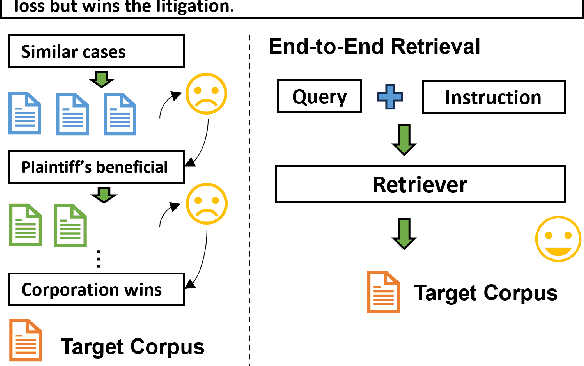
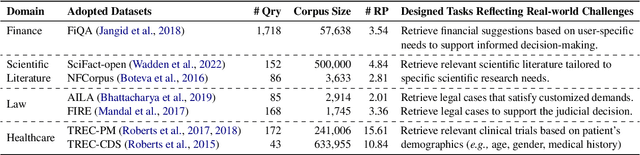
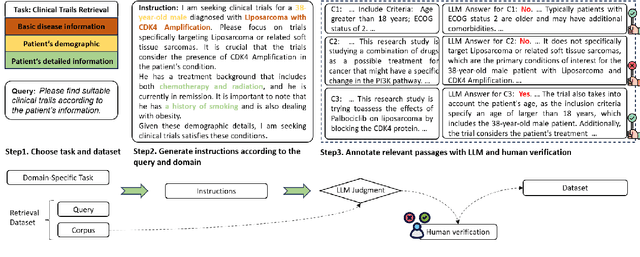

We introduce IFIR, the first comprehensive benchmark designed to evaluate instruction-following information retrieval (IR) in expert domains. IFIR includes 2,426 high-quality examples and covers eight subsets across four specialized domains: finance, law, healthcare, and science literature. Each subset addresses one or more domain-specific retrieval tasks, replicating real-world scenarios where customized instructions are critical. IFIR enables a detailed analysis of instruction-following retrieval capabilities by incorporating instructions at different levels of complexity. We also propose a novel LLM-based evaluation method to provide a more precise and reliable assessment of model performance in following instructions. Through extensive experiments on 15 frontier retrieval models, including those based on LLMs, our results reveal that current models face significant challenges in effectively following complex, domain-specific instructions. We further provide in-depth analyses to highlight these limitations, offering valuable insights to guide future advancements in retriever development.