 Add to Chrome
 Add to Firefox
 Add to Edge
ArcFlow: Unleashing 2-Step Text-to-Image Generation via High-Precision Non-Linear Flow Distillation
Feb 09, 2026
Diffusion models have achieved remarkable generation quality, but they suffer from significant inference cost due to their reliance on multiple sequential denoising steps, motivating recent efforts to distill this inference process into a few-step regime. However, existing distillation methods typically approximate the teacher trajectory by using linear shortcuts, which makes it difficult to match its constantly changing tangent directions as velocities evolve across timesteps, thereby leading to quality degradation. To address this limitation, we propose ArcFlow, a few-step distillation framework that explicitly employs non-linear flow trajectories to approximate pre-trained teacher trajectories. Concretely, ArcFlow parameterizes the velocity field underlying the inference trajectory as a mixture of continuous momentum processes. This enables ArcFlow to capture velocity evolution and extrapolate coherent velocities to form a continuous non-linear trajectory within each denoising step. Importantly, this parameterization admits an analytical integration of this non-linear trajectory, which circumvents numerical discretization errors and results in high-precision approximation of the teacher trajectory. To train this parameterization into a few-step generator, we implement ArcFlow via trajectory distillation on pre-trained teacher models using lightweight adapters. This strategy ensures fast, stable convergence while preserving generative diversity and quality. Built on large-scale models (Qwen-Image-20B and FLUX.1-dev), ArcFlow only fine-tunes on less than 5% of original parameters and achieves a 40x speedup with 2 NFEs over the original multi-step teachers without significant quality degradation. Experiments on benchmarks show the effectiveness of ArcFlow both qualitatively and quantitatively.

Efficient-LVSM: Faster, Cheaper, and Better Large View Synthesis Model via Decoupled Co-Refinement Attention
Feb 06, 2026Feedforward models for novel view synthesis (NVS) have recently advanced by transformer-based methods like LVSM, using attention among all input and target views. In this work, we argue that its full self-attention design is suboptimal, suffering from quadratic complexity with respect to the number of input views and rigid parameter sharing among heterogeneous tokens. We propose Efficient-LVSM, a dual-stream architecture that avoids these issues with a decoupled co-refinement mechanism. It applies intra-view self-attention for input views and self-then-cross attention for target views, eliminating unnecessary computation. Efficient-LVSM achieves 29.86 dB PSNR on RealEstate10K with 2 input views, surpassing LVSM by 0.2 dB, with 2x faster training convergence and 4.4x faster inference speed. Efficient-LVSM achieves state-of-the-art performance on multiple benchmarks, exhibits strong zero-shot generalization to unseen view counts, and enables incremental inference with KV-cache, thanks to its decoupled designs.
CL-bench: A Benchmark for Context Learning
Feb 03, 2026Current language models (LMs) excel at reasoning over prompts using pre-trained knowledge. However, real-world tasks are far more complex and context-dependent: models must learn from task-specific context and leverage new knowledge beyond what is learned during pre-training to reason and resolve tasks. We term this capability context learning, a crucial ability that humans naturally possess but has been largely overlooked. To this end, we introduce CL-bench, a real-world benchmark consisting of 500 complex contexts, 1,899 tasks, and 31,607 verification rubrics, all crafted by experienced domain experts. Each task is designed such that the new content required to resolve it is contained within the corresponding context. Resolving tasks in CL-bench requires models to learn from the context, ranging from new domain-specific knowledge, rule systems, and complex procedures to laws derived from empirical data, all of which are absent from pre-training. This goes far beyond long-context tasks that primarily test retrieval or reading comprehension, and in-context learning tasks, where models learn simple task patterns via instructions and demonstrations. Our evaluations of ten frontier LMs find that models solve only 17.2% of tasks on average. Even the best-performing model, GPT-5.1, solves only 23.7%, revealing that LMs have yet to achieve effective context learning, which poses a critical bottleneck for tackling real-world, complex context-dependent tasks. CL-bench represents a step towards building LMs with this fundamental capability, making them more intelligent and advancing their deployment in real-world scenarios.
Just Ask: Curious Code Agents Reveal System Prompts in Frontier LLMs
Jan 29, 2026Autonomous code agents built on large language models are reshaping software and AI development through tool use, long-horizon reasoning, and self-directed interaction. However, this autonomy introduces a previously unrecognized security risk: agentic interaction fundamentally expands the LLM attack surface, enabling systematic probing and recovery of hidden system prompts that guide model behavior. We identify system prompt extraction as an emergent vulnerability intrinsic to code agents and present \textbf{\textsc{JustAsk}}, a self-evolving framework that autonomously discovers effective extraction strategies through interaction alone. Unlike prior prompt-engineering or dataset-based attacks, \textsc{JustAsk} requires no handcrafted prompts, labeled supervision, or privileged access beyond standard user interaction. It formulates extraction as an online exploration problem, using Upper Confidence Bound-based strategy selection and a hierarchical skill space spanning atomic probes and high-level orchestration. These skills exploit imperfect system-instruction generalization and inherent tensions between helpfulness and safety. Evaluated on \textbf{41} black-box commercial models across multiple providers, \textsc{JustAsk} consistently achieves full or near-complete system prompt recovery, revealing recurring design- and architecture-level vulnerabilities. Our results expose system prompts as a critical yet largely unprotected attack surface in modern agent systems.
FRoM-W1: Towards General Humanoid Whole-Body Control with Language Instructions
Jan 19, 2026Humanoid robots are capable of performing various actions such as greeting, dancing and even backflipping. However, these motions are often hard-coded or specifically trained, which limits their versatility. In this work, we present FRoM-W1, an open-source framework designed to achieve general humanoid whole-body motion control using natural language. To universally understand natural language and generate corresponding motions, as well as enable various humanoid robots to stably execute these motions in the physical world under gravity, FRoM-W1 operates in two stages: (a) H-GPT: utilizing massive human data, a large-scale language-driven human whole-body motion generation model is trained to generate diverse natural behaviors. We further leverage the Chain-of-Thought technique to improve the model's generalization in instruction understanding. (b) H-ACT: After retargeting generated human whole-body motions into robot-specific actions, a motion controller that is pretrained and further fine-tuned through reinforcement learning in physical simulation enables humanoid robots to accurately and stably perform corresponding actions. It is then deployed on real robots via a modular simulation-to-reality module. We extensively evaluate FRoM-W1 on Unitree H1 and G1 robots. Results demonstrate superior performance on the HumanML3D-X benchmark for human whole-body motion generation, and our introduced reinforcement learning fine-tuning consistently improves both motion tracking accuracy and task success rates of these humanoid robots. We open-source the entire FRoM-W1 framework and hope it will advance the development of humanoid intelligence.
A Safety Report on GPT-5.2, Gemini 3 Pro, Qwen3-VL, Grok 4.1 Fast, Nano Banana Pro, and Seedream 4.5
Jan 16, 2026The rapid evolution of Large Language Models (LLMs) and Multimodal Large Language Models (MLLMs) has driven major gains in reasoning, perception, and generation across language and vision, yet whether these advances translate into comparable improvements in safety remains unclear, partly due to fragmented evaluations that focus on isolated modalities or threat models. In this report, we present an integrated safety evaluation of six frontier models--GPT-5.2, Gemini 3 Pro, Qwen3-VL, Grok 4.1 Fast, Nano Banana Pro, and Seedream 4.5--assessing each across language, vision-language, and image generation using a unified protocol that combines benchmark, adversarial, multilingual, and compliance evaluations. By aggregating results into safety leaderboards and model profiles, we reveal a highly uneven safety landscape: while GPT-5.2 demonstrates consistently strong and balanced performance, other models exhibit clear trade-offs across benchmark safety, adversarial robustness, multilingual generalization, and regulatory compliance. Despite strong results under standard benchmarks, all models remain highly vulnerable under adversarial testing, with worst-case safety rates dropping below 6%. Text-to-image models show slightly stronger alignment in regulated visual risk categories, yet remain fragile when faced with adversarial or semantically ambiguous prompts. Overall, these findings highlight that safety in frontier models is inherently multidimensional--shaped by modality, language, and evaluation design--underscoring the need for standardized, holistic safety assessments to better reflect real-world risk and guide responsible deployment.
What Do LLM Agents Know About Their World? Task2Quiz: A Paradigm for Studying Environment Understanding
Jan 14, 2026Large language model (LLM) agents have demonstrated remarkable capabilities in complex decision-making and tool-use tasks, yet their ability to generalize across varying environments remains a under-examined concern. Current evaluation paradigms predominantly rely on trajectory-based metrics that measure task success, while failing to assess whether agents possess a grounded, transferable model of the environment. To address this gap, we propose Task-to-Quiz (T2Q), a deterministic and automated evaluation paradigm designed to decouple task execution from world-state understanding. We instantiate this paradigm in T2QBench, a suite comprising 30 environments and 1,967 grounded QA pairs across multiple difficulty levels. Our extensive experiments reveal that task success is often a poor proxy for environment understanding, and that current memory machanism can not effectively help agents acquire a grounded model of the environment. These findings identify proactive exploration and fine-grained state representation as primary bottlenecks, offering a robust foundation for developing more generalizable autonomous agents.
Thinking with Deltas: Incentivizing Reinforcement Learning via Differential Visual Reasoning Policy
Jan 11, 2026Reinforcement Learning with Verifiable Rewards (RLVR) has significantly advanced reasoning capabilities in Large Language Models. However, adapting RLVR to multimodal domains suffers from a critical \textit{perception-reasoning decoupling}. Existing paradigms, driven by text-centric outcome rewards, reasoning in language medium, inadvertently encourage models to bypass visual perception. We empirically validate this through blind experiments: state-of-the-art policies maintain or surprisingly improve performance even when visual inputs are entirely removed. This reveals that these models degenerate into \textit{blind reasoners}, exploiting linguistic priors to generate plausible answers instead of attending to visual evidence. In response, we propose \textbf{Thinking with Deltas}, a framework driven by a \textbf{Differential Visual Reasoning Policy (DVRP)}. DVRP introduces intrinsic supervision via visual triplets, comprising original, masked, and perturbed inputs. It optimizes the model to maximize reasoning divergence from masked inputs (enforcing \textit{visual sensitivity}) while minimizing divergence from perturbed inputs (ensuring \textit{visual robustness}). By aligning reasoning variations strictly with the \textit{Delta} of visual information, DVRP inherently bolsters visual understanding capabilities and significantly outperforms state-of-the-art methods on both general and medical benchmarks, without requiring external annotations or auxiliary tools.
UniRec-0.1B: Unified Text and Formula Recognition with 0.1B Parameters
Dec 24, 2025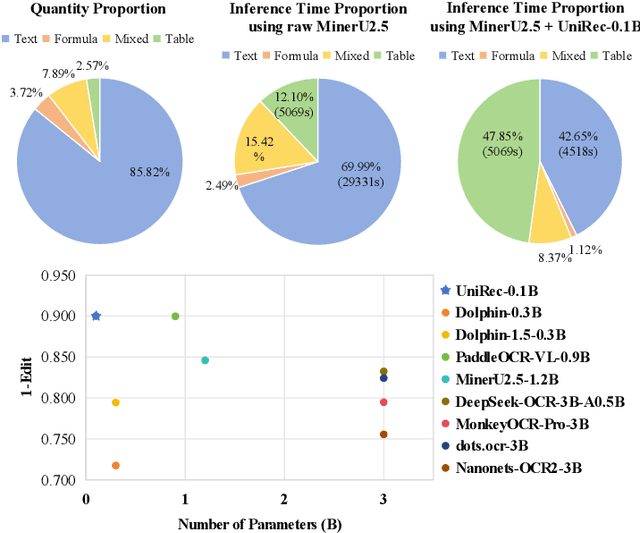

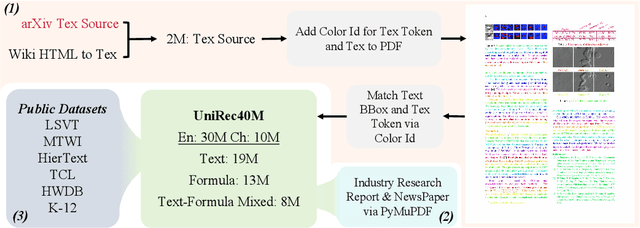
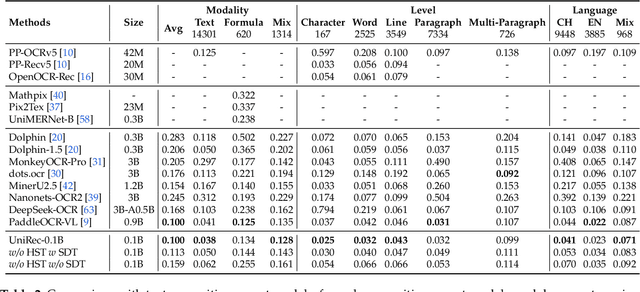
Text and formulas constitute the core informational components of many documents. Accurately and efficiently recognizing both is crucial for developing robust and generalizable document parsing systems. Recently, vision-language models (VLMs) have achieved impressive unified recognition of text and formulas. However, they are large-sized and computationally demanding, restricting their usage in many applications. In this paper, we propose UniRec-0.1B, a unified recognition model with only 0.1B parameters. It is capable of performing text and formula recognition at multiple levels, including characters, words, lines, paragraphs, and documents. To implement this task, we first establish UniRec40M, a large-scale dataset comprises 40 million text, formula and their mix samples, enabling the training of a powerful yet lightweight model. Secondly, we identify two challenges when building such a lightweight but unified expert model. They are: structural variability across hierarchies and semantic entanglement between textual and formulaic content. To tackle these, we introduce a hierarchical supervision training that explicitly guides structural comprehension, and a semantic-decoupled tokenizer that separates text and formula representations. Finally, we develop a comprehensive evaluation benchmark covering Chinese and English documents from multiple domains and with multiple levels. Experimental results on this and public benchmarks demonstrate that UniRec-0.1B outperforms both general-purpose VLMs and leading document parsing expert models, while achieving a 2-9$\times$ speedup, validating its effectiveness and efficiency. Codebase and Dataset: https://github.com/Topdu/OpenOCR.
Memory in the Age of AI Agents
Dec 15, 2025Memory has emerged, and will continue to remain, a core capability of foundation model-based agents. As research on agent memory rapidly expands and attracts unprecedented attention, the field has also become increasingly fragmented. Existing works that fall under the umbrella of agent memory often differ substantially in their motivations, implementations, and evaluation protocols, while the proliferation of loosely defined memory terminologies has further obscured conceptual clarity. Traditional taxonomies such as long/short-term memory have proven insufficient to capture the diversity of contemporary agent memory systems. This work aims to provide an up-to-date landscape of current agent memory research. We begin by clearly delineating the scope of agent memory and distinguishing it from related concepts such as LLM memory, retrieval augmented generation (RAG), and context engineering. We then examine agent memory through the unified lenses of forms, functions, and dynamics. From the perspective of forms, we identify three dominant realizations of agent memory, namely token-level, parametric, and latent memory. From the perspective of functions, we propose a finer-grained taxonomy that distinguishes factual, experiential, and working memory. From the perspective of dynamics, we analyze how memory is formed, evolved, and retrieved over time. To support practical development, we compile a comprehensive summary of memory benchmarks and open-source frameworks. Beyond consolidation, we articulate a forward-looking perspective on emerging research frontiers, including memory automation, reinforcement learning integration, multimodal memory, multi-agent memory, and trustworthiness issues. We hope this survey serves not only as a reference for existing work, but also as a conceptual foundation for rethinking memory as a first-class primitive in the design of future agentic intelligence.