 Add to Chrome
 Add to Firefox
 Add to Edge
EntangleCodec: A Unified Discrete Audio Tokenizer via Semantic-Acoustic Entanglement
Jun 01, 2026
Audio tokenizers serve as the discrete interface between continuous audio and Audio Language Models (ALMs), but existing tokenizers often struggle to support both understanding and generation. Reconstruction-oriented codecs preserve acoustic fidelity but lack rich semantics, while semantic-aware tokenizers typically rely on separate semantic and acoustic streams, introducing redundancy or misalignment. We propose \textbf{EntangleCodec}, a unified discrete audio tokenizer that learns caption-aligned semantic-acoustic representations before quantization. By aligning audio with rich captions rather than ASR transcripts, EntangleCodec captures linguistic content, speaker identity, emotion, prosody, and acoustic scenes within a compact token stream. A flow-matching diffusion decoder further enables high-quality reconstruction across speech, music, and general audio. EntangleCodec achieves reconstruction quality competitive with specialized codecs, outperforms all codec-based baselines on audio understanding by up to \textbf{+7.4\%} on MMAR, and supports both TTS and TTA generation in a unified framework. Furthermore, EntangleCodec-based audio language models demonstrate strong scaling behavior: even at \textit{0.6B} parameters, the model surpasses specialized continuous-representation LLMs with over \textit{13B} parameters across three benchmarks using \textbf{22$\times$} fewer parameters; scaling to \textit{8B} further establishes new state-of-the-art results on MMAR, highlighting that representation quality is as critical as model scale in audio language modeling. Code and model weights are available at https://github.com/luckyerr/EntangleCodec.

FRoM-W1: Towards General Humanoid Whole-Body Control with Language Instructions
Jan 19, 2026Humanoid robots are capable of performing various actions such as greeting, dancing and even backflipping. However, these motions are often hard-coded or specifically trained, which limits their versatility. In this work, we present FRoM-W1, an open-source framework designed to achieve general humanoid whole-body motion control using natural language. To universally understand natural language and generate corresponding motions, as well as enable various humanoid robots to stably execute these motions in the physical world under gravity, FRoM-W1 operates in two stages: (a) H-GPT: utilizing massive human data, a large-scale language-driven human whole-body motion generation model is trained to generate diverse natural behaviors. We further leverage the Chain-of-Thought technique to improve the model's generalization in instruction understanding. (b) H-ACT: After retargeting generated human whole-body motions into robot-specific actions, a motion controller that is pretrained and further fine-tuned through reinforcement learning in physical simulation enables humanoid robots to accurately and stably perform corresponding actions. It is then deployed on real robots via a modular simulation-to-reality module. We extensively evaluate FRoM-W1 on Unitree H1 and G1 robots. Results demonstrate superior performance on the HumanML3D-X benchmark for human whole-body motion generation, and our introduced reinforcement learning fine-tuning consistently improves both motion tracking accuracy and task success rates of these humanoid robots. We open-source the entire FRoM-W1 framework and hope it will advance the development of humanoid intelligence.
Speech-Language Models with Decoupled Tokenizers and Multi-Token Prediction
Jun 14, 2025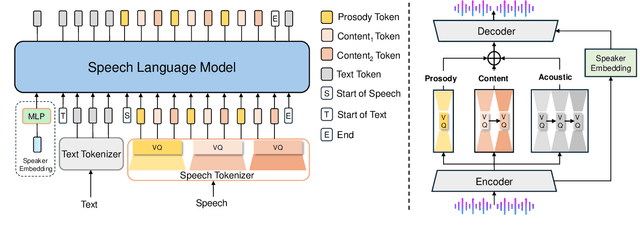
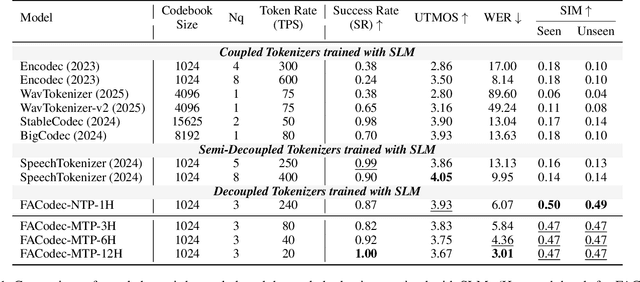
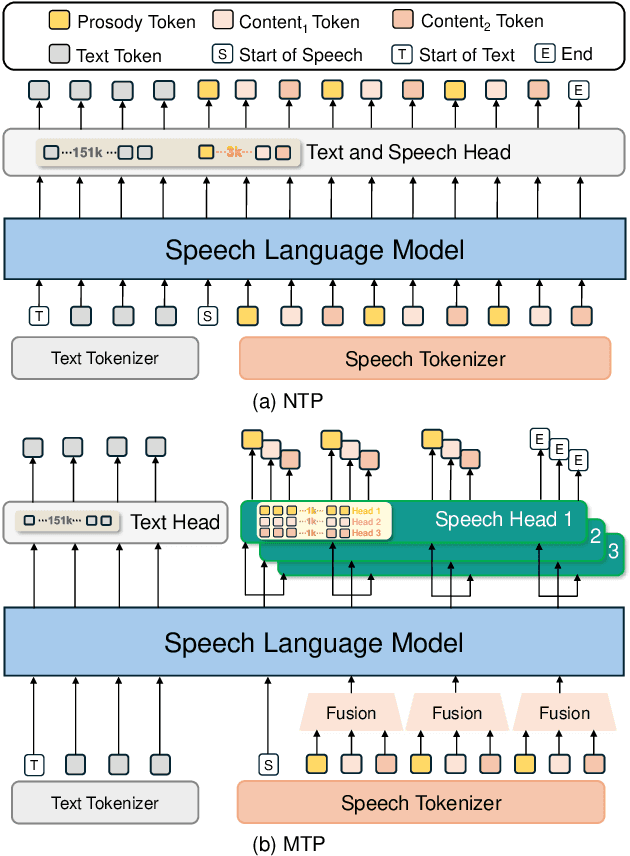
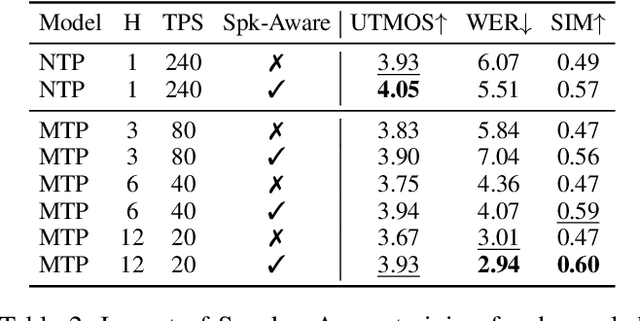
Speech-language models (SLMs) offer a promising path toward unifying speech and text understanding and generation. However, challenges remain in achieving effective cross-modal alignment and high-quality speech generation. In this work, we systematically investigate the impact of key components (i.e., speech tokenizers, speech heads, and speaker modeling) on the performance of LLM-centric SLMs. We compare coupled, semi-decoupled, and fully decoupled speech tokenizers under a fair SLM framework and find that decoupled tokenization significantly improves alignment and synthesis quality. To address the information density mismatch between speech and text, we introduce multi-token prediction (MTP) into SLMs, enabling each hidden state to decode multiple speech tokens. This leads to up to 12$\times$ faster decoding and a substantial drop in word error rate (from 6.07 to 3.01). Furthermore, we propose a speaker-aware generation paradigm and introduce RoleTriviaQA, a large-scale role-playing knowledge QA benchmark with diverse speaker identities. Experiments demonstrate that our methods enhance both knowledge understanding and speaker consistency.