 Add to Chrome
 Add to Firefox
 Add to Edge
MedUP: Awakening Unified Understanding and Perception in Medical Vision-Language Models
Aug 11, 2026
Medical Vision-Language Models (Med-VLMs) excel at verbalizing visual content, yet precise visual perception, segmentation, and grounding remain challenging. Existing approaches either verbalize regions as coordinate strings or rely on external modules that decouple perception from understanding, creating representation gaps for region-language alignment. We present MedUP, a Med-VLM that natively unifies perception and understanding within a shared token space. At its core lies UniMedTok, a region tokenizer that encodes masks as discrete tokens in the LLM vocabulary, enabling the model to seamlessly interleave mask tokens with text. We curate UniMed-Train, a 1.84M-instance corpus spanning text-guided segmentation, region-grounded understanding, medical VQA and CoT-based segmentation, and introduce UniMed-Bench for unified evaluation. Extensive experiments show that MedUP outperforms native, agentic, and dual-decoder Med-VLMs across all tasks while remaining competitive with specialist segmentors, demonstrating the strong potential of unified understanding and perception modeling.

EvoGraph-R1: Self-Evolving Multimodal Knowledge Hypergraphs for Agentic Retrieval
Jul 14, 2026Retrieval-augmented generation (RAG) has emerged as a critical paradigm for grounding Multimodal Large Language Models (MLLMs) in external knowledge. Recent GraphRAG methods introduce structured entity-relation graphs to improve retrieval and reasoning. However, they remain limited by treating knowledge graphs as static data structures built offline and queried in a single pass. This static paradigm misaligns with the interactive, iterative nature of knowledge-intensive reasoning, creating three bottlenecks: (i) text-centric fragmentation that impedes cross-modal reasoning, (ii) frozen structures unable to incorporate new evidence or correct errors, and (iii) rigid single-pass retrieval without adaptive refinement. To overcome these limitations, we introduce EvoGraph-R1, a self-evolving GraphRAG framework that reconceptualizes knowledge graphs as dynamic environments shaped through agent interactions. We formulate retrieval as a Markov Decision Process (MDP) where the agent observes the graph state and executes actions to query (GraphRetrieve), expand (WebSearch), refine (GraphEdit), or terminate (Answer) the reasoning. These actions reshape the hypergraph structure and generate feedback signals that guide subsequent evolution. Through this closed loop, the hypergraph evolves by integrating new evidence, correcting errors, and refining structure to support multi-hop reasoning. Experiments on multimodal VQA and text QA benchmarks demonstrate substantial improvements over existing RAG baselines in accuracy, coverage, and traceability, establishing self-evolving knowledge graphs as a fundamental paradigm across modalities.
MedStreamBench: A Time-Aware Benchmark for Streaming and Proactive Medical Video Understanding
Jul 02, 2026Existing medical video benchmarks primarily evaluate whether a model produces the correct answer, but rarely assess whether it answers at the right time. In real clinical settings, AI systems must decide not only what to predict, but also when to answer, defer judgment, or proactively raise alerts. This creates a critical gap between benchmark evaluation and deployment requirements. We present MedStreamBench, a benchmark for time-aware medical video understanding. MedStreamBench integrates 22 medical datasets and 5,419 QA instances across four temporal settings: retrospective, present, future, and proactive. Unlike conventional benchmarks that assume full-video access, MedStreamBench restricts models to temporally bounded evidence windows and supports both single-turn and streaming evaluation. We further introduce a proactive monitoring setting that requires models to determine whether and when clinically relevant alerts should be triggered. Beyond answer correctness, MedStreamBench evaluates temporal behavior through responsiveness and post-evidence stability. Experiments on leading general-purpose and medical vision-language models reveal a substantial gap between offline recognition and temporally grounded decision-making, with performance dropping markedly in streaming and proactive settings. Our benchmark is available at https://huggingface.co/datasets/Venn2024/MedStreamBench.
Project Imaging-X: A Survey of 1000+ Open-Access Medical Imaging Datasets for Foundation Model Development
Mar 29, 2026Foundation models have demonstrated remarkable success across diverse domains and tasks, primarily due to the thrive of large-scale, diverse, and high-quality datasets. However, in the field of medical imaging, the curation and assembling of such medical datasets are highly challenging due to the reliance on clinical expertise and strict ethical and privacy constraints, resulting in a scarcity of large-scale unified medical datasets and hindering the development of powerful medical foundation models. In this work, we present the largest survey to date of medical image datasets, covering over 1,000 open-access datasets with a systematic catalog of their modalities, tasks, anatomies, annotations, limitations, and potential for integration. Our analysis exposes a landscape that is modest in scale, fragmented across narrowly scoped tasks, and unevenly distributed across organs and modalities, which in turn limits the utility of existing medical image datasets for developing versatile and robust medical foundation models. To turn fragmentation into scale, we propose a metadata-driven fusion paradigm (MDFP) that integrates public datasets with shared modalities or tasks, thereby transforming multiple small data silos into larger, more coherent resources. Building on MDFP, we release an interactive discovery portal that enables end-to-end, automated medical image dataset integration, and compile all surveyed datasets into a unified, structured table that clearly summarizes their key characteristics and provides reference links, offering the community an accessible and comprehensive repository. By charting the current terrain and offering a principled path to dataset consolidation, our survey provides a practical roadmap for scaling medical imaging corpora, supporting faster data discovery, more principled dataset creation, and more capable medical foundation models.
Thinking with Deltas: Incentivizing Reinforcement Learning via Differential Visual Reasoning Policy
Jan 11, 2026Reinforcement Learning with Verifiable Rewards (RLVR) has significantly advanced reasoning capabilities in Large Language Models. However, adapting RLVR to multimodal domains suffers from a critical \textit{perception-reasoning decoupling}. Existing paradigms, driven by text-centric outcome rewards, reasoning in language medium, inadvertently encourage models to bypass visual perception. We empirically validate this through blind experiments: state-of-the-art policies maintain or surprisingly improve performance even when visual inputs are entirely removed. This reveals that these models degenerate into \textit{blind reasoners}, exploiting linguistic priors to generate plausible answers instead of attending to visual evidence. In response, we propose \textbf{Thinking with Deltas}, a framework driven by a \textbf{Differential Visual Reasoning Policy (DVRP)}. DVRP introduces intrinsic supervision via visual triplets, comprising original, masked, and perturbed inputs. It optimizes the model to maximize reasoning divergence from masked inputs (enforcing \textit{visual sensitivity}) while minimizing divergence from perturbed inputs (ensuring \textit{visual robustness}). By aligning reasoning variations strictly with the \textit{Delta} of visual information, DVRP inherently bolsters visual understanding capabilities and significantly outperforms state-of-the-art methods on both general and medical benchmarks, without requiring external annotations or auxiliary tools.
MedQ-Bench: Evaluating and Exploring Medical Image Quality Assessment Abilities in MLLMs
Oct 02, 2025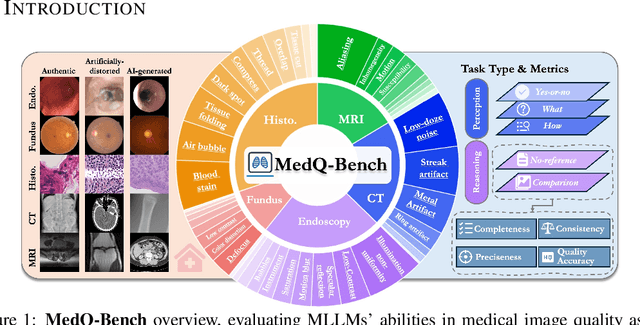
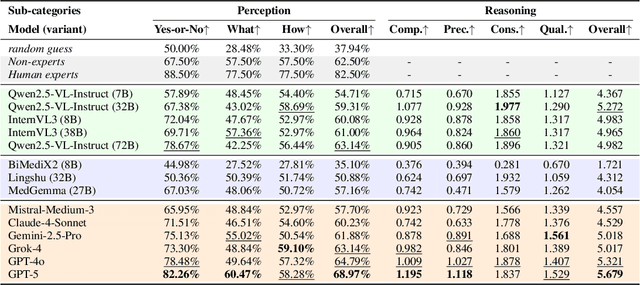
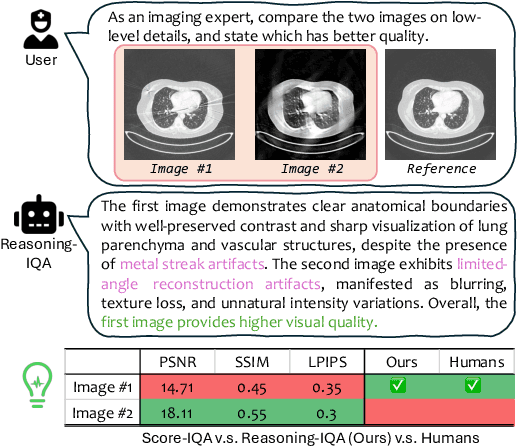

Medical Image Quality Assessment (IQA) serves as the first-mile safety gate for clinical AI, yet existing approaches remain constrained by scalar, score-based metrics and fail to reflect the descriptive, human-like reasoning process central to expert evaluation. To address this gap, we introduce MedQ-Bench, a comprehensive benchmark that establishes a perception-reasoning paradigm for language-based evaluation of medical image quality with Multi-modal Large Language Models (MLLMs). MedQ-Bench defines two complementary tasks: (1) MedQ-Perception, which probes low-level perceptual capability via human-curated questions on fundamental visual attributes; and (2) MedQ-Reasoning, encompassing both no-reference and comparison reasoning tasks, aligning model evaluation with human-like reasoning on image quality. The benchmark spans five imaging modalities and over forty quality attributes, totaling 2,600 perceptual queries and 708 reasoning assessments, covering diverse image sources including authentic clinical acquisitions, images with simulated degradations via physics-based reconstructions, and AI-generated images. To evaluate reasoning ability, we propose a multi-dimensional judging protocol that assesses model outputs along four complementary axes. We further conduct rigorous human-AI alignment validation by comparing LLM-based judgement with radiologists. Our evaluation of 14 state-of-the-art MLLMs demonstrates that models exhibit preliminary but unstable perceptual and reasoning skills, with insufficient accuracy for reliable clinical use. These findings highlight the need for targeted optimization of MLLMs in medical IQA. We hope that MedQ-Bench will catalyze further exploration and unlock the untapped potential of MLLMs for medical image quality evaluation.
A Survey of Scientific Large Language Models: From Data Foundations to Agent Frontiers
Aug 28, 2025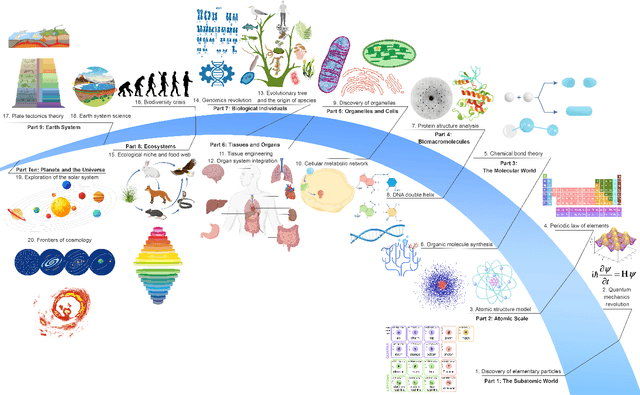
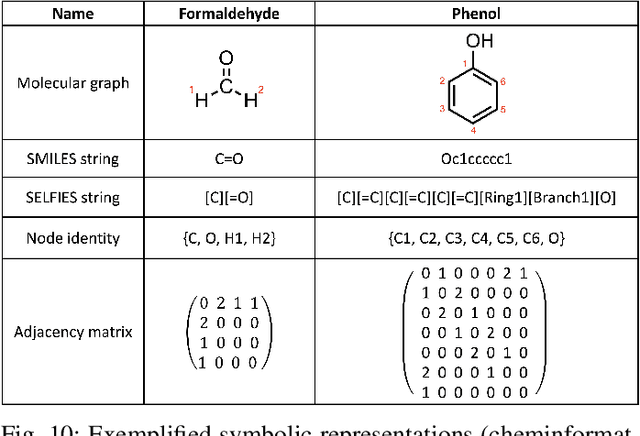
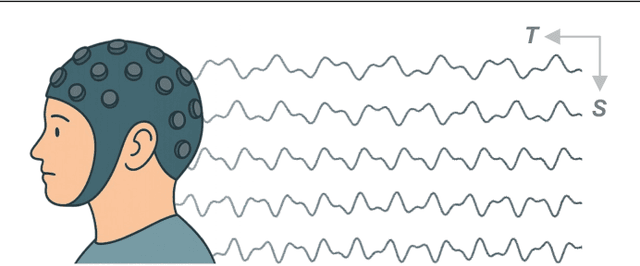
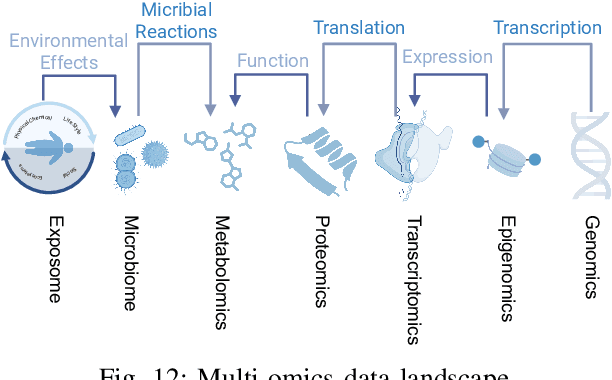
Scientific Large Language Models (Sci-LLMs) are transforming how knowledge is represented, integrated, and applied in scientific research, yet their progress is shaped by the complex nature of scientific data. This survey presents a comprehensive, data-centric synthesis that reframes the development of Sci-LLMs as a co-evolution between models and their underlying data substrate. We formulate a unified taxonomy of scientific data and a hierarchical model of scientific knowledge, emphasizing the multimodal, cross-scale, and domain-specific challenges that differentiate scientific corpora from general natural language processing datasets. We systematically review recent Sci-LLMs, from general-purpose foundations to specialized models across diverse scientific disciplines, alongside an extensive analysis of over 270 pre-/post-training datasets, showing why Sci-LLMs pose distinct demands -- heterogeneous, multi-scale, uncertainty-laden corpora that require representations preserving domain invariance and enabling cross-modal reasoning. On evaluation, we examine over 190 benchmark datasets and trace a shift from static exams toward process- and discovery-oriented assessments with advanced evaluation protocols. These data-centric analyses highlight persistent issues in scientific data development and discuss emerging solutions involving semi-automated annotation pipelines and expert validation. Finally, we outline a paradigm shift toward closed-loop systems where autonomous agents based on Sci-LLMs actively experiment, validate, and contribute to a living, evolving knowledge base. Collectively, this work provides a roadmap for building trustworthy, continually evolving artificial intelligence (AI) systems that function as a true partner in accelerating scientific discovery.