 Add to Chrome
 Add to Firefox
 Add to Edge
ICPR 2026 Competition on Low-Resolution License Plate Recognition
Apr 24, 2026
Low-Resolution License Plate Recognition (LRLPR) remains a challenging problem in real-world surveillance scenarios, where long capture distances, compression artifacts, and adverse imaging conditions can severely degrade license plate legibility. To promote progress in this area, we organized the ICPR 2026 Competition on Low-Resolution License Plate Recognition, the first competition specifically dedicated to LRLPR using real low-quality data collected under operationally relevant conditions. The competition was based on the LRLPR-26 dataset, which comprises 20,000 training tracks and 3,000 test tracks; each training track contains five low-resolution and five high-resolution images of the same license plate. Notably, a total of 269 teams from 41 countries registered for the competition, and 99 teams submitted valid entries in the Blind Test Phase. The winning team achieved a Recognition Rate of 82.13%, and four teams surpassed the 80% mark, highlighting both the high level of competition at the top of the leaderboard and the continued difficulty of the task. In addition to presenting the competition design, evaluation protocol, and main results, this paper summarizes the methods adopted by the top-5 teams and discusses current trends and promising directions for future research on LRLPR. The competition webpage is available at https://icpr26lrlpr.github.io/

Separating Diagnosis from Control: Auditable Policy Adaptation in Agent-Based Simulations with LLM-Based Diagnostics
Mar 24, 2026Mitigating elderly loneliness requires policy interventions that achieve both adaptability and auditability. Existing methods struggle to reconcile these objectives: traditional agent-based models suffer from static rigidity, while direct large language model (LLM) controllers lack essential traceability. This work proposes a three-layer framework that separates diagnosis from control to achieve both properties simultaneously. LLMs operate strictly as diagnostic instruments that assess population state and generate structured risk evaluations, while deterministic formulas with explicit bounds translate these assessments into traceable parameter updates. This separation ensures that every policy decision can be attributed to inspectable rules while maintaining adaptive response to emergent needs. We validate the framework through systematic ablation across five experimental conditions in elderly care simulation. Results demonstrate that explicit control rules outperform end-to-end black-box LLM approaches by 11.7\% while preserving full auditability, confirming that transparency need not compromise adaptive performance.
Words at Play: Benchmarking Audio Pun Understanding in Large Audio-Language Models
Mar 19, 2026Puns represent a typical linguistic phenomenon that exploits polysemy and phonetic ambiguity to generate humour, posing unique challenges for natural language understanding. Within pun research, audio plays a central role in human communication except text and images, while datasets and systematic resources for spoken puns remain scarce, leaving this crucial modality largely underexplored. In this paper, we present APUN-Bench, the first benchmark dedicated to evaluating large audio language models (LALMs) on audio pun understanding. Our benchmark contains 4,434 audio samples annotated across three stages: pun recognition, pun word location and pun meaning inference. We conduct a deep analysis of APUN-Bench by systematically evaluating 10 state-of-the-art LALMs, uncovering substantial performance gaps in recognizing, localizing, and interpreting audio puns. This analysis reveals key challenges, such as positional biases in audio pun location and error cases in meaning inference, offering actionable insights for advancing humour-aware audio intelligence.
UniRec-0.1B: Unified Text and Formula Recognition with 0.1B Parameters
Dec 24, 2025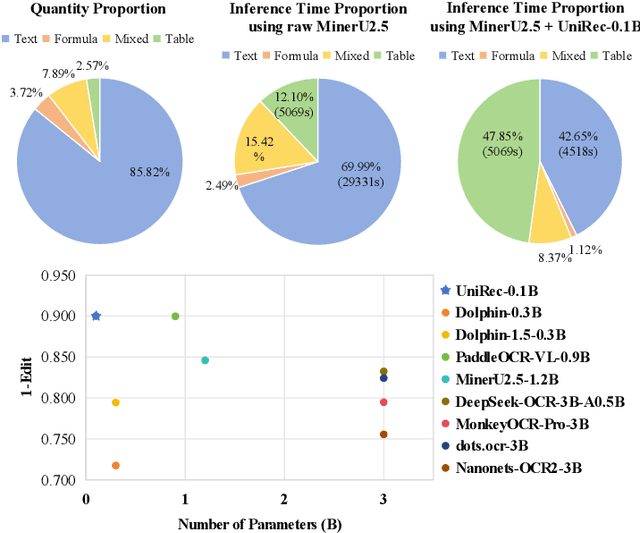

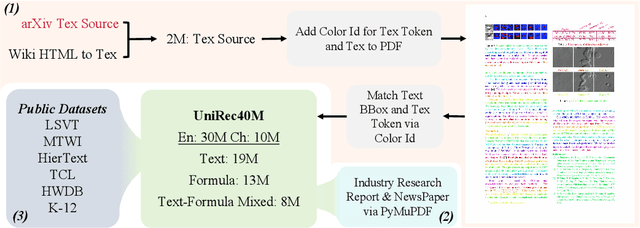
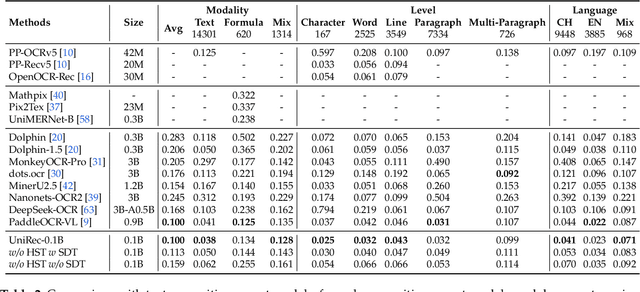
Text and formulas constitute the core informational components of many documents. Accurately and efficiently recognizing both is crucial for developing robust and generalizable document parsing systems. Recently, vision-language models (VLMs) have achieved impressive unified recognition of text and formulas. However, they are large-sized and computationally demanding, restricting their usage in many applications. In this paper, we propose UniRec-0.1B, a unified recognition model with only 0.1B parameters. It is capable of performing text and formula recognition at multiple levels, including characters, words, lines, paragraphs, and documents. To implement this task, we first establish UniRec40M, a large-scale dataset comprises 40 million text, formula and their mix samples, enabling the training of a powerful yet lightweight model. Secondly, we identify two challenges when building such a lightweight but unified expert model. They are: structural variability across hierarchies and semantic entanglement between textual and formulaic content. To tackle these, we introduce a hierarchical supervision training that explicitly guides structural comprehension, and a semantic-decoupled tokenizer that separates text and formula representations. Finally, we develop a comprehensive evaluation benchmark covering Chinese and English documents from multiple domains and with multiple levels. Experimental results on this and public benchmarks demonstrate that UniRec-0.1B outperforms both general-purpose VLMs and leading document parsing expert models, while achieving a 2-9$\times$ speedup, validating its effectiveness and efficiency. Codebase and Dataset: https://github.com/Topdu/OpenOCR.
Complex Mathematical Expression Recognition: Benchmark, Large-Scale Dataset and Strong Baseline
Dec 14, 2025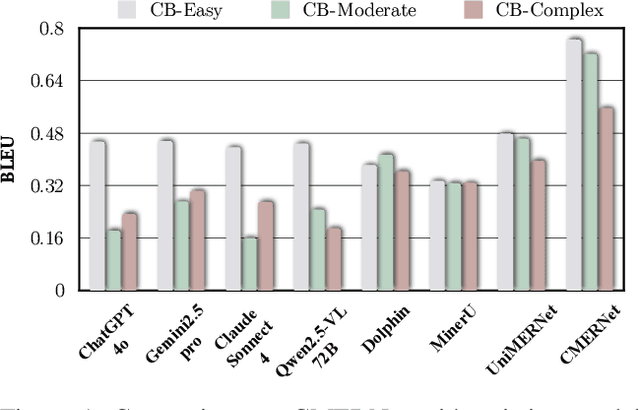
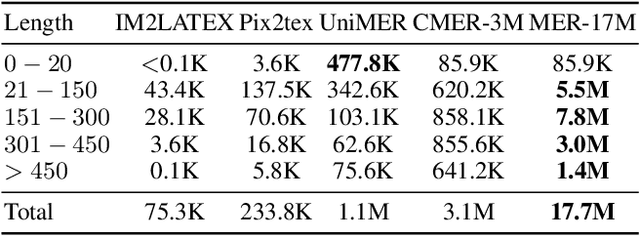
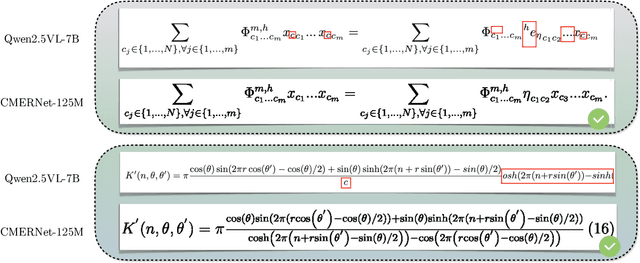
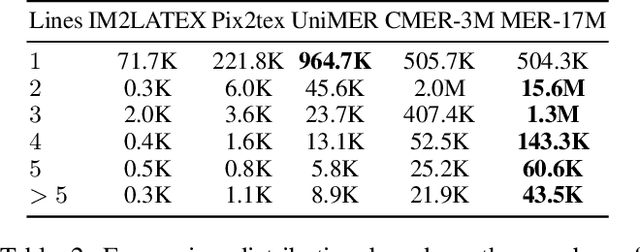
Mathematical Expression Recognition (MER) has made significant progress in recognizing simple expressions, but the robust recognition of complex mathematical expressions with many tokens and multiple lines remains a formidable challenge. In this paper, we first introduce CMER-Bench, a carefully constructed benchmark that categorizes expressions into three difficulty levels: easy, moderate, and complex. Leveraging CMER-Bench, we conduct a comprehensive evaluation of existing MER models and general-purpose multimodal large language models (MLLMs). The results reveal that while current methods perform well on easy and moderate expressions, their performance degrades significantly when handling complex mathematical expressions, mainly because existing public training datasets are primarily composed of simple samples. In response, we propose MER-17M and CMER-3M that are large-scale datasets emphasizing the recognition of complex mathematical expressions. The datasets provide rich and diverse samples to support the development of accurate and robust complex MER models. Furthermore, to address the challenges posed by the complicated spatial layout of complex expressions, we introduce a novel expression tokenizer, and a new representation called Structured Mathematical Language, which explicitly models the hierarchical and spatial structure of expressions beyond LaTeX format. Based on these, we propose a specialized model named CMERNet, built upon an encoder-decoder architecture and trained on CMER-3M. Experimental results show that CMERNet, with only 125 million parameters, significantly outperforms existing MER models and MLLMs on CMER-Bench.
LRANet++: Low-Rank Approximation Network for Accurate and Efficient Text Spotting
Nov 08, 2025End-to-end text spotting aims to jointly optimize text detection and recognition within a unified framework. Despite significant progress, designing an accurate and efficient end-to-end text spotter for arbitrary-shaped text remains largely unsolved. We identify the primary bottleneck as the lack of a reliable and efficient text detection method. To address this, we propose a novel parameterized text shape method based on low-rank approximation for precise detection and a triple assignment detection head to enable fast inference. Specifically, unlike other shape representation methods that employ data-irrelevant parameterization, our data-driven approach derives a low-rank subspace directly from labeled text boundaries. To ensure this process is robust against the inherent annotation noise in this data, we utilize a specialized recovery method based on an $\ell_1$-norm formulation, which accurately reconstructs the text shape with only a few key orthogonal vectors. By exploiting the inherent shape correlation among different text contours, our method achieves consistency and compactness in shape representation. Next, the triple assignment scheme introduces a novel architecture where a deep sparse branch (for stabilized training) is used to guide the learning of an ultra-lightweight sparse branch (for accelerated inference), while a dense branch provides rich parallel supervision. Building upon these advancements, we integrate the enhanced detection module with a lightweight recognition branch to form an end-to-end text spotting framework, termed LRANet++, capable of accurately and efficiently spotting arbitrary-shaped text. Extensive experiments on several challenging benchmarks demonstrate the superiority of LRANet++ compared to state-of-the-art methods. Code will be available at: https://github.com/ychensu/LRANet-PP.git
Explicit Relational Reasoning Network for Scene Text Detection
Dec 19, 2024


Connected component (CC) is a proper text shape representation that aligns with human reading intuition. However, CC-based text detection methods have recently faced a developmental bottleneck that their time-consuming post-processing is difficult to eliminate. To address this issue, we introduce an explicit relational reasoning network (ERRNet) to elegantly model the component relationships without post-processing. Concretely, we first represent each text instance as multiple ordered text components, and then treat these components as objects in sequential movement. In this way, scene text detection can be innovatively viewed as a tracking problem. From this perspective, we design an end-to-end tracking decoder to achieve a CC-based method dispensing with post-processing entirely. Additionally, we observe that there is an inconsistency between classification confidence and localization quality, so we propose a Polygon Monte-Carlo method to quickly and accurately evaluate the localization quality. Based on this, we introduce a position-supervised classification loss to guide the task-aligned learning of ERRNet. Experiments on challenging benchmarks demonstrate the effectiveness of our ERRNet. It consistently achieves state-of-the-art accuracy while holding highly competitive inference speed.
Hint-AD: Holistically Aligned Interpretability in End-to-End Autonomous Driving
Sep 10, 2024
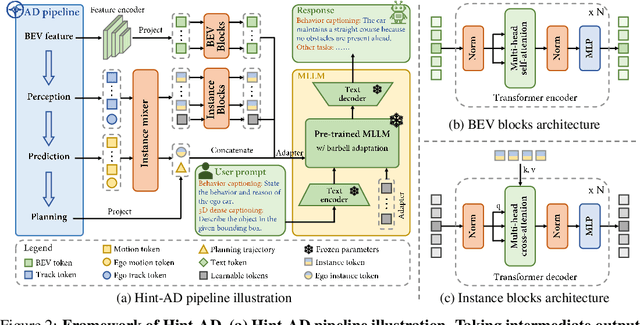

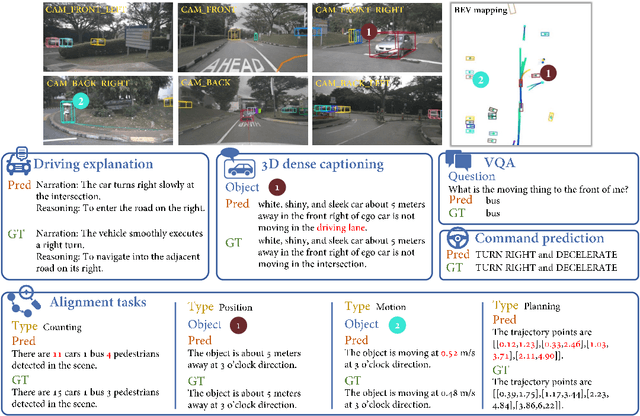
End-to-end architectures in autonomous driving (AD) face a significant challenge in interpretability, impeding human-AI trust. Human-friendly natural language has been explored for tasks such as driving explanation and 3D captioning. However, previous works primarily focused on the paradigm of declarative interpretability, where the natural language interpretations are not grounded in the intermediate outputs of AD systems, making the interpretations only declarative. In contrast, aligned interpretability establishes a connection between language and the intermediate outputs of AD systems. Here we introduce Hint-AD, an integrated AD-language system that generates language aligned with the holistic perception-prediction-planning outputs of the AD model. By incorporating the intermediate outputs and a holistic token mixer sub-network for effective feature adaptation, Hint-AD achieves desirable accuracy, achieving state-of-the-art results in driving language tasks including driving explanation, 3D dense captioning, and command prediction. To facilitate further study on driving explanation task on nuScenes, we also introduce a human-labeled dataset, Nu-X. Codes, dataset, and models will be publicly available.
Instruction-Guided Scene Text Recognition
Jan 31, 2024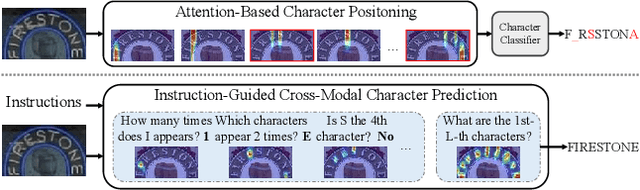
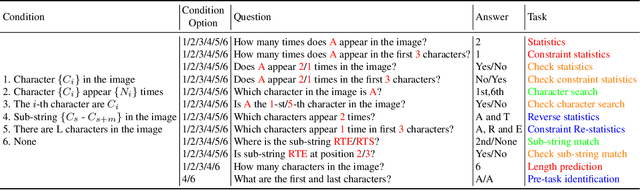

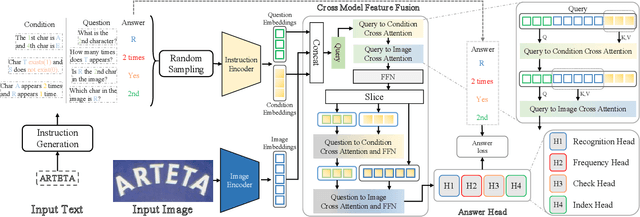
Multi-modal models have shown appealing performance in visual tasks recently, as instruction-guided training has evoked the ability to understand fine-grained visual content. However, current methods cannot be trivially applied to scene text recognition (STR) due to the gap between natural and text images. In this paper, we introduce a novel paradigm that formulates STR as an instruction learning problem, and propose instruction-guided scene text recognition (IGTR) to achieve effective cross-modal learning. IGTR first generates rich and diverse instruction triplets of <condition,question,answer>, serving as guidance for nuanced text image understanding. Then, we devise an architecture with dedicated cross-modal feature fusion module, and multi-task answer head to effectively fuse the required instruction and image features for answering questions. Built upon these designs, IGTR facilitates accurate text recognition by comprehending character attributes. Experiments on English and Chinese benchmarks show that IGTR outperforms existing models by significant margins. Furthermore, by adjusting the instructions, IGTR enables various recognition schemes. These include zero-shot prediction, where the model is trained based on instructions not explicitly targeting character recognition, and the recognition of rarely appearing and morphologically similar characters, which were previous challenges for existing models.
CT-Net: Arbitrary-Shaped Text Detection via Contour Transformer
Jul 25, 2023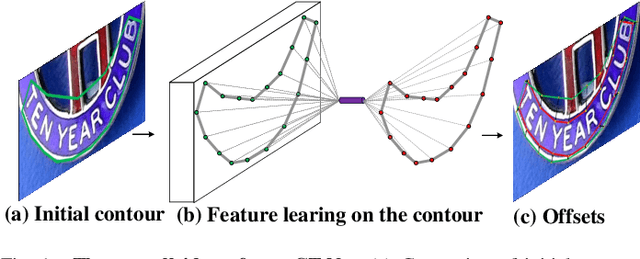
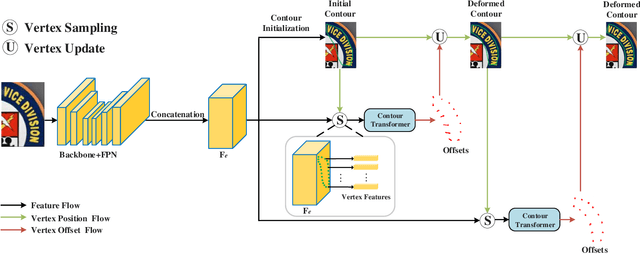
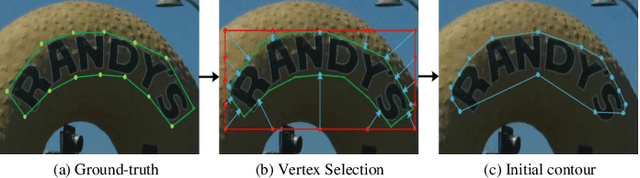
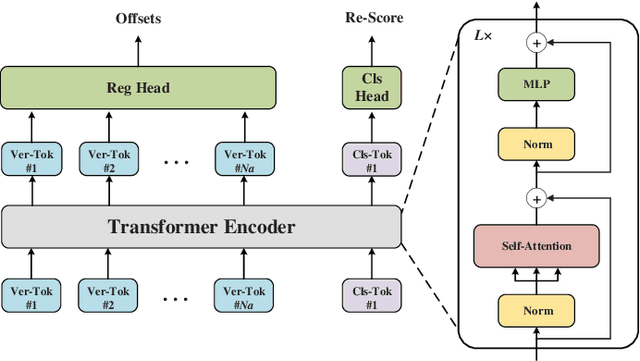
Contour based scene text detection methods have rapidly developed recently, but still suffer from inaccurate frontend contour initialization, multi-stage error accumulation, or deficient local information aggregation. To tackle these limitations, we propose a novel arbitrary-shaped scene text detection framework named CT-Net by progressive contour regression with contour transformers. Specifically, we first employ a contour initialization module that generates coarse text contours without any post-processing. Then, we adopt contour refinement modules to adaptively refine text contours in an iterative manner, which are beneficial for context information capturing and progressive global contour deformation. Besides, we propose an adaptive training strategy to enable the contour transformers to learn more potential deformation paths, and introduce a re-score mechanism that can effectively suppress false positives. Extensive experiments are conducted on four challenging datasets, which demonstrate the accuracy and efficiency of our CT-Net over state-of-the-art methods. Particularly, CT-Net achieves F-measure of 86.1 at 11.2 frames per second (FPS) and F-measure of 87.8 at 10.1 FPS for CTW1500 and Total-Text datasets, respectively.