 Add to Chrome
 Add to Firefox
 Add to Edge
IACM-RL: Intent-Aware Context Management and Reinforcement Learning for Complex Tool Invocation under Dynamic Intent Fluctuations
Aug 03, 2026
Executing long-horizon tool invocations in real-world environments is severely challenged by dynamic user intent noise. Existing methods attempt robustness via implicit history scanning or text compression, yet predominantly assume perfect instructions in simplistic scenarios. Inevitably, under fluctuating contexts, obsolete constraints dilute model attention, triggering catastrophic intent deviation and infinite API loops. To resolve this, we propose IACM-RL, a comprehensive framework for robust tool invocation. First, we introduce the DynamicIntent pipeline, synthesizing trajectories across 13 fine-grained fluctuation scenarios, paired with a five-dimensional diagnostic metric suite. Second, IACM-RL deploys a BeliefState-based Self-Generated Context Manager that proactively tracks shifting goals and isolates overwritten parameters using structural stale flags. To autonomously internalize this state-tracking capability, we optimize the policy using a hierarchical intent-driven reward alongside three auxiliary losses (action calibration, CM extraction, and state distillation). Experiments on DynamicIntent, BFCL-V3, and $\mathrmτ^2$-Bench demonstrate that IACM-RL significantly outperforms baselines, reducing infinite loops and stale context errors while enhancing out-of-domain generalization.

DLEBench: Evaluating Small-scale Object Editing Ability for Instruction-based Image Editing Model
Feb 27, 2026Significant progress has been made in the field of Instruction-based Image Editing Models (IIEMs). However, while these models demonstrate plausible adherence to instructions and strong reasoning ability on current benchmarks, their ability to edit small objects remains underexplored, despite its importance for precise local editing and refining details in both real and generated images. In this paper, we introduce DeepLookEditBench (DLEBench), the first benchmark dedicated to assessing the abilities of IIEMs in editing small-scale objects. Specifically, we construct a challenging testbed comprising 1889 samples across seven instruction types. In these samples, target objects occupy only 1%-10% of the image area, covering complex scenarios such as partial occlusion and multi-object editing. To ensure robust evaluation on this benchmark, we propose an evaluation protocol with refined score rubrics to minimize subjectivity and ambiguity in two criteria: Instruction Following and Visual Consistency. This protocol also introduces a dual-mode evaluation framework (Tool-driven and Oracle-guided Modes) addressing the misalignment between LMM-as-a-Judge and human judgements on DLEBench. Empirical results on 10 IIEMs reveal significant performance gaps in small-scale object editing, highlighting the need for specialized benchmarks to advance this ability.
MagicAgent: Towards Generalized Agent Planning
Feb 22, 2026The evolution of Large Language Models (LLMs) from passive text processors to autonomous agents has established planning as a core component of modern intelligence. However, achieving generalized planning remains elusive, not only by the scarcity of high-quality interaction data but also by inherent conflicts across heterogeneous planning tasks. These challenges result in models that excel at isolated tasks yet struggle to generalize, while existing multi-task training attempts suffer from gradient interference. In this paper, we present \textbf{MagicAgent}, a series of foundation models specifically designed for generalized agent planning. We introduce a lightweight and scalable synthetic data framework that generates high-quality trajectories across diverse planning tasks, including hierarchical task decomposition, tool-augmented planning, multi-constraint scheduling, procedural logic orchestration, and long-horizon tool execution. To mitigate training conflicts, we propose a two-stage training paradigm comprising supervised fine-tuning followed by multi-objective reinforcement learning over both static datasets and dynamic environments. Empirical results demonstrate that MagicAgent-32B and MagicAgent-30B-A3B deliver superior performance, achieving accuracies of $75.1\%$ on Worfbench, $55.9\%$ on NaturalPlan, $57.5\%$ on $τ^2$-Bench, $86.9\%$ on BFCL-v3, and $81.2\%$ on ACEBench, as well as strong results on our in-house MagicEval benchmarks. These results substantially outperform existing sub-100B models and even surpass leading closed-source models.
DFPO: Scaling Value Modeling via Distributional Flow towards Robust and Generalizable LLM Post-Training
Feb 05, 2026Training reinforcement learning (RL) systems in real-world environments remains challenging due to noisy supervision and poor out-of-domain (OOD) generalization, especially in LLM post-training. Recent distributional RL methods improve robustness by modeling values with multiple quantile points, but they still learn each quantile independently as a scalar. This results in rough-grained value representations that lack fine-grained conditioning on state information, struggling under complex and OOD conditions. We propose DFPO (Distributional Value Flow Policy Optimization with Conditional Risk and Consistency Control), a robust distributional RL framework that models values as continuous flows across time steps. By scaling value modeling through learning of a value flow field instead of isolated quantile predictions, DFPO captures richer state information for more accurate advantage estimation. To stabilize training under noisy feedback, DFPO further integrates conditional risk control and consistency constraints along value flow trajectories. Experiments on dialogue, math reasoning, and scientific tasks show that DFPO outperforms PPO, FlowRL, and other robust baselines under noisy supervision, achieving improved training stability and generalization.
CL-bench: A Benchmark for Context Learning
Feb 03, 2026Current language models (LMs) excel at reasoning over prompts using pre-trained knowledge. However, real-world tasks are far more complex and context-dependent: models must learn from task-specific context and leverage new knowledge beyond what is learned during pre-training to reason and resolve tasks. We term this capability context learning, a crucial ability that humans naturally possess but has been largely overlooked. To this end, we introduce CL-bench, a real-world benchmark consisting of 500 complex contexts, 1,899 tasks, and 31,607 verification rubrics, all crafted by experienced domain experts. Each task is designed such that the new content required to resolve it is contained within the corresponding context. Resolving tasks in CL-bench requires models to learn from the context, ranging from new domain-specific knowledge, rule systems, and complex procedures to laws derived from empirical data, all of which are absent from pre-training. This goes far beyond long-context tasks that primarily test retrieval or reading comprehension, and in-context learning tasks, where models learn simple task patterns via instructions and demonstrations. Our evaluations of ten frontier LMs find that models solve only 17.2% of tasks on average. Even the best-performing model, GPT-5.1, solves only 23.7%, revealing that LMs have yet to achieve effective context learning, which poses a critical bottleneck for tackling real-world, complex context-dependent tasks. CL-bench represents a step towards building LMs with this fundamental capability, making them more intelligent and advancing their deployment in real-world scenarios.
LLMEval-Med: A Real-world Clinical Benchmark for Medical LLMs with Physician Validation
Jun 04, 2025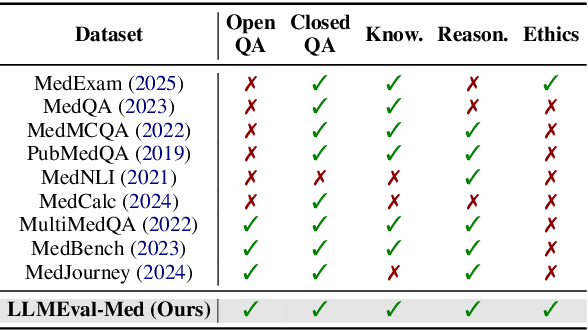
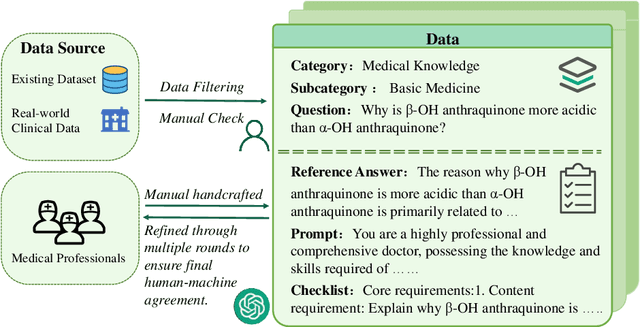
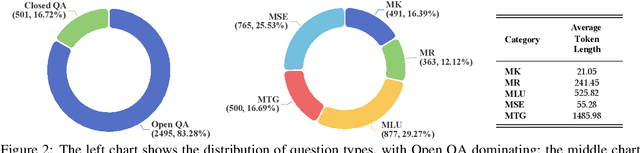
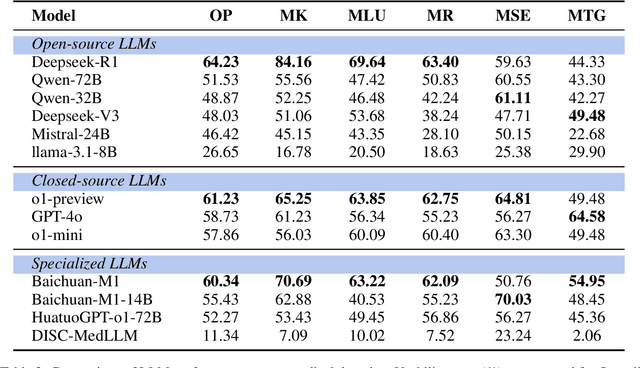
Evaluating large language models (LLMs) in medicine is crucial because medical applications require high accuracy with little room for error. Current medical benchmarks have three main types: medical exam-based, comprehensive medical, and specialized assessments. However, these benchmarks have limitations in question design (mostly multiple-choice), data sources (often not derived from real clinical scenarios), and evaluation methods (poor assessment of complex reasoning). To address these issues, we present LLMEval-Med, a new benchmark covering five core medical areas, including 2,996 questions created from real-world electronic health records and expert-designed clinical scenarios. We also design an automated evaluation pipeline, incorporating expert-developed checklists into our LLM-as-Judge framework. Furthermore, our methodology validates machine scoring through human-machine agreement analysis, dynamically refining checklists and prompts based on expert feedback to ensure reliability. We evaluate 13 LLMs across three categories (specialized medical models, open-source models, and closed-source models) on LLMEval-Med, providing valuable insights for the safe and effective deployment of LLMs in medical domains. The dataset is released in https://github.com/llmeval/LLMEval-Med.