 Add to Chrome
 Add to Firefox
 Add to Edge
SPIEval: Evaluating Large Language Models as Mobile Assistants over Scattered Personal Information
Aug 11, 2026
Large language models (LLMs) are increasingly deployed as mobile assistants, where a key challenge is leveraging personal information scattered across multiple applications (apps) to complete user instructions. However, due to the lack of dedicated benchmarks, their capabilities remain poorly understood. To address this gap, we introduce SPIEval, a human-curated benchmark grounded in five cognitive capabilities (i.e., reasoning, disambiguation, integration, preference inference, and multi-intent decomposition). SPIEval comprises 250 tasks spanning 4,335 personal records distributed across 10 apps and supports multi-turn interaction through 21 tools. Analysis shows that the benchmark exhibits diverse scenarios, challenging tasks, scattered information, controllable environments, and verifiable outcomes. We evaluate nine representative LLMs and find substantial room for improvement. The best-performing model, GPT-5.5 (xhigh), achieves only 57.3% accuracy, while the weakest achieves just 16.4%. Further analysis reveals that 79% of failures stem from inaccurate information localization, as LLMs often commit to plausible but incorrect information instead of continuing retrieval for verification. We also find that fewer than 2% of retrieval actions employ advanced search methods and observe substantial variation in search efficiency across models. These findings expose fundamental limitations of current LLM-based mobile assistants and motivate future research in this direction. Data and code are available at https://huggingface.co/datasets/Junjie-Ye/SPIEval.

LLMEval-Logic: A Solver-Verified Chinese Benchmark for Logical Reasoning of LLMs with Adversarial Hardening
May 19, 2026Evaluating large language models (LLMs) on natural-language logical reasoning is essential because rule-governed tasks require conclusions to follow strictly from stated premises. Many existing logical-reasoning benchmarks are generated by templating natural-language items from sampled formulas, provide only coarse or unaudited formal annotations, and are now quickly saturated by frontier reasoning models. We present LLMEval-Logic, a Chinese logical reasoning benchmark built from realistic situational scenarios. Its pipeline forward-authors and expert-audits natural-language items together with their reference formalizations, verifies annotated answers with Z3, constructs expert rubrics for natural-to-formal grading, and hardens selected items through a closed-loop adversarial workflow. The benchmark is released in two paired subsets: a 246-item Base subset shipped with 1,400 expert-developed rubric atoms, and a 190-item Hard subset with 938 multi-step sub-questions over closed model spaces. Evaluating 14 frontier LLMs on LLMEval-Logic reveals substantial gaps in current models: the best model reaches only 37.5% Hard Item Accuracy, and even with reference symbols the highest joint Z3+Rubric formalization score among evaluated models reaches only 60.16%. Our benchmark is publicly available at https://github.com/llmeval/LLMEval-Logic.
JFTA-Bench: Evaluate LLM's Ability of Tracking and Analyzing Malfunctions Using Fault Trees
Mar 24, 2026In the maintenance of complex systems, fault trees are used to locate problems and provide targeted solutions. To enable fault trees stored as images to be directly processed by large language models, which can assist in tracking and analyzing malfunctions, we propose a novel textual representation of fault trees. Building on it, we construct a benchmark for multi-turn dialogue systems that emphasizes robust interaction in complex environments, evaluating a model's ability to assist in malfunction localization, which contains $3130$ entries and $40.75$ turns per entry on average. We train an end-to-end model to generate vague information to reflect user behavior and introduce long-range rollback and recovery procedures to simulate user error scenarios, enabling assessment of a model's integrated capabilities in task tracking and error recovery, and Gemini 2.5 pro archives the best performance.
SciAgentGym: Benchmarking Multi-Step Scientific Tool-use in LLM Agents
Feb 13, 2026Scientific reasoning inherently demands integrating sophisticated toolkits to navigate domain-specific knowledge. Yet, current benchmarks largely overlook agents' ability to orchestrate tools for such rigorous workflows. To bridge this gap, we introduce SciAgentGym, a scalable interactive environment featuring 1,780 domain-specific tools across four natural science disciplines, supported by a robust execution infrastructure. Complementing this, we present SciAgentBench, a tiered evaluation suite designed to stress-test agentic capabilities from elementary actions to long-horizon workflows. Our evaluation identifies a critical bottleneck: state-of-the-art models struggle with complex scientific tool-use. Even for a leading model like GPT-5, success rates drop sharply from 60.6% to 30.9% as interaction horizons extend, primarily due to failures in multi-step workflow execution. To address this, we propose SciForge, a data synthesis method that models the tool action space as a dependency graph to generate logic-aware training trajectories. By fine-tuning on these trajectories, our SciAgent-8B outperforms the significantly larger Qwen3-VL-235B-Instruct while exhibiting positive cross-domain transfer of scientific tool-use capabilities. These results underscore the promising potential of next-generation autonomous scientific agents.
CL-bench: A Benchmark for Context Learning
Feb 03, 2026Current language models (LMs) excel at reasoning over prompts using pre-trained knowledge. However, real-world tasks are far more complex and context-dependent: models must learn from task-specific context and leverage new knowledge beyond what is learned during pre-training to reason and resolve tasks. We term this capability context learning, a crucial ability that humans naturally possess but has been largely overlooked. To this end, we introduce CL-bench, a real-world benchmark consisting of 500 complex contexts, 1,899 tasks, and 31,607 verification rubrics, all crafted by experienced domain experts. Each task is designed such that the new content required to resolve it is contained within the corresponding context. Resolving tasks in CL-bench requires models to learn from the context, ranging from new domain-specific knowledge, rule systems, and complex procedures to laws derived from empirical data, all of which are absent from pre-training. This goes far beyond long-context tasks that primarily test retrieval or reading comprehension, and in-context learning tasks, where models learn simple task patterns via instructions and demonstrations. Our evaluations of ten frontier LMs find that models solve only 17.2% of tasks on average. Even the best-performing model, GPT-5.1, solves only 23.7%, revealing that LMs have yet to achieve effective context learning, which poses a critical bottleneck for tackling real-world, complex context-dependent tasks. CL-bench represents a step towards building LMs with this fundamental capability, making them more intelligent and advancing their deployment in real-world scenarios.
Can Deep Research Agents Find and Organize? Evaluating the Synthesis Gap with Expert Taxonomies
Jan 18, 2026Deep Research Agents are increasingly used for automated survey generation. However, whether they can write surveys like human experts remains unclear. Existing benchmarks focus on fluency or citation accuracy, but none evaluates the core capabilities: retrieving essential papers and organizing them into coherent knowledge structures. We introduce TaxoBench, a diagnostic benchmark derived from 72 highly-cited computer science surveys. We manually extract expert-authored taxonomy trees containing 3,815 precisely categorized citations as ground truth. Our benchmark supports two evaluation modes: Deep Research mode tests end-to-end retrieval and organization given only a topic, while Bottom-Up mode isolates structuring capability by providing the exact papers human experts used. We evaluate 7 leading Deep Research agents and 12 frontier LLMs. Results reveal a dual bottleneck: the best agent recalls only 20.9% of expert-selected papers, and even with perfect input, the best model achieves only 0.31 ARI in organization. Current deep research agents remain far from expert-level survey writing. Our benchmark is publicly available at https://github.com/KongLongGeFDU/TaxoBench.
OpenNovelty: An LLM-powered Agentic System for Verifiable Scholarly Novelty Assessment
Jan 04, 2026Evaluating novelty is critical yet challenging in peer review, as reviewers must assess submissions against a vast, rapidly evolving literature. This report presents OpenNovelty, an LLM-powered agentic system for transparent, evidence-based novelty analysis. The system operates through four phases: (1) extracting the core task and contribution claims to generate retrieval queries; (2) retrieving relevant prior work based on extracted queries via semantic search engine; (3) constructing a hierarchical taxonomy of core-task-related work and performing contribution-level full-text comparisons against each contribution; and (4) synthesizing all analyses into a structured novelty report with explicit citations and evidence snippets. Unlike naive LLM-based approaches, \textsc{OpenNovelty} grounds all assessments in retrieved real papers, ensuring verifiable judgments. We deploy our system on 500+ ICLR 2026 submissions with all reports publicly available on our website, and preliminary analysis suggests it can identify relevant prior work, including closely related papers that authors may overlook. OpenNovelty aims to empower the research community with a scalable tool that promotes fair, consistent, and evidence-backed peer review.
LLMEval-3: A Large-Scale Longitudinal Study on Robust and Fair Evaluation of Large Language Models
Aug 07, 2025Existing evaluation of Large Language Models (LLMs) on static benchmarks is vulnerable to data contamination and leaderboard overfitting, critical issues that obscure true model capabilities. To address this, we introduce LLMEval-3, a framework for dynamic evaluation of LLMs. LLMEval-3 is built on a proprietary bank of 220k graduate-level questions, from which it dynamically samples unseen test sets for each evaluation run. Its automated pipeline ensures integrity via contamination-resistant data curation, a novel anti-cheating architecture, and a calibrated LLM-as-a-judge process achieving 90% agreement with human experts, complemented by a relative ranking system for fair comparison. An 20-month longitudinal study of nearly 50 leading models reveals a performance ceiling on knowledge memorization and exposes data contamination vulnerabilities undetectable by static benchmarks. The framework demonstrates exceptional robustness in ranking stability and consistency, providing strong empirical validation for the dynamic evaluation paradigm. LLMEval-3 offers a robust and credible methodology for assessing the true capabilities of LLMs beyond leaderboard scores, promoting the development of more trustworthy evaluation standards.
LLMEval-Med: A Real-world Clinical Benchmark for Medical LLMs with Physician Validation
Jun 04, 2025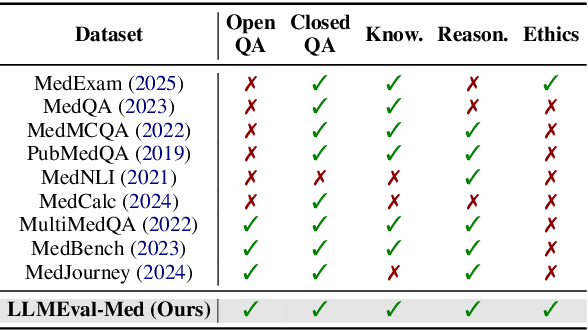
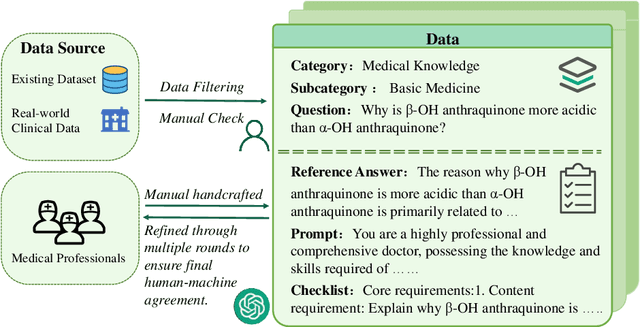
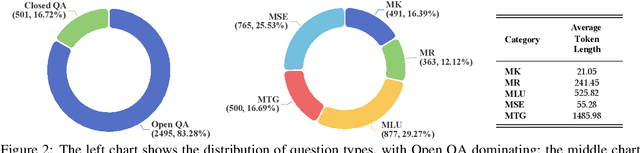
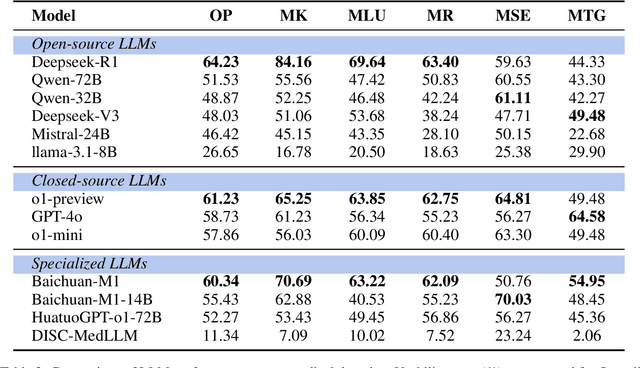
Evaluating large language models (LLMs) in medicine is crucial because medical applications require high accuracy with little room for error. Current medical benchmarks have three main types: medical exam-based, comprehensive medical, and specialized assessments. However, these benchmarks have limitations in question design (mostly multiple-choice), data sources (often not derived from real clinical scenarios), and evaluation methods (poor assessment of complex reasoning). To address these issues, we present LLMEval-Med, a new benchmark covering five core medical areas, including 2,996 questions created from real-world electronic health records and expert-designed clinical scenarios. We also design an automated evaluation pipeline, incorporating expert-developed checklists into our LLM-as-Judge framework. Furthermore, our methodology validates machine scoring through human-machine agreement analysis, dynamically refining checklists and prompts based on expert feedback to ensure reliability. We evaluate 13 LLMs across three categories (specialized medical models, open-source models, and closed-source models) on LLMEval-Med, providing valuable insights for the safe and effective deployment of LLMs in medical domains. The dataset is released in https://github.com/llmeval/LLMEval-Med.
Mitigating Object Hallucinations in MLLMs via Multi-Frequency Perturbations
Mar 19, 2025Recently, multimodal large language models (MLLMs) have demonstrated remarkable performance in visual-language tasks. However, the authenticity of the responses generated by MLLMs is often compromised by object hallucinations. We identify that a key cause of these hallucinations is the model's over-susceptibility to specific image frequency features in detecting objects. In this paper, we introduce Multi-Frequency Perturbations (MFP), a simple, cost-effective, and pluggable method that leverages both low-frequency and high-frequency features of images to perturb visual feature representations and explicitly suppress redundant frequency-domain features during inference, thereby mitigating hallucinations. Experimental results demonstrate that our method significantly mitigates object hallucinations across various model architectures. Furthermore, as a training-time method, MFP can be combined with inference-time methods to achieve state-of-the-art performance on the CHAIR benchmark.