 Add to Chrome
 Add to Firefox
 Add to Edge
Early Diagnosis of Wasted Computation in Multi-Agent LLM Systems via Failure-Aware Observability
May 31, 2026
Tool-using multi-agent large language model (LLM) systems spend computation through model tokens, tool calls, retries, and code execution before producing an answer. When a run fails, final-answer evaluation reveals the endpoint but usually not the point at which the trajectory stopped making recoverable progress. This paper introduces a failure-aware observability framework for diagnosing wasted computation in multi-agent LLM traces. The framework maps recurring failure modes to online trace signals, including tool reliability, execution recovery, orchestration loops, evidence availability, information change, and budget pressure. We instantiate the framework in a three- agent question-answering system and evaluate it on 165 GAIA validation traces under identical execution caps. Operational failures remain common: 22/53 level-1 runs, 33/86 level-2 runs, and 12/26 level-3 runs fail to produce a usable final answer. The traces expose different mechanisms behind these outcomes, including insufficient evidence, repeated-action loops, max-step termination, tool-failure streaks, and execution calls that succeed without useful output. Mean token use rises from 8,152 tokens at level 1 to 16,389 tokens at level 3, while evidence availability and sentence-level support diverge. A cached 10-trace LLM-judge grounding audit shows that cheap online signals and deeper semantic metrics capture complementary layers of failure. The results position failure-aware observability as a diagnostic layer between raw execution logs and final-answer accuracy.

Architecture Matters More Than Scale: A Comparative Study of Retrieval and Memory Augmentation for Financial QA Under SME Compute Constraints
Apr 20, 2026The rapid adoption of artificial intelligence (AI) and large language models (LLMs) is transforming financial analytics by enabling natural language interfaces for reporting, decision support, and automated reasoning. However, limited empirical understanding exists regarding how different LLM-based reasoning architectures perform across realistic financial workflows, particularly under the cost, accuracy, and compliance constraints faced by small and medium-sized enterprises (SMEs). SMEs typically operate within severe infrastructure constraints, lacking cloud GPU budgets, dedicated AI teams, and API-scale inference capacity, making architectural efficiency a first-class concern. To ensure practical relevance, we introduce an explicit SME-constrained evaluation setting in which all experiments are conducted using a locally hosted 8B-parameter instruction-tuned model without cloud-scale infrastructure. This design isolates the impact of architectural choices within a realistic deployment environment. We systematically compare four reasoning architectures: baseline LLM, retrieval-augmented generation (RAG), structured long-term memory, and memory-augmented conversational reasoning across both FinQA and ConvFinQA benchmarks. Results reveal a consistent architectural inversion: structured memory improves precision in deterministic, operand-explicit tasks, while retrieval-based approaches outperform memory-centric methods in conversational, reference-implicit settings. Based on these findings, we propose a hybrid deployment framework that dynamically selects reasoning strategies to balance numerical accuracy, auditability, and infrastructure efficiency, providing a practical pathway for financial AI adoption in resource-constrained environments.
TA-Mem: Tool-Augmented Autonomous Memory Retrieval for LLM in Long-Term Conversational QA
Mar 10, 2026Large Language Model (LLM) has exhibited strong reasoning ability in text-based contexts across various domains, yet the limitation of context window poses challenges for the model on long-range inference tasks and necessitates a memory storage system. While many current storage approaches have been proposed with episodic notes and graph representations of memory, retrieval methods still primarily rely on predefined workflows or static similarity top-k over embeddings. To address this inflexibility, we introduced a novel tool-augmented autonomous memory retrieval framework (TA-Mem), which contains: (1) a memory extraction LLM agent which is prompted to adaptively chuck an input into sub-context based on semantic correlation, and extract information into structured notes, (2) a multi-indexed memory database designed for different types of query methods including both key-based lookup and similarity-based retrieval, (3) a tool-augmented memory retrieval agent which explores the memory autonomously by selecting appropriate tools provided by the database based on the user input, and decides whether to proceed to the next iteration or finalizing the response after reasoning on the fetched memories. The TA-Mem is evaluated on the LoCoMo dataset, achieving significant performance improvements over existing baseline approaches. In addition, an analysis of tool use across different question types also demonstrates the adaptivity of the proposed method.
Tiny-Critic RAG: Empowering Agentic Fallback with Parameter-Efficient Small Language Models
Mar 01, 2026Retrieval-Augmented Generation (RAG) grounds Large Language Models (LLMs) to mitigate factual hallucinations. Recent paradigms shift from static pipelines to Modular and Agentic RAG frameworks, granting models autonomy for multi-hop reasoning or self-correction. However, current reflective RAG heavily relies on massive LLMs as universal evaluators. In high-throughput systems, executing complete forward passes for billion-parameter models merely for binary routing introduces severe computational redundancy. Furthermore, in autonomous agent scenarios, inaccurate retrieval causes models to expend excessive tokens on spurious reasoning and redundant tool calls, inflating Time-to-First-Token (TTFT) and costs. We propose Tiny-Critic RAG, decoupling evaluation by deploying a parameter-efficient Small Language Model (SLM) via Low-Rank Adaptation (LoRA). Acting as a deterministic gatekeeper, Tiny-Critic employs constrained decoding and non-thinking inference modes for ultra-low latency binary routing. Evaluations on noise-injected datasets demonstrate Tiny-Critic RAG achieves routing accuracy comparable to GPT-4o-mini while reducing latency by an order of magnitude, establishing a highly cost-effective paradigm for agent deployment.
A Safety Report on GPT-5.2, Gemini 3 Pro, Qwen3-VL, Grok 4.1 Fast, Nano Banana Pro, and Seedream 4.5
Jan 16, 2026The rapid evolution of Large Language Models (LLMs) and Multimodal Large Language Models (MLLMs) has driven major gains in reasoning, perception, and generation across language and vision, yet whether these advances translate into comparable improvements in safety remains unclear, partly due to fragmented evaluations that focus on isolated modalities or threat models. In this report, we present an integrated safety evaluation of six frontier models--GPT-5.2, Gemini 3 Pro, Qwen3-VL, Grok 4.1 Fast, Nano Banana Pro, and Seedream 4.5--assessing each across language, vision-language, and image generation using a unified protocol that combines benchmark, adversarial, multilingual, and compliance evaluations. By aggregating results into safety leaderboards and model profiles, we reveal a highly uneven safety landscape: while GPT-5.2 demonstrates consistently strong and balanced performance, other models exhibit clear trade-offs across benchmark safety, adversarial robustness, multilingual generalization, and regulatory compliance. Despite strong results under standard benchmarks, all models remain highly vulnerable under adversarial testing, with worst-case safety rates dropping below 6%. Text-to-image models show slightly stronger alignment in regulated visual risk categories, yet remain fragile when faced with adversarial or semantically ambiguous prompts. Overall, these findings highlight that safety in frontier models is inherently multidimensional--shaped by modality, language, and evaluation design--underscoring the need for standardized, holistic safety assessments to better reflect real-world risk and guide responsible deployment.
Wavelet-based Multi-View Fusion of 4D Radar Tensor and Camera for Robust 3D Object Detection
Dec 28, 20254D millimeter-wave (mmWave) radar has been widely adopted in autonomous driving and robot perception due to its low cost and all-weather robustness. However, its inherent sparsity and limited semantic richness significantly constrain perception capability. Recently, fusing camera data with 4D radar has emerged as a promising cost effective solution, by exploiting the complementary strengths of the two modalities. Nevertheless, point-cloud-based radar often suffer from information loss introduced by multi-stage signal processing, while directly utilizing raw 4D radar data incurs prohibitive computational costs. To address these challenges, we propose WRCFormer, a novel 3D object detection framework that fuses raw radar cubes with camera inputs via multi-view representations of the decoupled radar cube. Specifically, we design a Wavelet Attention Module as the basic module of wavelet-based Feature Pyramid Network (FPN) to enhance the representation of sparse radar signals and image data. We further introduce a two-stage query-based, modality-agnostic fusion mechanism termed Geometry-guided Progressive Fusion to efficiently integrate multi-view features from both modalities. Extensive experiments demonstrate that WRCFormer achieves state-of-the-art performance on the K-Radar benchmarks, surpassing the best model by approximately 2.4% in all scenarios and 1.6% in the sleet scenario, highlighting its robustness under adverse weather conditions.
Unsupervised Radar Point Cloud Enhancement via Arbitrary LiDAR Guided Diffusion Prior
May 15, 2025In industrial automation, radar is a critical sensor in machine perception. However, the angular resolution of radar is inherently limited by the Rayleigh criterion, which depends on both the radar's operating wavelength and the effective aperture of its antenna array.To overcome these hardware-imposed limitations, recent neural network-based methods have leveraged high-resolution LiDAR data, paired with radar measurements, during training to enhance radar point cloud resolution. While effective, these approaches require extensive paired datasets, which are costly to acquire and prone to calibration error. These challenges motivate the need for methods that can improve radar resolution without relying on paired high-resolution ground-truth data. Here, we introduce an unsupervised radar points enhancement algorithm that employs an arbitrary LiDAR-guided diffusion model as a prior without the need for paired training data. Specifically, our approach formulates radar angle estimation recovery as an inverse problem and incorporates prior knowledge through a diffusion model with arbitrary LiDAR domain knowledge. Experimental results demonstrate that our method attains high fidelity and low noise performance compared to traditional regularization techniques. Additionally, compared to paired training methods, it not only achieves comparable performance but also offers improved generalization capability. To our knowledge, this is the first approach that enhances radar points output by integrating prior knowledge via a diffusion model rather than relying on paired training data. Our code is available at https://github.com/yyxr75/RadarINV.
MS-Occ: Multi-Stage LiDAR-Camera Fusion for 3D Semantic Occupancy Prediction
Apr 22, 2025Accurate 3D semantic occupancy perception is essential for autonomous driving in complex environments with diverse and irregular objects. While vision-centric methods suffer from geometric inaccuracies, LiDAR-based approaches often lack rich semantic information. To address these limitations, MS-Occ, a novel multi-stage LiDAR-camera fusion framework which includes middle-stage fusion and late-stage fusion, is proposed, integrating LiDAR's geometric fidelity with camera-based semantic richness via hierarchical cross-modal fusion. The framework introduces innovations at two critical stages: (1) In the middle-stage feature fusion, the Gaussian-Geo module leverages Gaussian kernel rendering on sparse LiDAR depth maps to enhance 2D image features with dense geometric priors, and the Semantic-Aware module enriches LiDAR voxels with semantic context via deformable cross-attention; (2) In the late-stage voxel fusion, the Adaptive Fusion (AF) module dynamically balances voxel features across modalities, while the High Classification Confidence Voxel Fusion (HCCVF) module resolves semantic inconsistencies using self-attention-based refinement. Experiments on the nuScenes-OpenOccupancy benchmark show that MS-Occ achieves an Intersection over Union (IoU) of 32.1% and a mean IoU (mIoU) of 25.3%, surpassing the state-of-the-art by +0.7% IoU and +2.4% mIoU. Ablation studies further validate the contribution of each module, with substantial improvements in small-object perception, demonstrating the practical value of MS-Occ for safety-critical autonomous driving scenarios.
Talk2PC: Enhancing 3D Visual Grounding through LiDAR and Radar Point Clouds Fusion for Autonomous Driving
Mar 11, 2025Embodied outdoor scene understanding forms the foundation for autonomous agents to perceive, analyze, and react to dynamic driving environments. However, existing 3D understanding is predominantly based on 2D Vision-Language Models (VLMs), collecting and processing limited scene-aware contexts. Instead, compared to the 2D planar visual information, point cloud sensors like LiDAR offer rich depth information and fine-grained 3D representations of objects. Meanwhile, the emerging 4D millimeter-wave (mmWave) radar is capable of detecting the motion trend, velocity, and reflection intensity of each object. Therefore, the integration of these two modalities provides more flexible querying conditions for natural language, enabling more accurate 3D visual grounding. To this end, in this paper, we exploratively propose a novel method called TPCNet, the first outdoor 3D visual grounding model upon the paradigm of prompt-guided point cloud sensor combination, including both LiDAR and radar contexts. To adaptively balance the features of these two sensors required by the prompt, we have designed a multi-fusion paradigm called Two-Stage Heterogeneous Modal Adaptive Fusion. Specifically, this paradigm initially employs Bidirectional Agent Cross-Attention (BACA), which feeds dual-sensor features, characterized by global receptive fields, to the text features for querying. Additionally, we have designed a Dynamic Gated Graph Fusion (DGGF) module to locate the regions of interest identified by the queries. To further enhance accuracy, we innovatively devise an C3D-RECHead, based on the nearest object edge. Our experiments have demonstrated that our TPCNet, along with its individual modules, achieves the state-of-the-art performance on both the Talk2Radar and Talk2Car datasets.
Doracamom: Joint 3D Detection and Occupancy Prediction with Multi-view 4D Radars and Cameras for Omnidirectional Perception
Jan 26, 2025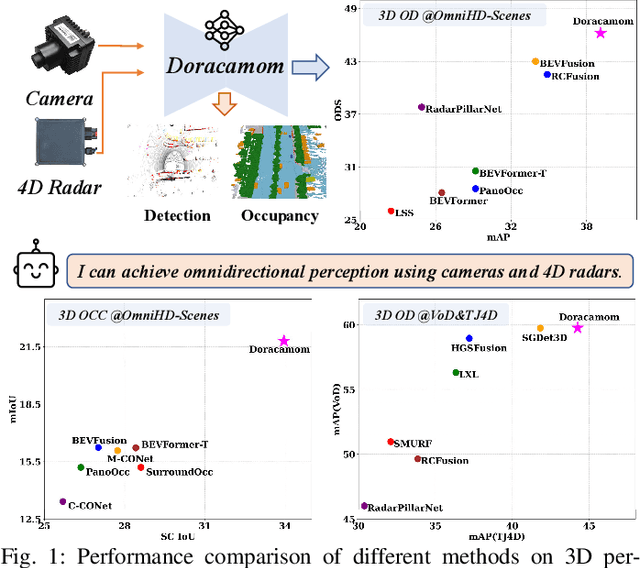


3D object detection and occupancy prediction are critical tasks in autonomous driving, attracting significant attention. Despite the potential of recent vision-based methods, they encounter challenges under adverse conditions. Thus, integrating cameras with next-generation 4D imaging radar to achieve unified multi-task perception is highly significant, though research in this domain remains limited. In this paper, we propose Doracamom, the first framework that fuses multi-view cameras and 4D radar for joint 3D object detection and semantic occupancy prediction, enabling comprehensive environmental perception. Specifically, we introduce a novel Coarse Voxel Queries Generator that integrates geometric priors from 4D radar with semantic features from images to initialize voxel queries, establishing a robust foundation for subsequent Transformer-based refinement. To leverage temporal information, we design a Dual-Branch Temporal Encoder that processes multi-modal temporal features in parallel across BEV and voxel spaces, enabling comprehensive spatio-temporal representation learning. Furthermore, we propose a Cross-Modal BEV-Voxel Fusion module that adaptively fuses complementary features through attention mechanisms while employing auxiliary tasks to enhance feature quality. Extensive experiments on the OmniHD-Scenes, View-of-Delft (VoD), and TJ4DRadSet datasets demonstrate that Doracamom achieves state-of-the-art performance in both tasks, establishing new benchmarks for multi-modal 3D perception. Code and models will be publicly available.